前付けまえがきPreface
Prefaceまえがき
About OpenStaxOpenStax について
OpenStax is part of Rice University, which is a 501(c)(3) nonprofit charitable corporation. Our mission is to make an amazing education accessible for all. Through our partnerships with philanthropic organizations and our alliance with other educational resource companies, we’re breaking down the most common barriers to learning. Because we believe that everyone should and can have access to knowledge.
OpenStax は Rice University の一部であり、501(c)(3) の非営利慈善法人である。私たちの使命は、すばらしい教育を誰もが手にできるようにすることだ。慈善団体との提携や、他の教育資源の会社との協力を通じて、学びを阻むもっとも一般的な壁を取り払っている。誰もが知識に触れるべきであり、触れられるはずだと信じているからだ。
About OpenStax ResourceOpenStax の資料について
Customization作り替えること
Algebra and Trigonometry 2e is licensed under a Creative Commons Attribution-NonCommercial-ShareAlike 4.0 (CC BY-NC-SA) license, which means that you can non-commercially distribute, remix, and build upon the content, as long as you provide attribution to OpenStax and its content contributors, and distribute all derivatives under the same license.
『代数と三角法 第2版』は Creative Commons 表示-非営利-継承 4.0 (CC BY-NC-SA) の許諾で公開されている。つまり、OpenStax と執筆に関わった人々への表示を付け、派生物すべてを同じ許諾で配る限り、非営利であれば内容を配布し、混ぜ、上に積み上げてよい。
Because our books are openly licensed, you are free to use the entire book or pick and choose the sections that are most relevant to the needs of your course. Feel free to remix the content by assigning your students certain chapters and sections in your syllabus, in the order that you prefer. You can even provide a direct link in your syllabus to the sections in the web view of your book.
本書は開かれた許諾のもとにあるので、まるごと使ってもよいし、自分の講義に必要な節だけを選んでもよい。好きな順に章や節を学生に割り当てて、内容を組み替えてかまわない。講義要項から、本書のウェブ版の節へ直接リンクを張ることもできる。
Instructors also have the option of creating a customized version of their OpenStax book. The custom version can be made available to students in low-cost print or digital form through their campus bookstore. Visit your book page on openstax.org for more information.
教員は OpenStax の本を自分向けに作り替えた版を作ることもできる。作り替えた版は、大学の書店を通じて安価な印刷物または電子版として学生に届けられる。詳しくは openstax.org の本書のページを見てほしい。
Art attribution図版の表示
In Algebra and Trigonometry 2e, most photos and third-party illustrations contain attribution to their creator, rights holder, host platform, and/or license within the caption. For any art that is openly licensed, non-commercial users or organizations may reuse the art as long as they provide the same attribution to its original source. (Commercial entities should contact OpenStax to discuss reuse rights and permissions.) To maximize readability and content flow, some art does not include attribution in the text. If you reuse art from this text that does not have attribution provided, use the following attribution: Copyright Rice University, OpenStax, under CC BY-NC-SA 4.0 license.
『代数と三角法 第2版』では、写真と第三者の図版のほとんどが、作者・権利者・掲載元・許諾のいずれかを説明の中に記している。開かれた許諾のもとにある図版は、非営利の利用者や団体であれば、元の出典と同じ表示を付ける限り再利用してよい(営利の団体は、再利用の権利と許可について OpenStax に問い合わせること)。読みやすさと流れを保つため、本文中に表示を入れていない図版もある。表示のない図版を本書から再利用するときは、次の表示を使うこと。Copyright Rice University, OpenStax, under CC BY-NC-SA 4.0 license.
Errata正誤
All OpenStax textbooks undergo a rigorous review process. However, like any professional-grade textbook, errors sometimes occur. Since our books are web based, we can make updates periodically when deemed pedagogically necessary. If you have a correction to suggest, submit it through the link on your book page on openstax.org. Subject matter experts review all errata suggestions. OpenStax is committed to remaining transparent about all updates, so you will also find a list of past errata changes on your book page on openstax.org.
OpenStax の教科書はすべて厳密な査読を経ている。とはいえ、専門の教科書がどれもそうであるように、誤りが混じることはある。本書はウェブ上にあるので、教育上必要と判断すれば折に触れて更新できる。訂正の提案があれば、openstax.org の本書のページにあるリンクから送ってほしい。正誤の提案はすべて専門家が確認する。OpenStax は更新をすべて明らかにしておくつもりでいるので、過去の訂正の一覧も本書のページにある。
Format形式
You can access this textbook for free in web view or PDF through openstax.org, and for a low cost in print.
本書は openstax.org でウェブ版または PDF として無料で読める。印刷物は安価で手に入る。
About Algebra and Trigonometry 2e『代数と三角法 第2版』について
Algebra and Trigonometry 2e provides a comprehensive exploration of algebraic principles and meets scope and sequence requirements for a typical introductory algebra and trigonometry course. The modular approach and the richness of content ensures that the book meets the needs of a variety of courses. Algebra and Trigonometry 2e offers a wealth of examples with detailed, conceptual explanations, building a strong foundation in the material before asking students to apply what they’ve learned.
『代数と三角法 第2版』は代数の原理を広く扱い、標準的な代数と三角法の入門講義が求める範囲と順序を満たす。単元ごとに区切った作りと内容の厚みによって、さまざまな形の講義に応えられる。本書には詳しい概念の説明を伴う例題が豊富にあり、学んだことを使わせる前に、土台をしっかり固めるようにできている。
Coverage and Scope扱う範囲
In determining the concepts, skills, and topics to cover, we engaged dozens of highly experienced instructors with a range of student audiences. The resulting scope and sequence proceeds logically while allowing for a significant amount of flexibility in instruction.
扱う概念・技能・話題を決めるにあたり、さまざまな学生を教えてきた経験豊富な教員数十名に加わってもらった。その結果できた範囲と順序は、筋道が通っていながら、教え方にかなりの自由がきく。
Chapters 1 and 2 provide both a review and foundation for study of functions that begins in Chapter 3. The authors recognize that while some institutions may find this material a prerequisite, other institutions have told us that they have a cohort that needs the prerequisite skills built into the course.
第1章と第2章は、第3章から始まる関数の学習に向けた復習と土台である。この内容を前提科目として扱う大学もあれば、前提となる技能を講義の中に組み込む必要のある学生層を抱えていると伝えてきた大学もある。著者たちはその両方を承知している。
• Chapter 1: Prerequisites• Chapter 2: Equations and Inequalities
・第1章 前提知識・第2章 方程式と不等式
Chapters 3–6: The Algebraic Functions
第3章〜第6章 代数的な関数
• Chapter 3: Functions• Chapter 4: Linear Functions• Chapter 5: Polynomial and Rational Functions• Chapter 6: Exponential and Logarithm Functions
・第3章 関数・第4章 一次関数・第5章 多項式関数と有理関数・第6章 指数関数と対数関数
Chapters 7–10: A Study of Trigonometry
第7章〜第10章 三角法の学習
• Chapter 7: The Unit Circle: Sine and Cosine Functions• Chapter 8: Periodic Functions• Chapter 9: Trigonometric Identities and Equations• Chapter 10: Further Applications of Trigonometry
・第7章 単位円:正弦関数と余弦関数・第8章 周期関数・第9章 三角関数の恒等式と方程式・第10章 三角法のさらなる応用
Chapters 11–13: Further Study in Algebra and Trigonometry
第11章〜第13章 代数と三角法のさらなる学習
• Chapter 11: Systems of Equations and Inequalities• Chapter 12: Analytic Geometry• Chapter 13: Sequences, Probability, and Counting Theory
・第11章 連立方程式と連立不等式・第12章 解析幾何・第13章 数列、確率、数え上げ
Development Overview作られた経緯
OpenStax Algebra and Trigonometry 2e is the product of a collaborative effort by a group of dedicated authors, editors, and instructors whose collective passion for this project has resulted in a text that is remarkably unified in purpose and voice. Special thanks is due to our Lead Author, Jay Abramson of Arizona State University, who provided the overall vision for the book and oversaw the development of each and every chapter, drawing up the initial blueprint, reading numerous drafts, and assimilating field reviews into actionable revision plans for our authors and editors.
OpenStax『代数と三角法 第2版』は、この企画に情熱を注いだ著者・編集者・教員たちの共同作業の産物であり、その結果として、目的も声も見事に一つにまとまった本になった。とりわけ Arizona State University の Jay Abramson には感謝したい。筆頭著者として本書全体の構想を示し、最初の設計図を引き、無数の草稿を読み、現場からの意見を著者と編集者が手を動かせる改訂案にまとめ上げ、すべての章の作成を統括した。
The collective experience of our author team allowed us to pinpoint the subtopics, exceptions, and individual connections that give students the most trouble. The textbook is therefore replete with well-designed features and highlights which help students overcome these barriers. As the students read and practice, they are coached in methods of thinking through problems and internalizing mathematical processes.
著者陣がそれぞれに積んだ経験によって、学生がもっともつまずく小さな話題・例外・つながりを特定できた。だから本書には、それらの壁を越えるための工夫と強調が随所にある。読んで手を動かすうちに、学生は問題を考え抜く方法と、数学の手続きを自分のものにする方法を教わることになる。
Accuracy of the Content内容の正確さ
We understand that precision and accuracy are imperatives in mathematics, and undertook a dedicated accuracy program led by experienced faculty.Examples, art, problems, and solutions were reviewed by dedicated faculty, with a separate team evaluating the answer key and solutions.
数学では精密さと正確さが絶対であることを私たちは理解しており、経験豊かな教員が率いる正確さの点検を専門に行った。例題・図版・問題・解答は担当の教員が確認し、それとは別の班が解答編と解法を検めた。
The text also benefits from years of usage by thousands of faculty and students. A core aspect of the second edition revision process included consolidating and ensuring consistency with regard to any errata and corrections that have been during in the series’ extensive usage and incorporation into homework systems.
本書はまた、数千人の教員と学生が何年も使ってきた蓄積の上にある。第2版の改訂で中心に据えたのは、この叢書が広く使われ、宿題システムに組み込まれてきた中で見つかった正誤と訂正を、一つにまとめて食い違いなく反映することだった。
Changes to the Second Edition第2版での変更
The Algebra and Trigonometry 2e revision focused on mathematical clarity and accuracy as well as inclusivity. Examples, Exercises, and Solutions were reviewed by multiple faculty experts. All improvement suggestions and errata updates, driven by faculty and students from several thousand colleges, were considered and unified across the different formats of the text.
『代数と三角法 第2版』の改訂では、数学としての明快さと正確さ、そして誰も置き去りにしないことに重きを置いた。例題・練習問題・解答は複数の専門家が確認した。数千の大学の教員と学生から寄せられた改善の提案と正誤の更新はすべて検討し、本書のさまざまな形式のあいだで食い違いが出ないようにした。
OpenStax and our authors are aware of the difficulties posed by shifting problem and exercise numbers when textbooks are revised. In an effort to make the transition to the 2nd edition as seamless as possible, we have minimized any shifting of exercise numbers.
教科書が改訂されると問題や練習問題の番号がずれてしまう。その厄介さを OpenStax と著者たちは承知している。第2版への移行がなるべく滑らかになるよう、練習問題の番号のずれは最小限にとどめた。
The revision also focused on supporting inclusive and welcoming learning experiences. The introductory narratives, example and problem contexts, and even many of the names used for fictional people in the text were all reviewed using a diversity, equity, and inclusion framework. Several hundred resulting revisions improve the balance and relevance to the students using the text, while maintaining a variety of applications to diverse careers and academic fields. In particular, explanations of scientific and historical aspects of mathematics have been expanded to include more contributors. For example, the authors added additional historical and multicultural context regarding what is widely known as Pascal’s Triangle, and similarly added details regarding the international process of decoding the Enigma machine (including the role of Polish college students). Several chapter opening narratives and in-chapter references are completely new, and contexts across all chapters were specifically reviewed for equity in gender representation and connotation.
改訂ではまた、誰もが迎え入れられる学びの場を支えることにも力を注いだ。章の導入の語り、例題や問題の設定、さらには本文に出てくる架空の人物の名前の多くまで、多様性・公正・包摂の枠組みで見直した。その結果として数百か所を直し、多様な職業や学問分野への応用の幅を保ったまま、本書を使う学生にとっての釣り合いと身近さを高めた。とりわけ、数学の科学的・歴史的な側面の説明を広げ、より多くの寄与者を含めた。たとえば著者たちは、一般にパスカルの三角形として知られるものについて歴史的・多文化的な背景を書き足し、同じくエニグマ機の解読が国際的な営みであったこと(ポーランドの大学生が果たした役割を含む)を書き加えた。章の冒頭の語りや章内の引き合いにはまったく新しいものもいくつかあり、全章の設定について、性別の描かれ方と含みが公正かどうかを特に見直した。
Finally, prior to the release of this edition, OpenStax published a series of Corequisite Skillsheets to support different models and approaches to instruction. These remain available, and are described in more detail below.
最後に、この版を出す前に、OpenStax はさまざまな教え方に応えるための併修用の技能シートを一続き公開した。これは今も手に入る。詳しくは後述する。
Pedagogical Foundations and Features教え方の土台と工夫
Learning Objectives学習目標
Each chapter is divided into multiple sections (or modules), each of which is organized around a set of learning objectives. The learning objectives are listed explicitly at the beginning of each section and are the focal point of every instructional element
各章は複数の節(単元)に分かれ、それぞれが一組の学習目標を軸に組み立てられている。学習目標は各節の冒頭にはっきりと並べてあり、教材のあらゆる要素の焦点になる。
Narrative text本文の語り
Narrative text is used to introduce key concepts, terms, and definitions, to provide real-world context, and to provide transitions between topics and examples. Throughout this book, we rely on a few basic conventions to highlight the most important ideas:
本文の語りは、重要な概念・用語・定義を導き、現実の文脈を与え、話題と例題のあいだをつなぐために使う。本書では、もっとも大事な考えを目立たせるために、いくつかの単純な約束に従っている。
• Key terms are boldfaced, typically when first introduced and/or when formally defined.• Key concepts and definitions are called out in a blue box for easy reference.
・重要語は太字にする。多くは最初に出てきたとき、あるいは正式に定義されたときである。・重要な概念と定義は、後から引きやすいように青い箱に入れて示す。
Examples例題
Each learning objective is supported by one or more worked examples, that demonstrate the problem-solving approaches that students must master. The multiple Examples model different approaches to the same type of problem, or introduce similar problems of increasing complexity.
学習目標にはそれぞれ、一つ以上の解いてみせる例題が付いている。例題は、学生が身につけるべき解き方を実演するものだ。複数の例題は、同じ型の問題に対する別々の道筋を示すか、似た問題を少しずつ難しくして並べている。
All Examples follow a simple two- or three-part format. The question clearly lays out a mathematical problem to solve. The Solution walks through the steps, usually providing context for the approach—in other words, why the instructor is solving the problem in a specific manner. Finally, the Analysis (for select Examples) reflects on the broader implications of the Solution just shown. Examples are followed by a Try It question, as explained below.
例題はすべて、二部か三部の単純な形をとる。まず問いが、解くべき数学の問題をはっきり示す。次に解答が手順を追い、たいていはその道筋を選んだ理由——なぜその解き方をするのか——も添える。最後に、一部の例題には考察が付き、いま見せた解答が持つより広い意味を振り返る。例題の後には、次に述べる「やってみよう」の問いが続く。
Figures図
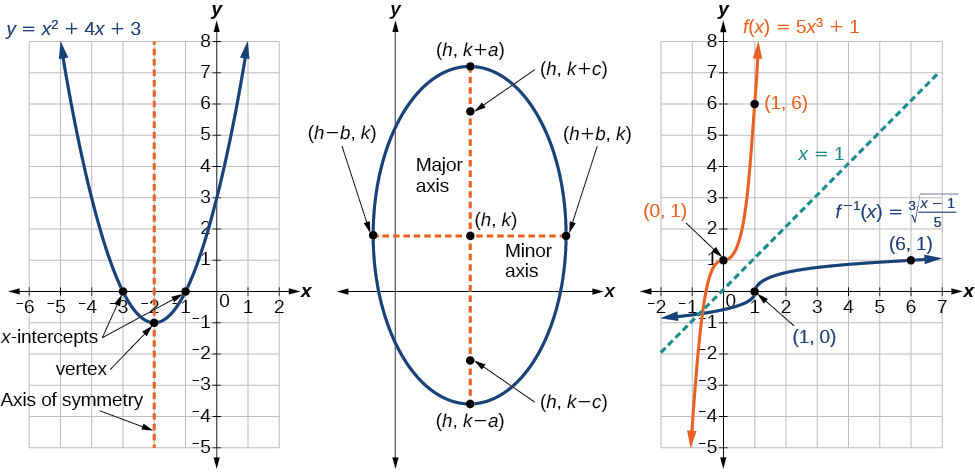
Algebra and Trigonometry 2e contains more than 2000 figures and illustrations, the vast majority of which are graphs and diagrams. Art throughout the text adheres to a clear, understated style, drawing the eye to the most important information in each figure while minimizing visual distractions. Color contrast is employed with discretion to distinguish between the different functions or features of a graph.
『代数と三角法 第2版』には2000点を超える図と挿絵があり、その大半はグラフと図解である。本書の図版は一貫して、明快で控えめな作りをしている。目を各図のもっとも大事な情報へ向けさせ、見た目の邪魔を減らすためだ。色の対比は、グラフの異なる関数や特徴を見分けるために、控えめに使っている。
Supporting Features理解を支える工夫
Several elements contribute to and check understanding.
理解を助け、また確かめるための要素がいくつかある。
• A “How To” is a list of steps necessary to solve a certain type of problem. A How To typically precedes an Example that proceeds to demonstrate the steps in action.• A “Try It” exercise immediately follows an Example or a set of related Examples, providing the student with an immediate opportunity to solve a similar problem. In the PDF and the Web View version of the text, answers to the Try It exercises are located in the Answer Key.• A Q&A may appear at any point in the narrative, but most often follows an Example. This feature pre-empts misconceptions by posing a commonly asked yes/no question, followed by a detailed answer and explanation.• The “Media” icon appears at the conclusion of each section, just prior to the Section Exercises. This icon marks a list of links to online video tutorials that reinforce the concepts and skills introduced in the section.
・「手順」は、ある型の問題を解くのに必要な段取りを並べたものである。手順はたいてい例題の直前に置かれ、その例題がそれを実際に動かしてみせる。・「やってみよう」の練習は、例題または関連する例題の並びの直後に置かれ、似た問題をその場で解く機会を学生に与える。PDF版とウェブ版では、やってみようの答えは解答編にある。・Q&A は語りのどこに現れてもよいが、多くは例題の後に来る。よく出る「はい・いいえ」の問いを立て、それに詳しい答えと説明を付けることで、思い違いを先回りして防ぐ。・「教材」の印は各節の終わり、節末問題の直前に現れる。この印は、その節で導いた概念と技能を補強するオンラインの動画講座へのリンクの一覧を示す。
While we have selected tutorials that closely align to our learning objectives, we did not produce these tutorials, nor were they specifically produced or tailored to accompany Algebra and Trigonometry 2e.
学習目標に沿った講座を選んではいるが、これらの講座は私たちが作ったものではなく、『代数と三角法 第2版』のために特に作られたり手を入れられたりしたものでもない。
Section Exercises節末問題
Each section of every chapter concludes with a well-rounded set of exercises that can be assigned as homework or used selectively for guided practice. With over 6300 exercises across the 13 chapters, instructors should have plenty from which to choose.
どの章のどの節も、宿題として出すことも、導きながら解かせるのに選んで使うこともできる、まとまりのよい問題の組で終わる。13章にわたって6300問を超える練習問題があるので、教員が選ぶには十分だろう。
Section Exercises are organized by question type, and generally appear in the following order:
節末問題は問いの型ごとに分かれており、おおむね次の順に並ぶ。
• Verbal questions assess conceptual understanding of key terms and concepts.• Algebraic problems require students to apply algebraic manipulations demonstrated in the section.• Graphical problems assess students’ ability to interpret or produce a graph.• Numeric problems require the student to perform calculations or computations.• Technology problems encourage exploration through use of a graphing utility, either to visualize or verify algebraic results or to solve problems via an alternative to the methods demonstrated in the section.• Extensions pose problems more challenging than the Examples demonstrated in the section. They require students to synthesize multiple learning objectives or apply critical thinking to solve complex problems.• Real-World Applications present realistic problem scenarios from fields such as physics, geology, biology, finance, and the social sciences.
・言葉で答える問題は、重要語と概念を筋道として理解できているかを測る。・代数の問題は、その節で示した式の変形を実際に使うことを求める。・グラフの問題は、グラフを読み取る力、あるいは描く力を測る。・数値の問題は、計算を実際に行うことを求める。・機器を使う問題は、グラフ作成ツールを使って探ることを促す。代数で得た結果を目で見て確かめるためにも、その節で示した方法とは別の道で問題を解くためにも使える。・発展問題は、その節の例題より手ごわい問題を出す。複数の学習目標を組み合わせるか、込み入った問題を解くために考え抜くことを求める。・応用問題は、物理・地質・生物・金融・社会科学といった分野から、現実にありそうな場面を出す。
Chapter Review Features章のまとめ
Each chapter concludes with a review of the most important takeaways, as well as additional practice problems that students can use to prepare for exams.
どの章も、もっとも大事な要点の振り返りと、試験に備えて使える追加の練習問題で終わる。
• Key Terms provides a formal definition for each bold-faced term in the chapter.• Key Equations presents a compilation of formulas, theorems, and standard-form equations.• Key Concepts summarizes the most important ideas introduced in each section, linking back to the relevant Example(s) in case students need to review.• Chapter Review Exercises include 40-80 practice problems that recall the most important concepts from each section.• Practice Test includes 25-50 problems assessing the most important learning objectives from the chapter. Note that the practice test is not organized by section, and may be more heavily weighted toward cumulative objectives as opposed to the foundational objectives covered in the opening sections.
・重要語は、章の中で太字にした語それぞれに正式な定義を与える。・重要な式は、公式・定理・標準形の方程式をまとめて並べる。・重要な概念は、各節で導いたもっとも大事な考えをまとめ、見直したいときのために対応する例題へ戻れるようにしている。・復習問題には、各節のもっとも大事な概念を思い出させる練習問題が40〜80問ある。・実力テストには、その章のもっとも大事な学習目標を測る問題が25〜50問ある。実力テストは節ごとには並んでおらず、はじめの節で扱う土台の目標より、章全体にまたがる目標に重みが寄っていることがある。
Corequisite Support併修の支え
Each Algebra and Trigonometry 2e section is paired with a thoughtfully developed, topically aligned skills module that prepares students for the course material. Sharon North (St. Louis Community College) developed a coordinated set of support resources, which provide review, instruction, and practice for algebra students. The author team identified foundational skills and concepts, then mapped them to each module. The corequisite sections include conceptual overviews, worked examples, and guided practice; they incorporate relevant material from OpenStax’s Developmental Math series. They are available as separate, openly accessible downloads from the student and instructor resources pages accompanying the text.
『代数と三角法 第2版』の各節には、その話題に合わせて丁寧に作られた技能の単元が対になっており、講義の内容に備えられるようになっている。この一続きの支援教材は Sharon North (St. Louis Community College) が作ったもので、代数を学ぶ学生に復習・説明・練習を与える。著者陣が土台となる技能と概念を洗い出し、それを各単元に割り当てた。併修の節には概念の見取り図・解いてみせる例題・導きながらの練習が入っており、OpenStax の基礎数学叢書から関連する内容を取り入れている。本書に付随する学生用・教員用の資料のページから、別冊として自由に手に入れられる。
Answers to Questions in the Book本書の問いの答え
Students are provided with answers to Examples directly below the question. The answer key in the book contains all answers to Try It questions as well as answers to odd-numbered Section Exercises, Review Exercises, and Practice Tests. In order to allow instructors as much flexibility as possible, even-numbered answers to Section Exercises, Review Exercises, and Practice Tests are provided only to instructors via the Instructor Answer Guide on the Instructor Resources page.
例題の答えは、問いのすぐ下に置いてある。本書の解答編には、やってみようの問いの答えすべてと、節末問題・復習問題・実力テストの奇数番号の答えが入っている。教員がなるべく自由に使えるよう、節末問題・復習問題・実力テストの偶数番号の答えは、教員用資料のページにある教員向け解答手引を通じて教員にのみ提供している。
Additional Resourcesその他の資料
Student and Instructor Resources学生用・教員用の資料
We’ve compiled additional resources for both students and instructors, including Getting Started Guides, instructor solution manual, Corequisite skillsheets, and PowerPoint slides. Instructor resources require a verified instructor account, which can be requested on your openstax.org log-in. Take advantage of these resources to supplement your OpenStax book.
学生と教員の双方に向けて、はじめ方の手引・教員用解法集・併修用の技能シート・スライドなど、追加の資料をまとめてある。教員用資料には教員として確認された利用者登録が必要で、openstax.org のログインから申請できる。これらを使って OpenStax の本を補ってほしい。
Community Hubs共同の広場
OpenStax partners with the Institute for the Study of Knowledge Management in Education (ISKME) to offer Community Hubs on OER Commons—a platform for instructors to share community-created resources that support OpenStax books, free of charge. Through our Community Hubs, instructors can upload their own materials or download resources to use in their own courses, including additional ancillaries, teaching material, multimedia, and relevant course content. We encourage instructors to join the hubs for the subjects most relevant to your teaching and research as an opportunity both to enrich your courses and to engage with other faculty. To reach the Community Hubs, visit www.oercommons.org/hubs/openstax.
OpenStax は Institute for the Study of Knowledge Management in Education (ISKME) と組み、OER Commons 上に共同の広場を設けている。ここは、OpenStax の本を支えるために利用者が作った資料を、教員どうしが無料で分け合う場である。この広場を通じて、教員は自分の教材を上げることも、自分の講義で使う資料——付随教材・授業用素材・動画・関連する講義内容——を落とすこともできる。自分の教育と研究にもっとも関わりの深い広場に加わることを勧めたい。講義を豊かにする機会でもあり、他の教員と交わる機会でもある。広場へは www.oercommons.org/hubs/openstax から行ける。
Technology partners技術面の協力先
As allies in making high-quality learning materials accessible, our technology partners offer optional low-cost tools that are integrated with OpenStax books. To access the technology options for your text, visit your book page on openstax.org.
質の高い学習教材を誰もが手にできるようにする仲間として、協力先の企業が OpenStax の本と組み合わせて使える安価な道具を任意で提供している。本書で使える技術面の選択肢は、openstax.org の本書のページで見られる。
About the Authors著者について
Senior Contributing Author筆頭著者
Jay Abramson, Arizona State University
Jay Abramson has been teaching Precalculus for over 35 years, the last 20 at Arizona State University, where he is a principal lecturer in the School of Mathematics and Statistics. His accomplishments at ASU include co-developing the university’s first hybrid and online math courses as well as an extensive library of video lectures and tutorials. In addition, he has served as a contributing author for two of Pearson Education’s math programs, NovaNet Precalculus and Trigonometry. Prior to coming to ASU, Jay taught at Texas State Technical College and Amarillo College. He received Teacher of the Year awards at both institutions.
Jay Abramson, Arizona State University Jay Abramson は35年以上にわたって微積分準備を教えており、そのうち直近の20年は Arizona State University の数学・統計学部で主任講師を務めている。同大学での仕事には、大学初のハイブリッド講義とオンライン数学講義の共同開発、および膨大な動画講義と解説の蓄積がある。さらに、Pearson Education の数学教材のうち NovaNet Precalculus と Trigonometry の二つで執筆に加わった。ASU に来る前は Texas State Technical College と Amarillo College で教え、どちらでも最優秀教員賞を受けた。
Contributing Authors執筆に加わった人々
Reviewers査読者
The following faculty contributed to the development of OpenStax Precalculus, the text from which this product was updated and derived.
Precalculus Reviewers
Nina Alketa, Cecil College
Kiran Bhutani, Catholic University of America
Brandie Biddy, Cecil College
Lisa Blank, Lyme Central School
Bryan Blount, Kentucky Wesleyan College
Jessica Bolz, The Bryn Mawr School
Sheri Boyd, Rollins College
Sarah Brewer, Alabama School of Math and Science
Charles Buckley, St. Gregory’s University
Michael Cohen, Hofstra University
Kenneth Crane, Texarkana College
Rachel Cywinski, Alamo Colleges
Nathan Czuba
Srabasti Dutta, Ashford University
Kristyanna Erickson, Notre Dame of Maryland University
Nicole Fernandez, Georgetown University / Kent State University
David French, Tidewater Community College
Douglas Furman, SUNY Ulster
Lance Hemlow, Raritan Valley Community College
Erinn Izzo, Nicaragua Christian Academy
John Jaffe
Jerry Jared, Blue Ridge School
Stan Kopec, Mount Wachusett Community College
Kathy Kovacs
Cynthia Landrigan, Erie Community College
Sara Lenhart, Christopher Newport University
Wendy Lightheart, Lane Community College
Joanne Manville, Bunker Hill Community College
Karla McCavit, Albion College
Cynthia McGinnis, Northwest Florida State College
Lana Neal, University of Texas at Austin
Rhonda Porter, Albany State University
Steven Purtee, Valencia College
William Radulovich, Florida State College Jacksonville
Alice Ramos, Bethel College
Nick Reynolds, Montgomery Community College
Amanda Ross, A. A. Ross Consulting and Research, LLC
Erica Rutter, Arizona State University
Sutandra Sarkar, Georgia State University
Willy Schild, Wentworth Institute of Technology
Todd Stephen, Cleveland State University
Scott Sykes, University of West Georgia
Linda Tansil, Southeast Missouri State University
John Thomas, College of Lake County
Diane Valade, Piedmont Virginia Community College
Allen Wolmer, Atlanta Jewish Academy
次の教員は、本書のもとになった OpenStax『微積分準備』の作成に寄与した。『微積分準備』査読者 Nina Alketa, Cecil College Kiran Bhutani, Catholic University of America Brandie Biddy, Cecil College Lisa Blank, Lyme Central School Bryan Blount, Kentucky Wesleyan College Jessica Bolz, The Bryn Mawr School Sheri Boyd, Rollins College Sarah Brewer, Alabama School of Math and Science Charles Buckley, St. Gregory’s University Michael Cohen, Hofstra University Kenneth Crane, Texarkana College Rachel Cywinski, Alamo Colleges Nathan Czuba Srabasti Dutta, Ashford University Kristyanna Erickson, Notre Dame of Maryland University Nicole Fernandez, Georgetown University / Kent State University David French, Tidewater Community College Douglas Furman, SUNY Ulster Lance Hemlow, Raritan Valley Community College Erinn Izzo, Nicaragua Christian Academy John Jaffe Jerry Jared, Blue Ridge School Stan Kopec, Mount Wachusett Community College Kathy Kovacs Cynthia Landrigan, Erie Community College Sara Lenhart, Christopher Newport University Wendy Lightheart, Lane Community College Joanne Manville, Bunker Hill Community College Karla McCavit, Albion College Cynthia McGinnis, Northwest Florida State College Lana Neal, University of Texas at Austin Rhonda Porter, Albany State University Steven Purtee, Valencia College William Radulovich, Florida State College Jacksonville Alice Ramos, Bethel College Nick Reynolds, Montgomery Community College Amanda Ross, A. A. Ross Consulting and Research, LLC Erica Rutter, Arizona State University Sutandra Sarkar, Georgia State University Willy Schild, Wentworth Institute of Technology Todd Stephen, Cleveland State University Scott Sykes, University of West Georgia Linda Tansil, Southeast Missouri State University John Thomas, College of Lake County Diane Valade, Piedmont Virginia Community College Allen Wolmer, Atlanta Jewish Academy