第11章連立方程式と連立不等式Systems of Equations and Inequalities
11.8 Solving Systems with Cramer's Rule11.8 クラメルの公式で連立方程式を解く
Learning Objectives 学習目標
In this section, you will:
この節を終えると、次のことができるようになる。
• Evaluate 2 × 2 determinants.• Use Cramer’s Rule to solve a system of equations in two variables.• Evaluate 3 × 3 determinants.• Use Cramer’s Rule to solve a system of three equations in three variables.• Know the properties of determinants.
・2 × 2 の行列式の値を求める。・クラメルの公式を使って二変数の連立方程式を解く。・3 × 3 の行列式の値を求める。・クラメルの公式を使って三変数三式の連立方程式を解く。・行列式の性質を知る。
We have learned how to solve systems of equations in two variables and three variables, and by multiple methods: substitution, addition, Gaussian elimination, using the inverse of a matrix, and graphing. Some of these methods are easier to apply than others and are more appropriate in certain situations. In this section, we will study two more strategies for solving systems of equations.
二変数と三変数の連立方程式を、いくつもの方法で解くしかたを学んできた。代入、足し算、ガウスの消去法、行列の逆を使うこと、グラフである。この中には、ほかより使いやすく、ある状況ではよりふさわしい方法もある。この節では、連立方程式を解く戦略をあと二つ学ぶ。
Evaluating the Determinant of a 2×2 Matrix2×2 行列の行列式の値を求める
A determinant is a real number that can be very useful in mathematics because it has multiple applications, such as calculating area, volume, and other quantities. Here, we will use determinants to reveal whether a matrix is invertible by using the entries of a square matrix to determine whether there is a solution to the system of equations. Perhaps one of the more interesting applications, however, is their use in cryptography. Secure signals or messages are sometimes sent encoded in a matrix. The data can only be decrypted with an invertible matrix and the determinant. For our purposes, we focus on the determinant as an indication of the invertibility of the matrix. Calculating the determinant of a matrix involves following the specific patterns that are outlined in this section.
行列式とは、面積、体積、その他の量の計算など多くの応用があるので、数学でたいへん役に立つ実数である。ここでは、正方行列の成分を使ってその連立方程式に解があるかどうかを決め、それによって行列が正則かどうかを明らかにするのに行列式を使う。だがおそらく、より面白い応用の一つは暗号での使い道である。安全な信号や文は、行列に暗号化して送られることがある。この資料は、正則な行列と行列式でしか解読できない。ここでの目的としては、行列が正則かどうかの目印としての行列式に絞る。行列の行列式の計算は、この節で述べる決まった型に従って行う。
Find the Determinant of a 2 × 2 Matrix 2×2行列の行列式
The determinant of a matrix, given
次が与えられたときの 行列の行列式は、
is defined as
次のように定められる。

Notice the change in notation. There are several ways to indicate the determinant, including and replacing the brackets in a matrix with straight lines,
表記が変わることに注意せよ。行列式を示すしかたはいくつもあり、 や、行列の角括弧をまっすぐな線に替えた などがある。
Example 1例1
Finding the Determinant of a 2 × 2 Matrix2 × 2 行列の行列式を求める
Find the determinant of the given matrix.
与えられた行列の行列式を求めよ。
Solution 解答
Using Cramer’s Rule to Solve a System of Two Equations in Two Variablesクラメルの公式を使って二変数二式の連立方程式を解く
We will now introduce a final method for solving systems of equations that uses determinants. Known as Cramer’s Rule, this technique dates back to the middle of the 18th century and is named for its innovator, the Swiss mathematician Gabriel Cramer (1704-1752), who introduced it in 1750 in Introduction à l'Analyse des lignes Courbes algébriques. Cramer’s Rule is a viable and efficient method for finding solutions to systems with an arbitrary number of unknowns, provided that we have the same number of equations as unknowns.
ここで、行列式を使って連立方程式を解く最後の方法を導入する。クラメルの公式として知られるこの手法は18世紀の半ばにさかのぼり、これを編み出したスイスの数学者ガブリエル・クラメル(1704-1752)にちなむ名である。彼は1750年に『代数曲線の解析入門』でこれを導入した。クラメルの公式は、未知数と同じ数の式があるかぎり、未知数がいくつであってもその組の解を求められる、実用的で効率のよい方法である。
Cramer’s Rule will give us the unique solution to a system of equations, if it exists. However, if the system has no solution or an infinite number of solutions, this will be indicated by a determinant of zero. To find out if the system is inconsistent or dependent, another method, such as elimination, will have to be used.
クラメルの公式は、連立方程式のただ一つの解が存在するなら、それを与える。だがその組に解が無いか解が無限にあるなら、行列式が零になることでそれが示される。その組に解が無いのか従属なのかを知るには、消去などの別の方法を使わねばならない。
To understand Cramer’s Rule, let’s look closely at how we solve systems of linear equations using basic row operations. Consider a system of two equations in two variables.
クラメルの公式を理解するために、基本の行の演算で連立一次方程式をどう解くかをよく見よう。二変数二式の組を考えよ。
We eliminate one variable using row operations and solve for the other. Say that we wish to solve for If equation (2) is multiplied by the opposite of the coefficient of in equation (1), equation (1) is multiplied by the coefficient of in equation (2), and we add the two equations, the variable will be eliminated.
行の演算で一つの変数を消し、もう一つについて解く。 について解きたいとしよう。式(2)に式(1)の の係数の符号を変えたものを掛け、式(1)に式(2)の の係数を掛け、二つの式を足せば、変数 が消える。
Now, solve for
では、 について解く。
Similarly, to solve for we will eliminate
同じように、 について解くには を消す。
Solving for gives
について解くと、次を得る。
Notice that the denominator for both and is the determinant of the coefficient matrix.
と のどちらの分母も、係数行列の行列式であることに注意せよ。
We can use these formulas to solve for and but Cramer’s Rule also introduces new notation:
この公式を使って と について解けるが、クラメルの公式は新しい表記も導入する。
• determinant of the coefficient matrix• determinant of the numerator in the solution of • determinant of the numerator in the solution of
・ 係数行列の行列式・ の解の分子の行列式・ の解の分子の行列式
The key to Cramer’s Rule is replacing the variable column of interest with the constant column and calculating the determinants. We can then express and as a quotient of two determinants.
クラメルの公式の要は、目当ての変数の列を定数の列で置き換えて行列式を計算することである。そうすれば と を二つの行列式の商として表せる。
Cramer’s Rule for 2×2 Systems 二元連立方程式のクラメルの公式
Cramer’s Rule is a method that uses determinants to solve systems of equations that have the same number of equations as variables.
クラメルの公式とは、式の数と変数の数が同じ連立方程式を、行列式を使って解く方法である。
Consider a system of two linear equations in two variables.
二変数二式の一次の組を考えよ。
The solution using Cramer’s Rule is given as
クラメルの公式による解は次で与えられる。
If we are solving for the column is replaced with the constant column. If we are solving for the column is replaced with the constant column.
について解くなら、 の列を定数の列で置き換える。 について解くなら、 の列を定数の列で置き換える。
Example 2例2
Using Cramer’s Rule to Solve a 2 × 2 Systemクラメルの公式を使って 2 × 2 の組を解く
Solve the following system using Cramer’s Rule.
クラメルの公式を使って、次の の組を解け。
Solution 解答
Solve for
について解く。
Solve for
について解く。
The solution is
解は である。
try it feature #1確認問題 1
Use Cramer’s Rule to solve the 2 × 2 system of equations.
クラメルの公式を使って 2 × 2 の連立方程式を解け。
Evaluating the Determinant of a 3 × 3 Matrix3 × 3 行列の行列式の値を求める
Finding the determinant of a 2×2 matrix is straightforward, but finding the determinant of a 3×3 matrix is more complicated. One method is to augment the 3×3 matrix with a repetition of the first two columns, giving a 3×5 matrix. Then we calculate the sum of the products of entries down each of the three diagonals (upper left to lower right), and subtract the products of entries up each of the three diagonals (lower left to upper right). This is more easily understood with a visual and an example.
2×2 行列の行列式を求めるのは素直だが、3×3 行列の行列式を求めるのはもっと込み入っている。一つの方法は、3×3 行列に初めの二列を繰り返して並べ、3×5 行列にすることである。そして三つの斜め(左上から右下)に沿った成分の積の和を計算し、三つの斜め(左下から右上)に沿った成分の積を引く。これは図と例を見ればもっとよく分かる。
Find the determinant of the 3×3 matrix.
3×3 行列の行列式を求めよ。
1. Augment with the first two columns. 2. From upper left to lower right: Multiply the entries down the first diagonal. Add the result to the product of entries down the second diagonal. Add this result to the product of the entries down the third diagonal.3. From lower left to upper right: Subtract the product of entries up the first diagonal. From this result subtract the product of entries up the second diagonal. From this result, subtract the product of entries up the third diagonal.
1. に初めの二列を並べる。2. 左上から右下へ。一つ目の斜めに沿って成分どうしを掛ける。その結果に二つ目の斜めに沿った成分の積を足す。この結果に三つ目の斜めに沿った成分の積を足す。3. 左下から右上へ。一つ目の斜めに沿った成分の積を引く。この結果から二つ目の斜めに沿った成分の積を引く。この結果から三つ目の斜めに沿った成分の積を引く。

The algebra is as follows:
代数は次のとおりである。
Example 3例3
Finding the Determinant of a 3 × 3 Matrix3 × 3 行列の行列式を求める
Find the determinant of the 3 × 3 matrix given
次が与えられたとき、3 × 3 行列の行列式を求めよ。
Solution 解答
Augment the matrix with the first two columns and then follow the formula. Thus,
この行列に初めの二列を並べ、そして公式に従う。よって、
try it feature #2確認問題 2
Find the determinant of the 3 × 3 matrix.
3 × 3 行列の行列式を求めよ。
QA疑問と答え
Can we use the same method to find the determinant of a larger matrix?
もっと大きな行列の行列式を求めるのにも同じ方法が使えるか。
No, this method only works for and matrices. For larger matrices it is best to use a graphing utility or computer software.
使えない。この方法は 行列と 行列にしかはたらかない。もっと大きな行列には、グラフを描く道具か計算機の算譜を使うのがよい。
Using Cramer’s Rule to Solve a System of Three Equations in Three Variablesクラメルの公式を使って三変数三式の連立方程式を解く
Now that we can find the determinant of a 3 × 3 matrix, we can apply Cramer’s Rule to solve a system of three equations in three variables. Cramer’s Rule is straightforward, following a pattern consistent with Cramer’s Rule for 2 × 2 matrices. As the order of the matrix increases to 3 × 3, however, there are many more calculations required.
3 × 3 行列の行列式が求められるようになったので、クラメルの公式を使って三変数三式の連立方程式を解ける。クラメルの公式は素直で、2 × 2 行列のクラメルの公式と同じ型に従う。だが行列の型が 3 × 3 に大きくなると、必要な計算はずっと多くなる。
When we calculate the determinant to be zero, Cramer’s Rule gives no indication as to whether the system has no solution or an infinite number of solutions. To find out, we have to perform elimination on the system.
行列式が零と計算されたとき、クラメルの公式は、その組に解が無いのか解が無限にあるのかを示さない。それを知るには、この組に消去を行わねばならない。
Consider a 3 × 3 system of equations.
3 × 3 の連立方程式を考えよ。
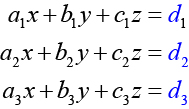
where
ここで

If we are writing the determinant we replace the column with the constant column. If we are writing the determinant we replace the column with the constant column. If we are writing the determinant we replace the column with the constant column. Always check the answer.
行列式 を書くなら、 の列を定数の列で置き換える。行列式 を書くなら、 の列を定数の列で置き換える。行列式 を書くなら、 の列を定数の列で置き換える。答えはつねに確かめよ。
Example 4例4
Solving a 3 × 3 System Using Cramer’s Ruleクラメルの公式を使って 3 × 3 の組を解く
Find the solution to the given 3 × 3 system using Cramer’s Rule.
クラメルの公式を使って、与えられた 3 × 3 の組の解を求めよ。
Solution 解答
Use Cramer’s Rule.
クラメルの公式を使う。
Then,
そして、
The solution is
解は である。
try it feature #3確認問題 3
Use Cramer’s Rule to solve the 3 × 3 matrix.
クラメルの公式を使って 3 × 3 行列を解け。
Example 5例5
Using Cramer’s Rule to Solve an Inconsistent Systemクラメルの公式を使って解の無い組を解く
Solve the system of equations using Cramer’s Rule.
クラメルの公式を使ってこの連立方程式を解け。
Solution 解答
We begin by finding the determinants
まず行列式 を求める。
We know that a determinant of zero means that either the system has no solution or it has an infinite number of solutions. To see which one, we use the process of elimination. Our goal is to eliminate one of the variables.
行列式が零ということは、その組に解が無いか解が無限にあるかのどちらかだと分かっている。どちらかを見るために、消去の手順を使う。目標は変数の一つを消すことである。
1. Multiply equation (1) by 2. Add the result to equation
1. 式(1)に を掛ける。2. その結果を式 に足す。
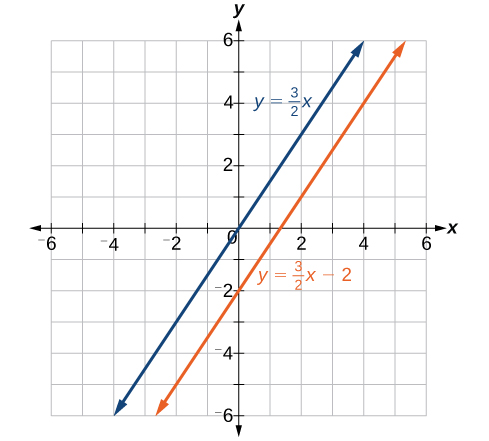
We obtain the equation which is false. Therefore, the system has no solution. Graphing the system reveals two parallel lines. See Figure 1.
式 が得られるが、これは偽である。したがって、この組に解は無い。この組のグラフを描くと二本の平行な直線が現れる。図1を見よ。
Example 6例6
Use Cramer’s Rule to Solve a Dependent Systemクラメルの公式を使って従属な組を解く
Solve the system with an infinite number of solutions.
解が無限にあるこの組を解け。
Solution 解答
Let’s find the determinant first. Set up a matrix augmented by the first two columns.
まず行列式を求めよう。初めの二列を並べた行列を立てる。
Then,
そして、
As the determinant equals zero, there is either no solution or an infinite number of solutions. We have to perform elimination to find out.
行列式が零に等しいので、解が無いか解が無限にあるかのどちらかである。どちらかを知るには消去を行わねばならない。
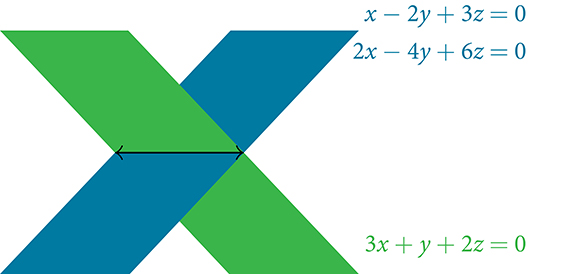
1. Multiply equation (1) by and add the result to equation (3): 2. Obtaining an answer of a statement that is always true, means that the system has an infinite number of solutions. Graphing the system, we can see that two of the planes are the same and they both intersect the third plane on a line. See Figure 2.
1. 式(1)に を掛け、その結果を式(3)に足す。2. つねに正しい式である という答えが得られたことは、この組に解が無限にあることを意味する。この組のグラフを描くと、二枚の平面が同じで、どちらも三つ目の平面と一直線で交わるのが分かる。図2を見よ。
Understanding Properties of Determinants行列式の性質を理解する
There are many properties of determinants. Listed here are some properties that may be helpful in calculating the determinant of a matrix.
行列式の性質は多い。ここに挙げるのは、行列の行列式を計算するのに役立ちうる性質である。
Note重要事項
Properties of Determinants行列式の性質
1. If the matrix is in upper triangular form, the determinant equals the product of entries down the main diagonal.2. When two rows are interchanged, the determinant changes sign.3. If either two rows or two columns are identical, the determinant equals zero.4. If a matrix contains either a row of zeros or a column of zeros, the determinant equals zero.5. The determinant of an inverse matrix is the reciprocal of the determinant of the matrix 6. If any row or column is multiplied by a constant, the determinant is multiplied by the same factor.
1. 行列が上三角の形なら、行列式は主対角線に沿った成分の積に等しい。2. 二つの行を入れ替えると、行列式の符号が変わる。3. 二つの行または二つの列が同一なら、行列式は零に等しい。4. 行列がすべて零の行かすべて零の列を含むなら、行列式は零に等しい。5. 逆行列 の行列式は、行列 の行列式の逆数である。6. どれかの行または列に定数を掛けると、行列式にも同じ数が掛かる。
Example 7例7
Illustrating Properties of Determinants行列式の性質を示す
Illustrate each of the properties of determinants.
行列式の各性質を示せ。
Solution 解答
Property 1 states that if the matrix is in upper triangular form, the determinant is the product of the entries down the main diagonal.
性質1は、行列が上三角の形なら、行列式は主対角線に沿った成分の積であると述べる。
Augment with the first two columns.
に初めの二列を並べる。
Then
そして
Property 2 states that interchanging rows changes the sign. Given
性質2は、行を入れ替えると符号が変わると述べる。次が与えられたとき、
Property 3 states that if two rows or two columns are identical, the determinant equals zero.
性質3は、二つの行または二つの列が同一なら行列式は零に等しいと述べる。
Property 4 states that if a row or column equals zero, the determinant equals zero. Thus,
性質4は、行または列が零に等しいなら行列式は零に等しいと述べる。よって、
Property 5 states that the determinant of an inverse matrix is the reciprocal of the determinant Thus,
性質5は、逆行列 の行列式は行列式 の逆数であると述べる。よって、
Property 6 states that if any row or column of a matrix is multiplied by a constant, the determinant is multiplied by the same factor. Thus,
性質6は、行列のどれかの行または列に定数を掛けると、行列式にも同じ数が掛かると述べる。よって、
Example 8例8
Using Cramer’s Rule and Determinant Properties to Solve a Systemクラメルの公式と行列式の性質を使って組を解く
Find the solution to the given 3 × 3 system.
与えられた 3 × 3 の組の解を求めよ。
Solution 解答
Using Cramer’s Rule, we have
クラメルの公式を使うと、次を得る。
Notice that the second and third columns are identical. According to Property 3, the determinant will be zero, so there is either no solution or an infinite number of solutions. We have to perform elimination to find out.
二つ目と三つ目の列が同一であることに注意せよ。性質3により行列式は零になるので、解が無いか解が無限にあるかのどちらかである。どちらかを知るには消去を行わねばならない。
1. Multiply equation (3) by –2 and add the result to equation (1).
1. 式(3)に–2を掛け、その結果を式(1)に足す。
Obtaining a statement that is a contradiction means that the system has no solution.
矛盾する式が得られたことは、この組に解が無いことを意味する。
Media関連教材
Access these online resources for additional instruction and practice with Cramer’s Rule.
クラメルの公式についての説明と練習をさらに求めるなら、次のオンライン教材にあたるとよい。
• Solve a System of Two Equations Using Cramer's Rule• Solve a Systems of Three Equations using Cramer's Rule
・クラメルの公式を使って二式の組を解く・クラメルの公式を使って三式の組を解く
Verbal言葉で答える問題
2. Examining Cramer’s Rule, explain why there is no unique solution to the system when the determinant of your matrix is 0. For simplicity, use a matrix.
2. クラメルの公式を調べて、行列の行列式が0のときにその組にただ一つの解が無いのはなぜかを説明せよ。簡単のため 行列を使え。
4. The determinant of matrix is 3. If you switch the rows and multiply the first row by 6 and the second row by 2, explain how to find the determinant and provide the answer.
4. 行列 の行列式は3である。行を入れ替え、1行目に6、2行目に2を掛けたとき、行列式の求めかたを説明し、答えを示せ。
Algebraic代数の問題
For the following exercises, find the determinant.
次の各問について、行列式を求めよ。
For the following exercises, solve the system of linear equations using Cramer’s Rule.
次の各問について、クラメルの公式を使ってこの連立一次方程式を解け。
For the following exercises, solve the system of linear equations using Cramer’s Rule.
次の各問について、クラメルの公式を使ってこの連立一次方程式を解け。
Technology機器を使う問題
For the following exercises, use the determinant function on a graphing utility.
次の各問について、グラフを描く道具の行列式の機能を使え。
Real-World Applications現実世界への応用
For the following exercises, create a system of linear equations to describe the behavior. Then, calculate the determinant. Will there be a unique solution? If so, find the unique solution.
次の各問について、その振る舞いを述べる連立一次方程式を作れ。そして行列式を計算せよ。解はただ一つあるか。あるなら、そのただ一つの解を求めよ。
50. Two numbers add up to 104. If you add two times the first number plus two times the second number, your total is 208
50. 二つの数を足すと104になる。一つ目の数の2倍と二つ目の数の2倍を足すと、合計は208になる。
52. Three numbers add to 216. The sum of the first two numbers is 112. The third number is 8 less than the first two numbers combined.
52. 三つの数を足すと216になる。初めの二つの数の和は112である。三つ目の数は、初めの二つの数を合わせたものより8小さい。
For the following exercises, create a system of linear equations to describe the behavior. Then, solve the system for all solutions using Cramer’s Rule.
次の各問について、その振る舞いを述べる連立一次方程式を作れ。そしてクラメルの公式を使って、この組の解をすべて求めよ。
54. You invest $80,000 into two accounts, $22,000 in one account, and $58,000 in the other account. At the end of one year, assuming simple interest, you have earned $2,470 in interest. The second account receives half a percent less than twice the interest on the first account. What are the interest rates for your accounts?
54. あなたは80,000ドルを二つの口座に投じる。一方の口座に22,000ドル、もう一方の口座に58,000ドルである。単利として、一年の終わりに2,470ドルの利息を得た。二つ目の口座の利率は、一つ目の口座の利率の2倍より0.5パーセント低い。各口座の利率はいくらか。
55. A theater needs to know how many adult tickets and children tickets were sold out of the 1,200 total tickets. If children’s tickets are $5.95, adult tickets are $11.15, and the total amount of revenue was $12,756, how many children’s tickets and adult tickets were sold?
55. ある劇場が、売れた券の合計1,200枚のうち、大人券と子ども券が何枚ずつ売れたかを知りたい。子ども券が5.95ドル、大人券が11.15ドルで、収入の合計が12,756ドルなら、子ども券と大人券は何枚ずつ売れたか。
56. A concert venue sells single tickets for $40 each and couple’s tickets for $65. If the total revenue was $18,090 and the 321 tickets were sold, how many single tickets and how many couple’s tickets were sold?
56. ある演奏会の会場が、一人券を1枚40ドル、二人券を65ドルで売る。収入の合計が18,090ドルで、券が321枚売れたなら、一人券と二人券は何枚ずつ売れたか。
57. You decide to paint your kitchen green. You create the color of paint by mixing yellow and blue paints. You cannot remember how many gallons of each color went into your mix, but you know there were 10 gal total. Additionally, you kept your receipt, and know the total amount spent was $29.50. If each gallon of yellow costs $2.59, and each gallon of blue costs $3.19, how many gallons of each color go into your green mix?
57. あなたは台所を緑に塗ることにする。黄色と青の塗料を混ぜてその色の塗料を作る。混ぜたそれぞれの色が何ガロンだったかは覚えていないが、合計10ガロンだったことは分かっている。さらに、控えを取ってあり、使った額の合計が29.50ドルだったと分かっている。黄色が1ガロン2.59ドル、青が1ガロン3.19ドルなら、緑の混ぜ物には各色が何ガロンずつ入っているか。
58. You sold two types of scarves at a farmers’ market and would like to know which one was more popular. The total number of scarves sold was 56, the yellow scarf cost $10, and the purple scarf cost $11. If you had total revenue of $583, how many yellow scarves and how many purple scarves were sold?
58. あなたは農産物直売所で二種類の襟巻きを売り、どちらの人気が高かったかを知りたい。売れた襟巻きの合計は56枚で、黄色の襟巻きは10ドル、紫の襟巻きは11ドルだった。収入の合計が583ドルなら、黄色と紫の襟巻きは何枚ずつ売れたか。
59. Your garden produced two types of tomatoes, one green and one red. The red weigh 10 oz, and the green weigh 4 oz. You have 30 tomatoes, and a total weight of 13 lb, 14 oz. How many of each type of tomato do you have?
59. あなたの菜園は二種類のトマト、緑と赤を実らせた。赤は1個10オンス、緑は4オンスである。トマトは30個あり、重さの合計は13ポンド14オンスである。各種類のトマトは何個ずつあるか。
60. At a market, the three most popular vegetables make up 53% of vegetable sales. Corn has 4% higher sales than broccoli, which has 5% more sales than onions. What percentage does each vegetable have in the market share?
60. ある市場で、もっとも人気のある三つの野菜が野菜の売り上げの53%を占める。とうもろこしはブロッコリーより売り上げが4%多く、ブロッコリーは玉ねぎより5%多い。各野菜は市場でそれぞれ何パーセントを占めるか。
61. At the same market, the three most popular fruits make up 37% of the total fruit sold. Strawberries sell twice as much as oranges, and kiwis sell one more percentage point than oranges. For each fruit, find the percentage of total fruit sold.
61. 同じ市場で、もっとも人気のある三つの果物が、売れた果物全体の37%を占める。いちごはみかんの2倍売れ、キウイはみかんより1パーセント多く売れる。各果物について、売れた果物全体に占める割合を求めよ。
62. Three artists performed at a concert venue. The first one charged $15 per ticket, the second artist charged $45 per ticket, and the final one charged $22 per ticket. There were 510 tickets sold, for a total of $12,700. If the first band had 40 more audience members than the second band, how many tickets were sold for each band?
62. 三組の演奏家がある演奏会の会場で演奏した。一組目は1枚15ドル、二組目は45ドル、最後の一組は22ドルの券を売った。券は510枚売れ、合計12,700ドルだった。一組目の楽団の観客が二組目より40人多かったとすると、各楽団の券は何枚ずつ売れたか。
63. A movie theatre sold tickets to three movies. The tickets to the first movie were $5, the tickets to the second movie were $11, and the third movie was $12. 100 tickets were sold to the first movie. The total number of tickets sold was 642, for a total revenue of $6,774. How many tickets for each movie were sold?
63. ある映画館が三つの映画の券を売った。一つ目の映画の券は5ドル、二つ目の映画の券は11ドル、三つ目の映画は12ドルだった。一つ目の映画の券は100枚売れた。売れた券の合計は642枚で、収入の合計は6,774ドルだった。各映画の券は何枚ずつ売れたか。
For the following exercises, use this scenario: A health-conscious company decides to make a trail mix out of almonds, dried cranberries, and chocolate-covered cashews. The nutritional information for these items is shown in Table 1.
次の各問では、次の筋書きを使え。健康を意識するある会社が、アーモンド、乾燥クランベリー、チョコレートをかけたカシューナッツで携行食を作ることにした。これらの品の栄養の情報を表1に示す。
| Fat (g)脂質(g) | Protein (g)たんぱく質(g) | Carbohydrates (g)炭水化物(g) | |
|---|---|---|---|
| Almonds (10)アーモンド(10粒) | 6 | 2 | 3 |
| Cranberries (10)クランベリー(10粒) | 0.02 | 0 | 8 |
| Cashews (10)カシューナッツ(10粒) | 7 | 3.5 | 5.5 |
64. For the special “low-carb”trail mix, there are 1,000 pieces of mix. The total number of carbohydrates is 425 g, and the total amount of fat is 570.2 g. If there are 200 more pieces of cashews than cranberries, how many of each item is in the trail mix?
64. 特製の「低炭水化物」携行食には1,000粒の混ぜ物が入っている。炭水化物の合計は425g、脂質の合計は570.2gである。カシューナッツがクランベリーより200粒多いとすると、この携行食には各品が何粒ずつ入っているか。
66. For the “energy-booster” mix, there are 1,000 pieces in the mix, containing 145 g of protein and 625 g of carbohydrates. If the number of almonds and cashews summed together is equivalent to the amount of cranberries, how many of each item is in the trail mix?
66. 「活力増し」の混ぜ物には1,000粒が入っており、たんぱく質145g、炭水化物625gを含む。アーモンドとカシューナッツを足した数がクランベリーの数に等しいとすると、この携行食には各品が何粒ずつ入っているか。
Key Terms重要語
addition method an algebraic technique used to solve systems of linear equations in which the equations are added in a way that eliminates one variable, allowing the resulting equation to be solved for the remaining variable; substitution is then used to solve for the first variable
足し算法 連立一次方程式を解くのに使う代数の手法。一つの変数が消えるように式どうしを足し、できた式を残りの変数について解く。そして代入して一つ目の変数について解く
augmented matrix a coefficient matrix adjoined with the constant column separated by a vertical line within the matrix brackets
拡大係数行列 行列の角括弧の中で、係数行列に縦線で区切って定数の列をつないだもの
break-even point the point at which a cost function intersects a revenue function; where profit is zero
損益分岐点 費用関数が収入関数と交わる点。利益が零になるところ
coefficient matrix a matrix that contains only the coefficients from a system of equations
係数行列 連立方程式の係数だけを含む行列
column a set of numbers aligned vertically in a matrix
列 行列で縦に並んだ数の組
consistent system a system for which there is a single solution to all equations in the system and it is an independent system, or if there are an infinite number of solutions and it is a dependent system
解を持つ組 その組のすべての式に対して解がただ一つあり独立な組であるか、解が無限にあり従属な組である組
cost function the function used to calculate the costs of doing business; it usually has two parts, fixed costs and variable costs
費用関数 商売をするのにかかる費用を計算するのに使う関数。ふつう固定費と変動費の二つの部分からなる
Cramer’s Rule a method for solving systems of equations that have the same number of equations as variables using determinants
クラメルの公式 式の数と変数の数が同じ連立方程式を、行列式を使って解く方法
dependent system a system of linear equations in which the two equations represent the same line; there are an infinite number of solutions to a dependent system
従属な組 二つの式が同じ直線を表す連立一次方程式。従属な組には解が無限にある
determinant a number calculated using the entries of a square matrix that determines such information as whether there is a solution to a system of equations
行列式 正方行列の成分を使って計算する数。連立方程式に解があるかどうかなどの情報を決める
entry an element, coefficient, or constant in a matrix
成分 行列の要素、係数、または定数
feasible region the solution to a system of nonlinear inequalities that is the region of the graph where the shaded regions of each inequality intersect
実行可能領域 一次でない連立不等式の解。グラフのうち、各不等式の影の領域が交わる領域
Gaussian elimination using elementary row operations to obtain a matrix in row-echelon form
ガウスの消去法 基本の行の演算を使って行列を行階段形にすること
identity matrix a square matrix containing ones down the main diagonal and zeros everywhere else; it acts as a 1 in matrix algebra
単位行列 主対角線に沿って1が並び、それ以外はすべて零の正方行列。行列の代数で1のはたらきをする
inconsistent system a system of linear equations with no common solution because they represent parallel lines, which have no point or line in common
解の無い組 共通の解を持たない連立一次方程式。平行な直線を表し、共通の点も直線も無いからである
independent system a system of linear equations with exactly one solution pair
独立な組 解の対 がちょうど一つある連立一次方程式
main diagonal entries from the upper left corner diagonally to the lower right corner of a square matrix
主対角線 正方行列の左上の隅から右下の隅へ斜めに並ぶ成分
matrix a rectangular array of numbers
行列 数の長方形の並び
multiplicative inverse of a matrix a matrix that, when multiplied by the original, equals the identity matrix
行列の掛け算についての逆 元の行列に掛けると単位行列に等しくなる行列
nonlinear inequality an inequality containing a nonlinear expression
一次でない不等式 一次でない式を含む不等式
partial fraction decomposition the process of returning a simplified rational expression to its original form, a sum or difference of simpler rational expressions
部分分数分解 簡単にした有理式を元の形、すなわちより簡単な有理式の和や差に戻す手順
partial fractions the individual fractions that make up the sum or difference of a rational expression before combining them into a simplified rational expression
部分分数 一つの簡単にした有理式にまとめる前の、有理式の和や差を作る個々の分数
profit function the profit function is written as revenue minus cost
利益関数 利益関数は と書く。収入から費用を引いたもの
revenue function the function that is used to calculate revenue, simply written as where quantity and price
収入関数 収入を計算するのに使う関数。単に と書く。ここで は数量、 は価格である
row a set of numbers aligned horizontally in a matrix
行 行列で横に並んだ数の組
row operations adding one row to another row, multiplying a row by a constant, interchanging rows, and so on, with the goal of achieving row-echelon form
行の演算 行階段形にすることを目標に、ある行を別の行に足す、行に定数を掛ける、行を入れ替える、などを行うこと
row-echelon form after performing row operations, the matrix form that contains ones down the main diagonal and zeros at every space below the diagonal
行階段形 行の演算を行ったあとの、主対角線に沿って1が並び、対角線より下のすべての場所が零である行列の形
row-equivalent two matrices and are row-equivalent if one can be obtained from the other by performing basic row operations
行について同値 二つの行列 と は、基本の行の演算を行って一方からもう一方が得られるなら、行について同値である
scalar multiple an entry of a matrix that has been multiplied by a scalar
スカラー倍 スカラーを掛けた行列の成分
solution set the set of all ordered pairs or triples that satisfy all equations in a system of equations
解の集合 連立方程式のすべての式を満たす順序対または順序三つ組すべての集合
substitution method an algebraic technique used to solve systems of linear equations in which one of the two equations is solved for one variable and then substituted into the second equation to solve for the second variable
代入法 連立一次方程式を解くのに使う代数の手法。二つの式の一方を一つの変数について解き、それを二つ目の式に代入して二つ目の変数について解く
system of linear equations a set of two or more equations in two or more variables that must be considered simultaneously.
連立一次方程式 同時に考えねばならない、二つ以上の変数の二つ以上の式の集まり。
system of nonlinear equations a system of equations containing at least one equation that is of degree larger than one
非線形連立方程式 次数が1より大きい式を少なくとも一つ含む連立方程式
system of nonlinear inequalities a system of two or more inequalities in two or more variables containing at least one inequality that is not linear
一次でない連立不等式 一次でない不等式を少なくとも一つ含む、二つ以上の変数の二つ以上の不等式の組