第13章数列、確率、数え上げSequences, Probability, and Counting Theory
13.1 Sequences and Their Notations13.1 数列とその表記
Learning Objectives 学習目標
In this section, you will:
この節を終えると、次のことができるようになる。
• Write the terms of a sequence defined by an explicit formula.• Write the terms of a sequence defined by a recursive formula.• Use factorial notation.
・一般項の公式で定められた数列の項を書く。・漸化式で定められた数列の項を書く。・階乗の表記を使う。
A video game company launches an exciting new advertising campaign. They predict the number of online visits to their website, or hits, will double each day. The model they are using shows 2 hits the first day, 4 hits the second day, 8 hits the third day, and so on. See Table 1.
あるテレビゲームの会社が心躍る新しい宣伝を始める。この会社は、自社の網頁への訪問数すなわち閲覧数が毎日2倍になると予想する。使っているモデルでは、1日目が2閲覧、2日目が4閲覧、3日目が8閲覧、という具合である。表1を見よ。
| Day日 | 1 | 2 | 3 | 4 | 5 | … |
| Hits閲覧数 | 2 | 4 | 8 | 16 | 32 | … |
If their model continues, how many hits will there be at the end of the month? To answer this question, we’ll first need to know how to determine a list of numbers written in a specific order. In this section, we will explore these kinds of ordered lists.
このモデルのとおりに続くなら、月の終わりには何閲覧になるか。この問いに答えるには、まず決まった順に書かれた数の並びをどう決めるかを知る必要がある。この節では、この種の順序を持つ並びを調べる。
Writing the Terms of a Sequence Defined by an Explicit Formula一般項の公式で定められた数列の項を書く
One way to describe an ordered list of numbers is as a sequence. A sequence is a function whose domain is a subset of the counting numbers. The sequence established by the number of hits on the website is
順序を持つ数の並びを述べるしかたの一つが数列である。数列とは、定義域が数え上げの数の部分集合である関数である。網頁の閲覧数が作る数列は次である。
The ellipsis (…) indicates that the sequence continues indefinitely. Each number in the sequence is called a term. The first five terms of this sequence are 2, 4, 8, 16, and 32.
点線(…)は、この数列が限りなく続くことを示す。この数列の各数を項という。この数列の初めの五項は 2、4、8、16、32 である。
Listing all of the terms for a sequence can be cumbersome. For example, finding the number of hits on the website at the end of the month would require listing out as many as 31 terms. A more efficient way to determine a specific term is by writing a formula to define the sequence.
数列のすべての項を並べるのは面倒になりうる。たとえば、月の終わりの網頁の閲覧数を求めるには、31もの項を並べる必要がある。ある項を決めるもっと効率のよいしかたは、数列を定める公式を書くことである。
One type of formula is an explicit formula, which defines the terms of a sequence using their position in the sequence. Explicit formulas are helpful if we want to find a specific term of a sequence without finding all of the previous terms. We can use the formula to find the nth term of the sequence, where is any positive number. In our example, each number in the sequence is double the previous number, so we can use powers of 2 to write a formula for the term.
公式の一つの型が一般項の公式であり、これは数列の項をその位置で定める。前のすべての項を求めずに数列のある項を求めたいときに、一般項の公式は役立つ。この公式を使えば数列の第n項が求まる。ここで はどの正の数でもよい。この例では、数列の各数が前の数の2倍なので、2の累乗を使って第 項の公式が書ける。

The first term of the sequence is the second term is the third term is and so on. The term of the sequence can be found by raising 2 to the power. An explicit formula for a sequence is named by a lower case letter with the subscript The explicit formula for this sequence is
この数列の第一項は 、第二項は 、第三項は 、という具合である。この数列の第 項は、2を 乗すれば求まる。数列の一般項の公式は、添字 を付けた小文字 で名付ける。この数列の一般項の公式は次である。
Now that we have a formula for the term of the sequence, we can answer the question posed at the beginning of this section. We were asked to find the number of hits at the end of the month, which we will take to be 31 days. To find the number of hits on the last day of the month, we need to find the 31st term of the sequence. We will substitute 31 for in the formula.
この数列の第 項の公式が手に入ったので、この節の初めに出した問いに答えられる。月の終わりの閲覧数を求めよと言われたが、ここでは31日とする。月の最後の日の閲覧数を求めるには、この数列の第31項を求める必要がある。公式の に31を代入する。
If the doubling trend continues, the company will get hits on the last day of the month. That is over 2.1 billion hits! The huge number is probably a little unrealistic because it does not take consumer interest and competition into account. It does, however, give the company a starting point from which to consider business decisions.
2倍になる流れが続くなら、この会社は月の最後の日に 閲覧を得る。21億閲覧を超える。この巨大な数はおそらく少し現実離れしている。消費者の関心と競合を考えに入れていないからである。だが、商売の決断を考えるための出発点にはなる。
Another way to represent the sequence is by using a table. The first five terms of the sequence and the term of the sequence are shown in Table 2.
この数列を表すもう一つのしかたは表を使うことである。この数列の初めの五項と第 項を表2に示す。
| 1 | 2 | 3 | 4 | 5 | ||
| term of the sequence, この数列の第 項、 | 2 | 4 | 8 | 16 | 32 |
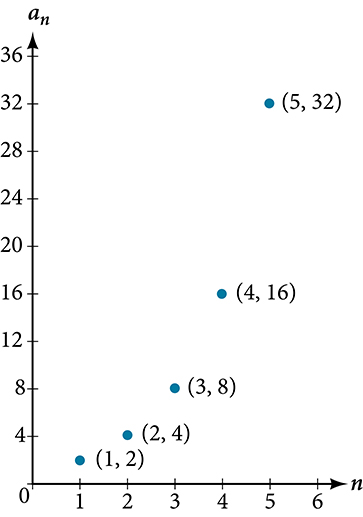
Graphing provides a visual representation of the sequence as a set of distinct points. We can see from the graph in Figure 1 that the number of hits is rising at an exponential rate. This particular sequence forms an exponential function.
グラフは、この数列を離れた点の集合として目に見える形で表す。図1のグラフから、閲覧数が指数の割合で増えているのが分かる。この数列は指数関数をなす。
Lastly, we can write this particular sequence as
最後に、この数列は次のようにも書ける。
A sequence that continues indefinitely is called an infinite sequence. The domain of an infinite sequence is the set of counting numbers. If we consider only the first 10 terms of the sequence, we could write
限りなく続く数列を無限数列という。無限数列の定義域は数え上げの数の集合である。この数列の初めの10項だけを考えるなら、次のように書ける。
This sequence is called a finite sequence because it does not continue indefinitely.
この数列は限りなく続かないので有限数列という。
Sequence 数列
A sequence is a function whose domain is the set of positive integers. A finite sequence is a sequence whose domain consists of only the first positive integers. The numbers in a sequence are called terms. The variable with a number subscript is used to represent the terms in a sequence and to indicate the position of the term in the sequence.
数列とは、定義域が正の整数の集合である関数である。有限数列とは、定義域が初めの 個の正の整数だけからなる数列である。数列の中の数を項という。数列の項を表し、数列の中でのその項の位置を示すのに、数を添字に付けた変数 を使う。
We call the first term of the sequence, the second term of the sequence, the third term of the sequence, and so on. The term is called the nth term of the sequence, or the general term of the sequence. An explicit formula defines the term of a sequence using the position of the term. A sequence that continues indefinitely is an infinite sequence.
をこの数列の第一項、 を第二項、 を第三項、という具合に呼ぶ。項 をこの数列の第n項、またはこの数列の一般項という。一般項の公式は、項の位置を使って数列の第 項を定める。限りなく続く数列は無限数列である。
Q&A 疑問と答え
Does a sequence always have to begin with
数列はつねに から始めねばならないか。
No. In certain problems, it may be useful to define the initial term as instead of In these problems, the domain of the function includes 0.
そうではない。問題によっては、初めの項を でなく と定めると便利なことがある。その場合、この関数の定義域には0が含まれる。
How To 手順
Given an explicit formula, write the first terms of a sequence.
一般項の公式が与えられたとき、数列の初めの 項を書く。
1. Substitute each value of into the formula. Begin with to find the first term, 2. To find the second term, use 3. Continue in the same manner until you have identified all terms.
1. 公式に の各値を代入する。第一項 を求めるには から始める。2. 第二項 を求めるには を使う。3. すべての 項が分かるまで同じように続ける。
Example 1例1
Writing the Terms of a Sequence Defined by an Explicit Formula一般項の公式で定められた数列の項を書く
Write the first five terms of the sequence defined by the explicit formula
一般項の公式 で定められる数列の初めの五項を書け。
Solution 解答
Substitute into the formula. Repeat with values 2 through 5 for
公式に を代入する。 に2から5までの値で繰り返す。
The first five terms are
初めの五項は である。
Analysis 考察
The sequence values can be listed in a table. A table, such as Table 3, is a convenient way to input the function into a graphing utility.
数列の値は表に並べられる。表3のような表は、グラフを描く道具にこの関数を入れるのに便利なしかたである。
| 1 | 2 | 3 | 4 | 5 | |
| 5 | 2 | –1 | –4 | –7 |
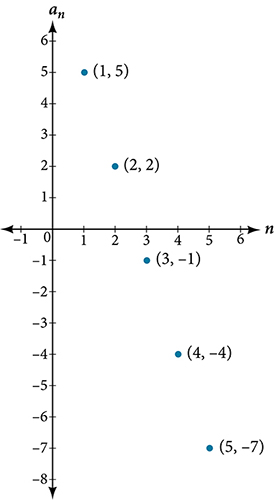
A graph can be made from this table of values. From the graph in Figure 2, we can see that this sequence represents a linear function, but notice the graph is not continuous because the domain is over the positive integers only.
この値の表からグラフが作れる。図2のグラフから、この数列が一次関数を表すと分かるが、定義域が正の整数だけなのでグラフが連続していないことに注意せよ。
Try It #1やってみよう1
Write the first five terms of the sequence defined by the explicit formula
一般項の公式 で定められる数列の初めの五項を書け。
Investigating Alternating Sequences符号が交互に変わる数列を調べる
Sometimes sequences have terms that are alternate. In fact, the terms may actually alternate in sign. The steps to finding terms of the sequence are the same as if the signs did not alternate. However, the resulting terms will not show increase or decrease as increases. Let’s take a look at the following sequence.
数列の項が交互に変わることがある。実際、項の符号が交互に変わることもある。数列の項を求める手順は、符号が交互に変わらない場合と同じである。だができる項は、 が増えても増加も減少も示さない。次の数列を見てみよう。
Notice the first term is greater than the second term, the second term is less than the third term, and the third term is greater than the fourth term. This trend continues forever. Do not rearrange the terms in numerical order to interpret the sequence.
第一項が第二項より大きく、第二項が第三項より小さく、第三項が第四項より大きいことに注意せよ。この流れは永遠に続く。この数列を読み解くのに項を数の大きさ順に並べ替えてはならない。
How To 手順
Given an explicit formula with alternating terms, write the first terms of a sequence.
項が交互に変わる一般項の公式が与えられたとき、数列の初めの 項を書く。
1. Substitute each value of into the formula. Begin with to find the first term, The sign of the term is given by the in the explicit formula.2. To find the second term, use 3. Continue in the same manner until you have identified all terms.
1. 公式に の各値を代入する。第一項 を求めるには から始める。項の符号は一般項の公式の で与えられる。2. 第二項 を求めるには を使う。3. すべての 項が分かるまで同じように続ける。
Example 2例2
Writing the Terms of an Alternating Sequence Defined by an Explicit Formula一般項の公式で定められた、符号が交互に変わる数列の項を書く
Write the first five terms of the sequence.
この数列の初めの五項を書け。
Solution 解答
Substitute and so on in the formula.
公式に などを代入する。
The first five terms are
初めの五項は である。
Analysis 考察
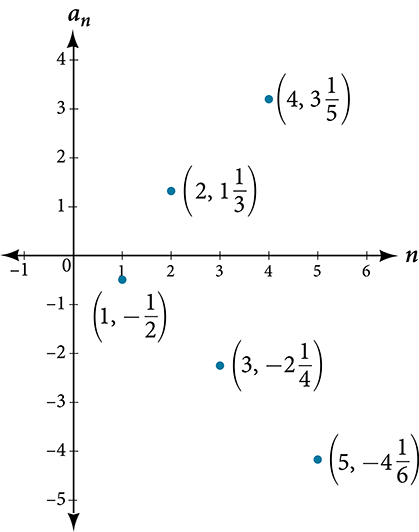
The graph of this function, shown in Figure 3, looks different from the ones we have seen previously in this section because the terms of the sequence alternate between positive and negative values.
図3に示すこの関数のグラフは、この節でこれまで見たものとは違って見える。数列の項が正と負のあいだで交互に変わるからである。
Q&A 疑問と答え
In Example 2, does the (–1) to the power of account for the oscillations of signs?
例2で、 乗した (–1) が符号の揺れを生んでいるのか。
Yes, the power might be and so on, but any odd powers will result in a negative term, and any even power will result in a positive term.
そうである。累乗は などになりうるが、奇数の累乗はどれも負の項を生み、偶数の累乗はどれも正の項を生む。
Try It #2やってみよう2
Write the first five terms of the sequence.
この数列の初めの五項を書け。
Investigating Piecewise Explicit Formulas場合分けした一般項の公式を調べる
We’ve learned that sequences are functions whose domain is over the positive integers. This is true for other types of functions, including some piecewise functions. Recall that a piecewise function is a function defined by multiple subsections. A different formula might represent each individual subsection.
数列が、定義域が正の整数である関数だと学んだ。これはほかの型の関数、たとえば区分けした関数の一部にも当てはまる。区分けした関数とは、複数の部分で定められる関数であることを思い出せ。各部分をそれぞれ違う公式が表すことがある。
How To 手順
Given an explicit formula for a piecewise function, write the first terms of a sequence
区分けした関数の一般項の公式が与えられたとき、数列の初めの 項を書く
1. Identify the formula to which applies.2. To find the first term, use in the appropriate formula.3. Identify the formula to which applies.4. To find the second term, use in the appropriate formula.5. Continue in the same manner until you have identified all terms.
1. に当てはまる公式を見分ける。2. 第一項 を求めるには、ふさわしい公式で を使う。3. に当てはまる公式を見分ける。4. 第二項 を求めるには、ふさわしい公式で を使う。5. すべての 項が分かるまで同じように続ける。
Example 3例3
Writing the Terms of a Sequence Defined by a Piecewise Explicit Formula場合分けした一般項の公式で定められた数列の項を書く
Write the first six terms of the sequence.
この数列の初めの六項を書け。
Solution 解答
Substitute and so on in the appropriate formula. Use when is not a multiple of 3. Use when is a multiple of 3.
ふさわしい公式に などを代入する。 が3の倍数でないときは を使う。 が3の倍数のときは を使う。
The first six terms are
初めの六項は である。
Analysis 考察
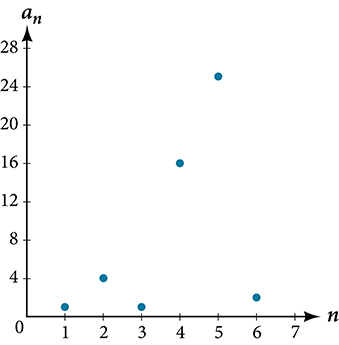
Every third point on the graph shown in Figure 4 stands out from the two nearby points. This occurs because the sequence was defined by a piecewise function.
図4に示すグラフでは、三つおきの点が近くの二点から離れて目立つ。これはこの数列が区分けした関数で定められているからである。
Try It #3やってみよう3
Write the first six terms of the sequence.
この数列の初めの六項を書け。
Finding an Explicit Formula一般項の公式を求める
Thus far, we have been given the explicit formula and asked to find a number of terms of the sequence. Sometimes, the explicit formula for the term of a sequence is not given. Instead, we are given several terms from the sequence. When this happens, we can work in reverse to find an explicit formula from the first few terms of a sequence. The key to finding an explicit formula is to look for a pattern in the terms. Keep in mind that the pattern may involve alternating terms, formulas for numerators, formulas for denominators, exponents, or bases.
ここまでは一般項の公式が与えられ、数列のいくつかの項を求めよと言われてきた。数列の第 項の一般項の公式が与えられないこともある。その代わりに、数列のいくつかの項が与えられる。そのときは、逆にたどって数列の初めのいくつかの項から一般項の公式を求められる。一般項の公式を求める要は、項の中に型を探すことである。その型が、交互に変わる項、分子の公式、分母の公式、指数、底にかかわることもあると心に留めよ。
How To 手順
Given the first few terms of a sequence, find an explicit formula for the sequence.
数列の初めのいくつかの項が与えられたとき、その数列の一般項の公式を求める。
1. Look for a pattern among the terms.2. If the terms are fractions, look for a separate pattern among the numerators and denominators.3. Look for a pattern among the signs of the terms.4. Write a formula for in terms of Test your formula for and
1. 項の中に型を探す。2. 項が分数なら、分子と分母のそれぞれに別の型を探す。3. 項の符号の中に型を探す。4. で表した の公式を書く。 と で公式を試す。
Example 4例4
Writing an Explicit Formula for the nth Term of a Sequence数列の一般項の公式を書く
Write an explicit formula for the term of each sequence.
各数列の第 項の一般項の公式を書け。
Solution 解答
Look for the pattern in each sequence.
各数列の型を探す。
ⓐThe terms alternate between positive and negative. We can use to make the terms alternate. The numerator can be represented by The denominator can be represented by ⓑThe terms are all negative. So we know that the fraction is negative, the numerator is 2, and the denominator can be represented by ⓒThe terms are powers of For the first term is so the exponent must be
ⓐ項が正と負のあいだで交互に変わる。項を交互に変えるには が使える。分子は で表せる。分母は で表せる。ⓑ項はすべて負である。よって分数は負、分子は2、分母は で表せると分かる。ⓒ項は の累乗である。 のとき第一項は なので、指数は でなければならない。
Try It #4やってみよう4
Write an explicit formula for the term of the sequence.
この数列の第 項の一般項の公式を書け。
Try It #5やってみよう5
Write an explicit formula for the term of the sequence.
この数列の第 項の一般項の公式を書け。
Try It #6やってみよう6
Write an explicit formula for the term of the sequence.
この数列の第 項の一般項の公式を書け。
Writing the Terms of a Sequence Defined by a Recursive Formula漸化式で定められた数列の項を書く
Sequences occur naturally in the growth patterns of nautilus shells, pinecones, tree branches, and many other natural structures. We may see the sequence in the leaf or branch arrangement, the number of petals of a flower, or the pattern of the chambers in a nautilus shell. Their growth follows the Fibonacci sequence, a famous sequence in which each term can be found by adding the preceding two terms. The numbers in the sequence are 1, 1, 2, 3, 5, 8, 13, 21, 34,…. Other examples from the natural world that exhibit the Fibonacci sequence are the Calla Lily, which has just one petal, the Black-Eyed Susan with 13 petals, and different varieties of daisies that may have 21 or 34 petals.
数列は、オウムガイの殻、松かさ、木の枝、その他多くの自然の造りの成長の型に自然に現れる。葉や枝の並び、花の花びらの数、オウムガイの殻の部屋の型に、数列が見て取れる。その成長はフィボナッチ数列に従う。これは各項が直前の二項を足せば求まる有名な数列である。この数列の数は 1、1、2、3、5、8、13、21、34、… である。フィボナッチ数列を示す自然界のほかの例には、花びらが一枚だけのオランダカイウ、花びらが13枚のオオハンゴンソウ、花びらが21枚や34枚のいろいろな種類のヒナギクがある。
Each term of the Fibonacci sequence depends on the terms that come before it. The Fibonacci sequence cannot easily be written using an explicit formula. Instead, we describe the sequence using a recursive formula, a formula that defines the terms of a sequence using previous terms.
フィボナッチ数列の各項は、その前に来る項に依存する。フィボナッチ数列は一般項の公式では簡単には書けない。その代わりに、漸化式、すなわち前の項を使って数列の項を定める公式で、この数列を述べる。
A recursive formula always has two parts: the value of an initial term (or terms), and an equation defining in terms of preceding terms. For example, suppose we know the following:
漸化式はつねに二つの部分を持つ。初めの項(または項)の値と、前の項で を定める式である。たとえば、次が分かっているとしよう。
We can find the subsequent terms of the sequence using the first term.
第一項を使って、この数列の後の項が求まる。
So the first four terms of the sequence are .
よってこの数列の初めの四項は である。
The recursive formula for the Fibonacci sequence states the first two terms and defines each successive term as the sum of the preceding two terms.
フィボナッチ数列の漸化式は、初めの二項を述べ、後続の各項を直前の二項の和として定める。
To find the tenth term of the sequence, for example, we would need to add the eighth and ninth terms. We were told previously that the eighth and ninth terms are 21 and 34, so
たとえばこの数列の第十項を求めるには、第八項と第九項を足す必要がある。第八項と第九項が21と34だと先に述べたので、
Recursive Formula 漸化式
A recursive formula is a formula that defines each term of a sequence using preceding term(s). Recursive formulas must always state the initial term, or terms, of the sequence.
漸化式とは、前の項を使って数列の各項を定める公式である。漸化式はつねに、その数列の初めの項(または項)を述べねばならない。
Q&A 疑問と答え
Must the first two terms always be given in a recursive formula?
漸化式ではつねに初めの二項が与えられねばならないか。
No. The Fibonacci sequence defines each term using the two preceding terms, but many recursive formulas define each term using only one preceding term. These sequences need only the first term to be defined.
そうではない。フィボナッチ数列は直前の二項を使って各項を定めるが、多くの漸化式は直前の一項だけを使って各項を定める。この数列は第一項だけが定められていればよい。
How To 手順
Given a recursive formula with only the first term provided, write the first terms of a sequence.
第一項だけが示された漸化式が与えられたとき、数列の初めの 項を書く。
1. Identify the initial term, which is given as part of the formula. This is the first term.2. To find the second term, substitute the initial term into the formula for Solve.3. To find the third term, substitute the second term into the formula. Solve.4. Repeat until you have solved for the term.
1. 公式の一部として与えられている初めの項 を見分ける。これが第一項である。2. 第二項 を求めるには、公式の に初めの項を代入する。解く。3. 第三項 を求めるには、公式に第二項を代入する。解く。4. 第 項について解けるまで繰り返す。
Example 5例5
Writing the Terms of a Sequence Defined by a Recursive Formula漸化式で定められた数列の項を書く
Write the first five terms of the sequence defined by the recursive formula.
この漸化式で定められる数列の初めの五項を書け。
Solution 解答
The first term is given in the formula. For each subsequent term, we replace with the value of the preceding term.
第一項は公式に与えられている。後続の各項では、 を直前の項の値に置き換える。
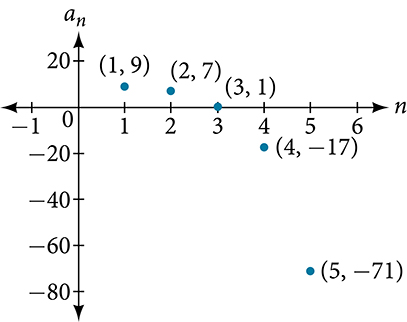
The first five terms are See Figure 5.
初めの五項は である。図5を見よ。
Try It #7やってみよう7
Write the first five terms of the sequence defined by the recursive formula.
この漸化式で定められる数列の初めの五項を書け。
How To 手順
Given a recursive formula with two initial terms, write the first terms of a sequence.
初めの二項がある漸化式が与えられたとき、数列の初めの 項を書く。
1. Identify the initial term, which is given as part of the formula.2. Identify the second term, which is given as part of the formula.3. To find the third term, substitute the initial term and the second term into the formula. Evaluate.4. Repeat until you have evaluated the term.
1. 公式の一部として与えられている初めの項 を見分ける。2. 公式の一部として与えられている第二項 を見分ける。3. 第三項を求めるには、公式に初めの項と第二項を代入する。値を求める。4. 第 項の値が求まるまで繰り返す。
Example 6例6
Writing the Terms of a Sequence Defined by a Recursive Formula漸化式で定められた数列の項を書く
Write the first six terms of the sequence defined by the recursive formula.
この漸化式で定められる数列の初めの六項を書け。
Solution 解答
The first two terms are given. For each subsequent term, we replace and with the values of the two preceding terms.
初めの二項が与えられている。後続の各項では、 と を直前の二項の値に置き換える。
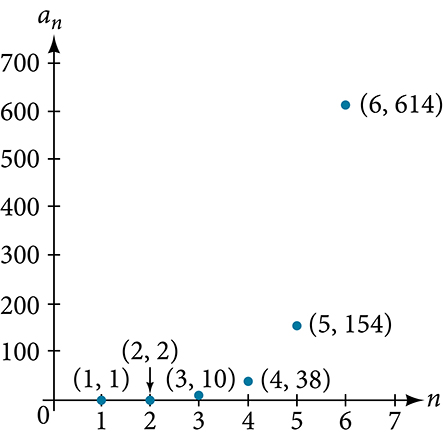
The first six terms are See Figure 6.
初めの六項は である。図6を見よ。
Try It #8やってみよう8
Write the first 8 terms of the sequence defined by the recursive formula.
この漸化式で定められる数列の初めの8項を書け。
Using Factorial Notation階乗の表記を使う
The formulas for some sequences include products of consecutive positive integers. factorial, written as is the product of the positive integers from 1 to For example,
数列によっては、公式に連続する正の整数の積が含まれる。 と書く の階乗は、1から までの正の整数の積である。たとえば、
An example of formula containing a factorial is The sixth term of the sequence can be found by substituting 6 for
階乗を含む公式の例が である。この数列の第六項は、 に6を代入すれば求まる。
The factorial of any whole number is We can therefore also think of as
どの自然数 の階乗も である。よって を と考えることもできる。
n Factorial nの階乗
n factorial is a mathematical operation that can be defined using a recursive formula. The factorial of denoted is defined for a positive integer as:
n の階乗は、漸化式で定められる数学の演算である。 と書く の階乗は、正の整数 について次のように定められる。
The special case is defined as
特別な場合 は と定められる。
Q&A 疑問と答え
Can factorials always be found using a calculator?
階乗はつねに電卓で求められるか。
No. Factorials get large very quickly—faster than even exponential functions! When the output gets too large for the calculator, it will not be able to calculate the factorial.
そうではない。階乗はたいへん速く大きくなる。指数関数よりも速い。出力が電卓に対して大きくなりすぎると、階乗は計算できなくなる。
Example 7例7
Writing the Terms of a Sequence Using Factorials階乗を使って数列の項を書く
Write the first five terms of the sequence defined by the explicit formula
一般項の公式 で定められる数列の初めの五項を書け。
Solution 解答
Substitute and so on in the formula.
公式に などを代入する。
The first five terms are
初めの五項は である。
Analysis 考察
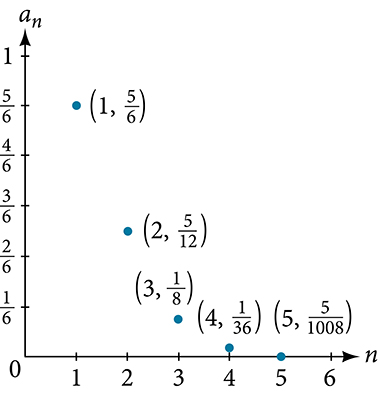
Figure 7 shows the graph of the sequence. Notice that, since factorials grow very quickly, the presence of the factorial term in the denominator results in the denominator becoming much larger than the numerator as increases. This means the quotient gets smaller and, as the plot of the terms shows, the terms are decreasing and nearing zero.
図7にこの数列のグラフを示す。階乗はたいへん速く大きくなるので、分母に階乗の項があると、 が増えるにつれて分母が分子よりずっと大きくなることに注意せよ。これは商が小さくなるということであり、項を打った図が示すとおり、項は減って零に近づいていく。
Try It #9やってみよう9
Write the first five terms of the sequence defined by the explicit formula
一般項の公式 で定められる数列の初めの五項を書け。
Media 教材
Access this online resource for additional instruction and practice with sequences.
数列についての説明と練習をさらに求めるなら、次のオンライン教材にあたるとよい。
・数列の項を求める
Verbal言葉で答える問題
2. Describe three ways that a sequence can be defined.
2. 数列を定めるしかたを三つ述べよ。
4. What happens to the terms of a sequence when there is a negative factor in the formula that is raised to a power that includes What is the term used to describe this phenomenon?
4. 公式に、 を含む累乗をされた負の因数があるとき、数列の項 はどうなるか。この現象を述べるのに使う語は何か。
Algebraic代数の問題
For the following exercises, write the first four terms of the sequence.
次の各問について、この数列の初めの四項を書け。
For the following exercises, write the first eight terms of the piecewise sequence.
次の各問について、この区分けした数列の初めの八項を書け。
式中の英語:is even:は偶数 / is odd:は奇数
式中の英語:or:または
For the following exercises, write an explicit formula for each sequence.
次の各問について、各数列の一般項の公式を書け。
For the following exercises, write the first five terms of the sequence.
次の各問について、この数列の初めの五項を書け。
For the following exercises, write the first eight terms of the sequence.
次の各問について、この数列の初めの八項を書け。
For the following exercises, write a recursive formula for each sequence.
次の各問について、各数列の漸化式を書け。
For the following exercises, evaluate the factorial.
次の各問について、階乗の値を求めよ。
For the following exercises, write the first four terms of the sequence.
次の各問について、この数列の初めの四項を書け。
Graphicalグラフの問題
For the following exercises, graph the first five terms of the indicated sequence
次の各問について、示された数列の初めの五項をグラフに描け。
式中の英語:is even:は偶数 / is odd:は奇数
For the following exercises, write an explicit formula for the sequence using the first five points shown on the graph.
次の各問について、グラフに示された初めの五点を使って、この数列の一般項の公式を書け。
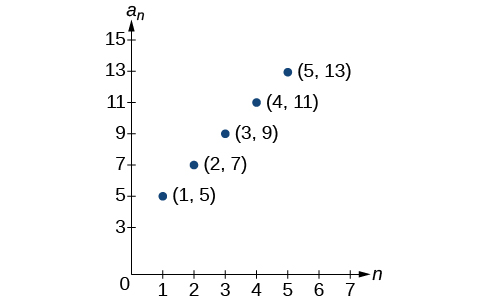
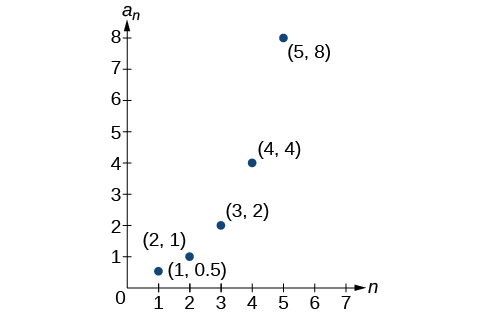
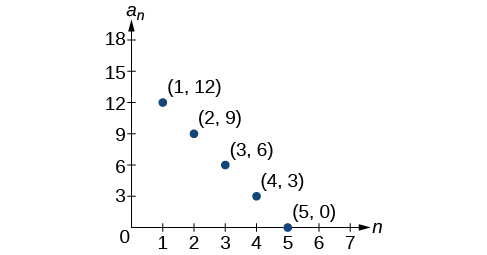
For the following exercises, write a recursive formula for the sequence using the first five points shown on the graph.
次の各問について、グラフに示された初めの五点を使って、この数列の漸化式を書け。
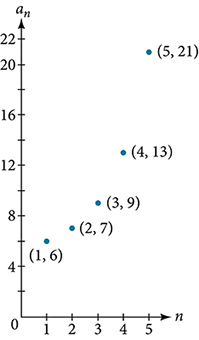
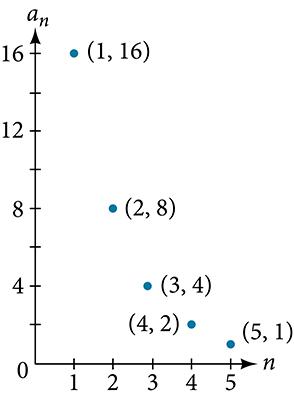
Technology機器を使う問題
Follow these steps to evaluate a sequence defined recursively using a graphing calculator:
グラフ電卓を使って、漸化式で定められた数列の値を求めるには、次の手順に従え。
• On the home screen, key in the value for the initial term and press [ENTER].• Enter the recursive formula by keying in all numerical values given in the formula, along with the key strokes [2ND] ANS for the previous term Press [ENTER].• Continue pressing [ENTER] to calculate the values for each successive term.
・最初の画面で初めの項 の値を打ち込み、[ENTER] を押す。・公式に与えられた数値をすべて打ち込み、直前の項 には [2ND] ANS のキー操作を使って漸化式を入れる。[ENTER] を押す。・[ENTER] を押し続けて、後続の各項の値を計算する。
For the following exercises, use the steps above to find the indicated term or terms for the sequence.
次の各問について、上の手順を使ってこの数列の示された項を求めよ。
58. Find the 15th term of the sequence ,
58. 数列 、 の第15項を求めよ。
60. Find the first ten terms of the sequence ,
60. 数列 、 の初めの十項を求めよ。
Follow these steps to evaluate a finite sequence defined by an explicit formula. Using a TI-84, do the following.
一般項の公式で定められた有限数列の値を求めるには、次の手順に従え。TI-84 を使うなら次のようにする。
• In the home screen, press [2ND] LIST.• Scroll over to OPS and choose “seq(” from the dropdown list. Press [ENTER].• In the line headed “Expr:” type in the explicit formula, using the button for • In the line headed “Variable:” type in the variable used on the previous step.• In the line headed “start:” key in the value of that begins the sequence.• In the line headed “end:” key in the value of that ends the sequence.• Press [ENTER] 3 times to return to the home screen. You will see the sequence syntax on the screen. Press [ENTER] to see the list of terms for the finite sequence defined. Use the right arrow key to scroll through the list of terms.
・最初の画面で [2ND] LIST を押す。・OPS まで移り、一覧から「seq(」を選ぶ。[ENTER] を押す。・「Expr:」の行に、 には のボタンを使って一般項の公式を打ち込む。・「Variable:」の行に、前の手順で使った変数を打ち込む。・「start:」の行に、この数列が始まる の値を打ち込む。・「end:」の行に、この数列が終わる の値を打ち込む。・[ENTER] を3回押して最初の画面に戻る。画面に数列の構文が出る。[ENTER] を押すと、定められた有限数列の項の一覧が出る。右矢印キーで項の一覧をたどる。
Using a TI-83, do the following.
TI-83 を使うなら次のようにする。
• In the home screen, press [2ND] LIST.• Scroll over to OPS and choose “seq(” from the dropdown list. Press [ENTER].• Enter the items in the order “Expr”, “Variable”, “start”, “end” separated by commas. See the instructions above for the description of each item.• Press [ENTER] to see the list of terms for the finite sequence defined. Use the right arrow key to scroll through the list of terms.
・最初の画面で [2ND] LIST を押す。・OPS まで移り、一覧から「seq(」を選ぶ。[ENTER] を押す。・「Expr」「Variable」「start」「end」の順に、読点で区切って項目を入れる。各項目の説明は上の指示を見よ。・[ENTER] を押すと、定められた有限数列の項の一覧が出る。右矢印キーで項の一覧をたどる。
For the following exercises, use the steps above to find the indicated terms for the sequence. Round to the nearest thousandth when necessary.
次の各問について、上の手順を使ってこの数列の示された項を求めよ。必要なら小数第三位まで求めよ。
62. List the first five terms of the sequence
62. 数列 の初めの五項を並べよ。
64. List the first five terms of the sequence
64. 数列 の初めの五項を並べよ。
66. List the first six terms of the sequence
66. 数列 の初めの六項を並べよ。
Extensions発展問題
68. What term in the sequence has the value Verify the result.
68. 数列 のどの項が値 を持つか。結果を確かめよ。
70. Calculate the first eight terms of the sequences and and then make a conjecture about the relationship between these two sequences.
70. 数列 と の初めの八項を計算し、そしてこの二つの数列の関係について予想を立てよ。