第13章数列、確率、数え上げSequences, Probability, and Counting Theory
13.3 Geometric Sequences13.3 等比数列
Learning Objectives 学習目標
In this section, you will:
この節を終えると、次のことができるようになる。
• Find the common ratio for a geometric sequence.• List the terms of a geometric sequence.• Use a recursive formula for a geometric sequence.• Use an explicit formula for a geometric sequence.
・等比数列の公比を求める。・等比数列の項を並べる。・等比数列の漸化式を使う。・等比数列の一般項の公式を使う。
Many jobs offer an annual cost-of-living increase to keep salaries consistent with inflation. Suppose, for example, a recent college graduate finds a position as a sales manager earning an annual salary of $26,000. He is promised a 2% cost of living increase each year. His annual salary in any given year can be found by multiplying his salary from the previous year by 102%. His salary will be $26,520 after one year; $27,050.40 after two years; $27,591.41 after three years; and so on. When a salary increases by a constant rate each year, the salary grows by a constant factor. In this section, we will review sequences that grow in this way.
多くの仕事では、給料を物価の上昇に合わせ続けるために、年ごとの生計費の上乗せがある。たとえば、ある大学を出たばかりの人が、年俸26,000ドルの販売の管理者の職に就くとしよう。彼は毎年2%の生計費の上乗せを約束される。ある年の彼の年俸は、前の年の給料に102%を掛ければ求まる。彼の給料は1年後に26,520ドル、2年後に27,050.40ドル、3年後に27,591.41ドル、という具合になる。給料が毎年一定の割合で増えるとき、給料は一定の倍率で増えていく。この節では、このように増える数列を見る。
Finding Common Ratios公比を求める
The yearly salary values described form a geometric sequence because they change by a constant factor each year. Each term of a geometric sequence increases or decreases by a constant factor called the common ratio. The sequence below is an example of a geometric sequence because each term increases by a constant factor of 6. Multiplying any term of the sequence by the common ratio 6 generates the subsequent term.
述べた年俸の値は、毎年一定の倍率で変わるので等比数列をなす。等比数列の各項は、公比という一定の倍率で増えるか減る。下の数列は等比数列の例である。各項が6という一定の倍率で増えるからである。この数列のどの項も公比6を掛ければ次の項が生まれる。

Definition of a Geometric Sequence 等比数列の定義
A geometric sequence is one in which any term divided by the previous term is a constant. This constant is called the common ratio of the sequence. The common ratio can be found by dividing any term in the sequence by the previous term. If is the initial term of a geometric sequence and is the common ratio, the sequence will be
等比数列とは、どの項を前の項で割っても定数になるものである。この定数をこの数列の公比という。公比は、この数列のどの項でも前の項で割れば求まる。 が等比数列の初めの項、 が公比なら、この数列は次のようになる。
How To 手順
Given a set of numbers, determine if they represent a geometric sequence.
数の組が与えられたとき、それが等比数列を表すかどうかを決める。
1. Divide each term by the previous term.2. Compare the quotients. If they are the same, a common ratio exists and the sequence is geometric.
1. 各項を前の項で割る。2. 商を比べる。同じなら公比があり、この数列は等比数列である。
Example 1例1
Finding Common Ratios公比を求める
Is the sequence geometric? If so, find the common ratio.
この数列は等比数列か。そうなら公比を求めよ。
Solution 解答
Divide each term by the previous term to determine whether a common ratio exists.
各項を前の項で割り、公比があるかどうかを決める。
ⓐ The sequence is geometric because there is a common ratio. The common ratio is 2.ⓑ The sequence is not geometric because there is not a common ratio.
ⓐ 公比があるので、この数列は等比数列である。公比は2である。ⓑ 公比が無いので、この数列は等比数列でない。
Analysis 考察
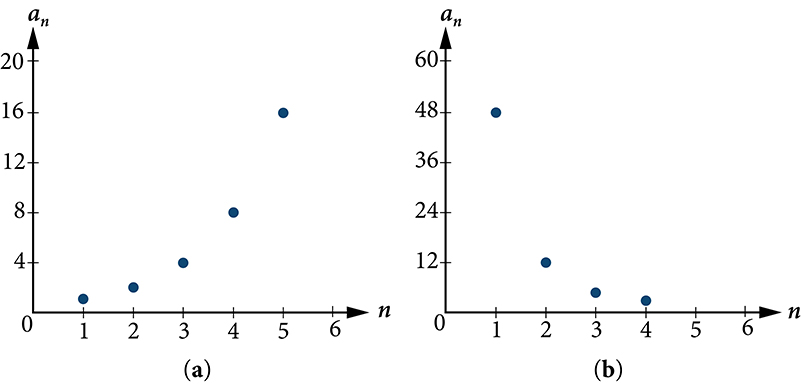
The graph of each sequence is shown in Figure 1. It seems from the graphs that both (a) and (b) appear have the form of the graph of an exponential function in this viewing window. However, we know that (a) is geometric and so this interpretation holds, but (b) is not.
各数列のグラフを図1に示す。グラフからは、この表示範囲では (a) も (b) も指数関数のグラフの形をしているように見える。だが (a) は等比数列なのでこの読み方が成り立つが、(b) はそうでないと分かっている。
Q&A 疑問と答え
If you are told that a sequence is geometric, do you have to divide every term by the previous term to find the common ratio?
数列が等比数列だと言われたとき、公比を求めるのに、すべての項を前の項で割らねばならないか。
No. If you know that the sequence is geometric, you can choose any one term in the sequence and divide it by the previous term to find the common ratio.
そうではない。数列が等比数列だと分かっているなら、この数列のどれか一項を選び、それを前の項で割れば公比が求まる。
Try It #1やってみよう1
Is the sequence geometric? If so, find the common ratio.
この数列は等比数列か。そうなら公比を求めよ。
Try It #2やってみよう2
Is the sequence geometric? If so, find the common ratio.
この数列は等比数列か。そうなら公比を求めよ。
Writing Terms of Geometric Sequences等比数列の項を書く
Now that we can identify a geometric sequence, we will learn how to find the terms of a geometric sequence if we are given the first term and the common ratio. The terms of a geometric sequence can be found by beginning with the first term and multiplying by the common ratio repeatedly. For instance, if the first term of a geometric sequence is and the common ratio is we can find subsequent terms by multiplying to get then multiplying the result to get and so on.
等比数列が見分けられるようになったので、第一項と公比が与えられたときに等比数列の項を求めるしかたを学ぶ。等比数列の項は、第一項から始めて公比を繰り返し掛ければ求まる。たとえば、等比数列の第一項が 、公比が なら、 を掛けて を得、その結果に を掛けて を得、という具合に後の項が求まる。
The first four terms are
初めの四項は である。
How To 手順
Given the first term and the common factor, find the first four terms of a geometric sequence.
第一項と公比が与えられたとき、等比数列の初めの四項を求める。
1. Multiply the initial term, by the common ratio to find the next term, 2. Repeat the process, using to find and then to find until all four terms have been identified.3. Write the terms separated by commons within brackets.
1. 初めの項 に公比を掛けて次の項 を求める。2. 四項すべてが分かるまで、 を使って を求め、そして を使って を求める、という手順を繰り返す。3. 波括弧の中に、読点で区切って項を書く。
Example 2例2
Writing the Terms of a Geometric Sequence等比数列の項を書く
List the first four terms of the geometric sequence with and
かつ の等比数列の初めの四項を並べよ。
Solution 解答
Multiply by to find Repeat the process, using to find and so on.
に を掛けて を求める。 を使って を求める、という具合に手順を繰り返す。
The first four terms are
初めの四項は である。
Try It #3やってみよう3
List the first five terms of the geometric sequence with and
かつ の等比数列の初めの五項を並べよ。
Using Recursive Formulas for Geometric Sequences等比数列の漸化式を使う
A recursive formula allows us to find any term of a geometric sequence by using the previous term. Each term is the product of the common ratio and the previous term. For example, suppose the common ratio is 9. Then each term is nine times the previous term. As with any recursive formula, the initial term must be given.
漸化式を使えば、前の項を使って等比数列のどの項も求まる。各項は、公比と前の項の積である。たとえば、公比が9だとしよう。すると各項は前の項の9倍である。どの漸化式でもそうだが、初めの項が与えられねばならない。
Recursive Formula for a Geometric Sequence 等比数列の漸化式
The recursive formula for a geometric sequence with common ratio and first term is
公比 、第一項 の等比数列の漸化式は次である。
How To 手順
Given the first several terms of a geometric sequence, write its recursive formula.
等比数列の初めのいくつかの項が与えられたとき、その漸化式を書く。
1. State the initial term.2. Find the common ratio by dividing any term by the preceding term.3. Substitute the common ratio into the recursive formula for a geometric sequence.
1. 初めの項を述べる。2. どれかの項を直前の項で割って公比を求める。3. 等比数列の漸化式に公比を代入する。
Example 3例3
Using Recursive Formulas for Geometric Sequences等比数列の漸化式を使う
Write a recursive formula for the following geometric sequence.
次の等比数列の漸化式を書け。
Solution 解答
The first term is given as 6. The common ratio can be found by dividing the second term by the first term.
第一項は6と与えられている。公比は、第二項を第一項で割れば求まる。
Substitute the common ratio into the recursive formula for geometric sequences and define
等比数列の漸化式に公比を代入し、 を定める。
Analysis 考察
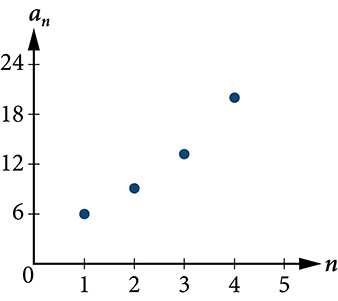
The sequence of data points follows an exponential pattern. The common ratio is also the base of an exponential function as shown in Figure 2
この資料の点の並びは指数の型に従う。図2に示すとおり、公比は指数関数の底でもある。
Q&A 疑問と答え
Do we have to divide the second term by the first term to find the common ratio?
公比を求めるのに、第二項を第一項で割らねばならないか。
No. We can divide any term in the sequence by the previous term. It is, however, most common to divide the second term by the first term because it is often the easiest method of finding the common ratio.
そうではない。この数列のどの項も、前の項で割れる。だが、第二項を第一項で割るのがもっとふつうである。公比を求めるいちばん楽なしかたであることが多いからである。
Try It #4やってみよう4
Write a recursive formula for the following geometric sequence.
次の等比数列の漸化式を書け。
Using Explicit Formulas for Geometric Sequences等比数列の一般項の公式を使う
Because a geometric sequence is an exponential function whose domain is the set of positive integers, and the common ratio is the base of the function, we can write explicit formulas that allow us to find particular terms.
等比数列は定義域が正の整数の集合である指数関数であり、公比がその関数の底なので、ある項を求められる一般項の公式が書ける。
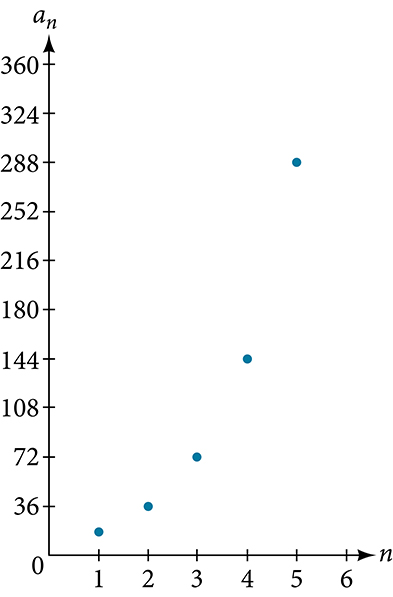
Let’s take a look at the sequence This is a geometric sequence with a common ratio of 2 and an exponential function with a base of 2. An explicit formula for this sequence is
数列 を見てみよう。これは公比2の等比数列であり、底2の指数関数である。この数列の一般項の公式は次である。
The graph of the sequence is shown in Figure 3.
この数列のグラフを図3に示す。
Explicit Formula for a Geometric Sequence 等比数列の一般項
The th term of a geometric sequence is given by the explicit formula:
等比数列の第 項は、次の一般項の公式で与えられる。
Example 4例4
Writing Terms of Geometric Sequences Using the Explicit Formula一般項の公式を使って等比数列の項を書く
Given a geometric sequence with and find
かつ の等比数列が与えられたとき、 を求めよ。
Solution 解答
The sequence can be written in terms of the initial term and the common ratio
この数列は、初めの項と公比 で書ける。
Find the common ratio using the given fourth term.
与えられた第四項を使って公比を求める。
Find the second term by multiplying the first term by the common ratio.
第一項に公比を掛けて第二項を求める。
Analysis 考察
The common ratio is multiplied by the first term once to find the second term, twice to find the third term, three times to find the fourth term, and so on. The tenth term could be found by multiplying the first term by the common ratio nine times or by multiplying by the common ratio raised to the ninth power.
第二項を求めるには公比を第一項に一度掛け、第三項には二度、第四項には三度、という具合である。第十項は、第一項に公比を九回掛けるか、公比を9乗したものを掛ければ求まる。
Try It #5やってみよう5
Given a geometric sequence with and , find
かつ の等比数列が与えられたとき、 を求めよ。
Example 5例5
Writing an Explicit Formula for the th Term of a Geometric Sequence等比数列の第 項の一般項の公式を書く
Write an explicit formula for the term of the following geometric sequence.
次の等比数列の第 項の一般項の公式を書け。
Solution 解答
The first term is 2. The common ratio can be found by dividing the second term by the first term.
第一項は2である。公比は、第二項を第一項で割れば求まる。
The common ratio is 5. Substitute the common ratio and the first term of the sequence into the formula.
公比は5である。この数列の公比と第一項を公式に代入する。
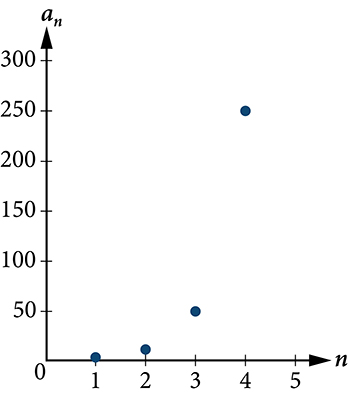
The graph of this sequence in Figure 4 shows an exponential pattern.
図4のこの数列のグラフは指数の型を示す。
Try It #6やってみよう6
Write an explicit formula for the following geometric sequence.
次の等比数列の一般項の公式を書け。
Solving Application Problems with Geometric Sequences等比数列で応用問題を解く
In real-world scenarios involving geometric sequences, we may need to use an initial term of instead of In these problems, we can alter the explicit formula slightly by using the following formula:
等比数列にかかわる現実世界の筋書きでは、初めの項を でなく とする必要があることがある。その場合、次の公式を使って一般項の公式を少し変えられる。
Example 6例6
Solving Application Problems with Geometric Sequences等比数列で応用問題を解く
In 2013, the number of students in a small school is 284. It is estimated that the student population will increase by 4% each year.
2013年、ある小さな学校の生徒数は284人である。生徒数は毎年4%ずつ増えると見積もられている。
ⓐWrite a formula for the student population.ⓑEstimate the student population in 2020.
ⓐ生徒数の公式を書け。ⓑ2020年の生徒数を見積もれ。
Solution 解答
ⓐThe situation can be modeled by a geometric sequence with an initial term of 284. The student population will be 104% of the prior year, so the common ratio is 1.04. Let be the student population and be the number of years after 2013. Using the explicit formula for a geometric sequence we getⓑWe can find the number of years since 2013 by subtracting. We are looking for the population after 7 years. We can substitute 7 for to estimate the population in 2020. The student population will be about 374 in 2020.
ⓐこの状況は、初めの項が284の等比数列でモデルにできる。生徒数は前の年の104%になるので、公比は1.04である。 を生徒数、 を2013年からの年数とする。等比数列の一般項の公式を使うと次を得る。ⓑ2013年からの年数は引き算で求まる。 7年後の生徒数を求めたい。 に7を代入すれば2020年の生徒数が見積もれる。 2020年の生徒数はおよそ374人になる。
Try It #7やってみよう7
A business starts a new website. Initially the number of hits is 293 due to the curiosity factor. The business estimates the number of hits will increase by 2.6% per week.
ある商売が新しい網頁を始める。初め、物珍しさから閲覧数は293である。この商売は、閲覧数が週に2.6%ずつ増えると見積もる。
ⓐWrite a formula for the number of hits.ⓑEstimate the number of hits in 5 weeks.
ⓐ閲覧数の公式を書け。ⓑ5週後の閲覧数を見積もれ。
Media 教材
Access these online resources for additional instruction and practice with geometric sequences.
等比数列についての説明と練習をさらに求めるなら、次のオンライン教材にあたるとよい。
• Geometric Sequences• Determine the Type of Sequence• Find the Formula for a Sequence
・等比数列・数列の種類を決める・数列の公式を求める
Verbal言葉で答える問題
2. How is the common ratio of a geometric sequence found?
2. 等比数列の公比はどう求めるか。
4. What is the difference between an arithmetic sequence and a geometric sequence?
4. 等差数列と等比数列の違いは何か。
Algebraic代数の問題
For the following exercises, find the common ratio for the geometric sequence.
次の各問について、この等比数列の公比を求めよ。
For the following exercises, determine whether the sequence is geometric. If so, find the common ratio.
次の各問について、この数列が等比数列かどうかを判定せよ。そうなら公比を求めよ。
For the following exercises, write the first five terms of the geometric sequence, given the first term and common ratio.
次の各問について、第一項と公比が与えられたとき、この等比数列の初めの五項を書け。
For the following exercises, write the first five terms of the geometric sequence, given any two terms.
次の各問について、二つの項が与えられたとき、この等比数列の初めの五項を書け。
For the following exercises, find the specified term for the geometric sequence, given the first term and common ratio.
次の各問について、第一項と公比が与えられたとき、この等比数列の指定された項を求めよ。
18. The first term is and the common ratio is Find the 5th term.
18. 第一項が 、公比が である。第5項を求めよ。
For the following exercises, find the specified term for the geometric sequence, given the first four terms.
次の各問について、初めの四項が与えられたとき、この等比数列の指定された項を求めよ。
20. Find
20. 。 を求めよ。
For the following exercises, write the first five terms of the geometric sequence.
次の各問について、この等比数列の初めの五項を書け。
For the following exercises, write a recursive formula for each geometric sequence.
次の各問について、各等比数列の漸化式を書け。
For the following exercises, write the first five terms of the geometric sequence.
次の各問について、この等比数列の初めの五項を書け。
For the following exercises, write an explicit formula for each geometric sequence.
次の各問について、各等比数列の一般項の公式を書け。
For the following exercises, find the specified term for the geometric sequence given.
次の各問について、与えられた等比数列の指定された項を求めよ。
42. Let Find
42. とする。 を求めよ。
For the following exercises, find the number of terms in the given finite geometric sequence.
次の各問について、与えられた有限の等比数列の項の数を求めよ。
Graphicalグラフの問題
For the following exercises, determine whether the graph shown represents a geometric sequence.
次の各問について、示されたグラフが等比数列を表すかどうかを判定せよ。
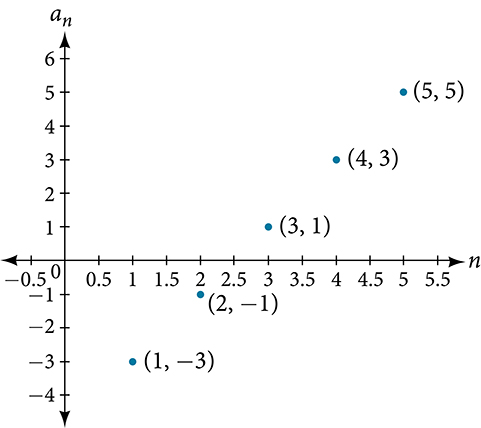
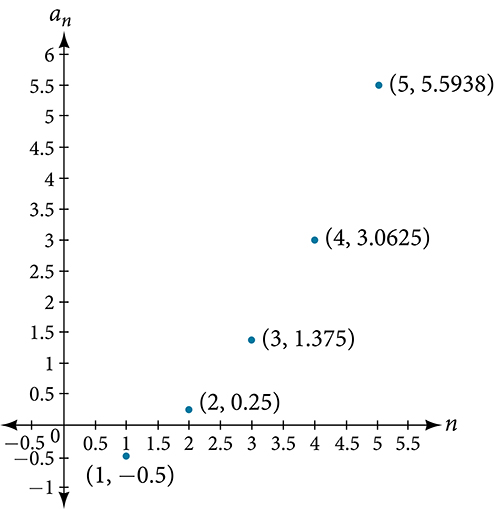
For the following exercises, use the information provided to graph the first five terms of the geometric sequence.
次の各問について、与えられた情報を使ってこの等比数列の初めの五項をグラフに描け。
Extensions発展問題
52. Use explicit formulas to give two examples of geometric sequences whose 7th terms are
52. 一般項の公式を使って、第7項が である等比数列の例を二つ挙げよ。
54. Find the 7th term of the geometric sequence
54. 等比数列 の第7項を求めよ。
56. At which term does the sequence begin to have integer values?
56. 数列 は第何項から整数の値を持ち始めるか。
58. Use the recursive formula to write a geometric sequence whose common ratio is an integer. Show the first four terms, and then find the 10th term.
58. 漸化式を使って、公比が整数の等比数列を書け。初めの四項を示し、そして第10項を求めよ。
60. Is it possible for a sequence to be both arithmetic and geometric? If so, give an example.
60. 数列が等差数列でも等比数列でもあることはありうるか。ありうるなら例を挙げよ。