第5章多項式関数と有理関数Polynomial and Rational Functions
5.7 Inverses and Radical Functions5.7 逆関数と無理関数
Learning Objectives 学習目標
In this section, you will:
この節を終えると、次のことができるようになる。
• Find the inverse of an invertible polynomial function.• Restrict the domain to find the inverse of a polynomial function.
・逆関数を持つ多項式関数の逆関数を求める。・定義域を制限して、多項式関数の逆関数を求める。
Park rangers and other trail managers may construct rock piles, stacks, or other arrangements, usually called cairns, to mark trails or other landmarks. (Rangers and environmental scientists discourage hikers from doing the same, in order to avoid confusion and preserve the habitats of plants and animals.) A cairn in the form of a mound of gravel is in the shape of a cone with the height equal to twice the radius.
公園の管理官やほかの登山道の管理者は、道や目印を示すために、ふつうケルンと呼ばれる石積みや石塔などを作ることがある。(管理官や環境科学者は、混乱を避け、動植物の生息地を守るために、登山者が同じことをするのを勧めない。)砂利を盛って作ったケルンは、高さが半径の2倍の円錐の形をしている。
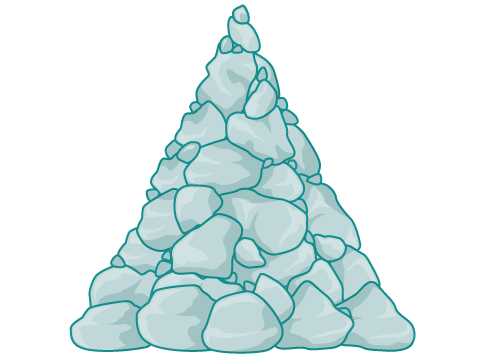
The volume is found using a formula from elementary geometry.
その体積は初等幾何の公式で求まる。
We have written the volume in terms of the radius However, in some cases, we may start out with the volume and want to find the radius. For example: A customer purchases 100 cubic feet of gravel to construct a cone shape mound with a height twice the radius. What are the radius and height of the new cone? To answer this question, we use the formula
体積 を半径 で表した。だが場合によっては、体積のほうから始めて半径を求めたいこともある。たとえば、ある客が、高さが半径の2倍の円錐形の山を作るために砂利を100立方フィート買う。この新しい円錐の半径と高さはどれだけか。この問いに答えるには、次の式を使う。
This function is the inverse of the formula for in terms of
この関数は、 で を表した公式の逆関数である。
In this section, we will explore the inverses of polynomial and rational functions and in particular the radical functions we encounter in the process.
この節では、多項式関数と有理関数の逆関数、とくにその過程で出会う無理関数を調べる。
Finding the Inverse of a Polynomial Function多項式関数の逆関数を求める
Two functions and are inverse functions if for every coordinate pair in there exists a corresponding coordinate pair in the inverse function, In other words, the coordinate pairs of the inverse functions have the input and output interchanged. Only one-to-one functions have inverses. Recall that a one-to-one function has a unique output value for each input value and passes the horizontal line test.
二つの関数 と が互いに逆関数であるとは、 のどの座標の組に対しても、逆関数 に対応する座標の組が存在することをいう。言い換えれば、逆関数の座標の組は入力と出力が入れ替わっている。逆関数を持つのは一対一の関数だけである。一対一の関数は、どの入力値に対しても出力値がただ一つ定まり、横の直線の判定に通ることを思い出そう。
For example, suppose the Sustainability Club builds a water runoff collector in the shape of a parabolic trough as shown in Figure 2. We can use the information in the figure to find the surface area of the water in the trough as a function of the depth of the water.
たとえば、持続可能性クラブが図2のような放物線状の樋の形をした雨水の集水器を作るとしよう。図の情報を使えば、樋の中の水の表面積を水の深さの関数として求められる。
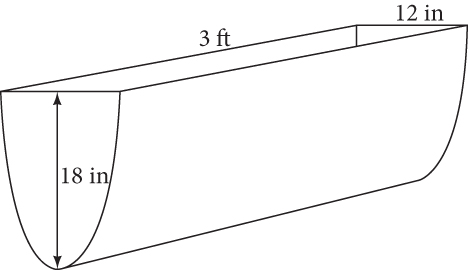
Because it will be helpful to have an equation for the parabolic cross-sectional shape, we will impose a coordinate system at the cross section, with measured horizontally and measured vertically, with the origin at the vertex of the parabola. See Figure 3.
放物線状の断面の形の方程式があると役立つので、断面に座標系を入れる。 を横向き、 を縦向きにとり、原点を放物線の頂点に置く。図3を見よ。
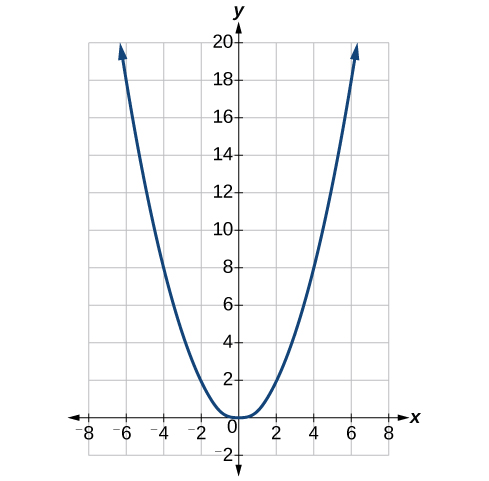
From this we find an equation for the parabolic shape. We placed the origin at the vertex of the parabola, so we know the equation will have form Our equation will need to pass through the point (6, 18), from which we can solve for the stretch factor
ここから、この放物線の形の方程式を求める。原点を放物線の頂点に置いたので、方程式は の形になると分かる。この方程式は点 (6, 18) を通らなければならず、そこから伸び率 が求まる。
Our parabolic cross section has the equation
この放物線状の断面の方程式は次のとおりである。
We are interested in the surface area of the water, so we must determine the width at the top of the water as a function of the water depth. For any depth the width will be given by so we need to solve the equation above for and find the inverse function. However, notice that the original function is not one-to-one, and indeed, given any output there are two inputs that produce the same output, one positive and one negative.
知りたいのは水の表面積なので、水面の幅を水の深さの関数として決めなければならない。どの深さ でも、幅は で与えられるので、上の方程式を について解いて逆関数を求める必要がある。だが、元の関数は一対一ではなく、実際、どの出力に対しても同じ出力を生む入力が正と負の二つあることに注目しよう。
To find an inverse, we can restrict our original function to a limited domain on which it is one-to-one. In this case, it makes sense to restrict ourselves to positive values. On this domain, we can find an inverse by solving for the input variable:
逆関数を求めるには、元の関数を一対一になる限られた定義域に制限すればよい。この場合、 の正の値に限るのが理にかなっている。この定義域では、入力の変数について解けば逆関数が求まる。
This is not a function as written. Since we are limiting ourselves to positive values in the original function, we can eliminate the negative solution, which gives us the inverse function we’re looking for.
このままでは関数ではない。元の関数で の正の値に限っているので、負の解を除ける。これで求めていた逆関数が得られる。
Because is the distance from the center of the parabola to either side, the entire width of the water at the top will be The trough is 3 feet (36 inches) long, so the surface area will then be:
は放物線の中心から両側までの距離なので、水面の幅全体は になる。樋の長さは3フィート(36インチ)なので、表面積は次のようになる。
This example illustrates two important points:
この例は二つの大切な点を示している。
1. When finding the inverse of a quadratic, we have to limit ourselves to a domain on which the function is one-to-one.2. The inverse of a quadratic function is a square root function. Both are toolkit functions and different types of power functions.
1. 二次関数の逆関数を求めるときは、その関数が一対一になる定義域に限らなければならない。2. 二次関数の逆関数は平方根の関数である。どちらも基本関数で、種類の違う累乗関数である。
Functions involving roots are often called radical functions. While it is not possible to find an inverse of most polynomial functions, some basic polynomials do have inverses. Such functions are called invertible functions, and we use the notation
根を含む関数は、しばしば無理関数と呼ばれる。ほとんどの多項式関数の逆関数は求められないが、基本的な多項式のいくつかは逆関数を持つ。そうした関数を可逆な関数と呼び、記号 を使う。
Warning: is not the same as the reciprocal of the function This use of “–1” is reserved to denote inverse functions. To denote the reciprocal of a function we would need to write
注意: は関数 の逆数と同じものではない。この「–1」の使い方は逆関数を表すためのものである。関数 の逆数を表すには と書く必要がある。
An important relationship between inverse functions is that they “undo” each other. If is the inverse of a function then is the inverse of the function In other words, whatever the function does to undoes it—and vice-versa.
逆関数どうしの大切な関係は、互いに相手を「元に戻す」ことである。 が関数 の逆関数なら、 は関数 の逆関数である。言い換えれば、関数 が に対して何をしようと、 がそれを元に戻す。逆もまた同じである。
and
そして
Note that the inverse switches the domain and range of the original function.
逆関数は、元の関数の定義域と値域を入れ替えることに注意せよ。
Verifying Two Functions Are Inverses of One Another 2つの関数が逆関数であることの確認
Two functions, and are inverses of one another if for all in the domain of and
二つの関数 と が互いに逆関数であるとは、 の定義域のすべての について、そして について成り立つことをいう。
How To 手順
Given a polynomial function, find the inverse of the function by restricting the domain in such a way that the new function is one-to-one.
多項式関数が与えられたとき、新しい関数が一対一になるように定義域を制限して、その関数の逆関数を求める。
1. Replace with 2. Interchange and 3. Solve for and rename the function
1. を に置き換える。2. と を入れ替える。3. について解き、この関数を と名づけ直す。
Example 1例1
Verifying Inverse Functions逆関数であることを確かめる
Show that and are inverses, for .
について、 と が互いに逆関数であることを示せ。
Solution 解答
We must show that and
と を示さなければならない。
Therefore, and are inverses.
したがって、 と は互いに逆関数である。
Try It #1やってみよう1
Show that and are inverses.
と が互いに逆関数であることを示せ。
Example 2例2
Finding the Inverse of a Cubic Function三次関数の逆関数を求める
Find the inverse of the function
関数 の逆関数を求めよ。
Solution 解答
This is a transformation of the basic cubic toolkit function, and based on our knowledge of that function, we know it is one-to-one. Solving for the inverse by solving for
これは基本の三次関数を変形したもので、その関数についての知識から、一対一だと分かる。 について解いて逆関数を求める。
Analysis 考察
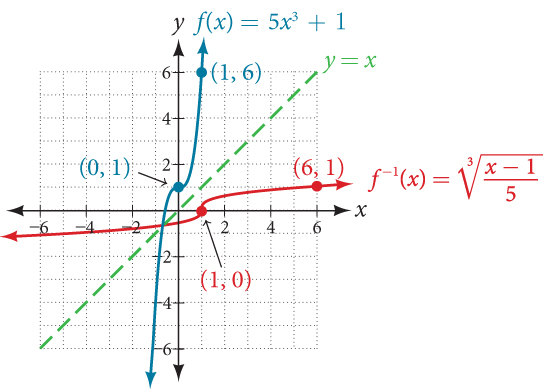
Look at the graph of and Notice that one graph is the reflection of the other about the line This is always the case when graphing a function and its inverse function.
と のグラフを見よ。一方のグラフが直線 に関する他方の鏡映になっているのに注目しよう。関数とその逆関数のグラフを描くと、つねにこうなる。
Also, since the method involved interchanging and notice corresponding points. If is on the graph of then is on the graph of Since is on the graph of then is on the graph of Similarly, since is on the graph of then is on the graph of See Figure 4.
また、この方法は と を入れ替えるものだったので、対応する点に注目しよう。 が のグラフ上にあるなら、 は のグラフ上にある。 が のグラフ上にあるので、 は のグラフ上にある。同じように、 が のグラフ上にあるので、 は のグラフ上にある。図4を見よ。
Try It #2やってみよう2
Find the inverse function of
の逆関数を求めよ。
Restricting the Domain to Find the Inverse of a Polynomial Function定義域を制限して、多項式関数の逆関数を求める
So far, we have been able to find the inverse functions of cubic functions without having to restrict their domains. However, as we know, not all cubic polynomials are one-to-one. Some functions that are not one-to-one may have their domain restricted so that they are one-to-one, but only over that domain. The function over the restricted domain would then have an inverse function. Since quadratic functions are not one-to-one, we must restrict their domain in order to find their inverses.
ここまでは、定義域を制限せずに三次関数の逆関数を求められた。だが知ってのとおり、三次の多項式がすべて一対一なわけではない。一対一でない関数の中には、定義域を制限すれば一対一になるものもある。ただし、その定義域の上でだけである。定義域を制限したその関数なら逆関数を持つ。二次関数は一対一でないので、逆関数を求めるには定義域を制限しなければならない。
Restricting the Domain 定義域の制限
If a function is not one-to-one, it cannot have an inverse. If we restrict the domain of the function so that it becomes one-to-one, thus creating a new function, this new function will have an inverse.
関数が一対一でないなら、逆関数は持てない。関数の定義域を制限して一対一にし、新しい関数を作れば、その新しい関数は逆関数を持つ。
How To 手順
Given a polynomial function, restrict the domain of a function that is not one-to-one and then find the inverse.
多項式関数が与えられたとき、一対一でない関数の定義域を制限して、その逆関数を求める。
1. Restrict the domain by determining a domain on which the original function is one-to-one.2. Replace with 3. Interchange and 4. Solve for and rename the function or pair of function 5. Revise the formula for by ensuring that the outputs of the inverse function correspond to the restricted domain of the original function.
1. 元の関数が一対一になる定義域を決めて、定義域を制限する。2. を に置き換える。3. と を入れ替える。4. について解き、その関数または関数の組を と名づけ直す。5. 逆関数の出力が元の関数の制限した定義域に対応するようにして、 の式を直す。
Example 3例3
Restricting the Domain to Find the Inverse of a Polynomial Function定義域を制限して、多項式関数の逆関数を求める
Find the inverse function of
の逆関数を求めよ。
Solution 解答
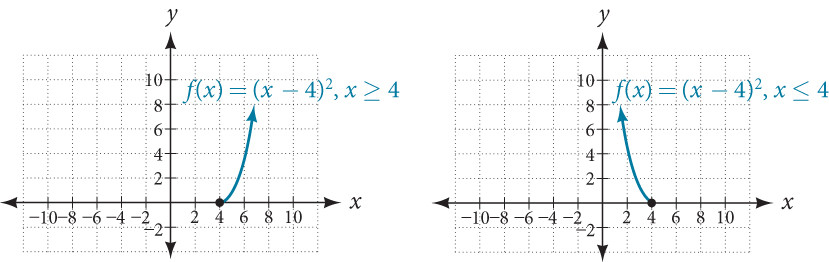
The original function is not one-to-one, but the function is restricted to a domain of or on which it is one-to-one. See Figure 5.
元の関数 は一対一ではないが、この関数は一対一になる定義域 または に制限されている。図5を見よ。
To find the inverse, start by replacing with the simple variable
逆関数を求めるために、まず を簡単な変数 に置き換える。
This is not a function as written. We need to examine the restrictions on the domain of the original function to determine the inverse. Since we reversed the roles of and for the original we looked at the domain: the values could assume. When we reversed the roles of and this gave us the values could assume. For this function, so for the inverse, we should have which is what our inverse function gives.
このままでは関数ではない。逆関数を決めるには、元の関数の定義域の制限を調べる必要がある。元の について と の役割を入れ替えたので、定義域、すなわち がとりうる値を見た。 と の役割を入れ替えると、これは がとりうる値になった。この関数では なので、逆関数では となるはずであり、実際その逆関数がそうなっている。
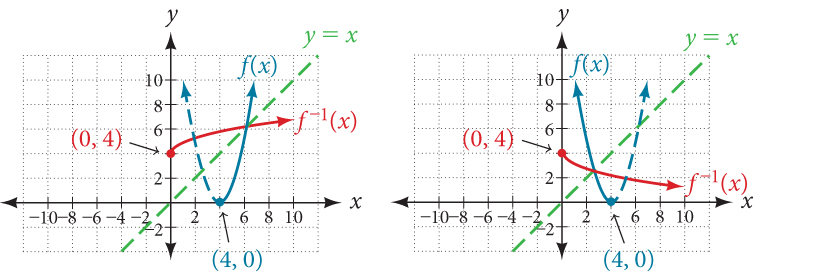
ⓐThe domain of the original function was restricted to so the outputs of the inverse need to be the same, and we must use the + case: ⓑThe domain of the original function was restricted to so the outputs of the inverse need to be the same, and we must use the – case:
ⓐ元の関数の定義域は に制限されていたので、逆関数の出力も同じ でなければならず、+ の場合を使う必要がある: ⓑ元の関数の定義域は に制限されていたので、逆関数の出力も同じ でなければならず、– の場合を使う必要がある:
Analysis 考察
On the graphs in Figure 6, we see the original function graphed on the same set of axes as its inverse function. Notice that together the graphs show symmetry about the line The coordinate pair is on the graph of and the coordinate pair is on the graph of For any coordinate pair, if is on the graph of then is on the graph of Finally, observe that the graph of intersects the graph of on the line Points of intersection for the graphs of and will always lie on the line
図6のグラフでは、元の関数とその逆関数を同じ座標軸に描いてある。二つのグラフが合わさって直線 に関する対称を示しているのに注目しよう。座標の組 は のグラフ上にあり、座標の組 は のグラフ上にある。どの座標の組についても、 が のグラフ上にあるなら、 は のグラフ上にある。最後に、 のグラフが のグラフと直線 の上で交わることに注意しよう。 と のグラフの交点は、つねに直線 の上にある。
Example 4例4
Finding the Inverse of a Quadratic Function When the Restriction Is Not Specified制限が指定されていないとき、二次関数の逆関数を求める
Restrict the domain and then find the inverse of
定義域を制限し、次の関数の逆関数を求めよ。
Solution 解答
We can see this is a parabola with vertex at that opens upward. Because the graph will be decreasing on one side of the vertex and increasing on the other side, we can restrict this function to a domain on which it will be one-to-one by limiting the domain to
これは頂点が で上に開く放物線だと分かる。グラフは頂点の片側で減り、もう片側で増えるので、定義域を に限れば、この関数を一対一になる定義域に制限できる。
To find the inverse, we will use the vertex form of the quadratic. We start by replacing with a simple variable, then solve for
逆関数を求めるために、二次関数の頂点形式を使う。まず を簡単な変数 に置き換え、それから について解く。
Now we need to determine which case to use. Because we restricted our original function to a domain of the outputs of the inverse should be the same, telling us to utilize the + case
次に、どちらの場合を使うかを決める必要がある。元の関数を定義域 に制限したので、逆関数の出力も同じでなければならず、+ の場合を使えばよいと分かる。
If the quadratic had not been given in vertex form, rewriting it into vertex form would be the first step. This way we may easily observe the coordinates of the vertex to help us restrict the domain.
二次式が頂点形式で与えられていなければ、まず頂点形式に書き直すのが最初の手順になる。そうすれば頂点の座標が簡単に見てとれ、定義域を制限するのに役立つ。
Analysis 考察
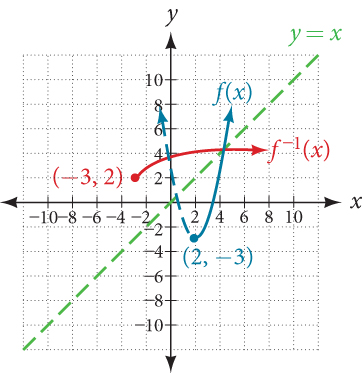
Notice that we arbitrarily decided to restrict the domain on We could just have easily opted to restrict the domain on in which case Observe the original function graphed on the same set of axes as its inverse function in Figure 7. Notice that both graphs show symmetry about the line The coordinate pair is on the graph of and the coordinate pair is on the graph of Observe from the graph of both functions on the same set of axes that
ここでは、定義域を に制限することを勝手に選んだことに注目しよう。同じくらい容易に定義域を に制限することも選べた。その場合は となる。図7で、元の関数とその逆関数を同じ座標軸に描いたものを見よ。どちらのグラフも直線 に関する対称を示している。座標の組 は のグラフ上にあり、座標の組 は のグラフ上にある。両方の関数を同じ座標軸に描いたグラフから、次が見てとれる。
and
そして
Finally, observe that the graph of intersects the graph of along the line
最後に、 のグラフが のグラフと直線 に沿って交わることに注意しよう。
Try It #3やってみよう3
Find the inverse of the function on the domain
定義域 における関数 の逆関数を求めよ。
Solving Applications of Radical Functions無理関数の応用問題を解く
Notice that the functions from previous examples were all polynomials, and their inverses were radical functions. If we want to find the inverse of a radical function, we will need to restrict the domain of the answer because the range of the original function is limited.
これまでの例の関数はどれも多項式で、その逆関数は無理関数だったことに注目しよう。無理関数の逆関数を求めたいなら、元の関数の値域が限られているので、答えの定義域を制限する必要がある。
How To 手順
Given a radical function, find the inverse.
無理関数が与えられたとき、その逆関数を求める。
1. Determine the range of the original function.2. Replace with then solve for 3. If necessary, restrict the domain of the inverse function to the range of the original function.
1. 元の関数の値域を決める。2. を に置き換え、それから について解く。3. 必要なら、逆関数の定義域を元の関数の値域に制限する。
Example 5例5
Finding the Inverse of a Radical Function無理関数の逆関数を求める
Restrict the domain of the function and then find the inverse.
関数 の定義域を制限し、その逆関数を求めよ。
Solution 解答
Note that the original function has range Replace with then solve for
元の関数の値域が であることに注意しよう。 を に置き換え、それから について解く。
Recall that the domain of this function must be limited to the range of the original function.
この関数の定義域は、元の関数の値域に限らなければならないことを思い出そう。
Analysis 考察
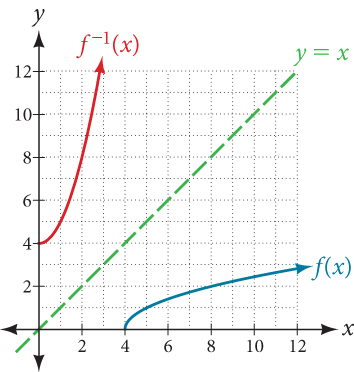
Notice in Figure 8 that the inverse is a reflection of the original function over the line Because the original function has only positive outputs, the inverse function has only positive inputs.
図8で、逆関数が元の関数を直線 で折り返したものになっているのに注目しよう。元の関数の出力は正の値だけなので、逆関数の入力も正の値だけである。
Try It #4やってみよう4
Restrict the domain and then find the inverse of the function
関数 の定義域を制限し、その逆関数を求めよ。
Solving Applications of Radical Functions無理関数の応用問題を解く
Radical functions are common in physical models, as we saw in the section opener. We now have enough tools to be able to solve the problem posed at the start of the section.
この節の初めで見たとおり、無理関数は物理のモデルによく現れる。この節の初めに立てた問題を解けるだけの道具がこれで揃った。
Example 6例6
Solving an Application with a Cubic Function三次関数の応用問題を解く
Park rangers construct a mound of gravel in the shape of a cone with the height equal to twice the radius. The volume of the cone in terms of the radius is given by
公園の管理官が、高さが半径の2倍の円錐の形に砂利を盛る。半径で表したこの円錐の体積は、次で与えられる。
Find the inverse of the function that determines the volume of a cone and is a function of the radius Then use the inverse function to calculate the radius of such a mound of gravel measuring 100 cubic feet. Use
円錐の体積 を決める、半径 の関数である関数 の逆関数を求めよ。そしてその逆関数を使って、100立方フィートの砂利の山の半径を計算せよ。 を使え。
Solution 解答
Start with the given function for Notice that the meaningful domain for the function is since negative radii would not make sense in this context nor would a radius of 0. Also note the range of the function (hence, the domain of the inverse function) is Solve for in terms of using the method outlined previously. Note that in real-world applications, we do not swap the variables when finding inverses. Instead, we change which variable is considered to be the independent variable.
与えられた の関数から始める。この文脈では負の半径も半径0も意味を持たないので、この関数の意味を持つ定義域は であることに注目しよう。この関数の値域(したがって逆関数の定義域)が であることにも注意しよう。前に述べた方法で、 を使って について解く。現実の応用では、逆関数を求めるときに変数を入れ替えないことに注意せよ。代わりに、どちらの変数を独立変数と見るかを変える。
This is the result stated in the section opener. Now evaluate this for and
これがこの節の初めに述べた結果である。次に と でこの値を求める。
Therefore, the radius is about 3.63 ft.
したがって、半径はおよそ3.63フィートである。
Determining the Domain of a Radical Function Composed with Other Functionsほかの関数と合成した無理関数の定義域を決める
When radical functions are composed with other functions, determining domain can become more complicated.
無理関数をほかの関数と合成すると、定義域を決めるのがより込み入ってくることがある。
Example 7例7
Finding the Domain of a Radical Function Composed with a Rational Function有理関数と合成した無理関数の定義域を求める
Find the domain of the function
関数 の定義域を求めよ。
Solution 解答
Because a square root is only defined when the quantity under the radical is non-negative, we need to determine where The output of a rational function can change signs (change from positive to negative or vice versa) at x-intercepts and at vertical asymptotes. For this equation, the graph could change signs at
平方根は根号の中の量が0以上のときにしか定義されないので、 となるところを決める必要がある。有理関数の出力は、x切片と垂直漸近線で符号が変わりうる(正から負、あるいはその逆になりうる)。この式では、グラフの符号が変わりうるのは である。
To determine the intervals on which the rational expression is positive, we could test some values in the expression or sketch a graph. While both approaches work equally well, for this example we will use a graph as shown in Figure 9.
この有理式が正になる区間を決めるには、式にいくつか値を入れて調べるか、グラフの概形を描けばよい。どちらの近づき方も同じくらいうまくいくが、この例では図9のようにグラフを使う。
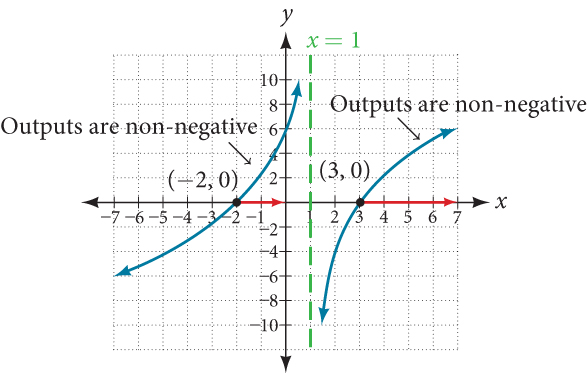
This function has two x-intercepts, both of which exhibit linear behavior near the x-intercepts. There is one vertical asymptote, corresponding to a linear factor; this behavior is similar to the basic reciprocal toolkit function, and there is no horizontal asymptote because the degree of the numerator is larger than the degree of the denominator. There is a y-intercept at
この関数には x切片が二つあり、どちらも x切片の近くで一次のふるまいを示す。垂直漸近線は一本で、一次因数に対応する。このふるまいは基本の逆数関数と似ている。分子の次数が分母の次数より大きいので、水平漸近線は無い。y切片は にある。
From the y-intercept and x-intercept at we can sketch the left side of the graph. From the behavior at the asymptote, we can sketch the right side of the graph.
y切片と の x切片から、グラフの左側の概形が描ける。漸近線でのふるまいから、グラフの右側の概形が描ける。
From the graph, we can now tell on which intervals the outputs will be non-negative, so that we can be sure that the original function will be defined. has domain or in interval notation,
このグラフから、出力が0以上になる区間、つまり元の関数 が定義されると確かめられる区間が分かる。 の定義域は 、区間の記法では である。
Finding Inverses of Rational Functions有理関数の逆関数を求める
As with finding inverses of quadratic functions, it is sometimes desirable to find the inverse of a rational function, particularly of rational functions that are the ratio of linear functions, such as in concentration applications.
二次関数の逆関数を求めるときと同じく、有理関数の逆関数を求めたいことがある。とくに、濃度の応用問題に出てくるような、一次関数の比である有理関数でそうである。
Example 8例8
Finding the Inverse of a Rational Function有理関数の逆関数を求める
The function represents the concentration of an acid solution after mL of 40% solution has been added to 100 mL of a 20% solution. First, find the inverse of the function; that is, find an expression for in terms of Then use your result to determine how much of the 40% solution should be added so that the final mixture is a 35% solution.
関数 は、20%の溶液100mLに40%の溶液を mL加えたあとの酸の溶液の濃度 を表す。まずこの関数の逆関数を求めよ。すなわち で を表す式を求めよ。そしてその結果を使って、最後の混合液が35%の溶液になるには40%の溶液をどれだけ加えればよいかを決めよ。
Solution 解答
We first want the inverse of the function in order to determine how many mL we need for a given concentration. We will solve for in terms of
与えられた濃度にするのに何mL要るかを決めたいので、まずこの関数の逆関数が要る。 を使って について解く。
Now evaluate this function at 35%, which is
次に、35%すなわち でこの関数の値を求める。
We can conclude that 300 mL of the 40% solution should be added.
40%の溶液を300mL加えればよいと結論できる。
Try It #5やってみよう5
Find the inverse of the function
関数 の逆関数を求めよ。
Media 教材
Access these online resources for additional instruction and practice with inverses and radical functions.
逆関数と無理関数についての説明と練習をさらに求めるなら、次のオンライン教材にあたるとよい。
• Graphing the Basic Square Root Function• Find the Inverse of a Square Root Function• Find the Inverse of a Rational Function• Find the Inverse of a Rational Function and an Inverse Function Value• Inverse Functions
・基本の平方根の関数のグラフを描く・平方根の関数の逆関数を求める・有理関数の逆関数を求める・有理関数の逆関数と逆関数の値を求める・逆関数
Verbal言葉で答える問題
2. Why must we restrict the domain of a quadratic function when finding its inverse?
2. 二次関数の逆関数を求めるとき、なぜ定義域を制限しなければならないのか。
4. The inverse of a quadratic function will always take what form?
4. 二次関数の逆関数は、つねにどんな形になるか。
Algebraic代数の問題
For the following exercises, find the inverse of the function on the given domain.
次の各問について、与えられた定義域でその関数の逆関数を求めよ。
For the following exercises, find the inverse of the functions.
次の各問について、その関数の逆関数を求めよ。
For the following exercises, find the inverse of the functions.
次の各問について、その関数の逆関数を求めよ。
Graphicalグラフの問題
For the following exercises, find the inverse of the function and graph both the function and its inverse.
次の各問について、その関数の逆関数を求め、関数とその逆関数の両方のグラフを描け。
For the following exercises, use a graph to help determine the domain of the functions.
次の各問について、グラフを使って関数の定義域を決めよ。
Technology機器を使う問題
For the following exercises, use a calculator to graph the function. Then, using the graph, give three points on the graph of the inverse with y-coordinates given.
次の各問について、電卓を使って関数のグラフを描け。そしてそのグラフを使い、与えられた y座標を持つ逆関数のグラフ上の点を三つ挙げよ。
Extensions発展問題
For the following exercises, find the inverse of the functions with positive real numbers.
次の各問について、 を正の実数として、その関数の逆関数を求めよ。
Real-World Applications応用問題
For the following exercises, determine the function described and then use it to answer the question.
次の各問について、述べられた関数を決め、それを使って問いに答えよ。
56. An object dropped from a height of 200 meters has a height, in meters after seconds have lapsed, such that Express as a function of height, and find the time to reach a height of 50 meters.
56. 高さ200メートルから落とした物体の 秒後の高さ (メートル)は である。 を高さ の関数として表し、高さ50メートルに達するまでの時間を求めよ。
58. The volume, of a sphere in terms of its radius, is given by Express as a function of and find the radius of a sphere with volume of 200 cubic feet.
58. 半径 で表した球の体積 は で与えられる。 を の関数として表し、体積が200立方フィートの球の半径を求めよ。
60. A container holds 100 mL of a solution that is 25 mL acid. If mL of a solution that is 60% acid is added, the function gives the concentration, as a function of the number of mL added, Express as a function of and determine the number of mL that need to be added to have a solution that is 50% acid.
60. ある容器に、酸が25mL入った溶液が100mL入っている。60%が酸の溶液を mL加えるとき、関数 は、加えたmL数 の関数として濃度 を与える。 を の関数として表し、50%が酸の溶液にするには何mL加える必要があるかを決めよ。
62. The volume of a cylinder , in terms of radius, and height, is given by If a cylinder has a height of 6 meters, express the radius as a function of and find the radius of a cylinder with volume of 300 cubic meters.
62. 半径 と高さ で表した円柱の体積 は で与えられる。円柱の高さが6メートルのとき、半径を の関数として表し、体積が300立方メートルの円柱の半径を求めよ。
63. The surface area, of a cylinder in terms of its radius, and height, is given by If the height of the cylinder is 4 feet, express the radius as a function of and find the radius if the surface area is 200 square feet.
63. 半径 と高さ で表した円柱の表面積 は で与えられる。円柱の高さが4フィートのとき、半径を の関数として表し、表面積が200平方フィートのときの半径を求めよ。
64. The volume of a right circular cone, in terms of its radius, and its height, is given by Express in terms of if the height of the cone is 12 feet and find the radius of a cone with volume of 50 cubic inches.
64. 半径 と高さ で表した直円錐の体積 は で与えられる。円錐の高さが12フィートのとき を で表し、体積が50立方インチの円錐の半径を求めよ。