第5章多項式関数と有理関数Polynomial and Rational Functions
5.5 Zeros of Polynomial Functions5.5 多項式関数の零点
Learning Objectives 学習目標
In this section, you will:
この節を終えると、次のことができるようになる。
• Evaluate a polynomial using the Remainder Theorem.• Use the Factor Theorem to solve a polynomial equation.• Use the Rational Zero Theorem to find rational zeros.• Find zeros of a polynomial function.• Use the Linear Factorization Theorem to find polynomials with given zeros.• Use Descartes’ Rule of Signs.• Solve real-world applications of polynomial equations
・剰余の定理を使って多項式の値を求める。・因数定理を使って多項式の方程式を解く。・有理根定理を使って有理数の零点を求める。・多項式関数の零点を求める。・一次因数分解定理を使って、与えられた零点を持つ多項式を求める。・デカルトの符号法則を使う。・多項式の方程式の応用問題を解く。
A new bakery offers decorated, multi-tiered cakes for display and cutting at Quinceañera and wedding celebrations, as well as sheet cakes to serve most of the guests. The bakery wants the volume of a small sheet cake to be 351 cubic inches. The cake is in the shape of a rectangular solid. They want the length of the cake to be four inches longer than the width of the cake and the height of the cake to be one-third of the width. What should the dimensions of the cake pan be?
新しくできた菓子店が、キンセアニェーラや結婚式で飾ったり切り分けたりするための、装飾された段重ねのケーキと、招待客の大半に配るためのシートケーキを売り出す。この店は、小さいシートケーキの体積を351立方インチにしたい。ケーキは直方体の形をしている。ケーキの縦は横より4インチ長く、高さは横の3分の1にしたい。ケーキ型の寸法をどうすればよいか。
This problem can be solved by writing a cubic function and solving a cubic equation for the volume of the cake. In this section, we will discuss a variety of tools for writing polynomial functions and solving polynomial equations.
この問題は、三次関数を書いて、ケーキの体積についての三次方程式を解けば解ける。この節では、多項式関数を書き、多項式の方程式を解くためのさまざまな道具を論じる。
Evaluating a Polynomial Using the Remainder Theorem剰余の定理を使って多項式の値を求める
In the last section, we learned how to divide polynomials. We can now use polynomial division to evaluate polynomials using the Remainder Theorem. If the polynomial is divided by the remainder may be found quickly by evaluating the polynomial function at that is, Let’s walk through the proof of the theorem.
前の節で多項式の割り算を学んだ。これで、剰余の定理を使い、多項式の割り算で多項式の値を求められる。多項式を で割るとき、その余りは多項式関数の での値、すなわち を求めればすぐに得られる。この定理の証明を追ってみよう。
Recall that the Division Algorithm states that, given a polynomial dividend and a non-zero polynomial divisor , there exist unique polynomials and such that
除法の定理は、割られる多項式 と、0でない多項式の割る式 が与えられたとき、次を満たす多項式 と がただ一組存在すると述べていたのを思い出そう。
and either or the degree of is less than the degree of . In practice divisors, will have degrees less than or equal to the degree of . If the divisor, is this takes the form
そして であるか、 の次数が の次数より小さいかのどちらかである。実際には、割る式 の次数は の次数以下になる。割る式 が なら、これは次の形になる。
Since the divisor is linear, the remainder will be a constant, And, if we evaluate this for we have
割る式 は一次なので、余りは定数 になる。そして でこれの値を求めると、次が得られる。
In other words, is the remainder obtained by dividing by
言い換えれば、 は を で割って得られる余りである。
The Remainder Theorem 剰余の定理
If a polynomial is divided by then the remainder is the value
多項式 を で割るとき、余りは値 である。
How To 手順
Given a polynomial function evaluate at using the Remainder Theorem.
多項式関数 が与えられたとき、剰余の定理を使って における の値を求める。
1. Use synthetic division to divide the polynomial by 2. The remainder is the value
1. 組立除法を使って、その多項式を で割る。2. 余りが値 である。
Example 1例1
Using the Remainder Theorem to Evaluate a Polynomial剰余の定理を使って多項式の値を求める
Use the Remainder Theorem to evaluate at
剰余の定理を使って、 における の値を求めよ。
Solution 解答
To find the remainder using the Remainder Theorem, use synthetic division to divide the polynomial by
剰余の定理で余りを求めるために、組立除法を使ってこの多項式を で割る。
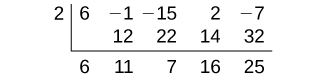
The remainder is 25. Therefore,
余りは25である。したがって である。
Analysis 考察
We can check our answer by evaluating
の値を求めれば、答えを検算できる。
Try It #1やってみよう1
Use the Remainder Theorem to evaluate at
剰余の定理を使って、 における の値を求めよ。
Using the Factor Theorem to Solve a Polynomial Equation因数定理を使って多項式の方程式を解く
The Factor Theorem is another theorem that helps us analyze polynomial equations. It tells us how the zeros of a polynomial are related to the factors. Recall that the Division Algorithm.
因数定理は、多項式の方程式を調べるのに役立つもう一つの定理である。多項式の零点が因数とどう関わるかを教えてくれる。除法の定理を思い出そう。
If is a zero, then the remainder is and or
が零点なら、余り は であり、、すなわち となる。
Notice, written in this form, is a factor of We can conclude if is a zero of then is a factor of
この形で書くと、 が の因数であることに注目しよう。 が の零点なら は の因数である、と結論できる。
Similarly, if is a factor of then the remainder of the Division Algorithm is 0. This tells us that is a zero.
同じように、 が の因数なら、除法の定理の余り は0である。これは が零点であることを教えている。
This pair of implications is the Factor Theorem. As we will soon see, a polynomial of degree in the complex number system will have zeros. We can use the Factor Theorem to completely factor a polynomial into the product of factors. Once the polynomial has been completely factored, we can easily determine the zeros of the polynomial.
この二つの含意の組が因数定理である。まもなく見るとおり、 次の多項式は複素数の範囲で 個の零点を持つ。因数定理を使えば、多項式を 個の因数の積に完全に因数分解できる。多項式を完全に因数分解してしまえば、その零点は簡単に決められる。
The Factor Theorem 因数定理
According to the Factor Theorem, is a zero of if and only if is a factor of
因数定理によれば、 が の零点であるのは、 が の因数であるとき、かつそのときに限る。
How To 手順
Given a factor and a third-degree polynomial, use the Factor Theorem to factor the polynomial.
因数と3次の多項式が与えられたとき、因数定理を使ってその多項式を因数分解する。
1. Use synthetic division to divide the polynomial by 2. Confirm that the remainder is 0.3. Write the polynomial as the product of and the quadratic quotient.4. If possible, factor the quadratic.5. Write the polynomial as the product of factors.
1. 組立除法を使って、その多項式を で割る。2. 余りが0であることを確かめる。3. その多項式を、 と二次の商の積として書く。4. できるなら、その二次式を因数分解する。5. その多項式を因数の積として書く。
Example 2例2
Using the Factor Theorem to Find the Zeros of a Polynomial Expression因数定理を使って多項式の式の零点を求める
Show that is a factor of Find the remaining factors. Use the factors to determine the zeros of the polynomial.
が の因数であることを示せ。残りの因数を求めよ。その因数を使って、この多項式の零点を決めよ。
Solution 解答
We can use synthetic division to show that is a factor of the polynomial.
組立除法を使えば、 がこの多項式の因数であることを示せる。
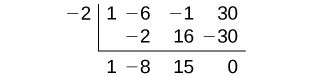
The remainder is zero, so is a factor of the polynomial. We can use the Division Algorithm to write the polynomial as the product of the divisor and the quotient:
余りは0なので、 はこの多項式の因数である。除法の定理を使えば、この多項式を割る式と商の積として書ける。
We can factor the quadratic factor to write the polynomial as
二次の因数を因数分解すれば、この多項式は次のように書ける。
By the Factor Theorem, the zeros of are –2, 3, and 5.
因数定理により、 の零点は–2、3、5である。
Try It #2やってみよう2
Use the Factor Theorem to find the zeros of given that is a factor of the polynomial.
がこの多項式の因数であるとして、因数定理を使って の零点を求めよ。
Using the Rational Zero Theorem to Find Rational Zeros有理根定理を使って有理数の零点を求める
Another use for the Remainder Theorem is to test whether a rational number is a zero for a given polynomial. But first we need a pool of rational numbers to test. The Rational Zero Theorem helps us to narrow down the number of possible rational zeros using the ratio of the factors of the constant term and factors of the leading coefficient of the polynomial
剰余の定理のもう一つの使い道は、ある有理数が与えられた多項式の零点かどうかを調べることである。だがその前に、調べる有理数の候補が要る。有理根定理は、その多項式の定数項の約数と最高次係数の約数の比を使って、ありうる有理数の零点の数を絞り込むのに役立つ。
Consider a quadratic function with two zeros, and By the Factor Theorem, these zeros have factors associated with them. Let us set each factor equal to 0, and then construct the original quadratic function absent its stretching factor.
零点を二つ と 持つ二次関数を考えよう。因数定理により、これらの零点にはそれに伴う因数がある。各因数を0とおき、そこから伸び率を除いた元の二次関数を組み立てよう。
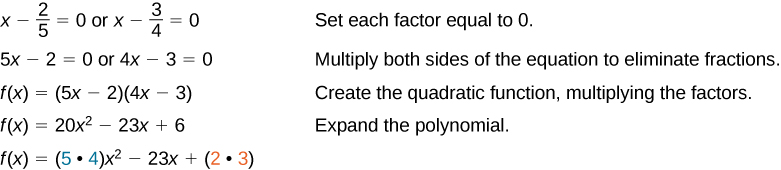
Notice that two of the factors of the constant term, 6, are the two numerators from the original rational roots: 2 and 3. Similarly, two of the factors from the leading coefficient, 20, are the two denominators from the original rational roots: 5 and 4.
定数項6の約数のうち二つが、元の有理数の根の分子2と3であることに注目しよう。同じように、最高次係数20の約数のうち二つが、元の有理数の根の分母5と4である。
We can infer that the numerators of the rational roots will always be factors of the constant term and the denominators will be factors of the leading coefficient. This is the essence of the Rational Zero Theorem; it is a means to give us a pool of possible rational zeros.
ここから、有理数の根の分子はつねに定数項の約数、分母は最高次係数の約数になると推し量れる。これが有理根定理の要点である。ありうる有理数の零点の候補を与えてくれる手立てである。
The Rational Zero Theorem 有理根の定理
The Rational Zero Theorem states that, if the polynomial has integer coefficients , then every rational zero of has the form where is a factor of the constant term and is a factor of the leading coefficient
有理根定理は、多項式 が整数の係数 を持つとき、 のどの有理数の零点も の形をしている、と述べる。ここで は定数項 の約数、 は最高次係数 の約数である。
When the leading coefficient is 1, the possible rational zeros are the factors of the constant term.
最高次係数が1のとき、ありうる有理数の零点は定数項の約数である。
How To 手順
Given a polynomial function use the Rational Zero Theorem to find rational zeros.
多項式関数 が与えられたとき、有理根定理を使って有理数の零点を求める。
1. Determine all factors of the constant term and all factors of the leading coefficient.2. Determine all possible values of where is a factor of the constant term and is a factor of the leading coefficient. Be sure to include both positive and negative candidates.3. Determine which possible zeros are actual zeros by evaluating each case of
1. 定数項の約数をすべて、最高次係数の約数をすべて求める。2. を定数項の約数、 を最高次係数の約数として、 のありうる値をすべて求める。正負の両方の候補を必ず入れること。3. の各場合の値を求めて、ありうる零点のうちどれが実際の零点かを決める。
Example 3例3
Listing All Possible Rational Zerosありうる有理数の零点をすべて挙げる
List all possible rational zeros of
のありうる有理数の零点をすべて挙げよ。
Solution 解答
The only possible rational zeros of are the quotients of the factors of the last term, –4, and the factors of the leading coefficient, 2.
のありうる有理数の零点は、定数項–4の約数と最高次係数2の約数の商だけである。
The constant term is –4; the factors of –4 are
定数項は–4である。–4の約数は である。
The leading coefficient is 2; the factors of 2 are
最高次係数は2である。2の約数は である。
If any of the four real zeros are rational zeros, then they will be of one of the following factors of –4 divided by one of the factors of 2.
四つの実の零点のうちどれかが有理数の零点なら、それは–4の約数のいずれかを2の約数のいずれかで割った、次のうちの一つになる。
Note that and which have already been listed. So we can shorten our list.
と はすでに挙がっていることに注意しよう。よってこの一覧は短くできる。
Example 4例4
Using the Rational Zero Theorem to Find Rational Zeros有理根定理を使って有理数の零点を求める
Use the Rational Zero Theorem to find the rational zeros of
有理根定理を使って、 の有理数の零点を求めよ。
Solution 解答
The Rational Zero Theorem tells us that if is a zero of then is a factor of 1 and is a factor of 2.
有理根定理は、 が の零点なら、 は1の約数、 は2の約数だと教えている。
The factors of 1 are and the factors of 2 are and The possible values for are and These are the possible rational zeros for the function. We can determine which of the possible zeros are actual zeros by substituting these values for in
1の約数は 、2の約数は と である。 のありうる値は と である。これがこの関数のありうる有理数の零点である。これらの値を の に代入すれば、ありうる零点のうちどれが実際の零点かを決められる。
Of those, are not zeros of 1 is the only rational zero of
このうち は の零点ではない。1が の唯一の有理数の零点である。
Try It #3やってみよう3
Use the Rational Zero Theorem to find the rational zeros of
有理根定理を使って、 の有理数の零点を求めよ。
Finding the Zeros of Polynomial Functions多項式関数の零点を求める
The Rational Zero Theorem helps us to narrow down the list of possible rational zeros for a polynomial function. Once we have done this, we can use synthetic division repeatedly to determine all of the zeros of a polynomial function.
有理根定理は、多項式関数のありうる有理数の零点の一覧を絞り込むのに役立つ。それができたら、組立除法を繰り返し使って、その多項式関数の零点をすべて決められる。
How To 手順
Given a polynomial function use synthetic division to find its zeros.
多項式関数 が与えられたとき、組立除法を使ってその零点を求める。
1. Use the Rational Zero Theorem to list all possible rational zeros of the function.2. Use synthetic division to evaluate a given possible zero by synthetically dividing the candidate into the polynomial. If the remainder is 0, the candidate is a zero. If the remainder is not zero, discard the candidate.3. Repeat step two using the quotient found with synthetic division. If possible, continue until the quotient is a quadratic.4. Find the zeros of the quadratic function. Two possible methods for solving quadratics are factoring and using the quadratic formula.
1. 有理根定理を使って、その関数のありうる有理数の零点をすべて挙げる。2. 組立除法で候補をその多項式に割り込ませて、ありうる零点の一つを調べる。余りが0なら、その候補は零点である。余りが0でないなら、その候補は捨てる。3. 組立除法で求めた商を使って、手順2を繰り返す。できるなら、商が二次式になるまで続ける。4. その二次関数の零点を求める。二次方程式を解く方法としては、因数分解と解の公式の二つがありうる。
Example 5例5
Finding the Zeros of a Polynomial Function with Repeated Real Zeros実の重複零点を持つ多項式関数の零点を求める
Find the zeros of
の零点を求めよ。
Solution 解答
The Rational Zero Theorem tells us that if is a zero of then is a factor of –1 and is a factor of 4.
有理根定理は、 が の零点なら、 は–1の約数、 は4の約数だと教えている。
The factors of are and the factors of are and The possible values for are and These are the possible rational zeros for the function. We will use synthetic division to evaluate each possible zero until we find one that gives a remainder of 0. Let’s begin with 1.
の約数は 、 の約数は と である。 のありうる値は と である。これがこの関数のありうる有理数の零点である。余りが0になるものが見つかるまで、組立除法でありうる零点を一つずつ調べる。1から始めよう。

Dividing by gives a remainder of 0, so 1 is a zero of the function. The polynomial can be written as
で割ると余りが0になるので、1はこの関数の零点である。この多項式は次のように書ける。
The quadratic is a perfect square. can be written as
この二次式は完全平方である。 は次のように書ける。
We already know that 1 is a zero. The other zero will have a multiplicity of 2 because the factor is squared. To find the other zero, we can set the factor equal to 0.
1が零点であることはすでに分かっている。もう一つの零点は、因数が2乗されているので重複度2になる。もう一つの零点を求めるには、その因数を0とおけばよい。
The zeros of the function are 1 and with multiplicity 2.
この関数の零点は1と、重複度2の である。
Analysis 考察
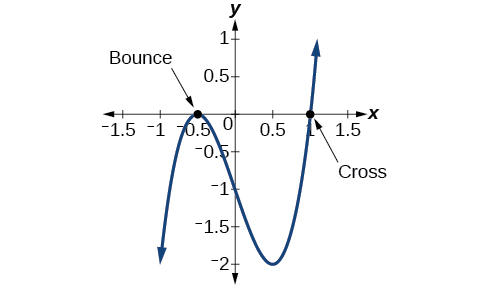
Look at the graph of the function in Figure 1. Notice, at the graph bounces off the x-axis, indicating the even multiplicity (2,4,6…) for the zero At the graph crosses the x-axis, indicating the odd multiplicity (1,3,5…) for the zero
図1の関数 のグラフを見よ。 でグラフが x軸から跳ね返っており、零点 の重複度が偶数(2、4、6…)であることを示している。 ではグラフが x軸を横切っており、零点 の重複度が奇数(1、3、5…)であることを示している。
Using the Fundamental Theorem of Algebra代数学の基本定理を使う
Now that we can find rational zeros for a polynomial function, we will look at a theorem that discusses the number of complex zeros of a polynomial function. The Fundamental Theorem of Algebra tells us that every polynomial function has at least one complex zero. This theorem forms the foundation for solving polynomial equations.
多項式関数の有理数の零点が求められるようになったので、多項式関数の複素数の零点の数を論じる定理を見よう。代数学の基本定理は、どの多項式関数も少なくとも一つ複素数の零点を持つと教えている。この定理が、多項式の方程式を解くことの土台をなす。
Suppose is a polynomial function of degree four, and The Fundamental Theorem of Algebra states that there is at least one complex solution, call it By the Factor Theorem, we can write as a product of and a polynomial quotient. Since is linear, the polynomial quotient will be of degree three. Now we apply the Fundamental Theorem of Algebra to the third-degree polynomial quotient. It will have at least one complex zero, call it So we can write the polynomial quotient as a product of and a new polynomial quotient of degree two. Continue to apply the Fundamental Theorem of Algebra until all of the zeros are found. There will be four of them and each one will yield a factor of
を4次の多項式関数とし、 とする。代数学の基本定理は、複素数の解が少なくとも一つあると述べる。それを とする。因数定理により、 は と多項式の商の積として書ける。 は一次なので、その多項式の商は3次になる。次に、この3次の多項式の商に代数学の基本定理を当てはめる。それは少なくとも一つ複素数の零点を持つ。それを とする。よってこの多項式の商は、 と2次の新しい多項式の商の積として書ける。零点がすべて求まるまで、代数学の基本定理を当てはめ続ける。零点は四つあり、それぞれが の因数を一つ生む。
The Fundamental Theorem of Algebra 代数学の基本定理
The Fundamental Theorem of Algebra states that, if is a polynomial of degree n > 0, then has at least one complex zero.
代数学の基本定理は、 が n > 0 次の多項式なら、 は少なくとも一つ複素数の零点を持つ、と述べる。
We can use this theorem to argue that, if is a polynomial of degree and is a non-zero real number, then has exactly linear factors
この定理を使えば、 が 次の多項式で が0でない実数なら、 はちょうど 個の一次因数を持つと論じられる。
where are complex numbers. Therefore, has roots if we allow for multiplicities.
ここで は複素数である。したがって、重複を許せば は 個の根を持つ。
Q&A 疑問と答え
Does every polynomial have at least one imaginary zero?
どの多項式も、少なくとも一つ虚数の零点を持つか。
No. Real numbers are a subset of complex numbers, but not the other way around. A complex number is not necessarily imaginary. Real numbers are also complex numbers.
いいえ。実数は複素数の部分集合だが、逆は成り立たない。複素数は必ずしも虚数ではない。実数もまた複素数である。
Example 6例6
Finding the Zeros of a Polynomial Function with Complex Zeros複素数の零点を持つ多項式関数の零点を求める
Find the zeros of
の零点を求めよ。
Solution 解答
The Rational Zero Theorem tells us that if is a zero of then is a factor of 3 and is a factor of 3.
有理根定理は、 が の零点なら、 は3の約数、 は3の約数だと教えている。
The factors of 3 are and The possible values for and therefore the possible rational zeros for the function, are We will use synthetic division to evaluate each possible zero until we find one that gives a remainder of 0. Let’s begin with –3.
3の約数は と である。 のありうる値、すなわちこの関数のありうる有理数の零点は である。余りが0になるものが見つかるまで、組立除法でありうる零点を一つずつ調べる。–3から始めよう。

Dividing by gives a remainder of 0, so –3 is a zero of the function. The polynomial can be written as
で割ると余りが0になるので、–3はこの関数の零点である。この多項式は次のように書ける。
We can then set the quadratic equal to 0 and solve to find the other zeros of the function.
次にこの二次式を0とおいて解けば、この関数の残りの零点が求まる。
The zeros of are –3 and
の零点は–3と である。
Analysis 考察
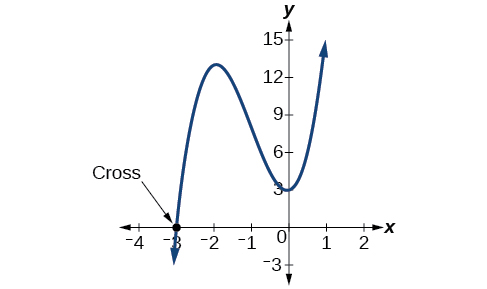
Look at the graph of the function in Figure 2. Notice that, at the graph crosses the x-axis, indicating an odd multiplicity (1) for the zero Also note the presence of the two turning points. This means that, since there is a 3rd degree polynomial, we are looking at the maximum number of turning points. So, the end behavior of increasing without bound to the right and decreasing without bound to the left will continue. Thus, all the x-intercepts for the function are shown. So either the multiplicity of is 1 and there are two complex solutions, which is what we found, or the multiplicity at is three. Either way, our result is correct.
図2の関数 のグラフを見よ。 でグラフが x軸を横切っており、零点 の重複度が奇数(1)であることを示している。折り返しの点が二つあることにも注意しよう。3次の多項式なので、これは折り返しの点の最大の数だということである。よって、右で限りなく増え、左で限りなく減るという端のふるまいはこのまま続く。したがって、この関数の x切片はすべて示されている。よって、 の重複度が1で複素数の解が二つある(これが求めたもの)か、 での重複度が3であるかのどちらかである。どちらにせよ、この結果は正しい。
Try It #4やってみよう4
Find the zeros of
の零点を求めよ。
Using the Linear Factorization Theorem to Find Polynomials with Given Zeros一次因数分解定理を使って、与えられた零点を持つ多項式を求める
A vital implication of the Fundamental Theorem of Algebra, as we stated above, is that a polynomial function of degree will have zeros in the set of complex numbers, if we allow for multiplicities. This means that we can factor the polynomial function into factors. The Linear Factorization Theorem tells us that a polynomial function will have the same number of factors as its degree, and that each factor will be in the form where is a complex number.
上で述べたとおり、代数学の基本定理の重要な帰結は、 次の多項式関数は、重複を許せば複素数の集合の中に 個の零点を持つということである。つまりその多項式関数は 個の因数に分解できる。一次因数分解定理は、多項式関数はその次数と同じ数の因数を持ち、各因数は の形になる( は複素数)と教えている。
Let be a polynomial function with real coefficients, and suppose is a zero of Then, by the Factor Theorem, is a factor of For to have real coefficients, must also be a factor of This is true because any factor other than when multiplied by will leave imaginary components in the product. Only multiplication with conjugate pairs will eliminate the imaginary parts and result in real coefficients. In other words, if a polynomial function with real coefficients has a complex zero then the complex conjugate must also be a zero of This is called the Complex Conjugate Theorem.
を実数の係数を持つ多項式関数とし、 が の零点だとする。すると因数定理により、 は の因数である。 が実数の係数を持つためには、 もまた の因数でなければならない。 以外のどの因数も、 と掛け合わせると積に虚数の成分が残るからである。共役な組との掛け算だけが虚部を消し、実数の係数をもたらす。言い換えれば、実数の係数を持つ多項式関数 が複素数の零点 を持つなら、その複素共役 もまた の零点でなければならない。これを共役複素数の定理という。
A Genereal Note 重要事項
Complex Conjugate Theorem共役複素数の定理
According to the Linear Factorization Theorem, a polynomial function will have the same number of factors as its degree, and each factor will be in the form , where is a complex number.
一次因数分解定理によれば、多項式関数はその次数と同じ数の因数を持ち、各因数は の形になる。ここで は複素数である。
If the polynomial function has real coefficients and a complex zero in the form then the complex conjugate of the zero, is also a zero.
多項式関数 が実数の係数を持ち、 の形の複素数の零点を持つなら、その零点の複素共役 もまた零点である。
How To 手順
Given the zeros of a polynomial function and a point (c, f(c)) on the graph of use the Linear Factorization Theorem to find the polynomial function.
多項式関数 の零点と、 のグラフ上の点 (c, f(c)) が与えられたとき、一次因数分解定理を使ってその多項式関数を求める。
1. Use the zeros to construct the linear factors of the polynomial.2. Multiply the linear factors to expand the polynomial.3. Substitute into the function to determine the leading coefficient.4. Simplify.
1. 零点を使って、その多項式の一次因数を組み立てる。2. 一次因数を掛けて、その多項式を展開する。3. をこの関数に代入して、最高次係数を決める。4. 簡単にする。
Example 7例7
Using the Linear Factorization Theorem to Find a Polynomial with Given Zeros一次因数分解定理を使って、与えられた零点を持つ多項式を求める
Find a fourth degree polynomial with real coefficients that has zeros of –3, 2, such that
実数の係数を持ち、零点が–3、2、 で、 を満たす4次の多項式を求めよ。
Solution 解答
Because is a zero, by the Complex Conjugate Theorem is also a zero. The polynomial must have factors of and Since we are looking for a degree 4 polynomial, and now have four zeros, we have all four factors. Let’s begin by multiplying these factors.
が零点なので、共役複素数の定理により も零点である。この多項式は と を因数に持たなければならない。求めるのは4次の多項式で、零点が四つ揃ったので、因数も四つ揃った。まずこれらの因数を掛けよう。
We need to find a to ensure Substitute and into
となるように a を求める必要がある。 と を に代入する。
So the polynomial function is
よって、この多項式関数は次のようになる。
or
すなわち
Analysis 考察
We found that both and were zeros, but only one of these zeros needed to be given. If is a zero of a polynomial with real coefficients, then must also be a zero of the polynomial because is the complex conjugate of
も も零点だと分かったが、与えられる必要があったのはこのうち一つだけである。実数の係数を持つ多項式の零点が なら、 は の複素共役なので、 もまたその多項式の零点でなければならない。
Q&A 疑問と答え
If were given as a zero of a polynomial with real coefficients, would also need to be a zero?
実数の係数を持つ多項式の零点として が与えられたら、 も零点でなければならないか。
Yes. When any complex number with an imaginary component is given as a zero of a polynomial with real coefficients, the conjugate must also be a zero of the polynomial.
そうである。虚部を持つ複素数が、実数の係数を持つ多項式の零点として与えられたなら、その共役もまたその多項式の零点でなければならない。
Try It #5やってみよう5
Find a third degree polynomial with real coefficients that has zeros of 5 and such that
実数の係数を持ち、零点が5と で、 を満たす3次の多項式を求めよ。
Using Descartes’ Rule of Signsデカルトの符号法則を使う
There is a straightforward way to determine the possible numbers of positive and negative real zeros for any polynomial function. If the polynomial is written in descending order, Descartes’ Rule of Signs tells us of a relationship between the number of sign changes in and the number of positive real zeros. For example, the polynomial function below has one sign change.
どの多項式関数についても、正の実の零点と負の実の零点のありうる個数を決める、まっすぐな方法がある。多項式が次数の高い順に書かれているとき、デカルトの符号法則は、 の符号の変わる回数と正の実の零点の数の関係を教えてくれる。たとえば、次の多項式関数では符号が1回変わる。

This tells us that the function must have 1 positive real zero.
これは、この関数が正の実の零点をちょうど1個持たなければならないと教えている。
There is a similar relationship between the number of sign changes in and the number of negative real zeros.
の符号の変わる回数と負の実の零点の数のあいだにも、同じような関係がある。

In this case, has 3 sign changes. This tells us that could have 3 or 1 negative real zeros.
この場合、 では符号が3回変わる。これは、 が負の実の零点を3個または1個持ちうると教えている。
Descartes’ Rule of Signs デカルトの符号則
According to Descartes’ Rule of Signs, if we let be a polynomial function with real coefficients:
デカルトの符号法則によれば、 を実数の係数を持つ多項式関数とすると、次が成り立つ。
• The number of positive real zeros is either equal to the number of sign changes of or is less than the number of sign changes by an even integer.• The number of negative real zeros is either equal to the number of sign changes of or is less than the number of sign changes by an even integer.
・正の実の零点の数は、 の符号の変わる回数に等しいか、それより偶数だけ少ない。・負の実の零点の数は、 の符号の変わる回数に等しいか、それより偶数だけ少ない。
Example 8例8
Using Descartes’ Rule of Signsデカルトの符号法則を使う
Use Descartes’ Rule of Signs to determine the possible numbers of positive and negative real zeros for
デカルトの符号法則を使って、 の正の実の零点と負の実の零点のありうる個数を決めよ。
Solution 解答
Begin by determining the number of sign changes.
まず、符号の変わる回数を決める。

There are two sign changes, so there are either 2 or 0 positive real roots. Next, we examine to determine the number of negative real roots.
符号は2回変わるので、正の実の根は2個か0個である。次に を調べて、負の実の根の数を決める。

Again, there are two sign changes, so there are either 2 or 0 negative real roots.
ここでも符号は2回変わるので、負の実の根は2個か0個である。
There are four possibilities, as we can see in Table 1.
表1で見てとれるとおり、四つの場合がありうる。
| Positive Real Zeros正の実の零点 | Negative Real Zeros負の実の零点 | Complex Zeros複素数の零点 | Total Zeros零点の総数 |
|---|---|---|---|
| 2 | 2 | 0 | 4 |
| 2 | 0 | 2 | 4 |
| 0 | 2 | 2 | 4 |
| 0 | 0 | 4 | 4 |
Analysis 考察
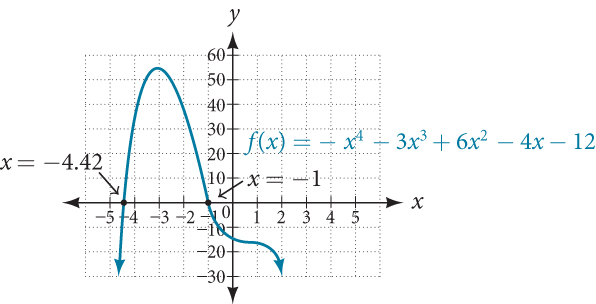
We can confirm the numbers of positive and negative real roots by examining a graph of the function. See Figure 5. We can see from the graph that the function has 0 positive real roots and 2 negative real roots.
この関数のグラフを調べれば、正と負の実の根の数を確かめられる。図5を見よ。グラフから、この関数は正の実の根を0個、負の実の根を2個持つと分かる。
Try It #6やってみよう6
Use Descartes’ Rule of Signs to determine the maximum possible numbers of positive and negative real zeros for Use a graph to verify the numbers of positive and negative real zeros for the function.
デカルトの符号法則を使って、 の正の実の零点と負の実の零点のありうる最大の個数を決めよ。グラフを使って、この関数の正と負の実の零点の数を確かめよ。
Solving Real-World Applications応用問題を解く
We have now introduced a variety of tools for solving polynomial equations. Let’s use these tools to solve the bakery problem from the beginning of the section.
多項式の方程式を解くさまざまな道具をここまでに導入した。この道具を使って、この節の初めの菓子店の問題を解こう。
Example 9例9
Solving Polynomial Equations多項式の方程式を解く
A new bakery offers decorated, multi-tiered cakes for display and cutting at Quinceañera and wedding celebrations, as well as sheet cakes to serve most of the guests. The bakery wants the volume of a small sheet cake to be 351 cubic inches. The cake is in the shape of a rectangular solid. They want the length of the cake to be four inches longer than the width of the cake and the height of the cake to be one-third of the width. What should the dimensions of the cake pan be?
新しくできた菓子店が、キンセアニェーラや結婚式で飾ったり切り分けたりするための、装飾された段重ねのケーキと、招待客の大半に配るためのシートケーキを売り出す。この店は、小さいシートケーキの体積を351立方インチにしたい。ケーキは直方体の形をしている。ケーキの縦は横より4インチ長く、高さは横の3分の1にしたい。ケーキ型の寸法をどうすればよいか。
Solution 解答
Begin by writing an equation for the volume of the cake. The volume of a rectangular solid is given by We were given that the length must be four inches longer than the width, so we can express the length of the cake as We were given that the height of the cake is one-third of the width, so we can express the height of the cake as Let’s write the volume of the cake in terms of width of the cake.
まずケーキの体積の方程式を書く。直方体の体積は で与えられる。縦は横より4インチ長くしなければならないと与えられているので、ケーキの縦は と表せる。ケーキの高さは横の3分の1だと与えられているので、ケーキの高さは と表せる。ケーキの体積をケーキの横で表そう。
Substitute the given volume into this equation.
与えられた体積をこの方程式に代入する。
Descartes' rule of signs tells us there is one positive solution. The Rational Zero Theorem tells us that the possible rational zeros are and We can use synthetic division to test these possible zeros. Only positive numbers make sense as dimensions for a cake, so we need not test any negative values. Let’s begin by testing values that make the most sense as dimensions for a small sheet cake. Use synthetic division to check
デカルトの符号法則は、正の解が一つあると教えている。有理根定理は、ありうる有理数の零点が と だと教えている。組立除法を使って、このありうる零点を試せる。ケーキの寸法として意味を持つのは正の数だけなので、負の値を試す必要は無い。まず、小さいシートケーキの寸法として最も理にかなう値から試そう。組立除法で を調べる。
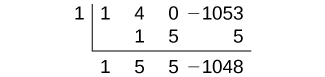
Since 1 is not a solution, we will check
1は解ではないので、次に を調べる。
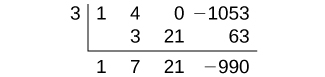
Since 3 is not a solution either, we will test
3も解ではないので、 を試す。
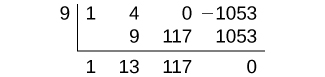
Synthetic division gives a remainder of 0, so 9 is a solution to the equation. We can use the relationships between the width and the other dimensions to determine the length and height of the sheet cake pan.
組立除法の余りは0なので、9はこの方程式の解である。横とほかの寸法の関係を使えば、シートケーキ型の縦と高さが決められる。
The sheet cake pan should have dimensions 13 inches by 9 inches by 3 inches.
シートケーキ型の寸法は、13インチ×9インチ×3インチにすればよい。
Try It #7やってみよう7
A shipping container in the shape of a rectangular solid must have a volume of 84 cubic meters. The client tells the manufacturer that, because of the contents, the length of the container must be one meter longer than the width, and the height must be one meter greater than twice the width. What should the dimensions of the container be?
直方体の形の輸送用コンテナの体積を84立方メートルにしなければならない。中身の都合で、コンテナの縦は横より1メートル長く、高さは横の2倍より1メートル大きくしてほしいと、客が製造元に伝えている。このコンテナの寸法をどうすればよいか。
Media 教材
Access these online resources for additional instruction and practice with zeros of polynomial functions.
多項式関数の零点についての説明と練習をさらに求めるなら、次のオンライン教材にあたるとよい。
• Real Zeros, Factors, and Graphs of Polynomial Functions• Complex Factorization Theorem• Find the Zeros of a Polynomial Function• Find the Zeros of a Polynomial Function 2• Find the Zeros of a Polynomial Function 3
・多項式関数の実の零点、因数、グラフ・複素数の因数分解定理・多項式関数の零点を求める・多項式関数の零点を求める 2・多項式関数の零点を求める 3
Verbal言葉で答える問題
2. Explain why the Rational Zero Theorem does not guarantee finding zeros of a polynomial function.
2. 有理根定理が、多項式関数の零点を求められると保証しないのはなぜかを説明せよ。
4. If Descartes’ Rule of Signs reveals a no change of signs or one sign of changes, what specific conclusion can be drawn?
4. デカルトの符号法則で、符号が変わらない、あるいは1回だけ変わると分かったとき、どんな結論が具体的に導けるか。
Algebraic代数の問題
For the following exercises, use the Remainder Theorem to find the remainder.
次の各問について、剰余の定理を使って余りを求めよ。
For the following exercises, use the given factor and the Factor Theorem to find all real zeros for the given polynomial function.
次の各問について、与えられた因数と因数定理を使って、与えられた多項式関数の実の零点をすべて求めよ。
For the following exercises, use the Rational Zero Theorem to find the real solution(s) to each equation.
次の各問について、有理根定理を使って各方程式の実の解を求めよ。
For the following exercises, find all complex solutions (real and non-real).
次の各問について、複素数の解(実数と非実数)をすべて求めよ。
Graphicalグラフの問題
For the following exercises, use Descartes’ Rule to determine the possible number of positive and negative solutions. Confirm with the given graph.
次の各問について、デカルトの法則を使って正の解と負の解のありうる個数を決めよ。与えられたグラフで確かめよ。
Numeric数値の問題
For the following exercises, list all possible rational zeros for the functions.
次の各問について、その関数のありうる有理数の零点をすべて挙げよ。
Technology機器を使う問題
For the following exercises, use your calculator to graph the polynomial function. Based on the graph, find the rational zeros. All real solutions are rational.
次の各問について、電卓を使って多項式関数のグラフを描け。そのグラフをもとに、有理数の零点を求めよ。実の解はすべて有理数である。
Extensions発展問題
For the following exercises, construct a polynomial function of least degree possible using the given information.
次の各問について、与えられた情報を使って、ありうる最小の次数の多項式関数を組み立てよ。
66. Real roots: –1, 1, 3 and
66. 実の根: –1、1、3、そして
68. Real roots: –2, (with multiplicity 2) and
68. 実の根: –2、(重複度2)、そして
70. Real roots: –4, –1, 1, 4 and
70. 実の根: –4、–1、1、4、そして
Real-World Applications応用問題
For the following exercises, find the dimensions of the box described.
次の各問について、述べられた箱の寸法を求めよ。
72. The length, width, and height are consecutive whole numbers. The volume is 120 cubic inches.
72. 縦、横、高さは連続する整数である。体積は120立方インチである。
74. The length is three times the height and the height is one inch less than the width. The volume is 108 cubic inches.
74. 縦は高さの3倍で、高さは横より1インチ小さい。体積は108立方インチである。
For the following exercises, find the dimensions of the right circular cylinder described.
次の各問について、述べられた直円柱の寸法を求めよ。
76. The radius is 3 inches more than the height. The volume is cubic meters.
76. 半径は高さより3インチ大きい。体積は 立方メートルである。
78. The radius and height differ by one meter. The radius is larger and the volume is cubic meters.
78. 半径と高さは1メートル違う。半径のほうが大きく、体積は 立方メートルである。
80. The radius is meter greater than the height. The volume is cubic meters.
80. 半径は高さより メートル大きい。体積は 立方メートルである。