第5章多項式関数と有理関数Polynomial and Rational Functions
Determining End Behavior端のふるまいを決める
As we have already learned, the behavior of a graph of a polynomial function of the form
すでに学んだとおり、次の形の多項式関数のグラフの特徴は、
will either ultimately rise or fall as increases without bound and will either rise or fall as decreases without bound. This is because for very large inputs, say 100 or 1,000, the leading term dominates the size of the output. The same is true for very small inputs, say –100 or –1,000.
が限りなく大きくなるとき最終的に上がるか下がるかのどちらかであり、 が限りなく小さくなるときも上がるか下がるかのどちらかである。100や1,000のようなとても大きな入力では、最高次の項が出力の大きさを支配するからである。–100や–1,000のようなとても小さな入力でも同じである。
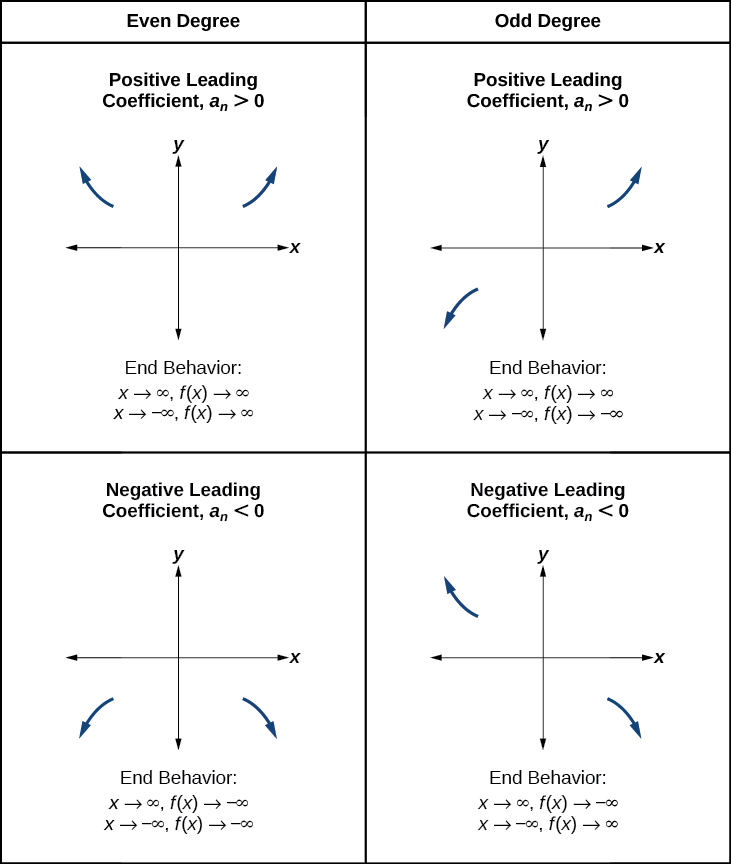
Recall that we call this behavior the end behavior of a function. As we pointed out when discussing quadratic equations, when the leading term of a polynomial function, is an even power function, as increases or decreases without bound, increases without bound. When the leading term is an odd power function, as decreases without bound, also decreases without bound; as increases without bound, also increases without bound. If the leading term is negative, it will change the direction of the end behavior. Figure 11 summarizes all four cases.
このふるまいを関数の端のふるまいと呼んだのを思い出そう。二次方程式のところで指摘したとおり、多項式関数の最高次の項 が偶数乗の累乗関数なら、 が限りなく大きくなっても小さくなっても、 は限りなく大きくなる。最高次の項が奇数乗の累乗関数なら、 が限りなく小さくなるとき も限りなく小さくなり、 が限りなく大きくなるとき も限りなく大きくなる。最高次の項が負なら、端のふるまいの向きが逆になる。図11に四つの場合をすべてまとめた。