第5章多項式関数と有理関数Polynomial and Rational Functions
5.2 Power Functions and Polynomial Functions5.2 累乗関数と多項式関数
Learning Objectives 学習目標
In this section, you will:
この節を終えると、次のことができるようになる。
• Identify power functions.• Identify end behavior of power functions.• Identify polynomial functions.• Identify the degree and leading coefficient of polynomial functions.
・累乗関数を見分ける。・累乗関数の端のふるまいを見分ける。・多項式関数を見分ける。・多項式関数の次数と最高次係数を見分ける。

Suppose a certain species of bird thrives on a small island. Its population over the last few years is shown in Table 1.
ある種の鳥が小さな島でよく育っているとしよう。ここ数年の個体数を表1に示す。
| Year年 | |||||
| Bird Population鳥の個体数 |
The population can be estimated using the function where represents the bird population on the island years after 2009. We can use this model to estimate the maximum bird population and when it will occur. We can also use this model to predict when the bird population will disappear from the island. In this section, we will examine functions that we can use to estimate and predict these types of changes.
この個体数は関数 で見積もれる。ここで は2009年から 年後の島の鳥の個体数を表す。このモデルを使えば、鳥の個体数の最大値と、それがいつ起きるかを見積もれる。このモデルは、鳥が島から消える時期の予測にも使える。この節では、こうした変化を見積もり予測するのに使える関数を調べる。
Identifying Power Functions累乗関数を見分ける
Before we can understand the bird problem, it will be helpful to understand a different type of function. A power function is a function with a single term that is the product of a real number, a coefficient, and a variable raised to a fixed real number.
鳥の問題を理解する前に、別の型の関数を理解しておくと役に立つ。累乗関数とは、実数の係数と、決まった実数の乗数に上げた変数との積である項が一つだけの関数である。
As an example, consider functions for area or volume. The function for the area of a circle with radius is
例として、面積や体積の関数を考えよう。半径 の円の面積の関数は次のとおりである。
and the function for the volume of a sphere with radius is
そして半径 の球の体積の関数は次のとおりである。
Both of these are examples of power functions because they consist of a coefficient, or multiplied by a variable raised to a power.
どちらも累乗関数の例である。係数 または に、乗数に上げた変数 を掛けたものだからである。
Power Function 累乗関数
A power function is a function that can be represented in the form
累乗関数とは、次の形で表せる関数である。
where and are real numbers, and is known as the coefficient.
ここで と は実数で、 を係数という。
Q&A 疑問と答え
Is a power function?
は累乗関数か。
No. A power function contains a variable base raised to a fixed power. This function has a constant base raised to a variable power. This is called an exponential function, not a power function.
違う。累乗関数は、変数の底を決まった乗数に上げたものを含む。この関数は定数の底を変数の乗数に上げている。これは指数関数といい、累乗関数ではない。
Example 1例1
Identifying Power Functions累乗関数を見分ける
Which of the following functions are power functions?
次の関数のうち、累乗関数はどれか。
Solution 解答
All of the listed functions are power functions.
並べた関数はすべて累乗関数である。
The constant and identity functions are power functions because they can be written as and respectively.
定数関数と恒等関数は、それぞれ と と書けるので累乗関数である。
The quadratic and cubic functions are power functions with whole number powers and
二次関数と三次関数は、乗数が非負整数 と の累乗関数である。
The reciprocal and reciprocal squared functions are power functions with negative whole number powers because they can be written as and
逆数の関数と逆数の二乗の関数は、 と と書けるので、乗数が負の整数の累乗関数である。
The square and cube root functions are power functions with fractional powers because they can be written as or
平方根の関数と三乗根の関数は、 や と書けるので、乗数が分数の累乗関数である。
Try It #1やってみよう1
Which functions are power functions?
累乗関数はどれか。
Identifying End Behavior of Power Functions累乗関数の端のふるまいを見分ける
Figure 2 shows the graphs of and which are all power functions with even, positive integer powers. Notice that these graphs have similar shapes, very much like that of the quadratic function in the toolkit. However, as the power increases, the graphs flatten somewhat near the origin and become steeper away from the origin.
図2に と のグラフを示す。どれも乗数が正の偶数の累乗関数である。これらのグラフの形が、道具となる二次関数によく似ていることに注意せよ。ただし乗数が大きくなるにつれ、グラフは原点の近くでいくらか平らになり、原点から離れると急になる。
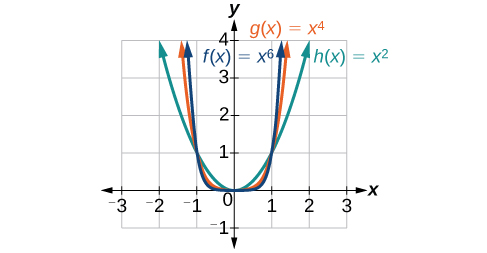
To describe the behavior as numbers become larger and larger, we use the idea of infinity. We use the symbol for positive infinity and for negative infinity. When we say that “ approaches infinity,” which can be symbolically written as we are describing a behavior; we are saying that is increasing without bound.
数がどんどん大きくなるときのふるまいを述べるために、無限という考えを使う。正の無限を 、負の無限を という記号で表す。「 が無限に近づく」といい、記号で と書くとき、それはふるまいを述べている。すなわち が限りなく増えていくということである。
With the positive even-power function, as the input increases or decreases without bound, the output values become very large, positive numbers. Equivalently, we could describe this behavior by saying that as approaches positive or negative infinity, the values increase without bound. In symbolic form, we could write
乗数が正の偶数の関数では、入力が限りなく増えても減っても、出力の値はとても大きな正の数になる。同じことを、 が正または負の無限に近づくにつれて の値が限りなく増える、とも述べられる。記号で書けば次のようになる。
Figure 3 shows the graphs of and which are all power functions with odd, whole-number powers. Notice that these graphs look similar to the cubic function in the toolkit. Again, as the power increases, the graphs flatten near the origin and become steeper away from the origin.
図3に と のグラフを示す。どれも乗数が奇数の非負整数の累乗関数である。これらのグラフが道具となる三次関数に似ていることに注意せよ。ここでも乗数が大きくなるにつれ、グラフは原点の近くで平らになり、原点から離れると急になる。
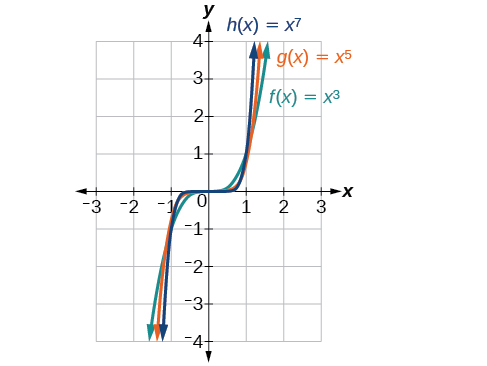
These examples illustrate that functions of the form reveal symmetry of one kind or another. First, in Figure 2 we see that even functions of the form even, are symmetric about the axis. In Figure 3 we see that odd functions of the form odd, are symmetric about the origin.
これらの例は、 の形の関数が何らかの対称性を示すことを表している。まず図2から、 が偶数である 軸に関して対称な偶関数が分かる。図3からは、 が奇数である原点に関して対称な奇関数が分かる。
For these odd power functions, as approaches negative infinity, decreases without bound. As approaches positive infinity, increases without bound. In symbolic form we write
これら奇数乗の関数では、 が負の無限に近づくにつれて は限りなく減る。 が正の無限に近づくにつれて は限りなく増える。記号で書けば次のようになる。
The behavior of the graph of a function as the input values get very small ( ) and get very large ( ) is referred to as the end behavior of the function. We can use words or symbols to describe end behavior.
入力値がとても小さくなるとき()と、とても大きくなるとき()の関数のグラフの特徴を、その関数の端のふるまいという。端のふるまいは言葉でも記号でも述べられる。
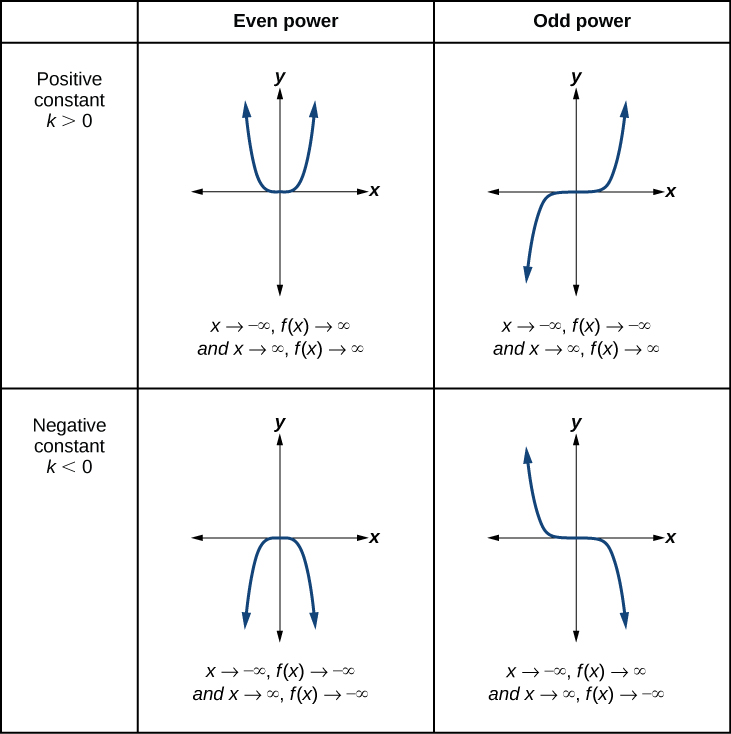
Figure 4 shows the end behavior of power functions in the form where is a non-negative integer depending on the power and the constant.
図4に、 の形の累乗関数の端のふるまいを示す。ここで は乗数と定数に応じて決まる非負整数である。
How To 手順
Given a power function where is a positive integer, identify the end behavior.
が正の整数である累乗関数 が与えられたとき、その端のふるまいを見分ける。
1. Determine whether the power is even or odd.2. Determine whether the constant is positive or negative.3. Use Figure 4 to identify the end behavior.
1. 乗数が偶数か奇数かを決める。2. 定数が正か負かを決める。3. 図4を使って端のふるまいを見分ける。
Example 2例2
Identifying the End Behavior of a Power Function累乗関数の端のふるまいを見分ける
Describe the end behavior of the graph of
のグラフの端のふるまいを述べよ。
Solution 解答
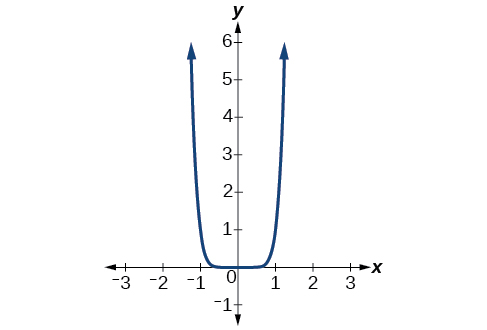
The coefficient is 1 (positive) and the exponent of the power function is 8 (an even number). As approaches infinity, the output (value of ) increases without bound. We write as As approaches negative infinity, the output increases without bound. In symbolic form, as We can graphically represent the function as shown in Figure 5.
係数は1(正)で、この累乗関数の指数は8(偶数)である。 が無限に近づくと、出力( の値)は限りなく増える。 と書く。 が負の無限に近づくときも、出力は限りなく増える。記号で書けば である。この関数を図5のようにグラフで表せる。
Example 3例3
Identifying the End Behavior of a Power Function.累乗関数の端のふるまいを見分ける。
Describe the end behavior of the graph of
のグラフの端のふるまいを述べよ。
Solution 解答
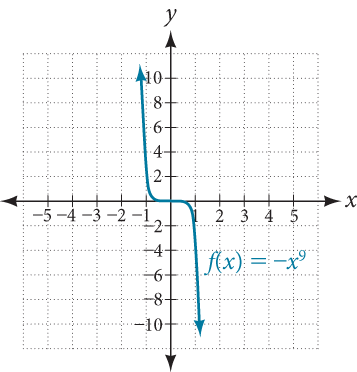
The exponent of the power function is 9 (an odd number). Because the coefficient is (negative), the graph is the reflection about the axis of the graph of Figure 6 shows that as approaches infinity, the output decreases without bound. As approaches negative infinity, the output increases without bound. In symbolic form, we would write
この累乗関数の指数は9(奇数)である。係数が (負)なので、このグラフは のグラフを 軸に関して折り返したものである。図6から、 が無限に近づくと出力は限りなく減ることが分かる。 が負の無限に近づくと、出力は限りなく増える。記号では次のように書く。
Analysis 考察
We can check our work by using the table feature on a graphing utility.
グラフ作成ツールの表の機能を使えば、答えを確かめられる。
| –10 | 1,000,000,000 |
| –5 | 1,953,125 |
| 0 | 0 |
| 5 | –1,953,125 |
| 10 | –1,000,000,000 |
We can see from Table 2 that, when we substitute very small values for the output is very large, and when we substitute very large values for the output is very small (meaning that it is a very large negative value).
表2から、 にとても小さい値を代入すると出力はとても大きくなり、 にとても大きい値を代入すると出力はとても小さくなる(すなわち絶対値の大きい負の値になる)ことが分かる。
Try It #2やってみよう2
Describe in words and symbols the end behavior of
の端のふるまいを言葉と記号で述べよ。
Identifying Polynomial Functions多項式関数を見分ける
An oil pipeline bursts in the Gulf of Mexico, causing an oil slick in a roughly circular shape. The slick is currently 24 miles in radius, but that radius is increasing by 8 miles each week. We want to write a formula for the area covered by the oil slick by combining two functions. The radius of the spill depends on the number of weeks that have passed. This relationship is linear.
メキシコ湾で石油の送管が破れ、ほぼ円い形の油膜が広がっている。油膜の半径はいま24マイルだが、その半径は毎週8マイルずつ増えている。二つの関数を組み合わせて、油膜が覆う面積の式を書きたい。油膜の半径 は、経った週数 に依る。この関係は一次である。
We can combine this with the formula for the area of a circle.
これを円の面積 の公式と組み合わせられる。
Composing these functions gives a formula for the area in terms of weeks.
この関数を合成すれば、週数を使った面積の式が得られる。
Multiplying gives the formula.
掛け合わせると、その式が出る。
This formula is an example of a polynomial function. A polynomial function consists of either zero or the sum of a finite number of non-zero terms, each of which is a product of a number, called the coefficient of the term, and a variable raised to a non-negative integer power.
この式は多項式関数の一例である。多項式関数とは、0であるか、有限個の0でない項の和であり、各項は数(その項の係数という)と、非負整数の乗数に上げた変数との積である。
Polynomial Functions 多項式関数
Let be a non-negative integer. A polynomial function is a function that can be written in the form
を非負整数とする。多項式関数とは、次の形に書ける関数である。
This is called the general form of a polynomial function. Each is a coefficient and in this section can only be a real number, but . Each expression is a term of a polynomial function.
これを多項式関数の一般形という。各 は係数で、この節では実数に限る。ただし とする。各式 が多項式関数の項である。
Example 4例4
Identifying Polynomial Functions多項式関数を見分ける
Which of the following are polynomial functions?
次のうち多項式関数はどれか。
Solution 解答
The first two functions are examples of polynomial functions because they can be written in the form where the powers are non-negative integers and the coefficients are real numbers.
はじめの二つは多項式関数の例である。乗数が非負整数で係数が実数である の形に書けるからである。
• can be written as • can be written as • cannot be written in this form and is therefore not a polynomial function.
・ は と書ける。・ は と書ける。・ はこの形に書けないので、多項式関数ではない。
Identifying the Degree and Leading Coefficient of a Polynomial Function多項式関数の次数と最高次係数を見分ける
Because of the form of a polynomial function, we can see an infinite variety in the number of terms and the power of the variable. Although the order of the terms in the polynomial function is not important for performing operations, we typically arrange the terms in descending order of power, or in general form. The degree of the polynomial is the highest power of the variable that occurs in the polynomial; it is the power of the first variable if the function is in general form. The leading term is the term containing the highest power of the variable, or the term with the highest degree. The leading coefficient is the coefficient of the leading term.
多項式関数の形からして、項の数と変数の乗数には限りない多様さがある。計算をするうえで多項式関数の項の順序は大事ではないが、ふつうは乗数の下がる順、すなわち一般形に並べる。多項式の次数とは、その多項式に現れる変数の最も高い乗数である。関数が一般形なら、それは最初の変数の乗数である。最高次の項とは、変数の最も高い乗数を含む項、すなわち次数のいちばん高い項である。最高次係数とは、最高次の項の係数である。
Terminology of Polynomial Functions 多項式関数の用語
We often rearrange polynomials so that the powers are descending.
多項式は、乗数が下がる順になるようにしばしば並べ替える。
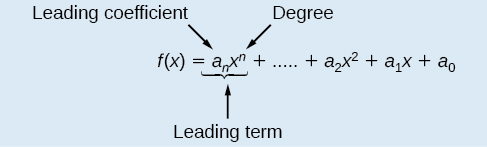
When a polynomial is written in this way, we say that it is in general form.
多項式がこのように書かれているとき、それは一般形であるという。
How To 手順
Given a polynomial function, identify the degree and leading coefficient.
多項式関数が与えられたとき、その次数と最高次係数を見分ける。
1. Find the highest power of to determine the degree of the function.2. Identify the term containing the highest power of to find the leading term.3. Identify the coefficient of the leading term.
1. の最も高い乗数を求めて、この関数の次数を決める。2. の最も高い乗数を含む項を見つけて、最高次の項を決める。3. 最高次の項の係数を見分ける。
Example 5例5
Identifying the Degree and Leading Coefficient of a Polynomial Function多項式関数の次数と最高次係数を見分ける
Identify the degree, leading term, and leading coefficient of the following polynomial functions.
次の多項式関数の次数・最高次の項・最高次係数を答えよ。
Solution 解答
For the function the highest power of is 3, so the degree is 3. The leading term is the term containing that degree, The leading coefficient is the coefficient of that term,
関数 では、 の最も高い乗数が3なので次数は3である。最高次の項はその次数を含む項 である。最高次係数はその項の係数 である。
For the function the highest power of is so the degree is The leading term is the term containing that degree, The leading coefficient is the coefficient of that term,
関数 では、 の最も高い乗数が なので次数は である。最高次の項はその次数を含む項 である。最高次係数はその項の係数 である。
For the function the highest power of is so the degree is The leading term is the term containing that degree, The leading coefficient is the coefficient of that term,
関数 では、 の最も高い乗数が なので次数は である。最高次の項はその次数を含む項 である。最高次係数はその項の係数 である。
Q&A #3疑問と答え
Identify the degree, leading term, and leading coefficient of the polynomial
多項式 の次数・最高次の項・最高次係数を答えよ。
Identifying End Behavior of Polynomial Functions多項式関数の端のふるまいを見分ける
Knowing the degree of a polynomial function is useful in helping us predict its end behavior. To determine its end behavior, look at the leading term of the polynomial function. Because the power of the leading term is the highest, that term will grow significantly faster than the other terms as gets very large or very small, so its behavior will dominate the graph. For any polynomial, the end behavior of the polynomial will match the end behavior of the power function consisting of the leading term. See Table 3.
多項式関数の次数が分かっていると、その端のふるまいを予測するのに役立つ。端のふるまいを決めるには、多項式関数の最高次の項を見ればよい。最高次の項の乗数がいちばん高いので、 がとても大きくなるかとても小さくなるとき、その項はほかの項よりずっと速く伸び、グラフを支配する。どの多項式でも、その端のふるまいは最高次の項からなる累乗関数の端のふるまいと一致する。表3を見よ。
| Polynomial Function多項式関数 | Leading Term最高次の項 | Graph of Polynomial Function多項式関数のグラフ |
|---|---|---|
Example 6例6
Identifying End Behavior and Degree of a Polynomial Function多項式関数の端のふるまいと次数を見分ける
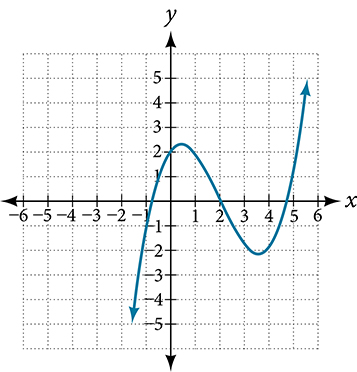
Describe the end behavior and determine a possible degree of the polynomial function in Figure 7.
図7の多項式関数について、端のふるまいを述べ、ありうる次数を決めよ。
Solution 解答
As the input values get very large, the output values increase without bound. As the input values get very small, the output values decrease without bound. We can describe the end behavior symbolically by writing
入力値 がとても大きくなると、出力値 は限りなく増える。入力値 がとても小さくなると、出力値 は限りなく減る。端のふるまいは記号で次のように書ける。
In words, we could say that as values approach infinity, the function values approach infinity, and as values approach negative infinity, the function values approach negative infinity.
言葉でいえば、 の値が無限に近づくと関数の値も無限に近づき、 の値が負の無限に近づくと関数の値も負の無限に近づく、となる。
We can tell this graph has the shape of an odd degree power function that has not been reflected, so the degree of the polynomial creating this graph must be odd and the leading coefficient must be positive.
このグラフは、折り返していない奇数次の累乗関数の形をしていると分かるので、このグラフを生む多項式の次数は奇数で、最高次係数は正でなければならない。
Try It #4やってみよう4
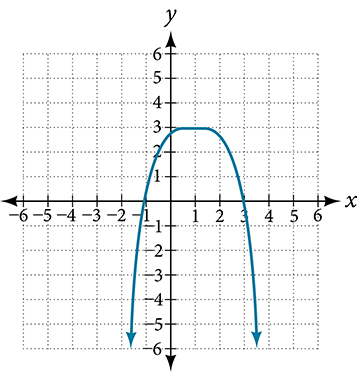
Describe the end behavior, and determine a possible degree of the polynomial function in Figure 8.
図8の多項式関数について、端のふるまいを述べ、ありうる次数を決めよ。
Example 7例7
Identifying End Behavior and Degree of a Polynomial Function多項式関数の端のふるまいと次数を見分ける
Given the function express the function as a polynomial in general form, and determine the leading term, degree, and end behavior of the function.
関数 が与えられたとき、この関数を一般形の多項式として表し、最高次の項・次数・端のふるまいを決めよ。
Solution 解答
Obtain the general form by expanding the given expression for
与えられた の式を展開して一般形を得る。
The general form is The leading term is therefore, the degree of the polynomial is 4. The degree is even (4) and the leading coefficient is negative (–3), so the end behavior is
一般形は である。最高次の項は なので、この多項式の次数は4である。次数は偶数(4)で最高次係数は負(–3)なので、端のふるまいは次のようになる。
Try It #5やってみよう5
Given the function express the function as a polynomial in general form and determine the leading term, degree, and end behavior of the function.
関数 が与えられたとき、この関数を一般形の多項式として表し、最高次の項・次数・端のふるまいを決めよ。
Identifying Local Behavior of Polynomial Functions多項式関数の局所のふるまいを見分ける
In addition to the end behavior of polynomial functions, we are also interested in what happens in the “middle” of the function. In particular, we are interested in locations where graph behavior changes. A turning point is a point at which the function values change from increasing to decreasing or decreasing to increasing.
多項式関数の端のふるまいに加えて、関数の「真ん中」で何が起きるかにも関心がある。とくにグラフの特徴が変わる場所に関心がある。折り返しの点とは、関数の値が増加から減少へ、または減少から増加へ変わる点である。
We are also interested in the intercepts. As with all functions, the y-intercept is the point at which the graph intersects the vertical axis. The point corresponds to the coordinate pair in which the input value is zero. Because a polynomial is a function, only one output value corresponds to each input value so there can be only one y-intercept The x-intercepts occur at the input values that correspond to an output value of zero. It is possible to have more than one x-intercept. See Figure 9.
切片にも関心がある。どの関数とも同じく、y切片はグラフが縦の軸と交わる点である。この点は入力値が0である座標の組に当たる。多項式は関数なので、各入力値に対応する出力値は一つしかなく、よって y切片 は一つしかありえない。x切片は、出力値が0になる入力値に現れる。x切片は二つ以上ありうる。図9を見よ。
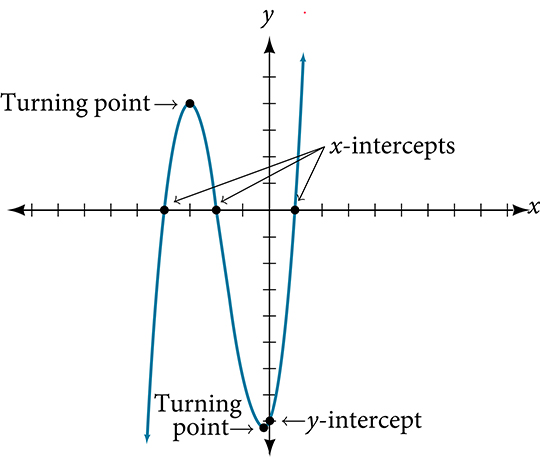
Intercepts and Turning Points of Polynomial Functions 多項式関数の切片と極値
A turning point of a graph is a point at which the graph changes direction from increasing to decreasing or decreasing to increasing. The y-intercept is the point at which the function has an input value of zero. The x-intercepts are the points at which the output value is zero.
グラフの折り返しの点とは、グラフの向きが増加から減少へ、または減少から増加へ変わる点である。y切片は、関数の入力値が0である点である。x切片は、出力値が0である点である。
How To 手順
Given a polynomial function, determine the intercepts.
多項式関数が与えられたとき、その切片を決める。
1. Determine the y-intercept by setting and finding the corresponding output value.2. Determine the x-intercepts by solving for the input values that yield an output value of zero.
1. とおいて対応する出力値を求め、y切片を決める。2. 出力値が0になる入力値を解いて、x切片を決める。
Example 8例8
Determining the Intercepts of a Polynomial Function多項式関数の切片を決める
Given the polynomial function written in factored form for your convenience, determine the y- and x-intercepts.
分かりやすいように因数分解した形で書いた多項式関数 について、y切片と x切片を求めよ。
Solution 解答
The y-intercept occurs when the input is zero so substitute 0 for
y切片は入力が0のときに現れるので、 に0を代入する。
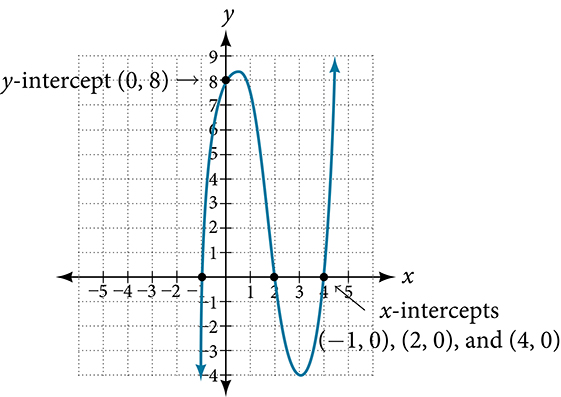
The y-intercept is (0, 8).
y切片は (0, 8) である。
The x-intercepts occur when the output is zero.
x切片は出力が0のときに現れる。
The x-intercepts are and
x切片は と である。
We can see these intercepts on the graph of the function shown in Figure 10.
図10のこの関数のグラフで、これらの切片が見てとれる。
Example 9例9
Determining the Intercepts of a Polynomial Function with Factoring因数分解して多項式関数の切片を決める
Given the polynomial function determine the y- and x-intercepts.
多項式関数 について、y切片と x切片を求めよ。
Solution 解答
The y-intercept occurs when the input is zero.
y切片は入力が0のときに現れる。
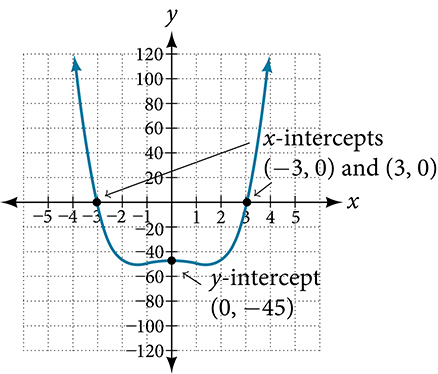
The y-intercept is
y切片は である。
The x-intercepts occur when the output is zero. To determine when the output is zero, we will need to factor the polynomial.
x切片は出力が0のときに現れる。出力が0になるときを決めるには、この多項式を因数分解する必要がある。
The x-intercepts are and
x切片は と である。
We can see these intercepts on the graph of the function shown in Figure 11. We can see that the function is even because
図11のこの関数のグラフで、これらの切片が見てとれる。 なので、この関数は偶関数だと分かる。
Try It #6やってみよう6
Given the polynomial function determine the y- and x-intercepts.
多項式関数 について、y切片と x切片を求めよ。
Comparing Smooth and Continuous Graphs滑らかなグラフと連続なグラフを比べる
The degree of a polynomial function helps us to determine the number of x-intercepts and the number of turning points. A polynomial function of degree is the product of factors, so it will have at most roots or zeros, or x-intercepts. The graph of the polynomial function of degree must have at most turning points. This means the graph has at most one fewer turning point than the degree of the polynomial or one fewer than the number of factors.
多項式関数の次数は、x切片の数と折り返しの点の数を決めるのに役立つ。 次の多項式関数は 個の因数の積なので、根すなわち零点、つまり x切片はたかだか 個である。 次の多項式関数のグラフの折り返しの点は、たかだか 個でなければならない。つまりグラフの折り返しの点は、多項式の次数、あるいは因数の数より必ず一つ少ないか、それ以下である。
A continuous function has no breaks in its graph: the graph can be drawn without lifting the pen from the paper. A smooth curve is a graph that has no sharp corners. The turning points of a smooth graph must always occur at rounded curves. The graphs of polynomial functions are both continuous and smooth.
連続な関数のグラフには切れ目が無い。紙から筆を離さずに描ける。滑らかな曲線とは、鋭い角の無いグラフである。滑らかなグラフの折り返しの点は、つねに丸みのある曲線として現れなければならない。多項式関数のグラフは連続でも滑らかでもある。
Intercepts and Turning Points of Polynomials 多項式関数の切片と極値
A polynomial of degree will have, at most, x-intercepts and turning points.
次の多項式は、x切片がたかだか 個、折り返しの点がたかだか 個である。
Example 10例10
Determining the Number of Intercepts and Turning Points of a Polynomial多項式の切片と折り返しの点の数を決める
Without graphing the function, determine the local behavior of the function by finding the maximum number of x-intercepts and turning points for
グラフを描かずに、 の x切片と折り返しの点の最大の数を求めて、この関数の局所のふるまいを決めよ。
Solution 解答
The polynomial has a degree of so there are at most 10 x-intercepts and at most 9 turning points.
この多項式の次数は なので、x切片はたかだか10個、折り返しの点はたかだか9個である。
Try It #7やってみよう7
Without graphing the function, determine the maximum number of x-intercepts and turning points for
グラフを描かずに、 の x切片と折り返しの点の最大の数を求めよ。
Example 11例11
Drawing Conclusions about a Polynomial Function from the Graphグラフから多項式関数について結論を導く
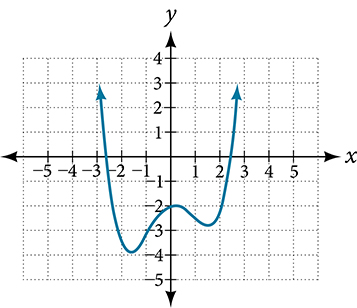
What can we conclude about the polynomial represented by the graph shown in Figure 12 based on its intercepts and turning points?
図12に示したグラフが表す多項式について、その切片と折り返しの点から何が結論できるか。
Solution 解答
The end behavior of the graph tells us this is the graph of an even-degree polynomial. See Figure 13.
グラフの端のふるまいから、これは偶数次の多項式のグラフだと分かる。図13を見よ。
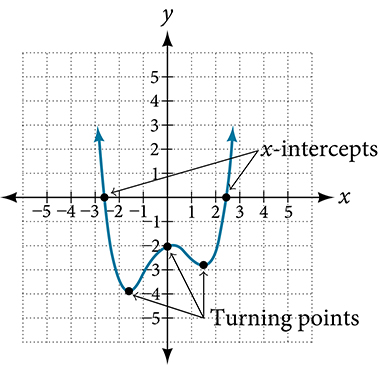
The graph has 2 x-intercepts, suggesting a degree of 2 or greater, and 3 turning points, suggesting a degree of 4 or greater. Based on this, it would be reasonable to conclude that the degree is even and at least 4.
このグラフには x切片が2個あるので次数は2以上、折り返しの点が3個あるので次数は4以上だと見込まれる。ここから、次数は偶数で少なくとも4だと結論するのが理にかなっている。
Try It #8やってみよう8
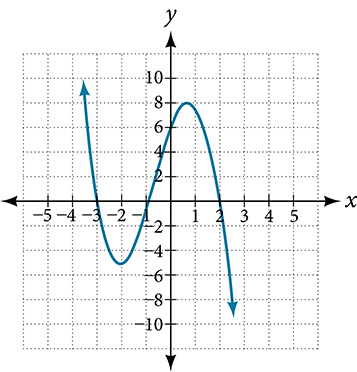
What can we conclude about the polynomial represented by the graph shown in Figure 14 based on its intercepts and turning points?
図14に示したグラフが表す多項式について、その切片と折り返しの点から何が結論できるか。
Example 12例12
Drawing Conclusions about a Polynomial Function from the Factors因数から多項式関数について結論を導く
Given the function determine the local behavior.
関数 が与えられたとき、その局所のふるまいを決めよ。
Solution 解答
The y-intercept is found by evaluating
y切片は の値を求めれば得られる。
The y-intercept is
y切片は である。
The x-intercepts are found by determining the zeros of the function.
x切片は、この関数の零点を求めれば得られる。
The x-intercepts are and
x切片は と である。
The degree is 3 so the graph has at most 2 turning points.
次数は3なので、グラフの折り返しの点はたかだか2個である。
Try It #9やってみよう9
Given the function determine the local behavior.
関数 が与えられたとき、その局所のふるまいを決めよ。
Media 教材
Access these online resources for additional instruction and practice with power and polynomial functions.
累乗関数と多項式関数についての説明と練習をさらに求めるなら、次のオンライン教材にあたるとよい。
• Find Key Information about a Given Polynomial Function• End Behavior of a Polynomial Function• Turning Points and intercepts of Polynomial Functions• Least Possible Degree of a Polynomial Function
・与えられた多項式関数の要点を求める・多項式関数の端のふるまい・多項式関数の折り返しの点と 切片・多項式関数のありうる最小の次数
Verbal言葉で答える問題
2. If a polynomial function is in factored form, what would be a good first step in order to determine the degree of the function?
2. 多項式関数が因数分解された形で与えられているとき、その次数を決めるにはまず何をするのがよいか。
4. What is the relationship between the degree of a polynomial function and the maximum number of turning points in its graph?
4. 多項式関数の次数と、そのグラフの折り返しの点の最大の数のあいだにはどんな関係があるか。
Algebraic代数の問題
For the following exercises, identify the function as a power function, a polynomial function, or neither.
次の各問について、その関数が累乗関数か、多項式関数か、どちらでもないかを答えよ。
For the following exercises, find the degree and leading coefficient for the given polynomial.
次の各問について、与えられた多項式の次数と最高次係数を求めよ。
For the following exercises, determine the end behavior of the functions.
次の各問について、関数の端のふるまいを決めよ。
For the following exercises, find the intercepts of the functions.
次の各問について、関数の切片を求めよ。
Graphicalグラフの問題
For the following exercises, determine the least possible degree of the polynomial function shown.
次の各問について、示された多項式関数のありうる最小の次数を決めよ。
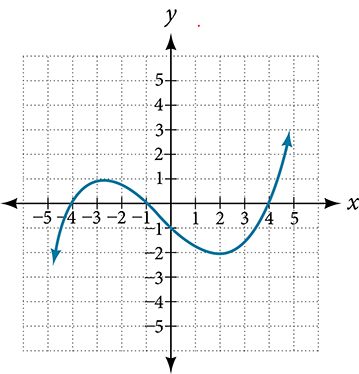
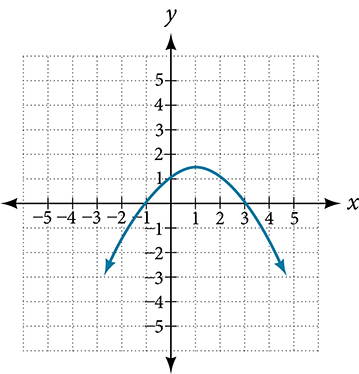
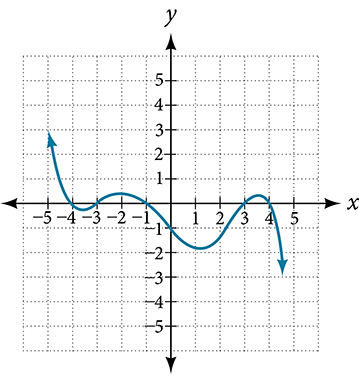
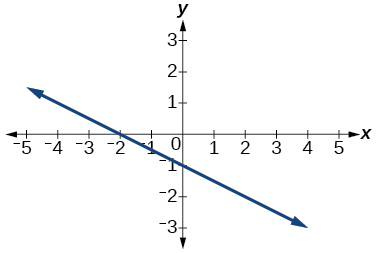
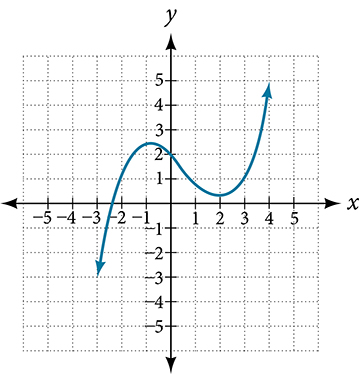
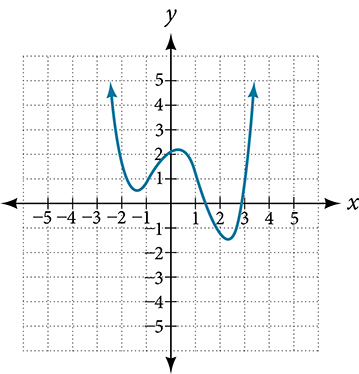
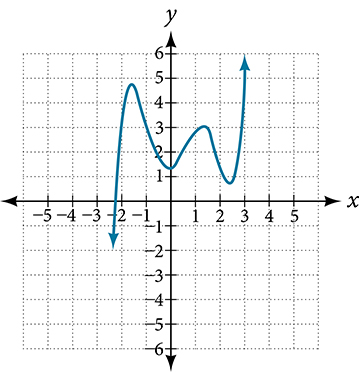
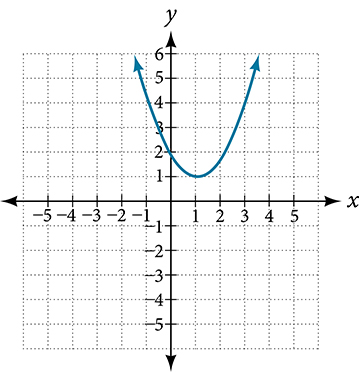
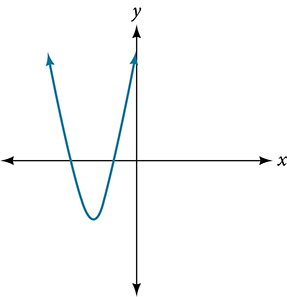
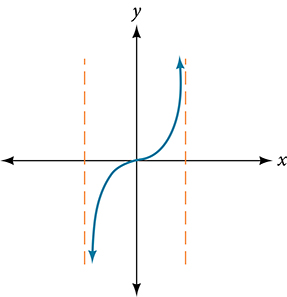
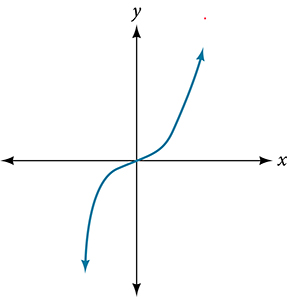
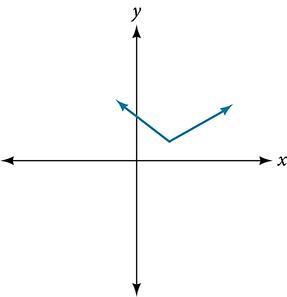
For the following exercises, determine whether the graph of the function provided is a graph of a polynomial function. If so, determine the number of turning points and the least possible degree for the function.
次の各問について、与えられた関数のグラフが多項式関数のグラフかどうかを判定せよ。そうなら、折り返しの点の数と、この関数のありうる最小の次数を決めよ。
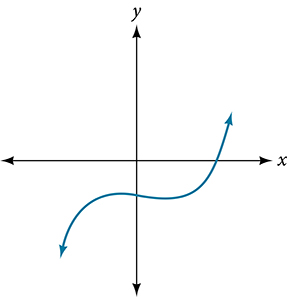
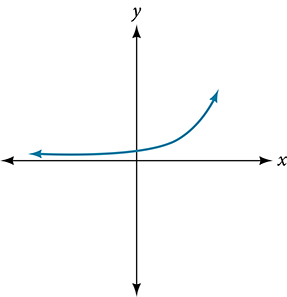
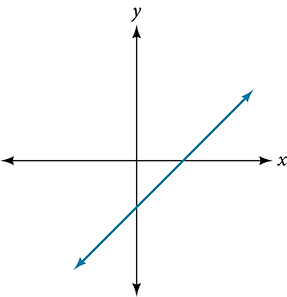
Numeric数値の問題
For the following exercises, make a table to confirm the end behavior of the function.
次の各問について、表を作って関数の端のふるまいを確かめよ。
Technology機器を使う問題
For the following exercises, graph the polynomial functions using a calculator. Based on the graph, determine the intercepts and the end behavior.
次の各問について、電卓を使って多項式関数のグラフを描け。そのグラフをもとに、切片と端のふるまいを決めよ。
Extensions発展問題
For the following exercises, use the information about the graph of a polynomial function to determine the function. Assume the leading coefficient is 1 or –1. There may be more than one correct answer.
次の各問について、多項式関数のグラフについての情報から、その関数を決めよ。最高次係数は1または–1とする。正しい答えは一つとは限らない。
End behavior: as , ; as ,
端のふるまい: のとき 、 のとき
62. The intercept is The intercepts are , Degree is 2.
62. 切片は 。 切片は 、。次数は2。
End behavior: as , , as ,
端のふるまい: のとき 、 のとき
End behavior: as , , as ,
端のふるまい: のとき 、 のとき
64. The intercept is The intercept is Degree is 3.
64. 切片は 。 切片は 。次数は3。
End behavior: as , , as ,
端のふるまい: のとき 、 のとき
Real-World Applications応用問題
For the following exercises, use the written statements to construct a polynomial function that represents the required information.
次の各問について、書かれた文から、求められている情報を表す多項式関数を組み立てよ。
66. An oil slick is expanding as a circle. The radius of the circle is increasing at the rate of 20 meters per day. Express the area of the circle as a function of the number of days elapsed.
66. 油膜が円く広がっている。円の半径は1日に20メートルの割合で増えている。経った日数 の関数として、円の面積を表せ。
68. A rectangle has a length of 10 inches and a width of 6 inches. If the length is increased by inches and the width increased by twice that amount, express the area of the rectangle as a function of
68. ある長方形の縦は10インチ、横は6インチである。縦を インチ、横をその2倍だけ伸ばすとき、長方形の面積を の関数として表せ。
70. A rectangle is twice as long as it is wide. Squares of side 2 feet are cut out from each corner. Then the sides are folded up to make an open box. Express the volume of the box as a function of the width ( ).
70. ある長方形は、縦が横の2倍である。各角から一辺2フィートの正方形を切り取る。そして辺を折り上げて蓋の無い箱を作る。この箱の体積を横()の関数として表せ。