プリンピキア

第5章多項式関数と有理関数Polynomial and Rational Functions

Answer Key解答

Solution 1解答 1

The path passes through the origin and has vertex at ( 4,7 ), so h(x)=7 16 (x+4) 2 +7. To make the shot, h( 7.5 ) would need to be about 4 but h(7.5)1.64; he doesn’t make it.

この軌道は原点を通り、頂点が ( 4,7 ) なので h(x)=7 16 (x+4) 2 +7. である。決めるには h( 7.5 ) がおよそ4である必要があるが、h(7.5)1.64; なので入らない。

Solution 2解答 2

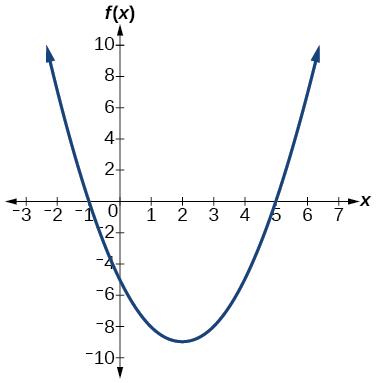
g(x)=x 2 6x+13 in general form; g(x)=(x3) 2 +4 in standard form

一般形では g(x)=x 2 6x+13。標準形では g(x)=(x3) 2 +4

Solution 3解答 3

The domain is all real numbers. The range is f(x)8 11 , or [ 8 11 , ).

定義域は実数全体である。値域は f(x)8 11 、すなわち [ 8 11 , ) である。

Solution 4解答 4

y-intercept at (0, 13), No x- intercepts

y切片は (0, 13)。x- 切片は無い。

Solution 5解答 5

3 seconds256 feet7 seconds

3秒256フィート7秒

Solution 1解答 1

f(x) is a power function because it can be written as f(x)=8x 4 . The other functions are not power functions.

f(x)f(x)=8x 4 と書けるので累乗関数である。ほかの関数は累乗関数ではない。

Solution 2解答 2

As x approaches positive or negative infinity, f( x ) decreases without bound: as x±, f(x) because of the negative coefficient.

x が正または負の無限大に近づくと、f( x ) は限りなく小さくなる。係数が負なので x±, f(x) となる。

Solution 3解答 3

The degree is 6. The leading term is x 6 . The leading coefficient is 1.

次数は6である。最高次の項は x 6 である。最高次係数は 1. である。

Solution 4解答 4

As x, f(x); as x, f(x). It has the shape of an even degree power function with a negative coefficient.

x, f(x); as x, f(x) となる。係数が負の偶数次の累乗関数の形をしている。

Solution 5解答 5

The leading term is 0.2x 3 , so it is a degree 3 polynomial. As x approaches positive infinity, f( x ) increases without bound; as x approaches negative infinity, f( x ) decreases without bound.

最高次の項は 0.2x 3 なので、3次の多項式である。x が正の無限大に近づくと f( x ) は限りなく大きくなり、x が負の無限大に近づくと f( x ) は限りなく小さくなる。

Solution 6解答 6

y-intercept (0,0); x-intercepts (0,0),(2,0), and (5,0)

y切片は (0,0);、x切片は (0,0),(2,0)(5,0)

Solution 7解答 7

There are at most 12 x- intercepts and at most 11 turning points.

x- 切片はたかだか12個、折り返しの点はたかだか11個である。

Solution 8解答 8

The end behavior indicates an odd-degree polynomial function; there are 3 x- intercepts and 2 turning points, so the degree is odd and at least 3. Because of the end behavior, we know that the lead coefficient must be negative.

端のふるまいは奇数次の多項式関数を示している。x- 切片が3個、折り返しの点が2個あるので、次数は奇数で3以上である。端のふるまいから、最高次係数は負でなければならないと分かる。

Solution 9解答 9

The x- intercepts are (2,0),(1,0), and (5,0), the y-intercept is (0,2), and the graph has at most 2 turning points.

x- 切片は (2,0),(1,0)(5,0)、y切片は (0,2) で、グラフの折り返しの点はたかだか2個である。

Solution 1解答 1

y-intercept (0,0); x-intercepts (0,0),(5,0),(2,0), and (3,0)

y切片は (0,0);、x切片は (0,0),(5,0),(2,0)(3,0)

Solution 2解答 2

The graph has a zero of –5 with multiplicity 3, a zero of -1 with multiplicity 2, and a zero of 3 with multiplicity 4.

このグラフは、重複度3の零点–5、重複度2の零点-1、重複度4の零点3を持つ。
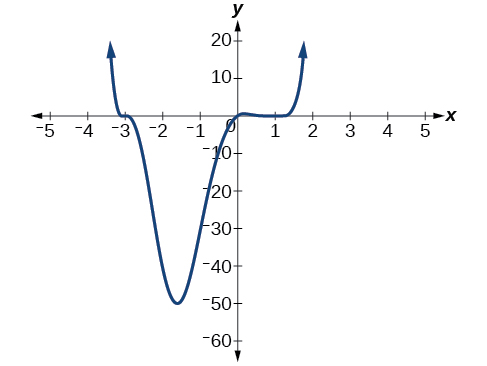
Solution 3解答 3

Graph of f(x)=(1/4)x(x-1)^4(x+3)^3.

Solution 4解答 4

Because f is a polynomial function and since f(1) is negative and f(2) is positive, there is at least one real zero between x=1 and x=2.

f は多項式関数で、f(1) が負、f(2) が正なので、x=1x=2. のあいだに実の零点が少なくとも一つある。

Solution 5解答 5

f(x)=1 8 (x2) 3 (x+1) 2 (x4)

Solution 6解答 6

The minimum occurs at approximately the point (0,6.5), and the maximum occurs at approximately the point (3.5,7).

最小値はおよそ点 (0,6.5) で、最大値はおよそ点 (3.5,7) で生じる。

Solution 1解答 1

4x 2 8x+1578 4x+5

Solution 2解答 2

3x 3 3x 2 +21x150+1,090 x+7

Solution 3解答 3

3x 2 4x+1

Solution 1解答 1

f(3)=412

Solution 2解答 2

The zeros are 2, –2, and –4.

零点は2、–2、–4である。

Solution 3解答 3

There are no rational zeros.

有理数の零点は無い。

Solution 4解答 4

The zeros are –4, 1 2 ,and 1.

零点は –4, 1 2 ,and 1 である。

Solution 5解答 5

f(x)=1 2 x 3 +5 2 x 2 2x+10

Solution 6解答 6

There must be 4, 2, or 0 positive real roots and 0 negative real roots. The graph shows that there are 2 positive real zeros and 0 negative real zeros.

正の実の根は4個、2個、0個のいずれかで、負の実の根は0個でなければならない。グラフから、正の実の零点が2個、負の実の零点が0個だと分かる。

Solution 7解答 7

3 meters by 4 meters by 7 meters

3メートル×4メートル×7メートル

Solution 1解答 1

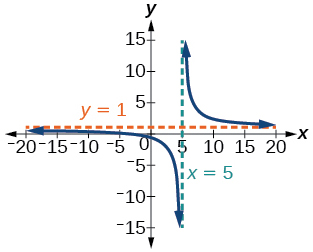
End behavior: as x±, f(x)0; Local behavior: as x0, f(x) (there are no x- or y-intercepts)

端のふるまい: x±, f(x)0;。局所のふるまい: x0, f(x)(x切片も y切片も無い)

Solution 2解答 2

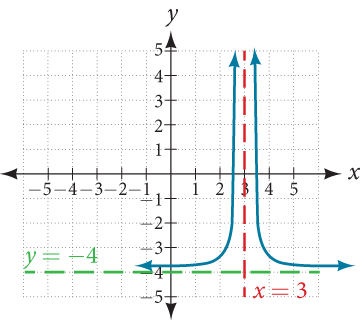
Graph of f(x)=1/(x-3)^2-4 with its vertical asymptote at x=3 and its horizontal asymptote at y=-4.

The function and the asymptotes are shifted 3 units right and 4 units down. As x3,f(x), and as x±,f(x)4.

関数と漸近線が右に3単位、下に4単位移る。x3,f(x) となり、x±,f(x)4. となる。

The function is f(x)=1 (x3) 2 4.

関数は f(x)=1 (x3) 2 4. である。

Solution 3解答 3

12 11

Solution 4解答 4

The domain is all real numbers except x=1 and x=5.

定義域は、x=1x=5. を除いた実数全体である。

Solution 5解答 5

Removable discontinuity at x=5. Vertical asymptotes: x=0,x=1.

x=5. に取り除ける不連続。垂直漸近線: x=0,x=1.

Solution 6解答 6

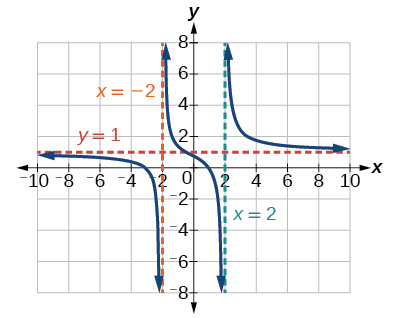
Vertical asymptotes at x=2 and x=3; horizontal asymptote at y=4.

x=2x=3; に垂直漸近線、y=4. に水平漸近線。

Solution 7解答 7

For the transformed reciprocal squared function, we find the rational form. f(x)=1 (x3) 2 4=14(x3) 2 (x3) 2 =14(x 2 6x+9) (x3)(x3) =4x 2 +24x35 x 2 6x+9

逆数の2乗の関数を変形したものについて、有理式の形を求める。f(x)=1 (x3) 2 4=14(x3) 2 (x3) 2 =14(x 2 6x+9) (x3)(x3) =4x 2 +24x35 x 2 6x+9

Because the numerator is the same degree as the denominator we know that as x±, f(x)4; so y=4 is the horizontal asymptote. Next, we set the denominator equal to zero, and find that the vertical asymptote is x=3, because as x3,f(x). We then set the numerator equal to 0 and find the x-intercepts are at (2.5,0) and (3.5,0). Finally, we evaluate the function at 0 and find the y-intercept to be at ( 0,35 9 ).

分子の次数が分母と同じなので、x±, f(x)4; so y=4 が水平漸近線だと分かる。次に分母を0とおくと、x3,f(x) なので垂直漸近線は x=3 だと分かる。そして分子を0とおくと、x切片は (2.5,0)(3.5,0) だと分かる。最後に0でこの関数の値を求めると、y切片は ( 0,35 9 ) だと分かる。

Solution 8解答 8

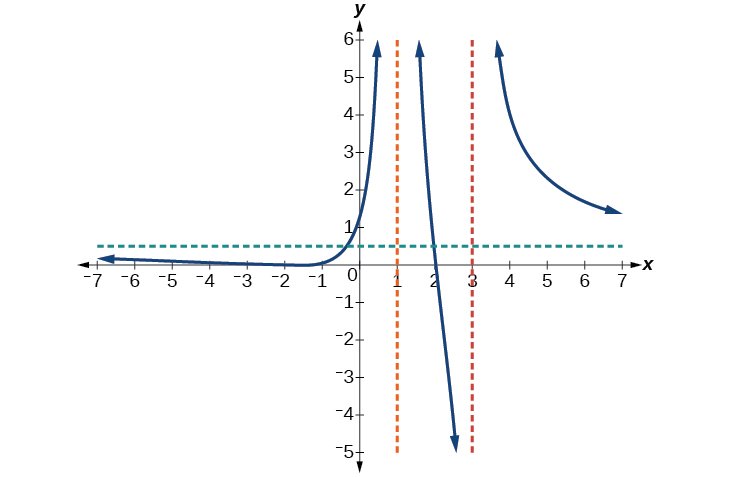
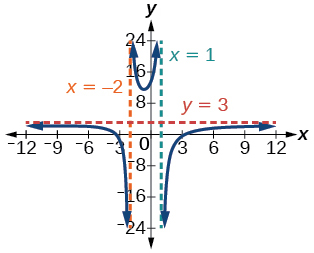
Horizontal asymptote at y=1 2 . Vertical asymptotes at x=1 and x=3. y-intercept at ( 0,4 3 . )

y=1 2 に水平漸近線、x=1 および x=3. に垂直漸近線、( 0,4 3 . ) に y切片。

x-intercepts at (2,0) and (2,0). (2,0) is a zero with multiplicity 2, and the graph bounces off the x-axis at this point. (2,0) is a single zero and the graph crosses the axis at this point.

x切片は (2,0) および(2,0)(2,0) は重複度2の零点で、この点でグラフは x軸から跳ね返る。(2,0) は単純零点で、この点でグラフは軸を横切る。

Graph of f(x)=(x+2)^2(x-2)/2(x-1)^2(x-3) with its vertical and horizontal asymptotes.

Solution 1解答 1

f 1 ( f( x ) )=f 1 ( x+5 3 )=3( x+5 3 )5=( x5 )+5=x and f( f 1 ( x ) )=f( 3x5 )=( 3x5 )+5 3 =3x 3 =x

f 1 ( f( x ) )=f 1 ( x+5 3 )=3( x+5 3 )5=( x5 )+5=xf( f 1 ( x ) )=f( 3x5 )=( 3x5 )+5 3 =3x 3 =x

Solution 2解答 2

f 1 (x)=x 3 4

Solution 3解答 3

f 1 (x)=x1

Solution 4解答 4

f 1 (x)=x 2 3 2 ,x0

Solution 5解答 5

f 1 (x)=2x+3 x1

Solution 1解答 1

128 3

Solution 2解答 2

9 2

Solution 3解答 3

x=20

5.1 Section Exercises5.1 節末問題

Solution 1解答 1

When written in that form, the vertex can be easily identified.

その形で書くと、頂点が簡単に見分けられる。

Solution 3解答 3

If a=0 then the function becomes a linear function.

a=0 なら、この関数は一次関数になる。

Solution 5解答 5

If possible, we can use factoring. Otherwise, we can use the quadratic formula.

できるなら因数分解が使える。そうでなければ解の公式が使える。

Solution 7解答 7

g(x)=(x+1) 2 4, Vertex ( 1,4 )

g(x)=(x+1) 2 4。頂点は ( 1,4 )

Solution 9解答 9

f(x)=( x+5 2 ) 2 33 4 , Vertex ( 5 2 ,33 4 )

f(x)=( x+5 2 ) 2 33 4 。頂点は ( 5 2 ,33 4 )

Solution 11解答 11

f(x)=3(x1) 2 12, Vertex (1,12)

f(x)=3(x1) 2 12。頂点は (1,12)

Solution 13解答 13

f(x)=3( x5 6 ) 2 37 12 , Vertex ( 5 6 ,37 12 )

f(x)=3( x5 6 ) 2 37 12 。頂点は ( 5 6 ,37 12 )

Solution 15解答 15

Minimum is 17 2 and occurs at 5 2 . Axis of symmetry is x=5 2 .

最小値は 17 2 で、5 2 のときに生じる。対称軸は x=5 2 である。

Solution 17解答 17

Minimum is 17 16 and occurs at 1 8 . Axis of symmetry is x=1 8 .

最小値は 17 16 で、1 8 のときに生じる。対称軸は x=1 8 である。

Solution 19解答 19

Minimum is 7 2 and occurs at −3. Axis of symmetry is x=−3.

最小値は 7 2 で、−3. のときに生じる。対称軸は x=−3. である。

Solution 21解答 21

Domain is ( , ). Range is [2,).

定義域は ( , )、値域は [2,) である。

Solution 23解答 23

Domain is ( , ). Range is [−5,).

定義域は ( , )、値域は [−5,) である。

Solution 25解答 25

Domain is ( , ). Range is [−12,).

定義域は ( , )、値域は [−12,) である。

Solution 27解答 27

f(x)=x 2 +4x+3

Solution 29解答 29

f(x)=x 2 -4x+7

Solution 31解答 31

f(x)= -149 x 2 +649x +8949

Solution 33解答 33

f(x)=x 2 -2x+1

Solution 35解答 35

Vertex: (3, −10), axis of symmetry: x = 3, intercepts: (3+10,0) and (3-10,0)

頂点: (3, −10)、対称軸: x = 3、切片: (3+10,0)(3-10,0)

A parabola on a Cartesian coordinate system. The parabola opens upwards, has its vertex in the fourth quadrant, and intersects the x-axis at (0,0) and approximately (7,0).

Solution 37解答 37

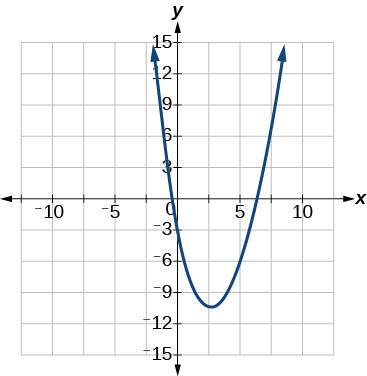
Vertex: ( 7 2, 37 4 ), axis of symmetry: x=72, y-intercept: (0,3), x-intercepts: ( 7+37 2, 0 ), ( 737 2, 0 )

頂点: ( 7 2, 37 4 )、対称軸: x=72、y切片: (0,3)、x切片: ( 7+37 2, 0 ), ( 737 2, 0 )

Graph of f(x)=4x^2-12x-3

Solution 39解答 39

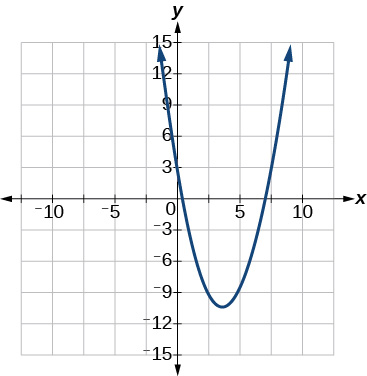
Vertex: (32,-12), axis of symmetry: x=32, intercept: ( 3+23 2 , 0) and ( 3-23 2 , 0)

頂点: (32,-12)、対称軸: x=32、切片: ( 3+23 2 , 0)( 3-23 2 , 0)

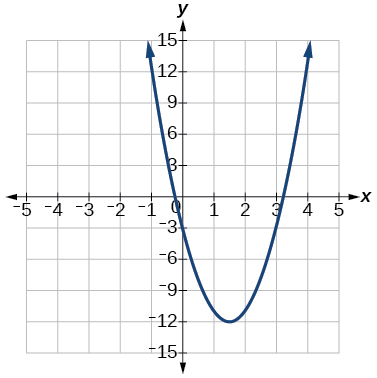
A graph displays a blue parabola opening upwards. The parabola's vertex is in the fourth quadrant, intersecting the x-axis around (3.5, 0) and the y-axis around (0, -3).

Solution 41解答 41

f(x)=x 2 +2x+3

Solution 43解答 43

f(x)=-3x 2 6x1

Solution 45解答 45

f(x)=-14x 2 x+2

Solution 47解答 47

f(x)=x 2 +2x+1

Solution 49解答 49

f(x)= - x 2 +2x

Solution 50解答 50

f(x)=2x 2

Solution 53解答 53

The graph is shifted to the right or left (a horizontal shift).

グラフが右または左に移る(横の移動)。

Solution 55解答 55

The suspension bridge has 1,000 feet distance from the center.

この吊り橋は中心から1,000フィートの距離である。

Solution 57解答 57

Domain is (,). Range is (-,2].

定義域は (,)、値域は (-,2] である。

Solution 59解答 59

Domain: (-,) ; range: [100,)

定義域: (-,)、値域: [100,)

Solution 61解答 61

f(x)=2x 2 +2

Solution 63解答 63

f(x)=-x 2 2

Solution 65解答 65

f(x)=3x 2 +6x-15

Solution 67解答 67

75 feet by 50 feet

75フィート×50フィート

Solution 69解答 69

3 and 3; product is 9

3と3。積は9。

Solution 71解答 71

The revenue reaches the maximum value when 1800 thousand phones are produced.

携帯電話を180万台作るとき、収入が最大の値に達する。

Solution 73解答 73

2.449 seconds

2.449秒

Solution 75解答 75

41 trees per acre

1エーカーあたり41本

5.2 Section Exercises5.2 節末問題

Solution 1解答 1

The coefficient of the power function is the real number that is multiplied by the variable raised to a power. The degree is the highest power appearing in the function.

累乗関数の係数は、累乗した変数に掛かる実数である。次数は、その関数に現れる最も高い指数である。

Solution 3解答 3

As x decreases without bound, so does f( x ). As x increases without bound, so does f( x ).

x が限りなく小さくなると f( x ) も限りなく小さくなる。x が限りなく大きくなると f( x ) も限りなく大きくなる。

Solution 5解答 5

The polynomial function is of even degree and leading coefficient is negative.

この多項式関数は偶数次で、最高次係数は負である。

Solution 7解答 7

Power function

累乗関数

Solution 9解答 9

Neither

どちらでもない

Solution 11解答 11

Neither

どちらでもない

Solution 13解答 13

Degree = 2, Coefficient = –2

次数 = 2、係数 = –2

Solution 15解答 15

Degree =4, Coefficient = –2

次数 = 4、係数 = –2

Solution 17解答 17

As x, f(x),asx,f(x)

x のとき f(x),asx,f(x)

Solution 19解答 19

As x, f(x),asx,f(x)

x のとき f(x),asx,f(x)

Solution 21解答 21

As x, f(x),asx,f(x)

x のとき f(x),asx,f(x)

Solution 23解答 23

As x, f(x),asx,f(x)

x のとき f(x),asx,f(x)

Solution 25解答 25

y-intercept is (0,12), t-intercepts are (1,0);(2,0);and (3,0).

y切片は (0,12)、t切片は (1,0);(2,0);および(3,0)

Solution 27解答 27

y-intercept is (0,16). x-intercepts are (2,0) and (2,0).

y切片は (0,16)、x切片は (2,0)(2,0)

Solution 29解答 29

y-intercept is (0,0). x-intercepts are (0,0),(4,0), and ( 2, 0 ).

y切片は (0,0)、x切片は (0,0),(4,0)( 2, 0 )

Solution 31解答 31

3

Solution 33解答 33

5

Solution 35解答 35

3

Solution 37解答 37

5

Solution 39解答 39

Yes. Number of turning points is 2. Least possible degree is 3.

はい。折り返しの点の数は2。ありうる最小の次数は3。

Solution 41解答 41

Yes. Number of turning points is 1. Least possible degree is 2.

はい。折り返しの点の数は1。ありうる最小の次数は2。

Solution 43解答 43

Yes. Number of turning points is 0. Least possible degree is 1.

はい。折り返しの点の数は0。ありうる最小の次数は1。
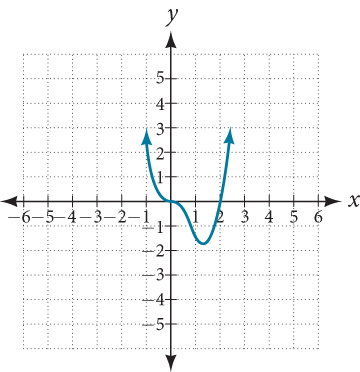
Solution 45解答 45

Yes. Number of turning points is 0. Least possible degree is 1.

はい。折り返しの点の数は0。ありうる最小の次数は1。
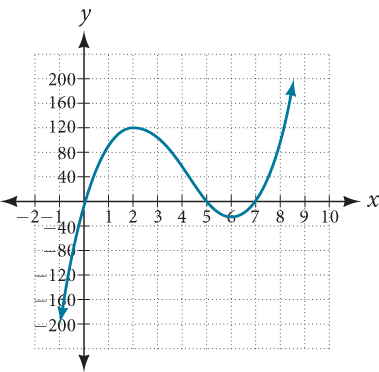
Solution 47解答 47

xf( x )
109,500
10099,950,000
–109,500
–10099,950,000

As x, f(x),asx,f(x)

x のとき f(x),asx,f(x)

Solution 49解答 49

xf( x )
10–504
100–941,094
–101,716
–1001,061,106

As x, f(x),asx,f(x)

x のとき f(x),asx,f(x)

Solution 51解答 51

Graph of f(x)=x^3(x-2).

The y- intercept is ( 0, 0 ). The x- intercepts are ( 0, 0 ),( 2, 0 ). As x, f(x),asx,f(x)

y- 切片は ( 0, 0 )x- 切片は ( 0, 0 ),( 2, 0 )x のとき f(x),asx,f(x)

Solution 53解答 53

Graph of f(x)=x(14-2x)(10-2x).

The y- intercept is ( 0,0 ) . The x- intercepts are ( 0, 0 ),( 5, 0 ),( 7, 0 ). As x, f(x),asx,f(x)

y- 切片は ( 0,0 )x- 切片は ( 0, 0 ),( 5, 0 ),( 7, 0 )x のとき f(x),asx,f(x)

Solution 55解答 55

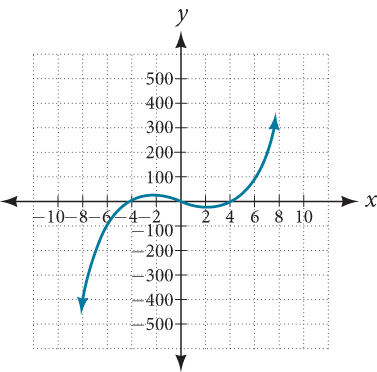
A graph on a coordinate plane displays a cubic function. The x-axis ranges from -10 to 10, and the y-axis ranges from -500 to 500. The blue curve illustrates the function, starting from approximately (-7, -400), increasing to a local maximum near (-1, 50), then decreasing to a local minimum near (3, -50), and finally increasing again, passing through (0, 0), (2, 0) and approximately (7, 300).

The y- intercept is ( 0, 0 ). The x- intercept is ( 4, 0 ),( 0, 0 ),( 4, 0 ). Asx, f(x),asx,f(x)

y- 切片は ( 0, 0 )x- 切片は ( 4, 0 ),( 0, 0 ),( 4, 0 )Asx のとき f(x),asx,f(x)

Solution 57解答 57

Graph of f(x)=x^3-27.

The y- intercept is ( 0, 81 ). The x- intercept are ( 3, 0 ),( 3, 0 ). As x, f(x),asx,f(x)

y- 切片は ( 0, 81 )x- 切片は ( 3, 0 ),( 3, 0 )x のとき f(x),asx,f(x)

Solution 59解答 59

Graph of f(x)=-x^3+x^2+2x.

The y- intercept is ( 0, 0 ). The x- intercepts are ( 3, 0 ),( 0, 0 ),( 5, 0 ). As x, f(x),asx,f(x)

y- 切片は ( 0, 0 )x- 切片は ( 3, 0 ),( 0, 0 ),( 5, 0 )x のとき f(x),asx,f(x)

Solution 61解答 61

f(x)=x 2 4

Solution 63解答 63

f(x)=x 3 4x 2 +4x

Solution 65解答 65

f(x)=x 4 +1

Solution 67解答 67

V(m)=8m 3 +36m 2 +54m+27

Solution 69解答 69

V(x)=4x 3 32x 2 +64x

5.3 Section Exercises5.3 節末問題

Solution 1解答 1

The x- intercept is where the graph of the function crosses the x- axis, and the zero of the function is the input value for which f(x)=0.

x- 切片はその関数のグラフが x- 軸を横切るところであり、その関数の零点は f(x)=0. となる入力値である。

Solution 3解答 3

If we evaluate the function at a and at b and the sign of the function value changes, then we know a zero exists between a and b.

ab で関数の値を求め、関数の値の符号が変われば、ab のあいだに零点があると分かる。

Solution 5解答 5

There will be a factor raised to an even power.

偶数乗した因数がある。

Solution 7解答 7

(2,0),(3,0),(5,0)

Solution 9解答 9

(3,0),(1,0),(0,0)

Solution 11解答 11

( 0,0 ),( 5,0 ),( 2,0 )

Solution 13解答 13

( 0,0 ),( 5,0 ),( 4,0 )

Solution 15解答 15

( 2,0 ),( 2,0 ),( 1,0 )

Solution 17解答 17

(2,0),(2,0),( 1 2 ,0 )

Solution 19解答 19

( 1,0 ),( 1,0 )

Solution 21解答 21

(0,0),(3 ,0),(3 ,0)

Solution 23解答 23

( 0,0 ),( 1,0 )( 1,0 ),( 2,0 ),( 2,0 )

Solution 25解答 25

f( 2 )=10 and f( 4 )=28. Sign change confirms.

f( 2 )=10f( 4 )=28.。符号の変化が確かめる。

Solution 27解答 27

f( 1 )=3 and f( 3 )=77. Sign change confirms.

f( 1 )=3f( 3 )=77.。符号の変化が確かめる。

Solution 29解答 29

f( 0.01 )=1.000001 and f( 0.1 )=7.999. Sign change confirms.

f( 0.01 )=1.000001f( 0.1 )=7.999.。符号の変化が確かめる。

Solution 31解答 31

0 with multiplicity 2, 3 2 with multiplicity 5, 4 with multiplicity 2

重複度2の0、重複度5の 3 2、重複度2の4

Solution 33解答 33

0 with multiplicity 2, –2 with multiplicity 2

重複度2の0、重複度2の–2

Solution 35解答 35

2 3 with multiplicity 5, 5 with multiplicity 2

重複度5の 2 3、重複度2の5

Solution 37解答 37

0 with multiplicity 4, 2 with multiplicity 1, −1 with multiplicity 1

重複度4の0、重複度1の2、重複度1の−1

Solution 39解答 39

3 2 with multiplicity 2, 0 with multiplicity 3

重複度2の 3 2、重複度3の0

Solution 41解答 41

0withmultiplicity6,2 3 withmultiplicity2

Solution 43解答 43

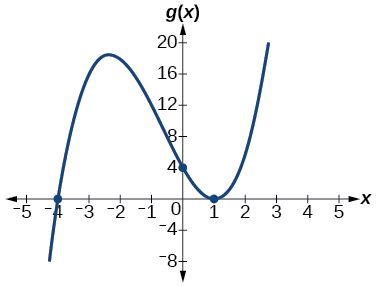
x-intercepts, ( 1, 0 ) with multiplicity 2, ( 4, 0 ) with multiplicity 1, y- intercept ( 0, 4 ). As x,f(x),asx,f(x).

x切片は、重複度2の ( 1, 0 ) と重複度1の ( 4, 0 )y- 切片は ( 0, 4 ).x,f(x),asx,f(x) となる。

Graph of g(x)=(x+4)(x-1)^2.

Solution 45解答 45

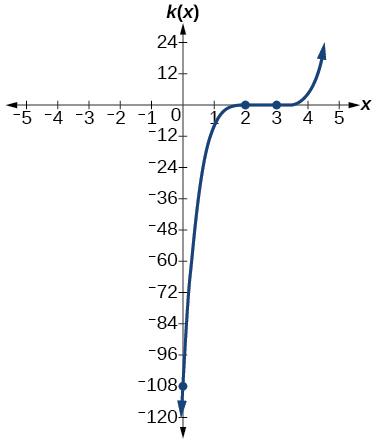
x-intercepts (3,0) with multiplicity 3, (2,0) with multiplicity 2, y- intercept (0,108). As x,f(x),asx,f(x).

x切片は、重複度3の (3,0) と重複度2の (2,0)y- 切片は (0,108)x,f(x),asx,f(x) となる。

Graph of k(x)=(x-3)^3(x-2)^2.

Solution 47解答 47

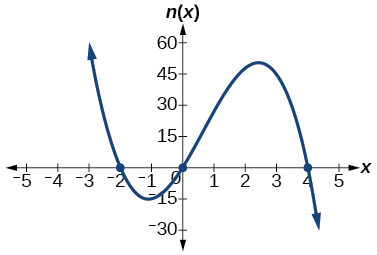
x-intercepts ( 0, 0 ),( 2, 0 ),( 4,0 ) with multiplicity 1, y- intercept (0, 0). As x,f(x),asx,f(x).

x切片は、重複度1の ( 0, 0 ),( 2, 0 ),( 4,0 )y- 切片は (0, 0)x,f(x),asx,f(x) となる。

Graph of n(x)=-3x(x+2)(x-4).

Solution 49解答 49

f(x)=2 9 (x3)(x+1)(x+3)

Solution 51解答 51

f(x)=1 4 (x+2) 2 (x3)

Solution 53解答 53

–4, –2, 1, 3 with multiplicity 1

–4、–2、1、3。いずれも重複度1。

Solution 55解答 55

–2, 3 each with multiplicity 2

–2、3。いずれも重複度2。

Solution 57解答 57

f(x)=2 3 (x+2)(x1)(x3)

Solution 59解答 59

f(x)=1 3 (x3) 2 (x1) 2 (x+3)

Solution 61解答 61

f(x)=−15(x1) 2 (x3) 3

Solution 63解答 63

f(x)=2( x+3 )( x+2 )( x1 )

Solution 65解答 65

f(x)=3 2 ( 2x1 ) 2 ( x6 )( x+2 )

Solution 67解答 67

local max ( .58, –.62 ), local min ( .58, –1.38 )

局所の最大 ( .58, –.62 )、局所の最小 ( .58, –1.38 )

Solution 69解答 69

global min ( .63, –.47 )

大域の最小 ( .63, –.47 )

Solution 71解答 71

global min (.75, .89)

大域の最小 (.75, .89)

Solution 73解答 73

f(x)=(x500) 2 (x+200)

Solution 75解答 75

f(x)=4x 3 36x 2 +80x

Solution 77解答 77

f(x)=4x 3 36x 2 +60x+100

Solution 79解答 79

f(x)=9π(x 3 +5x 2 +8x+4)

5.4 Section Exercises5.4 節末問題

Solution 1解答 1

The binomial is a factor of the polynomial.

その二項式はその多項式の因数である。

Solution 3解答 3

x+6+5 x-1 ,quotient:x+6,remainder:5

式中の英語:quotient::商: / remainder::余り:

Solution 5解答 5

3x+2,quotient: 3x+2,remainder: 0

式中の英語:quotient::商:

Solution 7解答 7

x5,quotient:x5,remainder:0

式中の英語:quotient::商: / remainder::余り:

Solution 9解答 9

2x7+16 x+2 ,quotient:2x7,remainder:16

式中の英語:quotient::商: / remainder::余り:

Solution 11解答 11

x2+6 3x+1 ,quotient:x2,remainder:6

式中の英語:quotient::商: / remainder::余り:

Solution 13解答 13

2x 2 3x+5,quotient:2x 2 3x+5,remainder:0

式中の英語:quotient::商: / remainder::余り:

Solution 15解答 15

2x 2 +2x+1+10 x4

Solution 17解答 17

2x 2 7x+12 2x+1

Solution 19解答 19

3x 2 11x+34106 x+3

Solution 21解答 21

x 2 +5x+1

Solution 23解答 23

4x 2 21x+84323 x+4

Solution 25解答 25

x 2 14x+49

Solution 27解答 27

3x 2 +x+2 3x1

Solution 29解答 29

x 3 3x+1

Solution 31解答 31

x 3 x 2 +2

Solution 33解答 33

x 3 6x 2 +12x8

Solution 35解答 35

x 3 9x 2 +27x27

Solution 37解答 37

2x 3 2x+2

Solution 39解答 39

Yes ( x2 )(3x 3 5)

はい。( x2 )(3x 3 5)

Solution 41解答 41

Yes ( x2 )(4x 3 +8x 2 +x+2)

はい。( x2 )(4x 3 +8x 2 +x+2)

Solution 43解答 43

No

いいえ

Solution 45解答 45

(x1)(x 2 +2x+4)

Solution 47解答 47

(x5)(x 2 +x+1)

Solution 49解答 49

Quotient:4x 2 +8x+16,remainder:1

式中の英語:remainder::余り:

Solution 51解答 51

Quotient:3x 2 +3x+5,remainder:0

式中の英語:remainder::余り:

Solution 53解答 53

Quotient:x 3 2x 2 +4x8,remainder:6

式中の英語:remainder::余り:

Solution 55解答 55

x 6 x 5 +x 4 x 3 +x 2 x+1

Solution 57解答 57

x 3 x 2 +x1+1 x+1

Solution 59解答 59

1+1+i xi

Solution 61解答 61

1+1i x+i

Solution 63解答 63

x 2 +ix1+1i xi

Solution 65解答 65

2x 2 +3

Solution 67解答 67

2x+3

Solution 69解答 69

x+2

Solution 71解答 71

x3

Solution 73解答 73

3x 2 2

5.5 Section Exercises5.5 節末問題

Solution 1解答 1

The theorem can be used to evaluate a polynomial.

この定理を使えば多項式の値が求められる。

Solution 3解答 3

Rational zeros can be expressed as fractions whereas real zeros include irrational numbers.

有理数の零点は分数で表せるが、実の零点には無理数も含まれる。

Solution 5解答 5

Polynomial functions can have repeated zeros, so the fact that number is a zero doesn’t preclude it being a zero again.

多項式関数は重複した零点を持ちうるので、ある数が零点だからといって、それが再び零点になることは妨げられない。
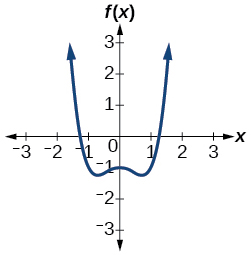
Solution 7解答 7

106

Solution 9解答 9

0

Solution 11解答 11

255

Solution 13解答 13

1

Solution 15解答 15

2, 1, 1 2

Solution 17解答 17

2

Solution 19解答 19

3

Solution 21解答 21

5 2 , 6 , 6

Solution 23解答 23

2, 4, 3 2

Solution 25解答 25

4, 4, 5

Solution 27解答 27

5, 3, 1 2

Solution 29解答 29

1 2 , 1+5 2 , 15 2

Solution 31解答 31

3 2

Solution 33解答 33

2, 3, 1, 2

Solution 35解答 35

1 2 , 1 2 , 2, 3

Solution 37解答 37

1, 1, 5 , 5

Solution 39解答 39

3 4 , 1 2

Solution 41解答 41

2, 3+2i, 32i

Solution 43解答 43

2 3 , 1+2i, 12i

Solution 45解答 45

1 2 , 1+4i, 14i

Solution 47解答 47

1 positive, 1 negative

正が1個、負が1個

Graph of f(x)=x^4-x^2-1.

Solution 49解答 49

3 or 1 positive, 0 negative

正が3個または1個、負が0個

Graph of f(x)=x^3-2x^2+x-1.

Solution 51解答 51

0 positive, 3 or 1 negative

正が0個、負が3個または1個

Graph of f(x)=2x^3+37x^2+200x+300.

Solution 53解答 53

2 or 0 positive, 2 or 0 negative

正が2個または0個、負が2個または0個

Graph of f(x)=2x^4-5x^3-5x^2+5x+3.

Solution 55解答 55

2 or 0 positive, 2 or 0 negative

正が2個または0個、負が2個または0個

Graph of f(x)=10x^4-21x^2+11.

Solution 57解答 57

±5,±1,±5 2 ,±1 2

Solution 59解答 59

±1, ±1 2 , ±1 3 , ±1 6

Solution 61解答 61

1, 1 2 , 1 3

Solution 63解答 63

2, 1 4 , 3 2

Solution 65解答 65

5 4

Solution 67解答 67

f(x)=4 9 ( x 3 +x 2 x1 )

Solution 69解答 69

f(x)=1 5 ( 4x 3 x )

Solution 71解答 71

8 by 4 by 6 inches

8×4×6インチ

Solution 73解答 73

5.5 by 4.5 by 3.5 inches

5.5×4.5×3.5インチ

Solution 75解答 75

8 by 5 by 3 inches

8×5×3インチ

Solution 77解答 77

Radius = 6 meters, Height = 2 meters

半径 = 6メートル、高さ = 2メートル

Solution 79解答 79

Radius = 2.5 meters, Height = 4.5 meters

半径 = 2.5メートル、高さ = 4.5メートル

5.6 Section Exercises5.6 節末問題

Solution 1解答 1

The rational function will be represented by a quotient of polynomial functions.

有理関数は多項式関数の商で表される。

Solution 3解答 3

The numerator and denominator must have a common factor.

分子と分母に共通の因数がなければならない。

Solution 5解答 5

Yes. The numerator of the formula of the functions would have only complex roots and/or factors common to both the numerator and denominator.

ありうる。その関数の式の分子が、複素数の根だけを持つか、分子と分母に共通の因数だけを持つ場合である。
Solution 7解答 7

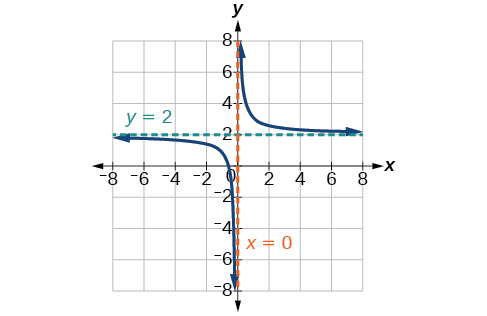
All reals x1, 1

式中の英語:All reals:実数全体

Solution 9解答 9

All reals x1, 2, 1, 2

式中の英語:All reals:実数全体

Solution 11解答 11

V.A. at x=2 5 ; H.A. at y=0; Domain is all reals x2 5

x=2 5 ; に垂直漸近線、y=0; に水平漸近線。定義域は x2 5 を除く実数全体。

Solution 13解答 13

V.A. at x=4, 9; H.A. at y=0; Domain is all reals x4, 9

x=4, 9; に垂直漸近線、y=0; に水平漸近線。定義域は x4, 9 を除く実数全体。

Solution 15解答 15

V.A. at x=0, 4, 4; H.A. at y=0; Domain is all reals x0,4, 4

x=0, 4, 4; に垂直漸近線、y=0; に水平漸近線。定義域は x0,4, 4 を除く実数全体。

Solution 17解答 17

V.A. at x=5; H.A. at y=0; Domain is all reals x5,5

x=5; に垂直漸近線、y=0; に水平漸近線。定義域は x5,5 を除く実数全体。

Solution 19解答 19

V.A. at x=1 3 ; H.A. at y=2 3 ; Domain is all reals x1 3 .

x=1 3 ; に垂直漸近線、y=2 3 ; に水平漸近線。定義域は x1 3 を除く実数全体。

Solution 21解答 21

none

無し

Solution 23解答 23

x-intercepts none, y-intercept ( 0,1 4 )

Solution 25解答 25

Local behavior: x1 2 + ,f(x),x1 2 ,f(x)

局所のふるまい: x1 2 + ,f(x),x1 2 ,f(x)

End behavior: x±,f(x)1 2

端のふるまい: x±,f(x)1 2

Solution 27解答 27

Local behavior: x6 + ,f(x),x6 ,f(x), End behavior: x±,f(x)2

局所のふるまい: x6 + ,f(x),x6 ,f(x)。端のふるまい: x±,f(x)2

Solution 29解答 29

Local behavior: x1 3 + ,f(x),x1 3 , f(x),x- 5 2 + ,f(x),x- 5 2 ,f(x)

局所のふるまい: x1 3 + ,f(x),x1 3 f(x),x- 5 2 + ,f(x),x- 5 2 ,f(x)

End behavior: x±,f(x)1 3

端のふるまい: x±,f(x)1 3

Solution 31解答 31

y=2x+4

Solution 33解答 33

y=2x

Solution 35解答 35

V.A.x=0,H.A.y=2

Graph of a rational function.

Solution 37解答 37

V.A.x=2,H.A.y=0

Graph of a rational function.

Solution 39解答 39

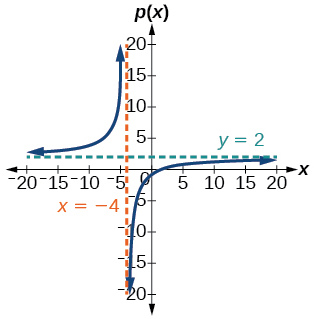
V.A.x=4,H.A.y=2;( 3 2 ,0 );( 0,3 4 )

Graph of p(x)=(2x-3)/(x+4) with its vertical asymptote at x=-4 and horizontal asymptote at y=2.

Solution 41解答 41

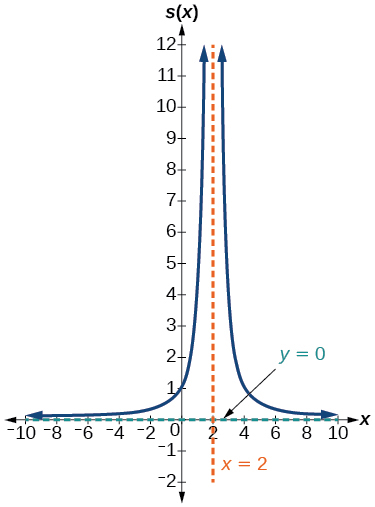
V.A.x=2,H.A.y=0,(0,1)

Graph of s(x)=4/(x-2)^2 with its vertical asymptote at x=2 and horizontal asymptote at y=0.

Solution 43解答 43

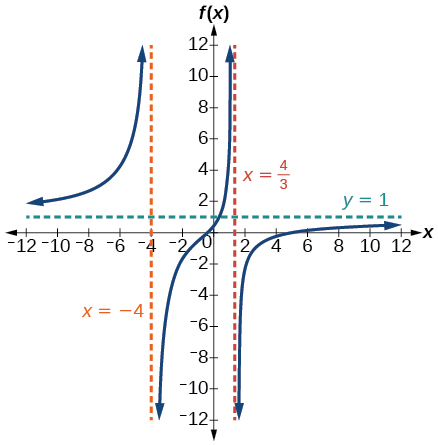
V.A.x=4,x=4 3 ,H.A.y=1;(5,0);( 1 3 ,0 );( 0,5 16 )

Graph of f(x)=(3x^2-14x-5)/(3x^2+8x-16) with its vertical asymptotes at x=-4 and x=4/3 and horizontal asymptote at y=1.

Solution 45解答 45

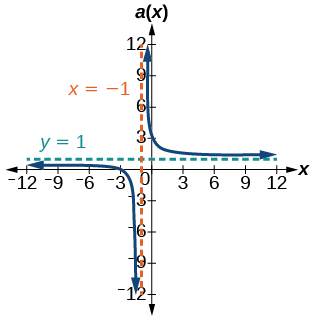
V.A.x=1,H.A.y=1;( 3,0 );( 0,3 )

Graph of a(x)=(x^2+2x-3)/(x^2-1) with its vertical asymptote at x=-1 and horizontal asymptote at y=1.

Solution 47解答 47

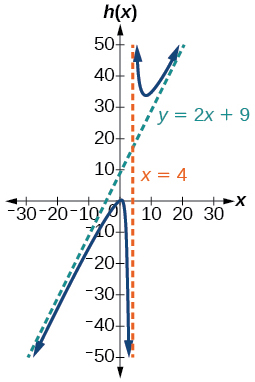
V.A.x=4,S.A.y=2x+9;( 1,0 );( 1 2 ,0 );( 0,1 4 )

Graph of h(x)=(2x^2+x-1)/(x-1) with its vertical asymptote at x=4 and slant asymptote at y=2x+9.

Solution 49解答 49

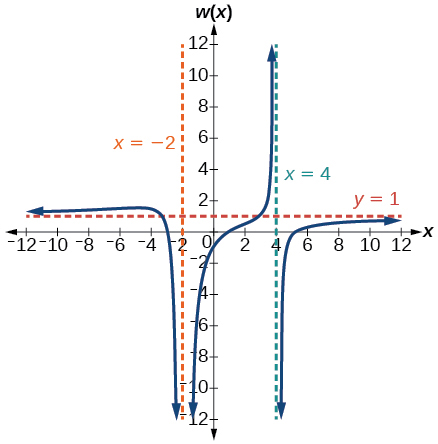
V.A.x=2,x=4,H.A.y=1,( 1,0 );( 5,0 );( 3,0 );( 0,15 16 )

Graph of w(x)=(x-1)(x+3)(x-5)/(x+2)^2(x-4) with its vertical asymptotes at x=-2 and x=4 and horizontal asymptote at y=1.

Solution 51解答 51

y=50x 2 x2 x 2 25

Solution 53解答 53

y=7x 2 +2x24 x 2 +9x+20

Solution 55解答 55

y=1 2 x 2 4x+4 x+1

Solution 57解答 57

y=4x3 x 2 x12

Solution 59解答 59

y= 27(x2) (x+3) (x3)2

Solution 61解答 61

y=1 3 x 2 +x6 x1

Solution 63解答 63

y=6(x1) 2 (x+3)(x2) 2

Solution 65解答 65

x2.012.0012.00011.991.999
y1001,00010,000–100–1,000
x101001,00010,000100,000
y.125.0102.001.0001.00001

Vertical asymptote x=2, Horizontal asymptote y=0

垂直漸近線 x=2、水平漸近線 y=0

Solution 67解答 67

x–4.1–4.01–4.001–3.99–3.999
y828028,002–798–7998
x101001,00010,000100,000
y1.42861.93311.9921.99921.999992

Vertical asymptote x=4, Horizontal asymptote y=2

垂直漸近線 x=4、水平漸近線 y=2

Solution 69解答 69

x–.9–.99–.999–1.1–1.01
y819,801998,00112110,201
x101001,00010,000100,000
y.82645.9803.998.9998

Vertical asymptote x=1, Horizontal asymptote y=1

垂直漸近線 x=1、水平漸近線 y=1

Solution 71解答 71

( 3 2 , )

Graph of f(x)=4/(2x-3).

Solution 73解答 73

(2,1)(4,)

Graph of f(x)=(x+2)/(x-1)(x-4).

Solution 75解答 75

( 2,4 )

Solution 77解答 77

( 2,5 )

Solution 79解答 79

( 1,1 )

Solution 81解答 81

C(t)=8+2t 300+20t

Solution 83解答 83

After about 6.12 hours.

およそ6.12時間後。

Solution 85解答 85

A(x)=50x 2 +800 x . 2 by 2 by 5 feet.

A(x)=50x 2 +800 x 。2×2×5フィート。

Solution 87解答 87

A(x)=πx 2 +100 x . Radius = 2.52 meters.

A(x)=πx 2 +100 x 。半径 = 2.52メートル。

5.7 Section Exercises5.7 節末問題

Solution 1解答 1

It can be too difficult or impossible to solve for x in terms of y.

yx について解くのが、難しすぎるか、できないことがあるから。

Solution 3解答 3

We will need a restriction on the domain of the answer.

答えの定義域に制限が要る。

Solution 5解答 5

f 1 (x)=x +4

Solution 7解答 7

f 1 (x)=x+3 1

Solution 9解答 9

f 1 (x)= 12x

Solution 11解答 11

f 1 (x)=x4 2

Solution 13解答 13

f 1 (x)=x1 3 3

Solution 15解答 15

f 1 (x)=4x 2 3

Solution 17解答 17

f −1 (x)=3x2 4 ,[ 0, )

Solution 19解答 19

f −1 (x)= (x-5)2+8 6

Solution 21解答 21

f −1 (x)= (3-x)2

Solution 23解答 23

f −1 (x)=4x+3 x

Solution 25解答 25

f −1 (x)=7x3 1x

Solution 27解答 27

f −1 (x)=2x-1 5x+5

Solution 29解答 29

f −1 (x)=x+3 2

Solution 31解答 31

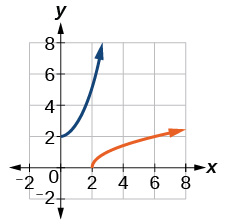
A graph displays two curved lines on a coordinate plane with x and y axes ranging from -2 to 8. A blue curve starts near (0.5, 2) and curves upwards and to the right, appearing to be an exponential function. An orange curve starts near (2, 0.5) and curves to the right and slightly upwards, appearing to be a logarithmic function. The curves suggest an inverse relationship.

f 1 (x)=x2

Solution 33解答 33

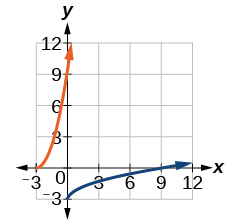
Two inverse functions plotted on a coordinate plane: an exponential curve (orange) in the second and first quadrants, and a logarithmic curve (blue) in the first and fourth quadrants.

f 1 (x)=x3

Solution 35解答 35

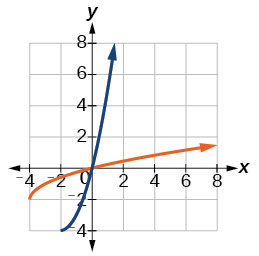
A graph displaying a blue curve and an orange curve on an x-y coordinate plane. The blue curve passes through (0,2) and (1,6), while the orange curve passes through (2,0) and (6,1). These curves are inverses of each other, reflected across the y=x line.

f 1 (x)= x3 3

Solution 37解答 37

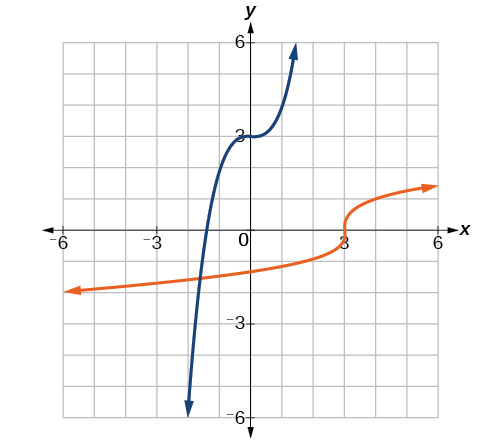
A Cartesian graph displays two distinct increasing functions: a blue curve with an upward concave shape and an orange curve with a downward concave shape.

f 1 (x)=x+4 -2

Solution 39解答 39

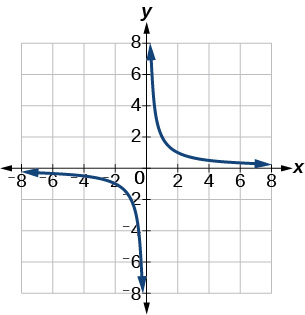
The graph of the reciprocal function f(x)=1/x, showing two branches in the first and third quadrants. There is a vertical asymptote at x=0 (the y-axis) and a horizontal asymptote at y=0 (the x-axis).

Solution 41解答 41

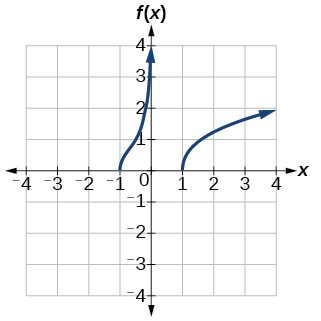
A Cartesian coordinate system displays a graph with two separate curves. The first curve starts at approximately (-1, 0) and extends upwards as it approaches x=0 from the left, showing a steep increase. The second curve starts at approximately (1, 0) and extends towards the upper right, gradually increasing as x increases. The x-axis is labeled from -4 to 4, and the y-axis from -4 to 4, with grid lines at integer values.

[-1,0)[1,)

Solution 43解答 43

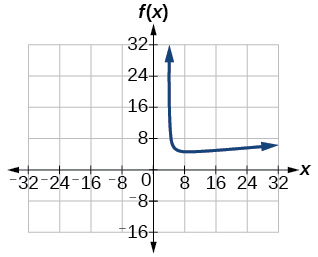
A graph displays a curve with a vertical asymptote at x=4. The curve descends from high y-values for x > 4, then gradually flattens out to the right, approaching a horizontal asymptote.

[-3,0](4,)

Solution 45解答 45

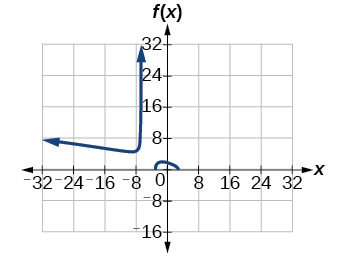
The graph displays a function f(x) on a Cartesian coordinate system. The x-axis and y-axis both range from -32 to 32, with grid lines every 8 units. The function exhibits a vertical asymptote near x = -4. From the left of this asymptote, the function approaches a value around y=6, then curves sharply downwards towards negative infinity as x decreases. From the right of x = -4, the function shoots upwards towards positive infinity. There appears to be another vertical asymptote near x = 1. As x approaches 1 from the left, the function goes towards negative infinity, while from the right, it rises towards positive infinity. Between these two asymptotes, the function forms a small curve with a local maximum around (0, 1). As x approaches negative infinity, the function seems to level off, approaching a horizontal asymptote around y = 8.

[-,-4][-3,3]

Solution 47解答 47

A coordinate plane shows the graph of a cubic function. The curve passes through the origin (0,0) and extends from the third quadrant, through (1,1), into the first quadrant, showing increasing values as x increases.

(2,0),(0,1),(8,2)

Solution 49解答 49

A graph showing a cubic function plotted on a coordinate plane. The blue curve passes through the origin (0,0) and increases from approximately (-2, -20) to (2, 20).

(13,1),(4,0),(5,1)

Solution 51解答 51

f 1 (x)=xb a 3

Solution 53解答 53

f 1 (x)=x 2 -b a

Solution 55解答 55

f 1 (x)= c x - ba - x

Solution 57解答 57

t(h)= 600-h 16 , 3.54 seconds

t(h)= 600-h 16、3.54秒

Solution 59解答 59

r(A)= A 4π , ≈ 8.92 in.

r(A)= A 4π , ≈、8.92インチ

Solution 61解答 61

l(T)=32.2(T2π), ≈ 3.26 ft

l(T)=32.2(T2π), ≈、3.26フィート

Solution 63解答 63

r(A)=A+ 8π 2π –2, 3.99 ft

r(A)=A+8π 2π、–2、3.99フィート

Solution 65解答 65

r(V)=V 10π , ≈ 5.64 ft

r(V)=V 10π ≈ 5.64フィート

5.8 Section Exercises5.8 節末問題
Solution 1解答 1

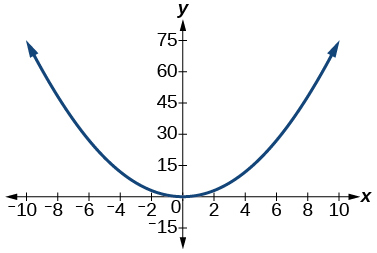
The graph will have the appearance of a power function.

グラフは累乗関数の見た目になる。

Solution 3解答 3

No. Multiple variables may jointly vary.

いいえ。複数の変数が複合的に比例しうる。

Solution 5解答 5

y=5x 2

Solution 7解答 7

y=11944x 3

Solution 9解答 9

y=6x 4

Solution 11解答 11

y=18 x 2

Solution 13解答 13

y=81 x 4

Solution 15解答 15

y=20 x 3

Solution 17解答 17

y=10xzw

Solution 19解答 19

y=10xz

Solution 21解答 21

y=4xz w

Solution 23解答 23

y=40xz w t 2

Solution 25解答 25

y=256

Solution 27解答 27

y=6

Solution 29解答 29

y=6

Solution 31解答 31

y=27

Solution 33解答 33

y=3

Solution 35解答 35

y=18

Solution 37解答 37

y=90

Solution 39解答 39

y=81 2

Solution 41解答 41

y=3 4 x 2

Graph of y=3/4(x^2).

Solution 43解答 43

y=1 3 x

Graph of y=1/3sqrt(x).

Solution 45解答 45

y=4 x 2

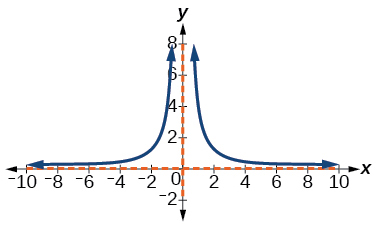
A graph of a function with a vertical dashed asymptote at x=0 and a horizontal dashed asymptote at y=0. The blue curve is symmetric about the y-axis, approaching infinity near x=0 and zero as x extends horizontally.

Solution 47解答 47

1.89 years

1.89年

Solution 49解答 49

0.61 years

0.61年

Solution 51解答 51

3 seconds

3秒

Solution 53解答 53

48 inches

48インチ

Solution 55解答 55

49.75 pounds

49.75ポンド

Solution 57解答 57

33.33 amperes

33.33アンペア

Solution 59解答 59

2.88 inches

2.88インチ

Review Exercises復習問題

Solution 1解答 1

f(x)=(x2) 2 9vertex (2,–9), intercepts (5,0); (–1,0); (0,–5)

Graph of f(x)=x^2-4x-5.

Solution 3解答 3

f(x)=3 25 ( x+2 ) 2 +3

Solution 5解答 5

300 meters by 150 meters, the longer side parallel to river.

300メートル×150メートル。長いほうの辺を川と平行にする。

Solution 7解答 7

Yes, degree = 5, leading coefficient = 4

はい。次数 = 5、最高次係数 = 4

Solution 9解答 9

Yes, degree = 4, leading coefficient = 1

はい。次数 = 4、最高次係数 = 1

Solution 11解答 11

Asx,f(x),asx,f(x)

Solution 13解答 13

–3 with multiplicity 2, 1 2 with multiplicity 1, –1 with multiplicity 3

重複度2の–3、重複度1の 1 2、重複度3の–1

Solution 15解答 15

4 with multiplicity 1

重複度1の4

Solution 17解答 17

1 2 with multiplicity 1, 3 with multiplicity 3

重複度1の 1 2、重複度3の3

Solution 19解答 19

x 2 +4 with remainder 12

x 2 +4、余り12

Solution 21解答 21

x 2 5x+2061 x+3

Solution 23解答 23

2x 2 2x3 , so factored form is (x+4)(2x 2 2x3)

2x 2 2x3 なので、因数分解した形は (x+4)(2x 2 2x3)

Solution 25解答 25

{ 2, 4, 1 2 }

Solution 27解答 27

{ 1, 3, 4, 1 2 }

Solution 29解答 29

0 or 2 positive, 1 negative

正が0個または2個、負が1個

Solution 31解答 31

Intercepts (–2,0)and( 0,2 5 ) , Asymptotes x=5 and y=1.

切片 (–2,0)および( 0,2 5 )、漸近線 x=5y=1.

Graph of f(x)=(x+1)/(x-5).

Solution 33解答 33

Intercepts (3, 0), (-3, 0), and ( 0,27 2 ), Asymptotes x=1, x=2, y=3.

切片 (3, 0)、(-3, 0)、( 0,27 2 )。漸近線 x=1, x=2, y=3.

Graph of f(x)=(3x^2-27)/(x^2+x-2).

Solution 35解答 35

y=x2

Solution 37解答 37

f 1 (x)=x +2

Solution 39解答 39

f 1 (x)=x+11 3

Solution 41解答 41

f 1 (x)=(x+3) 2 5 4 ,x3

Solution 43解答 43

y=64

Solution 45解答 45

y=72

Solution 47解答 47

148.5 pounds

148.5ポンド

Practice Test実力テスト

Solution 1解答 1

Degree: 5, leading coefficient: −2

次数: 5、最高次係数: −2

Solution 3解答 3

As x−∞,f(x), As x,f(x)

Solution 5解答 5

f(x)= 3(x-2)2

Solution 7解答 7

3 with multiplicity 3, 13 with multiplicity 1, 1 with multiplicity 2

重複度3の3、重複度1の 13、重複度2の1

Solution 9解答 9

-12 with multiplicity 3, 2 with multiplicity 2

重複度3の -12、重複度2の2

Solution 11解答 11

x3 + 2x2 + 7x + 14 + 24 x-2

Solution 13解答 13

{–3,–1,32}

Solution 15解答 15

1, −2, and − 32 (multiplicity 2)

1、−2、− 32(重複度2)

Solution 17解答 17

f(x)= -23(x-3)2 (x-1) (x+2)

Solution 19解答 19

2 or 0 positive, 1 negative

正が2個または0個、負が1個

Solution 21解答 21

( -3, 0 ) ( 1, 0 ) ( 0,3 4 )

A graph displays a rational function with three distinct branches. The x-axis ranges from -10 to 10, and the y-axis ranges from -8 to 8, both with increments of 2. There are two vertical dashed asymptotes, one labeled

Solution 23解答 23

f 1 (x)= (x-4)2 +2,x4

Solution 25解答 25

f 1 (x)= x+3 3x-2

Solution 27解答 27

y=20