第5章多項式関数と有理関数Polynomial and Rational Functions
Identifying Zeros and Their Multiplicities零点とその重複度を見分ける
Graphs behave differently at various x-intercepts. Sometimes, the graph will cross over the horizontal axis at an intercept. Other times, the graph will touch the horizontal axis and "bounce" off.
グラフの特徴は x切片ごとに違う。切片で横軸を横切ることもあれば、横軸に触れて「跳ね返る」こともある。
Suppose, for example, we graph the function shown.
たとえば、次の関数のグラフを描いてみよう。
Notice in Figure 7 that the behavior of the function at each of the x-intercepts is different.
図7で、各 x切片での関数のふるまいが違っているのに注目しよう。
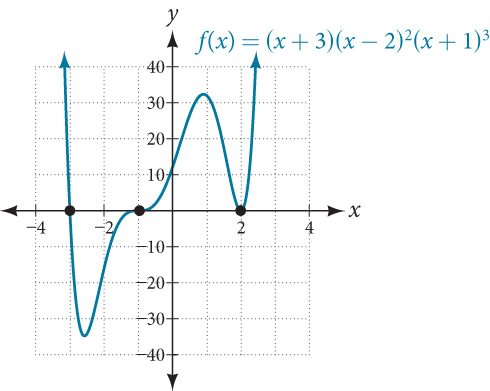
The x-intercept is the solution of equation The graph passes directly through the x-intercept at The factor is linear (has a degree of 1), so the behavior near the intercept is like that of a line—it passes directly through the intercept. We call this a single zero because the zero corresponds to a single factor of the function.
x切片 は方程式 の解である。グラフは の x切片をまっすぐ通り抜ける。この因数は一次(次数が1)なので、切片の近くのふるまいは直線のそれと同じで、切片をまっすぐ通り抜ける。この零点は関数の一つの因数に対応するので、単純零点と呼ぶ。
The x-intercept is the repeated solution of equation The graph touches the axis at the intercept and changes direction. The factor is quadratic (degree 2), so the behavior near the intercept is like that of a quadratic—it bounces off of the horizontal axis at the intercept.
x切片 は方程式 の重解である。グラフは切片で軸に触れ、向きを変える。この因数は二次(次数2)なので、切片の近くのふるまいは二次関数のそれと同じで、切片で横軸から跳ね返る。
The factor is repeated, that is, the factor appears twice. The number of times a given factor appears in the factored form of the equation of a polynomial is called the multiplicity. The zero associated with this factor, has multiplicity 2 because the factor occurs twice.
この因数は重複している。つまり因数 が二度現れる。多項式の方程式を因数分解した形で、ある因数が現れる回数を重複度という。この因数に伴う零点 は、因数 が二度現れるので重複度2である。
The x-intercept is the repeated solution of factor The graph passes through the axis at the intercept, but flattens out a bit first. This factor is cubic (degree 3), so the behavior near the intercept is like that of a cubic—with the same S-shape near the intercept as the toolkit function We call this a triple zero, or a zero with multiplicity 3.
x切片 は因数 の重解である。グラフは切片で軸を通り抜けるが、その前に少し平らになる。この因数は三次(次数3)なので、切片の近くのふるまいは三次関数のそれと同じで、切片の近くで基本関数 と同じS字を描く。これを三重零点、すなわち重複度3の零点と呼ぶ。
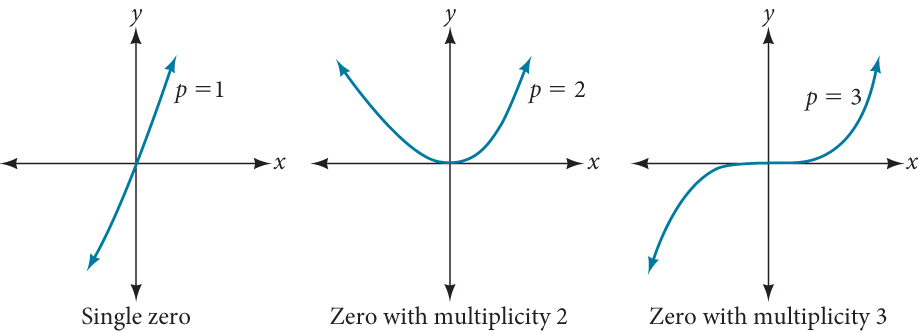
For zeros with even multiplicities, the graphs touch or are tangent to the x-axis. For zeros with odd multiplicities, the graphs cross or intersect the x-axis. See Figure 8 for examples of graphs of polynomial functions with multiplicity 1, 2, and 3.
重複度が偶数の零点では、グラフは x軸に触れる、すなわち接する。重複度が奇数の零点では、グラフは x軸を横切る、すなわち交わる。重複度1、2、3の多項式関数のグラフの例は図8を見よ。
For higher even powers, such as 4, 6, and 8, the graph will still touch and bounce off of the horizontal axis but, for each increasing even power, the graph will appear flatter as it approaches and leaves the x-axis.
4、6、8のようにより高い偶数乗では、グラフはやはり横軸に触れて跳ね返るが、偶数乗が上がるごとに、x軸に近づくときと離れるときのグラフはより平らに見える。
For higher odd powers, such as 5, 7, and 9, the graph will still cross through the horizontal axis, but for each increasing odd power, the graph will appear flatter as it approaches and leaves the x-axis.
5、7、9のようにより高い奇数乗では、グラフはやはり横軸を通り抜けるが、奇数乗が上がるごとに、x軸に近づくときと離れるときのグラフはより平らに見える。
Graphical Behavior of Polynomials at 多項式のグラフの特徴
Graphical Behavior of Polynomials at x-Interceptsx切片での多項式のグラフの特徴
If a polynomial contains a factor of the form the behavior near the intercept is determined by the power We say that is a zero of multiplicity
多項式が の形の因数を含むとき、 切片 の近くのふるまいは、指数 で決まる。 は重複度 の零点であるという。
The graph of a polynomial function will touch the x-axis at zeros with even multiplicities. The graph will cross the x-axis at zeros with odd multiplicities.
多項式関数のグラフは、重複度が偶数の零点では x軸に触れる。重複度が奇数の零点では x軸を横切る。
The sum of the multiplicities is the degree of the polynomial function.
重複度の和は、その多項式関数の次数である。
How To 手順
Given a graph of a polynomial function of degree identify the zeros and their multiplicities.
次の多項式関数のグラフが与えられたとき、零点とその重複度を見分ける。
1. If the graph crosses the x-axis and appears almost linear at the intercept, it is a single zero.2. If the graph touches the x-axis and bounces off of the axis, it is a zero with even multiplicity.3. If the graph crosses the x-axis at a zero, it is a zero with odd multiplicity.4. The sum of the multiplicities is
1. グラフが x軸を横切り、切片でほぼ直線に見えるなら、それは単純零点である。2. グラフが x軸に触れて跳ね返るなら、それは重複度が偶数の零点である。3. グラフがある零点で x軸を横切るなら、それは重複度が奇数の零点である。4. 重複度の和は である。
Example 6例6
Identifying Zeros and Their Multiplicities零点とその重複度を見分ける
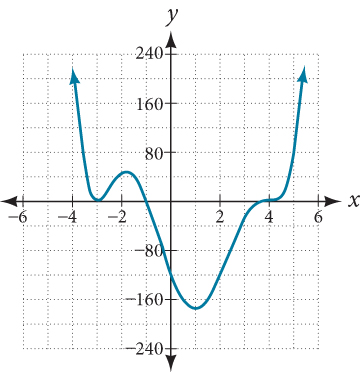
Use the graph of the function of degree 6 in Figure 9 to identify the zeros of the function and their possible multiplicities.
図9の6次の関数のグラフを使って、この関数の零点とそのありうる重複度を見分けよ。
Solution 解答
The polynomial function is of degree 6. The sum of the multiplicities must be 6.
この多項式関数は6次である。重複度の和は6でなければならない。
Starting from the left, the first zero occurs at The graph touches the x-axis, so the multiplicity of the zero must be even. The zero of most likely has multiplicity
左から見ていくと、最初の零点は にある。グラフは x軸に触れているので、この零点の重複度は偶数でなければならない。 の零点は、重複度 である見込みが高い。
The next zero occurs at The graph looks almost linear at this point. This is a single zero of multiplicity 1.
次の零点は にある。この点でグラフはほぼ直線に見える。これは重複度1の単純零点である。
The last zero occurs at The graph crosses the x-axis, so the multiplicity of the zero must be odd. We know that the multiplicity is likely 3 and that the sum of the multiplicities is 6.
最後の零点は にある。グラフは x軸を横切るので、この零点の重複度は奇数でなければならない。重複度はおそらく3で、重複度の和が6になると分かる。
Try It #2やってみよう2
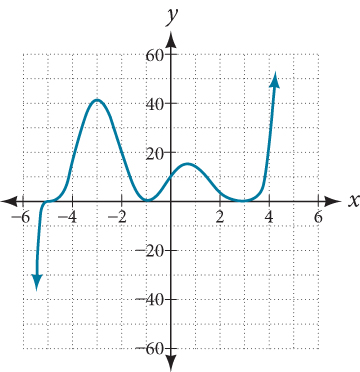
Use the graph of the function of degree 9 in Figure 10 to identify the zeros of the function and their multiplicities.
図10の9次の関数のグラフを使って、この関数の零点とその重複度を見分けよ。