第1章過去を理解するUnderstanding the Past
1.2 Primary Sources1.2 一次史料
Learning Objectives学習の目標
By the end of this section, you will be able to:
この節を学ぶと、次のことができるようになる。
Identify different types of primary sources
一次史料のさまざまな種類を区別する。
Analyze primary sources in a historical context
歴史的な文脈のなかで一次史料を分析する。
Interpret primary sources effectively
一次史料を適切に解釈する。
Historians develop interpretations of the past based on source material, and we do the same in this book. From ancient hieroglyphs to works of art to blog posts, from histories and biographies written by later scholars to Google Maps, sources help us build our interpretations of the human story.
英語のヒント
歴史家は史料に基づいて過去の解釈を組み立てる。本書でも同じことを行う。古代の象形文字、美術作品、ブログの記事、後世の学者が書いた歴史書や伝記、Googleマップまで、さまざまな史料が、人類の歩みの解釈を組み立てる助けになる。
Learning to Evaluate Documents and Images文書や画像を評価する方法を学ぶ
There are two main kinds of historical sources, primary and secondary. A primary source is a gateway to the past because it is an object or document that comes directly from the time period to which it refers. Primary sources might be government documents, menus from restaurants, diaries, letters, musical instruments, photographs, portraits drawn from life, songs, and so on. If a historian is looking at Ancient Egypt, a statue of a pharaoh is a primary source for that time period, as are hieroglyphs that tell of the pharaoh’s reign. Primary sources, when we have them, are considered more valuable than other sources because they are as close in time as we can get to the events being studied. Think, for example, of a court trial: The ideal is to have the trial quickly so that witness testimony is fresher and therefore more reliable. With the passage of time, people can forget, they might subconsciously add or take away parts of a memory, and they may be influenced to interpret events differently.
英語のヒント
歴史史料は、大きく一次史料と二次史料の二種類に分かれる。一次史料は、扱っている時代そのものに由来する物や文書なので、過去への入り口となる。政府文書、飲食店のメニュー、日記、手紙、楽器、写真、本人を前にして描かれた肖像画、歌などが一次史料になりうる。歴史家が古代エジプトを研究しているなら、ファラオの像はその時代の一次史料であり、ファラオの統治を伝えるヒエログリフもそうである。一次史料が残っていれば、ほかの史料より価値が高いとされる。研究対象の出来事に、時間的にできるかぎり近づけるからである。たとえば裁判を考えてみよう。証言者の記憶がより新しく、そのぶん信頼できるうちに、速やかに審理を行うのが理想である。時間がたつと、人は忘れたり、無意識に記憶の一部を付け足したり削ったりすることがあり、影響を受けて出来事を別のように解釈する場合もある。
A secondary source is one written or created after the fact. A twentieth-century biography of an Egyptian pharaoh is a secondary source, as are a map drawn in the 1960s to identify the battle sites of World War II (1939–1945) and a museum curator’s blog post about the artistic achievements of the Ming (1368–1644). These types of scholarly sources are critical for the evolution of historical knowledge and are often the place students begin to form an understanding of past events. Secondary sources are useful for setting context and placing a topic in relationship to others of the same era. They also provide access to scholarly research based on primary sources for students whose access might be limited by language or geography. Good research requires both types of sources and some attention to historiography, which is the study of how other historians have already interpreted and written about the past.
英語のヒント
二次史料とは、出来事が起きた後に書かれたり作られたりした史料である。20世紀に書かれたエジプトのファラオの伝記、第二次世界大戦(1939~1945年)の戦場を示すために1960年代に描かれた地図、明代(1368~1644年)の美術的成果について博物館の学芸員が書いたブログ記事は、いずれも二次史料に当たる。こうした学術的な史料は歴史知識の発展に欠かせず、学生が過去の出来事について理解を深め始める際の出発点となることも多い。二次史料は、背景を示し、ある話題を同時代のほかの話題との関係のなかに位置付けるのに役立つ。また、言語や地理的な制約で一次史料に触れにくい学生にも、一次史料に基づく学術研究への道を開く。よい研究には両方の種類の史料が必要であり、ほかの歴史家がすでに過去をどのように解釈し、書いてきたかを研究する「歴史学史」にも目を向けなければならない。
All primary sources are not equal. History technically begins with the advent of writing, when humans began to deliberately make records and, after that, to develop the idea that preserving the past was a worthwhile endeavor. This is not to say that there isn’t anything valuable to be found in the oral histories of preliterate societies, or in prehistoric cave paintings and archaeological artifacts. For historians, however, the written word is more accurate evidence for building narratives of the past. For example, imagine a modern magazine with a rock or pop star on the front, dressed for performance in a vibrant or provocative style. If that were the only piece of evidence that existed five hundred years from now, how would historians interpret our era? Without context, interpretation of the past is quite difficult. Studying artifacts is certainly worthwhile, but text offers us greater clarity. Even if the cover of the magazine bore only a caption, like “Pop star rising to the top of the charts,” future historians would have significantly more information than from the photo alone. However, even textual sources must be met with a critical eye. “Fake news” is not new, but the speed at which it travels today is unprecedented. We must investigate the full context of any source and look for corroboration.
英語のヒント
一次史料なら何でも同じ価値があるわけではない。厳密な意味での歴史は、文字の出現から始まる。人類が意図的に記録を残し始め、その後、過去を保存することには価値があると考えるようになったときである。これは、文字を持たない社会の口承史や、先史時代の洞窟壁画、考古学的な遺物に価値あるものが見いだせないという意味ではない。しかし歴史家にとって、文字で書かれた言葉は、過去の叙述を組み立てるための、より正確な証拠となる。たとえば、ロックやポップスのスターが、舞台用の鮮やかな、あるいは挑発的な服装で表紙を飾る現代の雑誌を想像してみよう。今から500年後に残る証拠がそれだけだとしたら、歴史家は私たちの時代をどう解釈するだろうか。背景がなければ、過去の解釈はかなり難しい。遺物を研究することにはもちろん価値があるが、文章があれば、よりはっきりと理解できる。雑誌の表紙に「チャートの首位へ駆け上がるポップスター」という説明が一言あるだけでも、将来の歴史家は写真だけの場合よりはるかに多くの情報を得られる。ただし、文字史料にも批判的な目を向けなければならない。「フェイクニュース」は新しい現象ではないが、今日の拡散速度はかつてないものだ。どの史料についても背景全体を調べ、裏付けを探す必要がある。
It takes time to develop the skills necessary to interpret primary sources. As an example, consider the act of reading a poem. You can read the surface of a poem, the literal meaning of the words presented. But that seldom reflects the true meaning the poet meant to convey. You must also look for nuances, hidden meanings, or repeated metaphors. We approach a primary source in a similar way.
英語のヒント
一次史料を解釈するために必要な技能を身に付けるには、時間がかかる。例として、詩を読むことを考えてみよう。詩の表面、つまりそこにある言葉の文字どおりの意味を読むことはできる。しかしそれだけでは、詩人が伝えようとした本当の意味は、めったに捉えられない。微妙な含み、隠れた意味、繰り返される比喩にも目を向ける必要がある。一次史料にも、これと似た方法で向き合う。
There are four key areas to consider when interpreting sources: the author, the audience, the intent, and the context. Here are some key questions to ask yourself when exploring a new source:
英語のヒント
史料を解釈するときには、書き手、読み手、意図、文脈という四つの重要な点を考える。新しい史料を調べるとき、自分に問いかけるべき重要な問いをいくつか挙げよう。
What kind of source is it? Government documents have a different purpose than personal diaries. A former president commenting on a political issue has a different view from a comedian doing the same.
どのような種類の史料だろうか。政府文書は個人の日記とは目的が異なる。政治問題について発言する元大統領の見方は、同じことをするコメディアンの見方とは異なる。
Who authored the source and why? Is the author responsible for simply recording the information, or was the author involved in the event? Is the author reliable, or does the author have an agenda?
英語のヒント
誰が、なぜその史料を作ったのだろうか。書き手は情報を記録しただけなのか、それとも出来事に関与していたのか。書き手は信頼できるのか、それとも何らかの思惑があるのか。
What is the historical context? How does the source relate to the events covered in the chapter?
歴史的な文脈は何だろうか。その史料は、この章で扱う出来事とどのように関係しているだろうか。
None of the answers disqualify a source from adding value, but precisely what that source brings to the overall picture depends heavily on those answers.
英語のヒント
どのような答えが出たとしても、それだけでその史料に価値がなくなるわけではない。しかし、その史料が全体像に具体的に何をもたらすかは、これらの答えに大きく左右される。
In a world where many sources are available in digital format, searching online, as many students do, is a convenient way of doing research. But the internet has just as much misinformation as it has legitimate sources. Historians evaluate the strength of both primary and secondary sources, especially online. How do we decide what a good source is? Some clues are more obvious than others. For example, it is unlikely any truly scholarly material will be found on the first page of a Google search, unless the search terms include key phrases or use targeted search engines such as Google Scholar. Online encyclopedias may be a good place to start your research, but they should be only a springboard to more refined study.
英語のヒント
多くの史料がデジタル形式で利用できる今日、多くの学生がしているように、インターネットで検索するのは便利な調査方法である。しかしネット上には、正当な資料と同じくらい誤情報もある。歴史家は一次史料と二次史料の双方の確かさを評価する。オンラインの史料では、特にそうである。よい史料かどうかは、どう判断すればよいのだろうか。手がかりには、分かりやすいものも分かりにくいものもある。たとえば、検索語に重要な語句を入れるか、Google Scholarのような対象を絞った検索エンジンを使わなければ、Google検索の最初のページに真に学術的な資料が出てくる可能性は低い。オンライン百科事典は調査のよい出発点になりうるが、より精密な研究へ進むための足掛かりにとどめるべきである。
Your work is only as strong as the sources you use. Whether you are writing a paper, a discussion post online, or even a creative writing piece, the better your sources, the more persuasive will be your writing. Sites like Wikipedia and Encyclopedia.com offer a quick view of content, but they will not give enough depth to allow for the critical thinking necessary to produce quality work. However, they are useful for introducing a topic with which you might not be familiar. And if you start with encyclopedic sources, you can often find pathways to better sources. They might spark new lines of inquiry, for instance, or have bibliographic information that can lead you to higher-quality material.
英語のヒント
あなたの文章の確かさは、使う史料の確かさにかかっている。論文、ネット上の議論への投稿、さらには創作であっても、史料がよいほど文章の説得力は増す。WikipediaやEncyclopedia.comのようなサイトでは、内容を手早く把握できる。しかし、質の高い成果を生むために必要な批判的思考を行えるだけの深さは得られない。それでも、なじみのない話題を知る入り口としては役に立つ。百科事典的な資料から始めれば、よりよい史料へ進む道が見つかることも多い。たとえば、新たな問いを思い付くきっかけになったり、より質の高い資料へ導く参考文献情報が載っていたりする。
Always make sure you can tell who is producing the website. Is it a scholar, a museum, or a research organization? If so, there is a good chance the material is sound. Is the information cited? In other words, does the source tell you where it got the information? Are those sources in turn objective and reliable? Can you corroborate the site’s information? This means doing some fact checking. You should see whether other sources present similar data and whether your source fits into the narrative developed by other scholars. Does your school library list the site as a resource? Finally, if you are not sure, ask. Librarians work in online spaces too, and you can generally reach out to these experts with any questions.
英語のヒント
ウェブサイトを誰が作っているのか、必ず確認しよう。研究者、博物館、研究機関だろうか。そうであれば、資料が確かなものである可能性は高い。情報の出典は示されているだろうか。つまり、その史料は情報をどこから得たかを明示しているだろうか。その出典自体も客観的で信頼できるだろうか。サイトの情報を裏付けられるだろうか。これは、事実確認を行うということである。ほかの史料も同様のデータを示しているか、その史料がほかの研究者による叙述と整合しているかを調べよう。学校の図書館はそのサイトを資料として挙げているだろうか。最後に、判断に迷ったら質問しよう。図書館員はオンラインでも活動しており、たいていは疑問があれば、こうした専門家に相談できる。
As you explore world history via this text, you will be asked many times to read and interpret primary sources. These will normally be set off as feature boxes, as noted earlier. Let’s work through a few examples. The goal is to become more familiar with the types of questions you should ask of sources, as well as the variety of sources you will work with throughout the text.
英語のヒント
この教科書で世界史を学ぶなかで、一次史料を読み、解釈することが何度も求められる。先に述べたように、そうした史料は通常、特集欄にまとめてある。いくつか例を見てみよう。史料に対して立てるべき問いと、本書を通じて扱う史料の多様さに、よりなじむことが目的である。
First, an image exercise. The following images are exterior and interior views of the Hagia Sophia in Istanbul, a wonder of the late antique world whose name means “Holy Wisdom” in Greek. Buildings and other material objects change as they are affected by historical events. Images of them can tell us much about those events and the people who enter or interact with them.
英語のヒント
まず、画像を使う練習である。以下の画像は、イスタンブルのハギア・ソフィアの外観と内部を示している。古代末期の驚異とされる建造物で、その名はギリシア語で「聖なる知恵」を意味する。建物などの物的なものは、歴史上の出来事の影響を受けて変化する。その画像からは、それらの出来事や、その場所に入り、関わりを持つ人々について、多くのことが分かる。
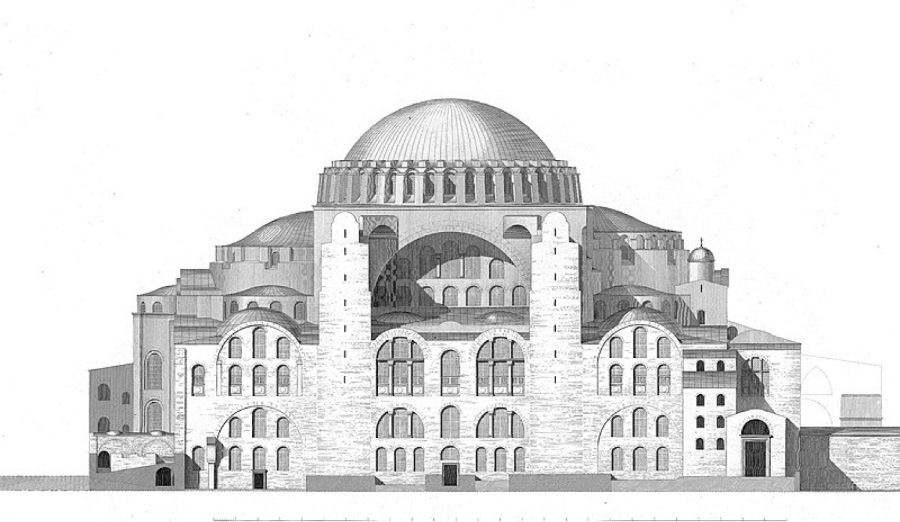
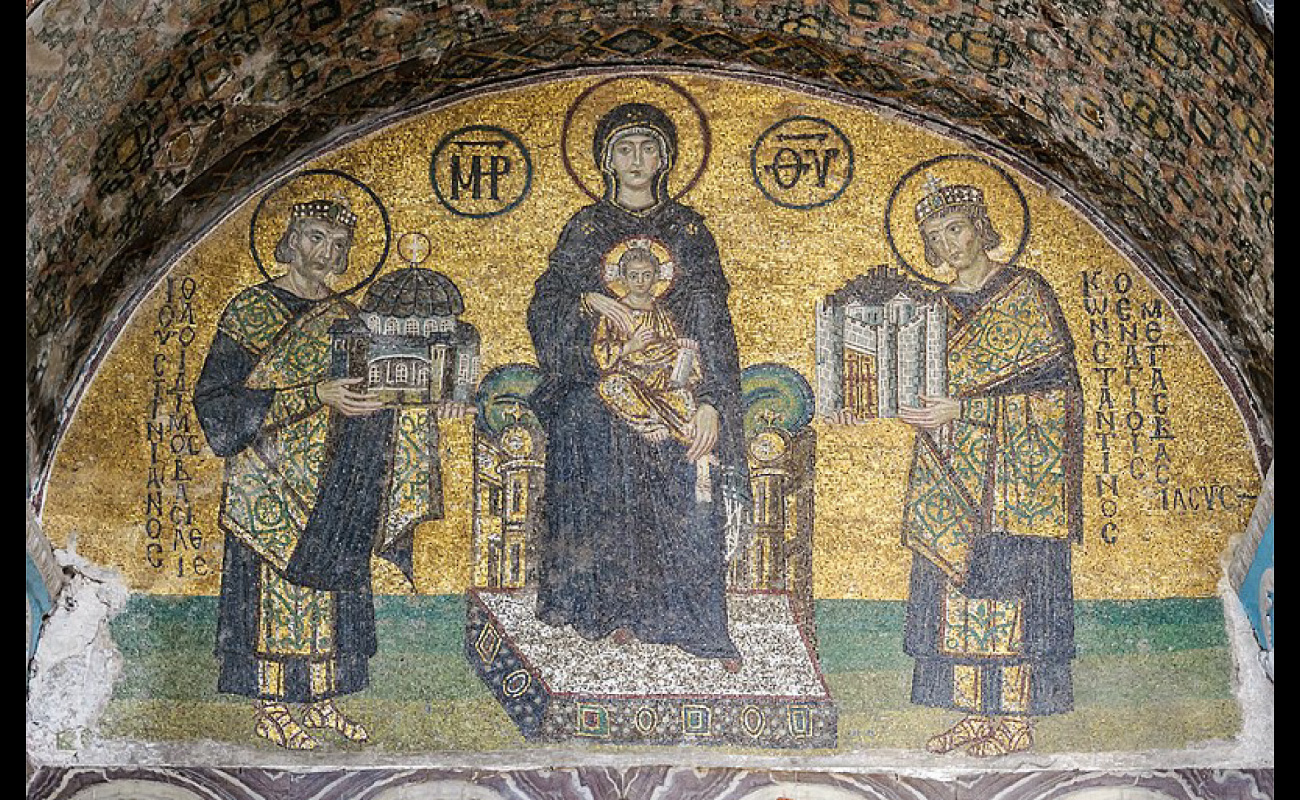
The first set of images (Figure 1.4 and Figure 1.5) provide a likeness of the famous church at the time it was built, during the reign of the Byzantine emperor Justinian I (483–565 CE). The domed structure was unique for its engineering and stunning in its effect. Decorated with Greek iconography, the visual images and symbols used in a work of art, the basilica stood as an emblem of Justinian’s power, the awesome nature of the Christian God, and the surviving wealth and stability of the East. Churches at the time were meant to inspire awe; because most people could not read, stories of religious figures and events were told through highly decorative and symbolic images, and obedience and a desire to join a religious community could be motivated by the buildings’ grandeur. As you study the renderings, reflect on the following questions: What are the key features of the building? What does it make you think about? What does it tell you about the period in which it was built? What would you think about it if you were a poor sixth-century farmer, an urban merchant of some wealth, or a foreign leader?
英語のヒント
最初の一組の画像(図1.4と図1.5)は、ビザンツ皇帝ユスティニアヌス1世(483~565年)の治世に建てられた、有名な教会の姿を示している。このドームを備えた建物は、建築技術の点で独特であり、見る者に圧倒的な印象を与えた。美術作品で使う視覚的な像や象徴、すなわちギリシア的な図像で飾られたこの聖堂は、ユスティニアヌスの権力、キリスト教の神の畏怖すべき性質、そして東方に保たれていた富と安定を象徴していた。当時の教会は、畏敬の念を起こさせることを意図していた。多くの人は文字を読めなかったため、宗教上の人物や出来事の物語は、装飾的で象徴性の高い画像を通して語られた。また、壮大な建物は服従を促し、信仰の共同体に加わりたいという気持ちを起こさせることができた。これらの表現を見ながら、次の問いを考えよう。建物の主な特徴は何だろうか。何を連想するだろうか。建てられた時代について、何が読み取れるだろうか。もし自分が6世紀の貧しい農民、ある程度裕福な都市商人、あるいは外国の支配者だったなら、この建物をどう思うだろうか。
Exterior of Hagia Sophia.ハギア・ソフィアの外観
(credit: “Saint Sophia, Constantinopolis” by ETH Library/Wikimedia Commons, Public Domain) · Public Domain
Figure 1.4 Note the domes and archways in this drawing of the exterior of the Hagia Sophia. Such architectural features were particularly hard to build during the sixth century and often collapsed because the engineering was flawed. Thanks to their durability, those of Hagia Sophia were a marvel at the time it was built. (credit: “Saint Sophia, Constantinopolis” by ETH Library/Wikimedia Commons, Public Domain)
図1.4 ハギア・ソフィアの外観を描いたこの図では、ドームとアーチに注目しよう。こうした構造は6世紀には特に建設が難しく、技術上の欠陥から崩壊することも多かった。ハギア・ソフィアのドームやアーチは丈夫だったため、建設当時の人々を驚嘆させた。(出典:ETH Library/Wikimedia Commons「Saint Sophia, Constantinopolis」、パブリックドメイン)
Interior of Hagia Sophia.ハギア・ソフィアの内部
(credit: “Hagia Sophia Southwestern entrance mosaics 2” by “Myrabella”/Wikimedia Commons, CC0 1.0) · CC0 1.0
Figure 1.5 The Greek Christian iconography found in the interior of the Hagia Sophia includes halos on the figures, signifying holiness. Also note the lavish use of precious gold in this tenth-century mosaic of Mary and the child Jesus (center), and the emperors Justinian (left), and Constantine (right). (credit: “Hagia Sophia Southwestern entrance mosaics 2” by “Myrabella”/Wikimedia Commons, CC0 1.0)
図1.5 ハギア・ソフィア内部のギリシア系キリスト教の図像には、聖性を示す光輪が描かれている。10世紀のこのモザイクには、中央の聖母マリアと幼児イエス、左のユスティニアヌス帝、右のコンスタンティヌス帝が描かれ、貴重な金がふんだんに使われている点にも注目しよう。(出典:Myrabella/Wikimedia Commons「Hagia Sophia Southwestern entrance mosaics 2」、CC0 1.0)
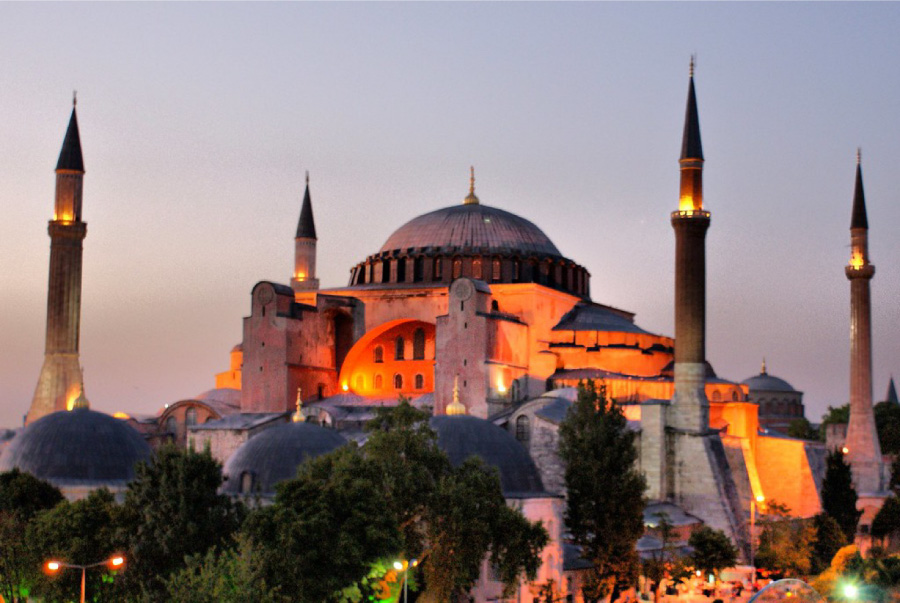
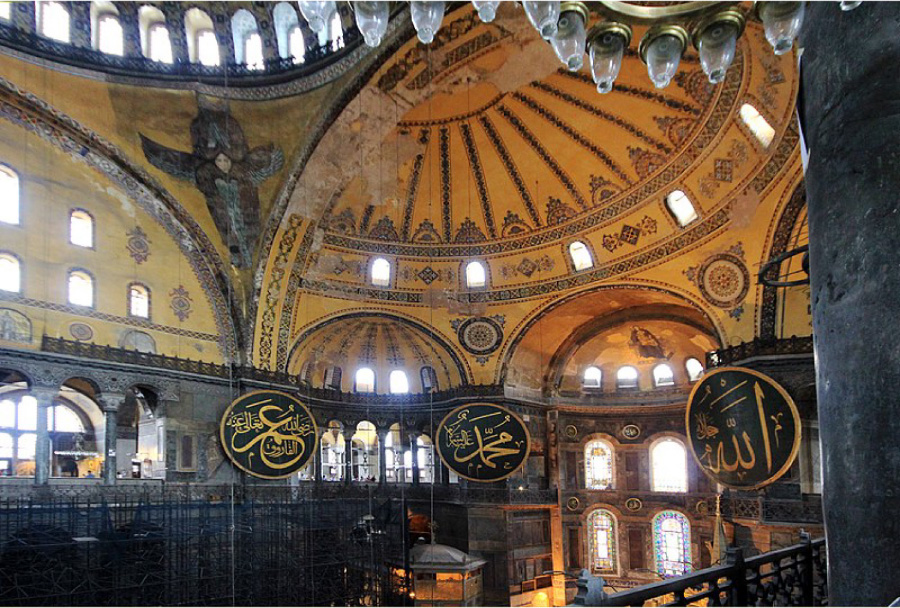
In 1453, nearly a thousand years after the reign of Justinian, the city of Constantinople (now called Istanbul in present-day Turkey) was conquered by Muslim Turks. According to contemporary accounts of the conquest, when the Ottoman leader Sultan Mehmed II came to the Hagia Sophia, he recognized its beauty and saved it from destruction. To Muslims, the Christian God and the Muslim God are the same, so Mehmed made the church a mosque—following a long tradition in the Middle East of continuing the use of sacred spaces. Minarets, towers from which the Muslim call to prayer is issued, were added at the four corners of the building, and Arabic writing was placed beside the ancient Greek iconography.
英語のヒント
ユスティニアヌスの治世からおよそ1000年後の1453年、コンスタンティノープル(現在のトルコのイスタンブル)は、ムスリムのトルコ人に征服された。征服当時の記録によれば、オスマン帝国の君主スルタン・メフメト2世は、ハギア・ソフィアを訪れるとその美しさを認め、破壊から守った。ムスリムにとって、キリスト教の神とイスラームの神は同じである。そのためメフメトは、聖なる場所を引き続き用いるという中東の長い伝統に従い、この教会をモスクにした。建物の四隅には、礼拝への呼びかけを行う塔であるミナレットが加えられ、古いギリシアの図像の隣にはアラビア文字が置かれた。
The second set of images (Figure 1.6 and Figure 1.7) show the Hagia Sophia as it stands today, having also been a museum and now serving as a mosque once again. The building tells a tale spanning hundreds of years and highlights many fascinating aspects of the region’s history. But without the context, its meaning would be far less clear.
英語のヒント
次の一組の画像(図1.6と図1.7)は、現在のハギア・ソフィアを示している。博物館だった時期を経て、今では再びモスクとして使われている。この建物は数百年にわたる物語を伝え、この地域の歴史のさまざまな興味深い側面を浮かび上がらせる。しかし背景を知らなければ、その意味ははるかに分かりにくくなる。
Hagia Sophia’s Minarets.ハギア・ソフィアのミナレット
(credit: “Hagia Sophia (Istanbul)” by Frank Mago/Flickr, CC BY 2.0) · CC BY 2.0
Figure 1.6 Hagia Sophia has four tall minarets, which were added a thousand years after its initial construction. Minarets are towers from which the Muslim call to prayer goes out multiple times a day. (credit: “Hagia Sophia (Istanbul)” by Frank Mago/Flickr, CC BY 2.0)
図1.6 ハギア・ソフィアには、最初の建設から1000年後に加えられた4本の高いミナレットがある。ミナレットは、1日に何度もムスリムの礼拝への呼びかけを行う塔である。(出典:Frank Mago/Flickr「Hagia Sophia (Istanbul)」、CC BY 2.0)
Hagia Sophia’s Many Influences.ハギア・ソフィアに重なるさまざまな影響
(credit: “Hagia Sophia Istanbul 2013 13” by Karelj/Wikimedia Commons, Public Domain) · Public Domain
Figure 1.7 Muslims consider themselves the heirs of Judaism and Christianity, and until recently, you could still see the early Greek iconography in the interior of Hagia Sophia. Now it is covered during prayer times by large medallions bearing Arabic writing. (credit: “Hagia Sophia Istanbul 2013 13” by Karelj/Wikimedia Commons, Public Domain)
図1.7 ムスリムは自分たちをユダヤ教とキリスト教の継承者と考えている。少し前までは、ハギア・ソフィア内部で初期のギリシアの図像をそのまま見ることができた。現在は、礼拝の時間中、アラビア文字を記した大きな円形の額によって覆われる。(出典:Karelj/Wikimedia Commons「Hagia Sophia Istanbul 2013 13」、パブリックドメイン)