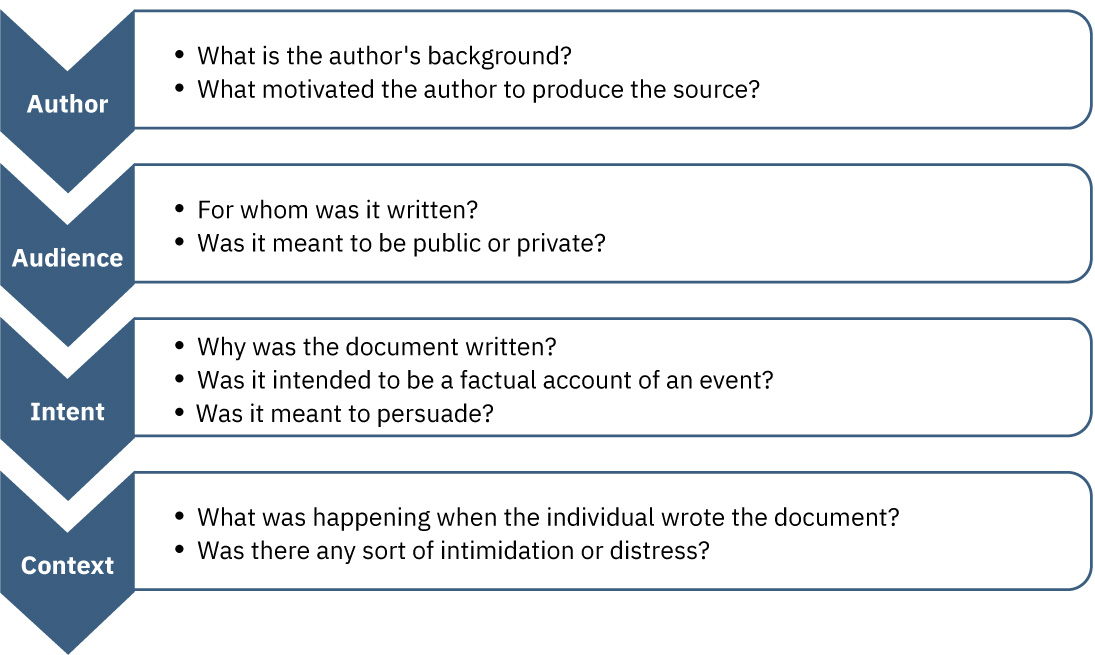
Textual, or written, primary sources are considered the best possible resource for historians. They tend to offer both far more context and far more information than other types of sources, and sometimes clues about the writer’s intent. But even they must be approached with method and scrutiny. We must evaluate the author, audience, intent, and context in order to accurately interpret a primary source document. Some questions you might ask about the author include the following: Who wrote the piece and what is their background? What was important to the author? Why might the author have written what they did? In some cases, the answers will be fairly obvious. In others, a deeper inspection might reveal hidden motives.
You must also take into account the planned audience for a document: For whom was it written? Was it meant to be public or private? Is it a letter to a friend or an essay submitted for publication? For a modern example, is it a text to a friend or to a mother? Texts will one day be a source for historians to use, but knowing who sent them, and to whom, will be essential to interpreting them correctly. (For fun, search online using the term “misinterpreted texts.”)
In addition to considering the audience, you should think about the intent: Why was the document written? Was it intended to be a factual account of an event? Was it meant to persuade? Is it a complete falsification? Often people write things that present them in the best light rather than reveal weaknesses.
Finally, you should reflect on the circumstances of the document’s creation. Some questions you may want to ask include the following: What is the general time period of the document, and what was that time like? What was happening when the individual wrote the document? Was there any sort of intimidation or distress? Is it a time of war or peace? Is there religious conflict? Is there an economic crisis? A health crisis? A natural disaster? Could the writer have been fending off an attack or lobbying for one? Are we missing other perspectives or voices we would like to hear?
The answers to these questions will shape your interpretation of the primary source and bring you closer to its true meaning. Most text-based sources have meanings beyond the obvious, and it is the historian’s job to uncover these. Be sure to keep these questions in mind throughout this course and whenever you undertake historical research or are considering the accuracy of information you encounter (Figure 1.8).
(attribution: Copyright Rice University, OpenStax, under CC BY 4.0 license) · CC BY 4.0
Figure 1.8 These key questions to ask about primary sources help us evaluate the author, audience, intent, and context. (attribution: Copyright Rice University, OpenStax, under CC BY 4.0 license)
図1.8 一次史料について立てるこれらの重要な問いは、書き手、読み手、意図、文脈を評価する助けとなる。(権利表示:Copyright Rice University, OpenStax、CC BY 4.0)
To gain experience using these questions, consider the two accounts in Child Labor in Great Britain, both recorded in the Hansard, the official report of debates in Parliament and dealing with the same subject from different perspectives. According to the first account, which is recorded as a direct speech delivered to Britain’s House of Commons (one of the two chambers of Parliament) on March 16, 1832, by reformer Michael Sadler, children who worked in textile factories suffered terribly. The second account, which is a reporting of the speech delivered to the House of Commons by one of Sadler’s opponents, John Thomas Hope, argues that child labor is not necessarily a bad thing. What should historians do with such competing texts? How do they decide what each one adds to the true story of child labor in the Industrial Revolution? If you were to read only one of these accounts, what important information or point of view would you miss? As you read, keep these questions in mind.