第13章産業・組織心理学
13.4 Human Factors Psychology and Workplace Design13.4 ヒューマンファクター心理学と職場の設計
Learning Objectives学習目標
By the end of this section, you will be able to:
この節を学び終えると、次のことができるようになる。
- Describe the field of human factors psychologyヒューマンファクター心理学という分野について説明する
- Explain the role of human factors psychology in safety, productivity, and job satisfaction安全、生産性、職務満足においてヒューマンファクター心理学が果たす役割を説明する
Human factors psychology (or ergonomics, a term that is favored in Europe) is the third subject area within industrial and organizational psychology. This field is concerned with the integration of the human-machine interface in the workplace, through design, and specifically with researching and designing machines that fit human requirements. The integration may be physical or cognitive, or a combination of both. Anyone who needs to be convinced that the field is necessary need only try to operate an unfamiliar television remote control or use a new piece of software for the first time. Whereas the two other areas of I-O psychology focus on the interface between the worker and team, group, or organization, human factors psychology focuses on the individual worker’s interaction with a machine, work station, information displays, and the local environment, such as lighting. In the United States, human factors psychology has origins in both psychology and engineering; this is reflected in the early contributions of Lillian Gilbreth (psychologist and engineer) and her husband Frank Gilbreth (engineer).
英語のヒント
ヒューマンファクター心理学(または人間工学。ヨーロッパではこちらの用語が好まれる)は、産業・組織心理学の中の三つ目の領域である。この分野が扱うのは、設計を通じて職場のヒューマン・マシン・インターフェースを統合すること、とりわけ、人間の要件に合う機械を研究し設計することである。この統合は、身体的なものである場合も、認知的なものである場合も、その両方の組み合わせである場合もある。この分野の必要性にまだ納得できない人は、使い慣れないテレビのリモコンを操作してみるか、新しいソフトウェアを初めて使ってみさえすればよい。I-O心理学のほかの二つの領域が、労働者と、チーム、集団、あるいは組織とのあいだの接点に焦点を当てるのに対して、ヒューマンファクター心理学は、個々の労働者と、機械、作業場所、情報表示装置、そして照明などの周囲の環境との相互作用に焦点を当てる。アメリカでは、ヒューマンファクター心理学は心理学と工学の両方に起源を持つ。このことは、リリアン・ギルブレス(心理学者であり技術者)とその夫フランク・ギルブレス(技術者)の初期の貢献に表れている。
Human factor professionals are involved in design from the beginning of a project, as is more common in software design projects, or toward the end in testing and evaluation, as is more common in traditional industries (Howell, 2003). Another important role of human factor professionals is in the development of regulations and principles of best design. These regulations and principles are often related to work safety. For example, the Three Mile Island nuclear accident lead to Nuclear Regulatory Commission (NRC) requirements for additional instrumentation in nuclear facilities to provide operators with more critical information and increased operator training (United States Nuclear Regulatory Commission, 2013). The American National Standards Institute (ANSI, 2000), an independent developer of industrial standards, develops many standards related to ergonomic design, such as the design of control-center workstations that are used for transportation control or industrial process control.
英語のヒント
ヒューマンファクターの専門家は、プロジェクトの初めから設計にかかわることもあれば、終わり近くになって試験と評価の段階でかかわることもある。前者はソフトウェア設計のプロジェクトで、後者は伝統的な産業で、より一般的である(Howell, 2003)。ヒューマンファクターの専門家のもう一つの重要な役割は、規制や最良の設計の原則をつくることにある。こうした規制や原則は、多くの場合、労働安全にかかわっている。たとえば、スリーマイル島の原子力事故は、米国原子力規制委員会(NRC)による次のような要件につながった。運転員により多くの重要な情報を与えるために原子力施設に計測機器を追加することと、運転員の訓練を増やすことである(United States Nuclear Regulatory Commission, 2013)。工業規格を策定する独立機関である米国規格協会(ANSI, 2000)は、交通管制や工業プロセスの制御に使われる管制センターの作業卓の設計など、人間工学的な設計にかかわる規格を数多く策定している。
Many of the concerns of human factors psychology are related to workplace safety. These concerns can be studied to help prevent work-related injuries of individual workers or those around them. Safety protocols may also be related to activities, such as commercial driving or flying, medical procedures, and law enforcement, that have the potential to impact the public.
英語のヒント
ヒューマンファクター心理学の関心事の多くは、職場の安全にかかわっている。こうした関心事を研究すれば、個々の労働者やその周囲にいる人々が仕事に関連したけがを負うのを防ぐ助けになりうる。安全手順は、業務としての運転や飛行、医療処置、法執行など、一般の人々に影響を与える可能性のある活動にかかわる場合もある。
One of the methods used to reduce accidents in the workplace is a checklist. The airline industry is one industry that uses checklists. Pilots are required to go through a detailed checklist of the different parts of the aircraft before takeoff to ensure that all essential equipment is working correctly. Astronauts also go through checklists before takeoff. The surgical safety checklist shown in Figure 13.15 was developed by the World Health Organization (WHO) and serves as the basis for many checklists at medical facilities.
英語のヒント
職場での事故を減らすために使われる方法の一つに、チェックリストがある。航空業界は、チェックリストを使う業界の一つである。パイロットは離陸前に、必要不可欠な装置がすべて正しく作動していることを確かめるため、機体のさまざまな部分についての詳細なチェックリストをひととおり確認することを義務づけられている。宇宙飛行士も、打ち上げ前にチェックリストを確認する。図13.15に示した手術安全チェックリストは世界保健機関(WHO)が作成したもので、医療施設で使われる多くのチェックリストのもとになっている。
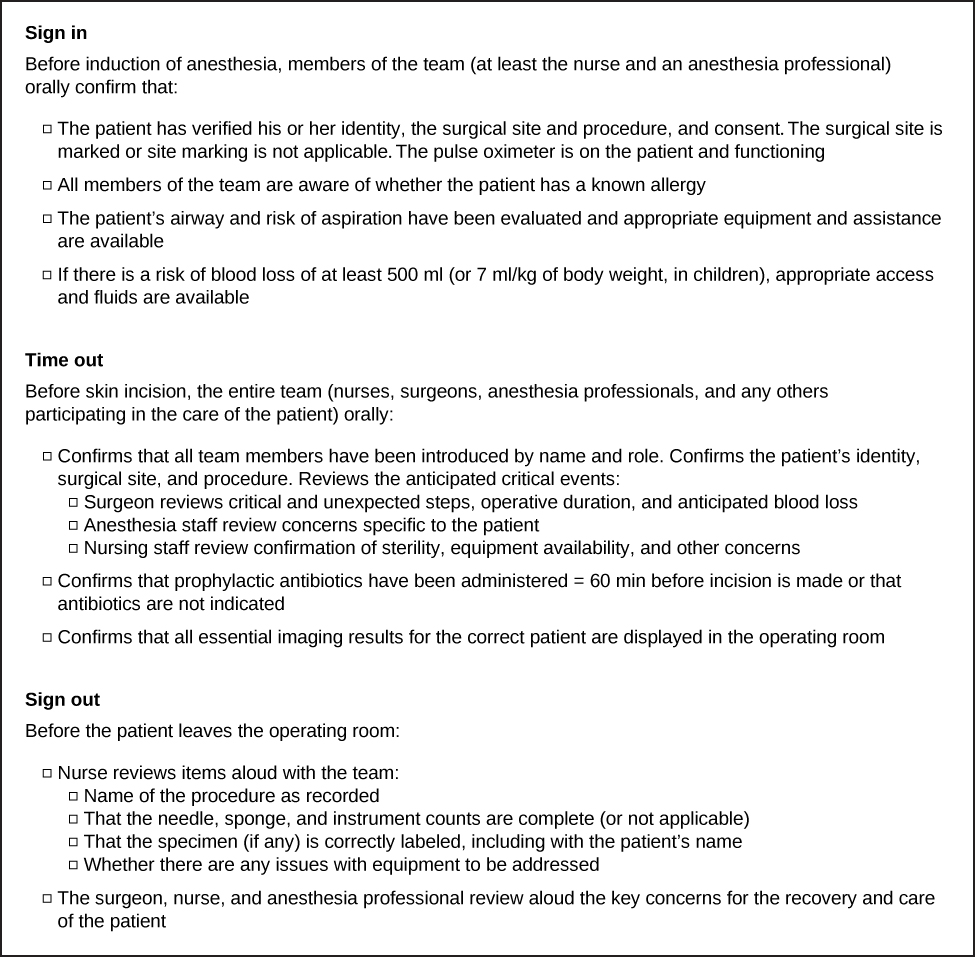

Figure 13.15図 13.15
Checklists, such as the WHO surgical checklist shown here, help reduce workplace accidents.
ここに示したWHOの手術チェックリストのようなチェックリストは、職場の事故を減らすのに役立つ。
Safety concerns also lead to limits to how long an operator, such as a pilot or truck driver, is allowed to operate the equipment. Recently the Federal Aviation Administration (FAA) introduced limits for how long a pilot is allowed to fly without an overnight break.
英語のヒント
安全上の懸念は、パイロットやトラック運転手のような操作者が装置を操作してよい時間の上限にもつながっている。最近、連邦航空局(FAA)は、パイロットが一晩の休息をとらずに飛行してよい時間の上限を設けた。
Howell (2003) outlines some important areas of research and practice in the field of human factors. These are summarized in Table 13.4.
英語のヒント
ハウエル(2003)は、ヒューマンファクターの分野における研究と実践の重要な領域をいくつか概説している。それらを表13.4にまとめる。
Areas of Study in Human Factors Psychology ヒューマンファクター心理学の研究領域 |
||
|---|---|---|
Area 領域 |
Description 説明 |
I-O Questions I-O心理学の問い |
Attention 注意 |
Includes vigilance and monitoring, recognizing signals in noise, mental resources, and divided attention ヴィジランス(注意の持続)と監視、ノイズの中の信号の認識、心的資源、分割的注意を含む |
How is attention maintained? What about tasks maintains attention? How to design systems to support attention? 注意はどのように維持されるのか。タスクのどのような点が注意を維持させるのか。注意を支えるには、システムをどう設計すればよいか。 |
Cognitive engineering 認知工学 |
Includes human software interactions in complex automated systems, especially the decision-making processes of workers as they are supported by the software system 複雑な自動化システムにおける人間とソフトウェアの相互作用、とくにソフトウェアシステムに支えられているときの労働者の意思決定過程を含む |
How do workers use and obtain information provided by software? 労働者は、ソフトウェアが提供する情報をどのように利用し、入手しているのか。 |
Task analysis タスク分析 |
Breaking down the elements of a task タスクを構成要素に分解すること |
How can a task be performed more efficiently? How can a task be performed more safely? どうすればタスクをより効率よく行えるか。どうすればタスクをより安全に行えるか。 |
Cognitive task analysis 認知的タスク分析 |
Breaking down the elements of a cognitive task 認知的なタスクを構成要素に分解すること |
How are decisions made? 意思決定はどのように行われるのか。 |
As an example of research in human factors psychology Bruno & Abrahão (2012) examined the impact of the volume of operator decisions on the accuracy of decisions made within an information security center at a banking institution in Brazil. The study examined a total of about 45,000 decisions made by 35 operators and 4 managers over a period of 60 days. Their study found that as the number of decisions made per day by the operators climbed, that is, as their cognitive effort increased, the operators made more mistakes in falsely identifying incidents as real security breaches (when, in reality, they were not). Interestingly, the opposite mistake of identifying real intrusions as false alarms did not increase with increased cognitive demand. This appears to be good news for the bank, since false alarms are not as costly as incorrectly rejecting a genuine threat. These kinds of studies combine research on attention, perception, teamwork, and human–computer interactions in a field of considerable societal and business significance. This is exactly the context of the events that led to the massive data breach for Target in the fall of 2013. Indications are that security personnel received signals of a security breach but did not interpret them correctly, thus allowing the breach to continue for two weeks until an outside agency, the FBI, informed the company (Riley, Elgin, Lawrence, & Matlack, 2014).
英語のヒント
ヒューマンファクター心理学の研究の一例として、ブルーノとアブラアン(2012)は、ブラジルのある銀行の情報セキュリティセンターを対象に、オペレーターの決定の量が、センター内で下される決定の正確さにどう影響するかを調べた。この研究では、35人のオペレーターと4人の管理者が60日間に下した、合計約4万5000件の決定を調べた。その結果、オペレーターが1日に下す決定の数が増えるにつれて、つまり認知的努力が増すにつれて、オペレーターは、実際にはセキュリティ侵害ではないインシデントを本物の侵害だと誤って判定するミスを、より多く犯すようになることが分かった。興味深いことに、本物の侵入を誤警報と判定するという逆のミスは、認知的要求が増しても増えなかった。誤警報は本物の脅威を誤って退けることほど代償が大きくないので、これは銀行にとってよい知らせであるように思われる。この種の研究は、社会的にもビジネスの面でも大きな意義を持つ分野において、注意、知覚、チームワーク、ヒューマン・コンピューター・インタラクションについての研究を組み合わせるものである。2013年秋にターゲット社で起きた大規模なデータ侵害につながった一連の出来事は、まさにこうした状況の中で起きた。セキュリティ担当者はセキュリティ侵害を示す信号を受け取っていたものの、それを正しく解釈しなかったため、外部の機関であるFBIが同社に知らせるまでの2週間、侵害が続くのを許してしまったとみられる(Riley, Elgin, Lawrence, & Matlack, 2014)。