第13章産業・組織心理学
13.2 Industrial Psychology: Selecting and Evaluating Employees13.2 産業心理学:従業員の選考と評価
Learning Objectives学習目標
By the end of this section, you will be able to:
この節を学び終えると、次のことができるようになる。
- Explain the aspects of employee selection従業員の選考のさまざまな側面を説明する
- Describe the kinds of job training研修の種類を説明する
- Describe the approaches to and issues surrounding performance assessment人事評価へのアプローチと、それをめぐる問題を説明する
The branch of I-O psychology known as industrial psychology focuses on identifying and matching persons to tasks within an organization. This involves job analysis, which means accurately describing the task or job. Then, organizations must identify the characteristics of applicants for a match to the job analysis. It also involves training employees from their first day on the job throughout their tenure within the organization, and appraising their performance along the way.
英語のヒント
I-O心理学のうち、産業心理学として知られる分野は、組織内の作業に適した人を見きわめ、人と作業を組み合わせることに焦点を当てる。そこには職務分析、すなわち作業や職務を正確に記述することが含まれる。そのうえで組織は、職務分析と合致する人を見つけるために、応募者の特徴を把握しなければならない。産業心理学はまた、従業員を初出勤の日から組織に在職するあいだずっと研修し、その過程で彼らの働きぶりを評価することにもかかわる。
Selecting Employees従業員の選考
When you read job advertisements, do you ever wonder how the company comes up with the job description? Often, this is done with the help of I-O psychologists. There are two related but different approaches to job analysis—you may be familiar with the results of each as they often appear on the same job advertisement. The first approach is task-oriented and lists in detail the tasks that will be performed for the job. Each task is typically rated on scales for how frequently it is performed, how difficult it is, and how important it is to the job. The second approach is worker-oriented. This approach describes the characteristics required of the worker to successfully perform the job. This second approach has been called job specification (Dierdorff & Wilson, 2003). For job specification, the knowledge, skills, and abilities (KSAs) that the job requires are identified.
英語のヒント
求人広告を読むとき、会社がどのようにしてその職務記述書を作っているのか、不思議に思ったことはないだろうか。多くの場合、これはI-O心理学者の助けを借りて行われている。職務分析には、互いに関連してはいるが異なる二つのアプローチがある。どちらの結果も同じ求人広告に載ることが多いので、見覚えがあるかもしれない。第一のアプローチは作業志向で、その職務で遂行される作業を詳しく列挙する。それぞれの作業は通常、どのくらいの頻度で行われるか、どのくらい難しいか、その職務にとってどのくらい重要かについて、尺度で評定される。第二のアプローチは作業者志向である。このアプローチは、職務をうまく遂行するために作業者に求められる特徴を記述する。この第二のアプローチは職務明細と呼ばれてきた(Dierdorff & Wilson, 2003)。職務明細では、その職務が必要とする知識・技能・能力(KSA)が特定される。
Observation, surveys, and interviews are used to obtain the information required for both types of job analysis. It is possible to observe someone who is proficient in a position and analyze what skills are apparent. Another approach used is to interview people presently holding that position, their peers, and their supervisors to get a consensus of what they believe are the requirements of the job.
英語のヒント
どちらのタイプの職務分析でも、必要な情報を得るために、観察、調査、面接が用いられる。ある職に熟達した人を観察して、どのような技能が表れているかを分析する方法がある。もう一つのアプローチは、現在その職に就いている人々、その同僚、その上司に面接して、その職務の要件だと彼らが考えるものについて合意を得ることである。
How accurate and reliable is a job analysis? Research suggests that it can depend on the nature of the descriptions and the source for the job analysis. For example, Dierdorff & Wilson (2003) found that job analyses developed from descriptions provided by people holding the job themselves were the least reliable; however, they did not study or speculate why this was the case.
英語のヒント
職務分析はどのくらい正確で、信頼できるのだろうか。研究からは、それが記述の性質や、職務分析の情報源によって左右されうることが示唆されている。たとえばディアドーフとウィルソン(2003)は、その職に就いている本人たちが提供した記述をもとに作られた職務分析が、最も信頼性が低いことを見いだした。ただし、なぜそうなるのかについては、研究も推測もしていない。
The United States Department of Labor maintains a database of previously compiled job analyses for different jobs and occupations. This allows the I-O psychologist to access previous analyses for nearly any type of occupation. This system is called O*Net (accessible at www.onetonline.org). The site is open and you can see the KSAs that are listed for your own position or one you might be curious about (Figure 13.8). Each occupation lists the tasks, knowledge, skills, abilities, work context, work activities, education requirements, interests, personality requirements, and work styles that are deemed necessary for success in that position. You can also see data on average earnings and projected job growth in that industry.
英語のヒント
米国労働省は、さまざまな職務や職業について過去に作成された職務分析のデータベースを管理している。これによってI-O心理学者は、ほぼどのような職業についても、過去の分析を参照できる。このシステムはO*Netと呼ばれる(www.onetonline.orgで利用できる)。このサイトは公開されており、自分の職や、興味のある職について挙げられているKSAを確認できる(図13.8)。各職業には、その職で成功するのに必要だとみなされる作業、知識、技能、能力、仕事の文脈、仕事上の活動、教育の要件、興味、パーソナリティの要件、仕事のスタイルが挙げられている。その業界の平均収入や、見込まれる雇用の伸びについてのデータも見られる。
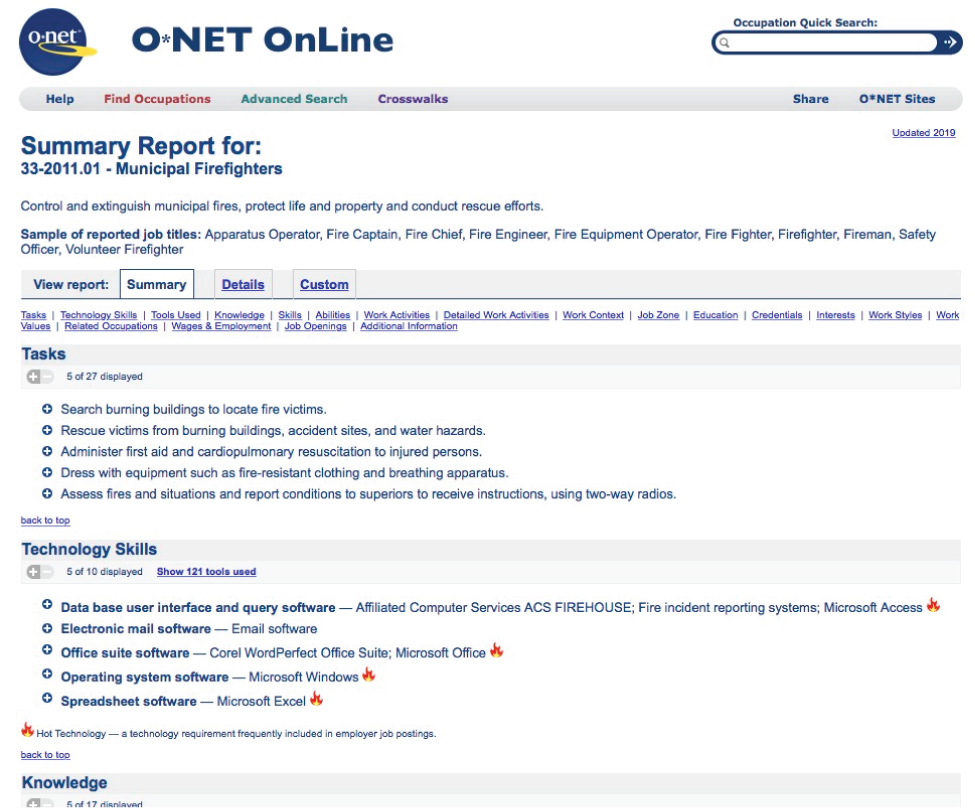

Figure 13.8図 13.8
The O*Net database from the United States Department of Labor provides information about a variety of occupations, including the knowledge, skills, and abilities desired for the position. In this example, the search shows information related to the job of being a municipal firefighter.
米国労働省のO*Netデータベースは、さまざまな職業について、その職に求められる知識・技能・能力を含む情報を提供している。この例では、自治体の消防士という職業に関する情報が検索結果として表示されている。
Candidate Analysis and Testing候補者の分析と検査
Once a company identifies potential candidates for a position, the candidates’ knowledge, skills, and other abilities must be evaluated and compared with the job description. These evaluations can involve testing, an interview, and work samples or exercises. You learned about personality tests in the chapter on personality; in the I-O context, they are used to identify the personality characteristics of the candidate in an effort to match those to personality characteristics that would ensure good performance on the job. For example, a high rating of agreeableness might be desirable in a customer support position. However, it is not always clear how best to correlate personality characteristics with predictions of job performance. It might be that too high of a score on agreeableness is actually a hindrance in the customer support position. For example, if a customer has a misperception about a product or service, agreeing with their misperception will not ultimately lead to resolution of their complaint. Any use of personality tests should be accompanied by a verified assessment of what scores on the test correlate with good performance (Arthur, Woehr, & Graziano, 2001). Other types of tests that may be given to candidates include IQ tests, integrity tests, and physical tests, such as drug tests or physical fitness tests.
英語のヒント
会社がある職の候補になりうる人々を見つけたら、次に候補者の知識、技能、その他の能力を評価し、職務記述書と照らし合わせなければならない。この評価には、検査、面接、作業サンプルや演習が含まれうる。パーソナリティ検査についてはパーソナリティの章で学んだ。I-Oの文脈では、パーソナリティ検査は、候補者のパーソナリティの特徴を明らかにし、それを職務での良い成績を確実にするようなパーソナリティの特徴と照合するために用いられる。たとえば、顧客サポートの職では、協調性の評定が高いことが望ましいかもしれない。しかし、パーソナリティの特徴を職務成績の予測とどう結びつけるのが最善かは、必ずしも明らかではない。協調性の得点が高すぎると、顧客サポートの職ではかえって妨げになるということもありうる。たとえば、顧客が製品やサービスについて誤解している場合、その誤解に同意しても、最終的に苦情の解決にはつながらない。パーソナリティ検査を使うときには必ず、検査のどの得点が良い成績と相関するかについて、検証された評価を伴わせるべきである(Arthur, Woehr, & Graziano, 2001)。候補者に課されることのあるほかの種類の検査には、IQテスト、インテグリティ(誠実さ)検査、そして薬物検査や体力テストのような身体面の検査がある。
To better understand the hiring process, let’s consider an example case. A company determined it had an open position and advertised it. The human resources (HR) manager directed the hiring team to start the recruitment process. Imani saw the advertisement and submitted her résumé, which went into the collection of candidate résumés. The HR team reviewed the candidates’ credentials and provided a list of the best potential candidates to the department manager, who reached out to them (including Imani) to set up individual interviews.
英語のヒント
採用の過程をよりよく理解するために、一つの事例を考えてみよう。ある会社は、欠員のある職があると判断し、その求人広告を出した。人事(HR)部長は採用チームに募集の手続きを始めるよう指示した。イマニはその広告を見て履歴書を提出し、その履歴書は候補者の履歴書の束に加えられた。人事チームは候補者の経歴や資格を検討し、最も有望な候補者のリストを部門の責任者に渡した。部門の責任者は、個別の面接を設定するために、それらの候補者(イマニを含む)に連絡をとった。