第13章産業・組織心理学
Evaluating Employees従業員の評価
Industrial and organizational psychologists are typically involved in designing performance-appraisal systems for organizations. These systems are designed to evaluate whether each employee is performing satisfactorily. Industrial and organizational psychologists study, research, and implement ways to make work evaluations as fair and positive as possible; they also work to decrease the subjectivity involved with performance ratings. Fairly evaluated work helps employees do their jobs better, improves the likelihood of people being in the right jobs for their talents, maintains fairness, and identifies company and individual training needs. In our example case, Imani was offered the position and was hired with a 90-day probation period. During that time, she met with her supervisor to discuss her performance and the expectations of the position and her growth. At the end of the 90 days, it was determined that Imani was meeting the expectations of her employer and had passed her probationary period. Imani was excited to now have a permanent job.
英語のヒント
産業・組織心理学者は、組織の人事評価制度の設計にかかわるのが一般的である。この制度は、各従業員が満足のいく働きをしているかどうかを評価するように設計されている。産業・組織心理学者は、仕事の評価をできるかぎり公正で前向きなものにする方法を検討し、研究し、実施する。また、成績の評定にかかわる主観性を減らすことにも取り組む。公正に評価された仕事は、従業員が仕事をよりよく行う助けとなり、人々が自分の才能に合った職に就く可能性を高め、公平さを保ち、会社と個人の研修の必要を明らかにする。先ほどの事例では、イマニはその職を提示され、90日間の試用期間つきで採用された。その期間中、彼女は上司と面談して、自分の仕事ぶりや、その職に期待されること、自分の成長について話し合った。90日が終わった時点で、イマニは雇用主の期待に応えており、試用期間を通過したと判断された。イマニは、これで正規の職に就けたことを喜んだ。
Performance appraisals are typically documented several times a year, often with a formal process and an annual face-to-face brief meeting between an employee and their supervisor. It is important that the original job analysis play a role in performance appraisal as well as any goals that have been set by the employee or by the employee and supervisor. The meeting is often used for the supervisor to communicate specific concerns about the employee’s performance and to positively reinforce elements of good performance. It may also be used to discuss specific performance rewards, such as a pay increase, or consequences of poor performance, such as a probationary period. Part of the function of performance appraisals for the organization is to document poor performance to bolster decisions to terminate an employee.
英語のヒント
人事評価は通常、年に数回記録に残される。その際には、正式な手続きと、従業員と上司が年に一度対面で行う短い面談が伴うことが多い。人事評価では、もとの職務分析と、従業員が(あるいは従業員と上司が一緒に)設定した目標が、ともに役割を果たすことが重要である。この面談は、上司が従業員の仕事ぶりについての具体的な懸念を伝え、良い仕事ぶりの要素に正の強化を与えるために使われることが多い。また、昇給のような具体的な成績への報酬や、観察期間のような成績不良の結果について話し合うためにも使われうる。組織にとっての人事評価の機能の一つは、成績不良を記録に残し、従業員を解雇する決定の裏づけとすることである。
Performance appraisals are becoming more complex processes within organizations and are often used to motivate employees to improve performance and expand their areas of competence, in addition to assessing their job performance. In this capacity, performance appraisals can be used to identify opportunities for training or whether a particular training program has been successful. One approach to performance appraisal is called 360-degree feedback appraisal (Figure 13.10). In this system, the employee’s appraisal derives from a combination of ratings by supervisors, peers, employees supervised by the employee, and from the employee herself. Occasionally, outside observers may be used as well, such as customers. The purpose of the 360-degree system is to give the employee (who may be a manager) and supervisor different perspectives of the employee’s job performance; the system should help employees make improvements through their own efforts or through training. The system is also used in a traditional performance-appraisal context, providing the supervisor with more information with which to make decisions about the employee’s position and compensation (Tornow, 1993a).
英語のヒント
人事評価は、組織の中でますます複雑な過程になりつつあり、従業員の職務成績を評価することに加えて、従業員が成績を向上させ、能力の及ぶ範囲を広げるよう動機づけるためにも用いられることが多い。この役割においては、人事評価は、研修の機会を見つけたり、特定の研修プログラムが成功したかどうかを確かめたりするためにも使える。人事評価のアプローチの一つに、360度フィードバック評価と呼ばれるものがある(図13.10)。この方式では、従業員の評価は、上司、同僚、その従業員が監督している部下、そして従業員本人による評定を組み合わせたものから得られる。ときには、顧客のような外部の観察者が用いられることもある。360度方式の目的は、従業員(管理職であることもある)と上司に、その従業員の職務成績についての異なる視点を与えることである。この方式は、従業員が自分自身の努力や研修を通して改善を行う助けになるはずである。この方式は伝統的な人事評価の文脈でも用いられ、上司が従業員の地位と報酬について決定を下すための、より多くの情報を提供する(Tornow, 1993a)。
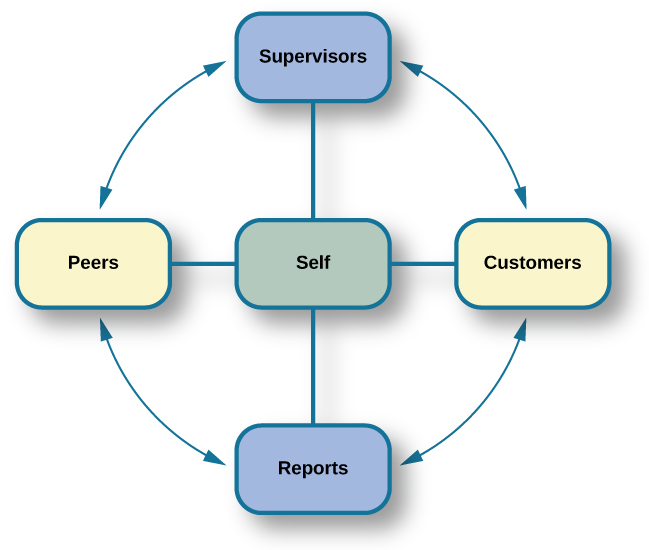

Figure 13.10図 13.10
In a 360-degree performance appraisal, supervisors, customers, direct reports, peers, and the employee himself rate an employee’s performance.
360度人事評価では、上司、顧客、直属の部下、同僚、そして従業員本人が、その従業員の仕事ぶりを評定する。
Few studies have assessed the effectiveness of 360-degree methods, but Atkins and Wood (2002) found that the self and peer ratings were unreliable as an assessment of an employee’s performance and that even supervisors tended to underrate employees that gave themselves modest feedback ratings. However, a different perspective sees this variability in ratings as a positive in that it provides for greater learning on the part of the employees as they and their supervisor discuss the reasons for the discrepancies (Tornow, 1993b).
英語のヒント
360度方式の有効性を評価した研究は少ないが、アトキンスとウッド(2002)は、本人による評定と同僚による評定は従業員の仕事ぶりの評価としては信頼できないこと、そして上司でさえ、自分に控えめなフィードバック評定を付けた従業員を過小に評定する傾向があることを見いだした。しかし、別の見方では、評定のこのばらつきを肯定的なものととらえる。従業員と上司が食い違いの理由を話し合う中で、従業員の側により大きな学びが生まれるという点においてである(Tornow, 1993b)。
In theory, performance appraisals should be an asset for an organization wishing to achieve its goals, and most employees will actually solicit feedback regarding their jobs if it is not offered (DeNisi & Kluger, 2000). However, in practice, many performance evaluations are disliked by organizations, employees, or both (Fletcher, 2001), and few of them have been adequately tested to see if they do in fact improve performance or motivate employees (DeNisi & Kluger, 2000). One of the reasons evaluations fail to accomplish their purpose in an organization is that performance appraisal systems are often used incorrectly or are of an inappropriate type for an organization’s particular culture (Schraeder, Becton, & Portis, 2007). An organization’s culture is how the organization is run, how it operates, and how it makes decisions. It is based on the collective values, hierarchies, and how individuals within the organization interact. Examining the effectiveness of performance appraisal systems in particular organizations and the effectiveness of training for the implementation of the performance appraisal system is an active area of research in industrial psychology (Fletcher, 2001).
英語のヒント
理論上は、人事評価は目標を達成しようとする組織にとって有用な資産となるはずであり、たいていの従業員は、フィードバックが与えられなければ、実際に自分の仕事についてのフィードバックを自ら求める(DeNisi & Kluger, 2000)。しかし実際には、多くの人事評価は組織か従業員、あるいはその両方に嫌われており(Fletcher, 2001)、人事評価が本当に成績を向上させたり従業員を動機づけたりするかを確かめるために十分に検証されたものはほとんどない(DeNisi & Kluger, 2000)。評価が組織の中でその目的を果たせない理由の一つは、人事評価制度がしばしば誤って用いられていたり、その組織に特有の文化にとって不適切なタイプのものであったりすることである(Schraeder, Becton, & Portis, 2007)。組織文化とは、その組織がどのように運営され、どのように機能し、どのように意思決定を行うかである。それは、共有された価値観や階層、そして組織の中の個人どうしがどのようにかかわり合うかに基づいている。特定の組織における人事評価制度の有効性と、人事評価制度を導入するための研修の有効性を検討することは、産業心理学における活発な研究領域である(Fletcher, 2001)。