第13章産業・組織心理学
13.3 Organizational Psychology: The Social Dimension of Work13.3 組織心理学:仕事の社会的側面
Learning Objectives学習目標
By the end of this section, you will be able to:
この節を学び終えると、次のことができるようになる。
- Define organizational psychology組織心理学を定義する
- Explain the measurement and determinants of job satisfaction職務満足の測定方法と決定要因を説明する
- Describe key elements of management and leadershipマネジメントとリーダーシップの重要な要素を述べる
- Explain the significance of organizational culture組織文化の重要性を説明する
Organizational psychology is the second major branch of study and practice within the discipline of industrial and organizational psychology. In organizational psychology, the focus is on social interactions and their effect on the individual and on the functioning of the organization. In this section, you will learn about the work organizational psychologists have done to understand job satisfaction, different styles of management, different styles of leadership, organizational culture, and teamwork.
英語のヒント
組織心理学は、産業・組織心理学という学問分野における、研究と実践の第二の主要な部門である。組織心理学では、社会的な相互作用と、それが個人と組織の機能に及ぼす影響に焦点が当てられる。この節では、職務満足、さまざまなマネジメントのスタイル、さまざまなリーダーシップのスタイル、組織文化、チームワークを理解するために、組織心理学者が行ってきた研究について学ぶ。
Job Satisfaction職務満足
Some people love their jobs, some people tolerate their jobs, and some people cannot stand their jobs. Job satisfaction describes the degree to which individuals enjoy their job. It was described by Edwin Locke (1976) as the state of feeling resulting from appraising one’s job experiences. While job satisfaction results from both how we think about our work (our cognition) and how we feel about our work (our affect) (Saari & Judge, 2004), it is described in terms of affect. Job satisfaction is impacted by the work itself, our personality, and the culture we come from and live in (Saari & Judge, 2004).
英語のヒント
自分の仕事が大好きな人もいれば、なんとか我慢している人も、どうしても耐えられない人もいる。職務満足とは、人が自分の仕事をどの程度楽しんでいるかを表す言葉である。エドウィン・ロック(1976)は職務満足を、自分の職務経験を評価することから生じる感情の状態と説明した。職務満足は、私たちが仕事についてどう考えるか(認知)と、どう感じるか(感情)の両方から生じるが(Saari & Judge, 2004)、感情の観点から説明される。職務満足は、仕事そのもの、私たちのパーソナリティ、そして私たちが生まれ育ち、いま暮らしている文化の影響を受ける(Saari & Judge, 2004)。
Job satisfaction is typically measured after a change in an organization, such as a shift in the management model, to assess how the change affects employees. It may also be routinely measured by an organization to assess one of many factors expected to affect the organization’s performance. In addition, polling companies like Gallup regularly measure job satisfaction on a national scale to gather broad information on the state of the economy and the workforce (Saad, 2012).
英語のヒント
職務満足は通常、マネジメント・モデルの転換のような組織の変化の後に、その変化が従業員にどのような影響を与えるかを評価するために測定される。また、組織の業績に影響すると考えられる多くの要因の一つを評価するために、組織が定期的に測定することもある。さらに、ギャラップのような世論調査会社は、経済と労働力の状況について幅広い情報を集めるため、全国規模で職務満足を定期的に測定している(Saad, 2012)。
Job satisfaction is measured using questionnaires that employees complete. Sometimes a single question might be asked in a very straightforward way to which employees respond using a rating scale, such as a Likert scale, which was discussed in the chapter on personality. A Likert scale (typically) provides five possible answers to a statement or question that allows respondents to indicate their positive-to-negative strength of agreement or strength of feeling regarding the question or statement. Thus the possible responses to a question such as “How satisfied are you with your job today?” might be “Very satisfied,” “Somewhat satisfied,” “Neither satisfied, nor dissatisfied,” “Somewhat dissatisfied,” and “Very dissatisfied.” More commonly the survey will ask a number of questions about the employee’s satisfaction to determine more precisely why they are satisfied or dissatisfied. Sometimes these surveys are created for specific jobs; at other times, they are designed to apply to any job. Job satisfaction can be measured at a global level, meaning how satisfied in general the employee is with work, or at the level of specific factors intended to measure which aspects of the job lead to satisfaction (Table 13.2).
英語のヒント
職務満足は、従業員が記入する質問紙を用いて測定される。ときには、たった一つの質問がごく率直な形で尋ねられ、従業員がそれに、パーソナリティの章で取り上げたリッカート尺度のような評定尺度を使って答えることもある。リッカート尺度は(通常)、ある文や質問に対して五つの回答の選択肢を示し、回答者がその質問や文に対する同意の強さや気持ちの強さを、肯定から否定までの段階で示せるようにする。したがって、「今日のあなたは、自分の仕事にどのくらい満足していますか」といった質問に対する回答の選択肢は、「とても満足している」「やや満足している」「満足でも不満でもない」「やや不満である」「とても不満である」となるだろう。より一般的には、調査では従業員の満足についていくつもの質問をして、その人がなぜ満足しているのか、あるいは不満なのかを、より正確に突き止めようとする。こうした調査は、特定の職務向けに作られることもあれば、どの職務にも当てはまるように設計されることもある。職務満足は、全体的なレベル、つまり従業員が全般的に仕事にどれくらい満足しているかというレベルで測定することも、職務のどの側面が満足につながるかを測るための個別の要因のレベルで測定することもできる(表13.2)。
Factors Involved in Job Satisfaction and Dissatisfaction 職務満足と不満足にかかわる要因 |
|
|---|---|
Factor 要因 |
Description 説明 |
Autonomy 自律性 |
Individual responsibility, control over decisions 個人としての責任、意思決定に対する裁量 |
Work content 仕事内容 |
Variety, challenge, role clarity 多様性、挑戦しがい、役割の明確さ |
Communication コミュニケーション |
Feedback フィードバック |
Financial rewards 金銭的報酬 |
Salary and benefits 給与と福利厚生 |
Growth and development 成長と能力開発 |
Personal growth, training, education 個人的成長、研修、教育 |
Promotion 昇進 |
Career advancement opportunity キャリアアップの機会 |
Coworkers 同僚 |
Professional relations or adequacy 仕事上の人間関係、または同僚の力量 |
Supervision and feedback 監督とフィードバック |
Support, recognition, fairness 支援、承認、公正さ |
Workload 仕事量 |
Time pressure, tedium 時間的な切迫、単調さ |
Work demands 職務上の要求 |
Extra work requirements, insecurity of position 追加業務の要求、地位の不安定さ |
Research has suggested that the work-content factor, which includes variety, difficulty level, and role clarity of the job, is the most strongly predictive factor of overall job satisfaction (Saari & Judge, 2004). In contrast, there is only a weak correlation between pay level and job satisfaction (Judge, Piccolo, Podsakoff, Shaw, & Rich, 2010). Judge et al. (2010) suggest that individuals adjust or adapt to higher pay levels: Higher pay no longer provides the satisfaction the individual may have initially felt when their salary increased.
英語のヒント
研究から、仕事内容という要因(職務の多様性、難しさの程度、役割の明確さを含む)が、全体的な職務満足を最も強く予測する要因であることが示唆されている(Saari & Judge, 2004)。これに対して、給与の水準と職務満足のあいだには弱い相関しかない(Judge, Piccolo, Podsakoff, Shaw, & Rich, 2010)。ジャッジら(2010)は、人はより高い給与の水準に慣れ、順応してしまうと示唆している。給与が上がったときに最初は感じていたかもしれない満足を、高い給与はもはやもたらさなくなるのである。
Why should we care about job satisfaction? Or more specifically, why should an employer care about job satisfaction? Measures of job satisfaction are somewhat correlated with job performance; in particular, they appear to relate to organizational citizenship or discretionary behaviors on the part of an employee that further the goals of the organization (Judge & Kammeyer-Mueller, 2012). Job satisfaction is related to general life satisfaction, although there has been limited research on how the two influence each other or whether personality and cultural factors affect both job and general life satisfaction. One carefully controlled study suggested that the relationship is reciprocal: Job satisfaction affects life satisfaction positively, and vice versa (Judge & Watanabe, 1993). Of course, organizations cannot control life satisfaction’s influence on job satisfaction. Job satisfaction, specifically low job satisfaction, is also related to withdrawal behaviors, such as leaving a job or absenteeism (Judge & Kammeyer-Mueller, 2012). The relationship with turnover itself, however, is weak (Judge & Kammeyer-Mueller, 2012). Finally, it appears that job satisfaction is related to organizational performance, which suggests that implementing organizational changes to improve employee job satisfaction will improve organizational performance (Judge & Kammeyer-Mueller, 2012).
英語のヒント
なぜ職務満足に関心を持つべきなのだろうか。より具体的に言えば、雇用主はなぜ職務満足に関心を持つべきなのだろうか。職務満足の測定値は、職務遂行とある程度相関している。とりわけ、組織の目標を推進する、従業員の側の組織市民行動ないし裁量的行動と関連しているようである(Judge & Kammeyer-Mueller, 2012)。職務満足は生活全般の満足と関連している。ただし、両者が互いにどう影響し合うのか、あるいはパーソナリティや文化的要因が職務満足と生活全般の満足の両方に影響するのかについての研究は限られている。入念に統制されたある研究は、この関係が相互的であることを示唆した。職務満足は生活満足に良い影響を与え、その逆もまた成り立つのである(Judge & Watanabe, 1993)。もちろん、生活満足が職務満足に与える影響を、組織が制御することはできない。職務満足、とくに低い職務満足は、仕事を辞めることや欠勤のような離脱行動とも関連している(Judge & Kammeyer-Mueller, 2012)。しかし、離職そのものとの関係は弱い(Judge & Kammeyer-Mueller, 2012)。最後に、職務満足は組織の業績と関連しているようであり、このことは、従業員の職務満足を高めるための組織の変革を実施すれば、組織の業績が向上することを示唆している(Judge & Kammeyer-Mueller, 2012)。
There is opportunity for more research in the area of job satisfaction. For example, Weiss (2002) suggests that the concept of job satisfaction measurements have combined both emotional and cognitive concepts, and measurements would be more reliable and show better relationships with outcomes like performance if the measurement of job satisfaction separated these two possible elements of job satisfaction.
英語のヒント
職務満足の領域には、さらに研究を進める余地がある。たとえばワイス(2002)は、職務満足の測定という概念はこれまで感情的な概念と認知的な概念の両方を組み合わせてきたと示唆している。そして、職務満足の測定において、職務満足を構成しうるこの二つの要素を区別すれば、測定はより信頼できるものになり、業績のような成果との関連もよりよく示すようになるだろうという。
Job stress affects job satisfaction. Job stress, or job strain, is caused by specific stressors in an occupation. Stress can be an ambiguous term as it is used in common language. Stress is the perception and response of an individual to events judged as overwhelming or threatening to the individual’s well-being (Gyllensten & Palmer, 2005). The events themselves are the stressors. Stress is a result of an employee’s perception that the demands placed on them exceed their ability to meet them (Gyllensten & Palmer, 2005), such as having to fill multiple roles in a job or life in general, workplace role ambiguity, lack of career progress, lack of job security, lack of control over work outcomes, isolation, work overload, discrimination, harassment, and bullying (Colligan & Higgins, 2005). The stressors are different for women than men and these differences are a significant area of research (Gyllensten & Palmer, 2005). Job stress leads to poor employee health, job performance, and family life (Colligan & Higgins, 2005).
英語のヒント
職務ストレスは職務満足に影響する。職務ストレス、すなわち職務ストレインは、その職業に特有のストレッサーによって引き起こされる。ストレスは日常語としても使われるため、あいまいな用語になりうる。ストレスとは、手に負えない、あるいは自分の幸福を脅かすと判断される出来事に対する、個人の知覚と反応である(Gyllensten & Palmer, 2005)。出来事そのものはストレッサーである。ストレスは、自分に課された要求が、それに応える自分の能力を超えているという従業員の知覚から生じる(Gyllensten & Palmer, 2005)。その例としては、仕事や生活全般で複数の役割を担わなければならないこと、職場での役割のあいまいさ、キャリアが進展しないこと、雇用が保障されていないこと、仕事の成果を自分で制御できないこと、孤立、過重労働、差別、ハラスメント、いじめが挙げられる(Colligan & Higgins, 2005)。ストレッサーは女性と男性とで異なり、その違いは重要な研究領域となっている(Gyllensten & Palmer, 2005)。職務ストレスは、従業員の健康、職務遂行、家庭生活の悪化につながる(Colligan & Higgins, 2005)。
As already mentioned, job insecurity contributes significantly to job stress. Two increasing threats to job security are downsizing events and corporate mergers. Businesses typically involve I-O psychologists in planning for, implementing, and managing these types of organizational change.
英語のヒント
すでに述べたように、雇用の不安定さは職務ストレスの大きな一因となる。雇用の安定を脅かすものとして増えつつある二つが、人員削減と企業合併である。企業は通常、こうした種類の組織変革の計画、実施、管理に、I-O心理学者をかかわらせる。
Downsizing is an increasingly common response to a business’s pronounced failure to achieve profit goals, and it involves laying off a significant percentage of the company’s employees. Industrial-organizational psychologists may be involved in all aspects of downsizing: how the news is delivered to employees (both those being let go and those staying), how laid-off employees are supported (e.g., separation packages), and how retained employees are supported. The latter is important for the organization because downsizing events affect the retained employee’s intent to quit, organizational commitment, and job insecurity (Ugboro, 2006).
英語のヒント
人員削減は、企業が利益目標の達成にはっきりと失敗したときの対応として、ますます一般的になっており、会社の従業員のかなりの割合を解雇することを伴う。産業・組織心理学者は、人員削減のあらゆる側面にかかわる可能性がある。その知らせを従業員(解雇される人と残る人の両方)にどう伝えるか、解雇された従業員をどう支援するか(たとえば退職手当)、そして残留する従業員をどう支援するか、である。組織にとっては最後の点が重要である。人員削減は、残留した従業員の離職意図、組織コミットメント、雇用の不安定さに影響するからである(Ugboro, 2006)。
In addition to downsizing as a way of responding to outside strains on a business, corporations often grow larger by combining with other businesses. This can be accomplished through a merger (i.e., the joining of two organizations of equal power and status) or an acquisition (i.e., one organization purchases the other). In an acquisition, the purchasing organization is usually the more powerful or dominant partner. In both cases, there is usually a duplication of services between the two companies, such as two accounting departments and two sales forces. Both departments must be merged, which commonly involves a reduction of staff (Figure 13.14). This leads to organizational processes and stresses similar to those that occur in downsizing events. Mergers require determining how the organizational culture will change, to which employees also must adjust (van Knippenberg, van Knippenberg, Monden, & de Lima, 2002). There can be additional stress on workers as they lose their connection to the old organization and try to make connections with the new combined group (Amiot, Terry, Jimmieson, & Callan, 2006). Research in this area focuses on understanding employee reactions and making practical recommendations for managing these organizational changes.
英語のヒント
企業は、外部からの圧力に対応する方法としての人員削減に加えて、ほかの企業と一緒になることで規模を大きくすることも多い。これは、合併(すなわち、同等の力と地位を持つ二つの組織が一つになること)や買収(すなわち、一方の組織がもう一方を買い取ること)によって実現できる。買収では、通常、買い取る側の組織のほうが力の強い、あるいは支配的な立場になる。どちらの場合も、二つの経理部門や二つの営業部隊のように、両社のあいだで業務が重複することが多い。その両方の部門を統合しなければならず、それにはふつう人員の削減が伴う(図13.14)。このことは、人員削減で起こるものと似た組織のプロセスやストレスにつながる。合併では、組織文化がどのように変わるのかを決める必要があり、従業員もその変化に適応しなければならない(van Knippenberg, van Knippenberg, Monden, & de Lima, 2002)。働く人々が、以前の組織とのつながりを失い、統合された新しい集団とのつながりを築こうとする中で、さらなるストレスが生じうる(Amiot, Terry, Jimmieson, & Callan, 2006)。この領域の研究は、従業員の反応を理解し、こうした組織の変化を管理するための実践的な提言をすることに焦点を当てている。
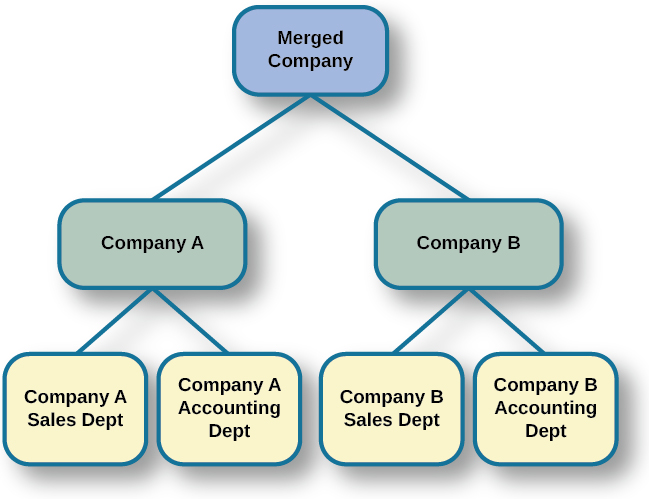

Figure 13.14図 13.14
When companies are combined through a merger (or acquisition), there are often cuts due to duplication of core functions, like sales and accounting, at each company.
企業が合併(または買収)によって一つになると、営業や経理のような中核的な機能が各社で重複するため、削減が行われることが多い。