第10章感情と動機づけ
10.4 Emotion10.4 感情
Learning Objectives学習目標
By the end of this section, you will be able to:
この節を学び終えると、次のことができるようになる。
- Explain the major theories of emotion感情の主な理論を説明する
- Describe the role that limbic structures play in emotional processing感情の処理において大脳辺縁系の構造が果たす役割を述べる
- Understand the ubiquitous nature of producing and recognizing emotional expression感情の表出をつくり出し、認識することが普遍的であることを理解する
As we move through our daily lives, we experience a variety of emotions. An emotion is a subjective state of being that we often describe as our feelings. Emotions result from the combination of subjective experience, expression, cognitive appraisal, and physiological responses (Levenson, Carstensen, Friesen, & Ekman, 1991). However, as discussed later in the chapter, the exact order in which the components occur is not clear, and some parts may happen at the same time. An emotion often begins with a subjective (individual) experience, which is a stimulus. Often the stimulus is external, but it does not have to be from the outside world. For example, it might be that one thinks about war and becomes sad, even though they never experienced war. Emotional expression refers to the way one displays an emotion and includes nonverbal and verbal behaviors (Gross, 1999). One also performs a cognitive appraisal in which a person tries to determine the way they will be impacted by a situation (Roseman & Smith, 2001). In addition, emotions include physiological responses, such as possible changes in heart rate, sweating, etc. (Soussignan, 2002).
英語のヒント
日々の生活を送るなかで、私たちはさまざまな感情を経験する。感情とは主観的な状態であり、私たちはそれをしばしば自分の気持ちと表現する。感情は、主観的経験、表出、認知的評価、生理的反応の組み合わせから生じる(Levenson, Carstensen, Friesen, & Ekman, 1991)。ただし、この章の後半で論じるように、これらの構成要素がどのような順序で生じるのかは正確には分かっておらず、いくつかの部分は同時に起こるのかもしれない。感情はしばしば、主観的な(個人的な)経験から始まる。これが刺激である。刺激は外的なものであることが多いが、外界から来るものである必要はない。たとえば、戦争を一度も経験したことがないのに、戦争について考えて悲しくなるということもあるかもしれない。感情の表出とは、人が感情を表に出すしかたのことであり、非言語的な行動と言語的な行動を含む(Gross, 1999)。人はまた、認知的評価も行う。認知的評価では、ある状況によって自分がどのような影響を受けるのかを見定めようとする(Roseman & Smith, 2001)。さらに感情には、心拍数の変化や発汗など、起こりうる生理的反応も含まれる(Soussignan, 2002)。
The words emotion and mood are sometimes used interchangeably, but psychologists use these words to refer to two different things. Typically, the word emotion indicates a subjective, affective state that is relatively intense and that occurs in response to something we experience (Figure 10.20). Emotions are often thought to be consciously experienced and intentional. Mood, on the other hand, refers to a prolonged, less intense, affective state that does not occur in response to something we experience. Mood states may not be consciously recognized and do not carry the intentionality that is associated with emotion (Beedie, Terry, Lane, & Devonport, 2011). Here we will focus on emotion, and you will learn more about mood in the chapter that covers psychological disorders.
英語のヒント
感情(emotion)と気分(mood)という語は、区別せずに使われることもあるが、心理学者はこの二つの語を、異なる二つのものを指すのに使う。一般に、感情という語は、比較的強く、私たちが経験する何かへの反応として生じる、主観的な情動状態を表す(図10.20)。感情は多くの場合、意識的に経験され、志向的なものだと考えられている。一方、気分とは、長く続き、強さがより弱く、私たちが経験する何かへの反応として生じるのではない情動状態を指す。気分の状態は意識的に認識されないこともあり、感情に伴う志向性を持たない(Beedie, Terry, Lane, & Devonport, 2011)。ここでは感情に焦点を当てる。気分については、心理的障害を扱う章でさらに詳しく学ぶ。
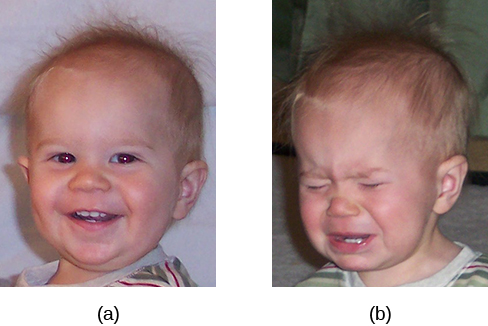
OpenStax, Rice University; Psychology 2e. (credit a: modification of work by Kerry Ceszyk; credit b: modification of work by Kerry Ceszyk) · CC BY 4.0 · Source出典

Figure 10.20図 10.20
Toddlers can cycle through emotions quickly, being (a) extremely happy one moment and (b) extremely sad the next. (credit a: modification of work by Kerry Ceszyk; credit b: modification of work by Kerry Ceszyk)
幼児の感情はめまぐるしく移り変わることがあり、ある瞬間には(a)このうえなく楽しそうでも、次の瞬間には(b)ひどく悲しそうになる。(出典a:Kerry Ceszykの作品を改変、出典b:Kerry Ceszykの作品を改変)
We can be at the heights of joy or in the depths of despair. We might feel angry when we are betrayed, fear when we are threatened, and surprised when something unexpected happens. This section will outline some of the most well-known theories explaining our emotional experience and provide insight into the biological bases of emotion. This section closes with a discussion of the ubiquitous nature of facial expressions of emotion and our abilities to recognize those expressions in others.
英語のヒント
私たちは喜びの絶頂にいることもあれば、絶望のどん底にいることもある。裏切られれば怒りを感じ、脅かされれば恐怖を感じ、思いがけないことが起これば驚くかもしれない。この節では、私たちの感情経験を説明する理論のうち最もよく知られたものをいくつか概観し、感情の生物学的基盤について理解を深める。節の最後では、感情を表す顔の表情がどこにでも見られるという性質と、他者のそうした表情を読み取る私たちの能力について論じる。
Theories of Emotion感情の理論
Our emotional states are combinations of physiological arousal, psychological appraisal, and subjective experiences. Together, these are the components of emotion, and our experiences, backgrounds, and cultures inform our emotions. Therefore, different people may have different emotional experiences even when faced with similar circumstances. Over time, several different theories of emotion, shown in Figure 10.21, have been proposed to explain how the various components of emotion interact with one another.
英語のヒント
私たちの感情の状態は、生理的覚醒、心理的評価、主観的経験が組み合わさったものである。これらを合わせたものが感情の構成要素であり、私たちの経験、生い立ち、文化が感情を形づくる。そのため、似たような状況に置かれても、人によって異なる感情経験をすることがある。これまでに、感情のさまざまな構成要素が互いにどのように作用し合うのかを説明するため、図10.21に示す、いくつかの異なる感情の理論が提唱されてきた。
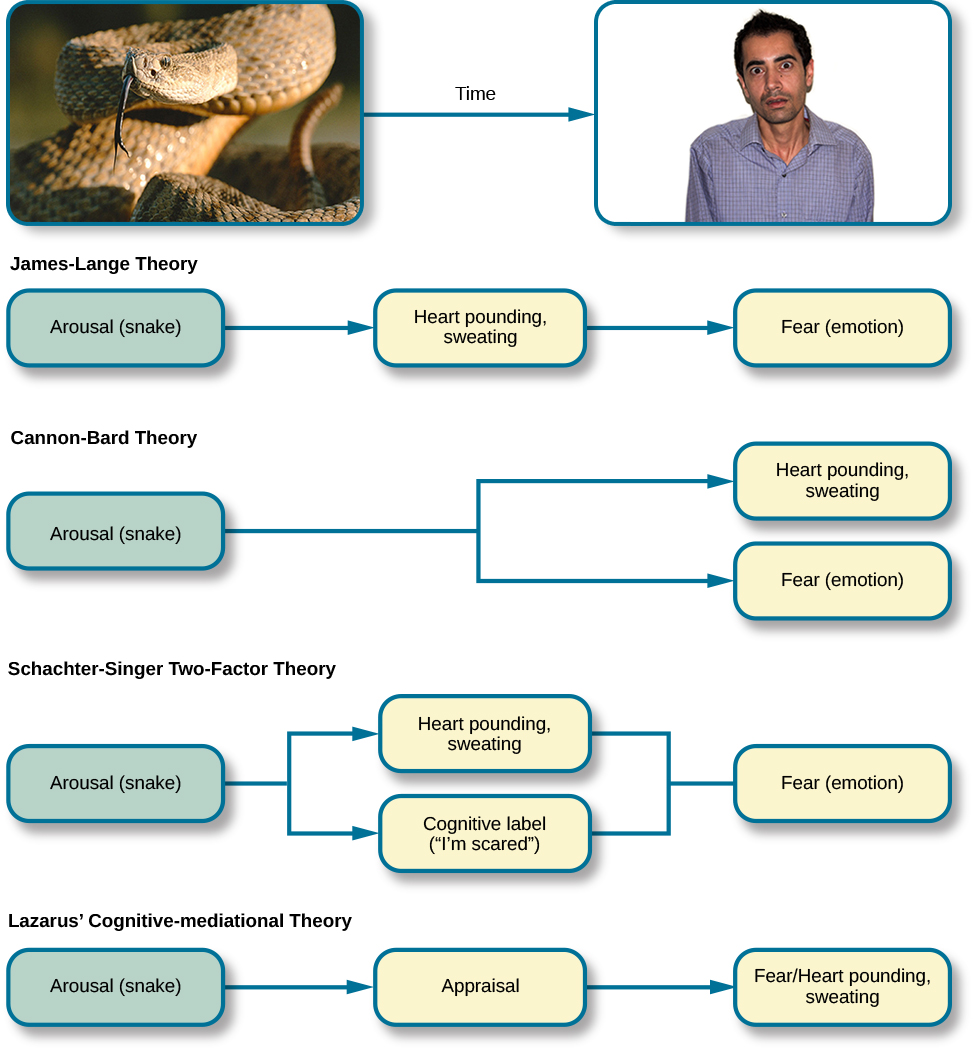
OpenStax, Rice University; Psychology 2e. (credit "snake": modification of work by "tableatny"/Flickr; credit "face": modification of work by Cory Zanker) · CC BY 4.0 · Source出典

Figure 10.21図 10.21
This figure illustrates the major assertions of the James-Lange, Cannon-Bard, and Schachter-Singer two-factor theories of emotion. (credit "snake": modification of work by "tableatny"/Flickr; credit "face": modification of work by Cory Zanker)
この図は、感情のジェームズ=ランゲ説、キャノン=バード説、シャクター=シンガー二要因理論の主な主張を示している。(出典「ヘビ」:“tableatny”/Flickrの作品を改変、出典「顔」:Cory Zankerの作品を改変)
The James-Lange theory of emotion asserts that emotions arise from physiological arousal. Recall what you have learned about the sympathetic nervous system and our fight or flight response when threatened. If you were to encounter some threat in your environment, like a venomous snake in your backyard, your sympathetic nervous system would initiate significant physiological arousal, which would make your heart race and increase your respiration rate. According to the James-Lange theory of emotion, you would only experience a feeling of fear after this physiological arousal had taken place. Furthermore, different arousal patterns would be associated with different feelings.
英語のヒント
感情のジェームズ=ランゲ説は、感情は生理的覚醒から生じると主張する。交感神経系と、脅かされたときの闘争・逃走反応について学んだことを思い出してほしい。もし身の回りで何らかの脅威、たとえば裏庭にいる毒ヘビに出くわしたとしたら、交感神経系がかなりの生理的覚醒を引き起こし、それによって心臓は早鐘を打ち、呼吸数が増えるだろう。感情のジェームズ=ランゲ説によれば、あなたは、この生理的覚醒が起こった後になって初めて、恐怖という気持ちを経験するだろう。さらに、異なる覚醒のパターンが、それぞれ異なる気持ちと結びついていることになる。
Other theorists, however, doubted that the physiological arousal that occurs with different types of emotions is distinct enough to result in the wide variety of emotions that we experience. Thus, the Cannon-Bard theory of emotion was developed. According to this view, physiological arousal and emotional experience occur simultaneously, yet independently (Lang, 1994). So, when you see the venomous snake, you feel fear at exactly the same time that your body mounts its fight or flight response. This emotional reaction would be separate and independent of the physiological arousal, even though they co-occur.
英語のヒント
しかし、ほかの理論家たちは、さまざまな種類の感情に伴って生じる生理的覚醒が、私たちが経験する多種多様な感情を生み出せるほど互いにはっきり異なっているのか疑問に思った。こうして、感情のキャノン=バード説が考え出された。この見方によれば、生理的覚醒と感情経験は同時に、しかし互いに独立して生じる(Lang, 1994)。つまり、毒ヘビを見たとき、あなたは、体が闘争・逃走反応を起こすのとまったく同じ瞬間に恐怖を感じる。この感情的な反応は、生理的覚醒と同時に起こるとしても、それとは別個の、独立したものだということになる。
Does smiling make you happy? Alternatively, does being happy make you smile? The facial feedback hypothesis proposes that your facial expression can actually affect your emotional experience (Adelman & Zajonc, 1989; Boiger & Mesquita, 2012; Buck, 1980; Capella, 1993; Soussignan, 2001). Research investigating the facial feedback hypothesis suggested that suppression of facial expression of emotion lowered the intensity of some emotions experienced by participants (Davis, Senghas, & Ochsner, 2009). Havas, Glenberg, Gutowski, Lucarelli, and Davidson (2010) used Botox injections to paralyze facial muscles and limit facial expressions, including frowning, and they found that depressed people reported less depression after their frowning muscles were paralyzed. Other research found that the intensities of facial expressions affected the emotional reactions (Soussignan, 2002). In other words, if something insignificant occurs and you smile as if you just won lottery, you will actually be happier about the little thing than you would be if you only had a tiny smile. Conversely, if you walk around frowning all the time, it might cause you to have less positive emotions than you would if you had smiled. Interestingly, Soussignan (2002) also reported physiological arousal differences associated with the intensities of one type of smile.
英語のヒント
笑顔になると幸せな気分になるのだろうか。それとも、幸せだから笑顔になるのだろうか。顔面フィードバック仮説は、顔の表情が実際に感情経験に影響しうると提唱する(Adelman & Zajonc, 1989; Boiger & Mesquita, 2012; Buck, 1980; Capella, 1993; Soussignan, 2001)。顔面フィードバック仮説を調べた研究は、感情を顔に出すのを抑えると、参加者が経験するいくつかの感情の強さが弱まることを示唆した(Davis, Senghas, & Ochsner, 2009)。ハヴァス、グレンバーグ、グトウスキー、ルカレッリ、デヴィッドソン(2010)は、ボトックス注射を用いて顔の筋肉を麻痺させ、しかめ面を含む顔の表情を制限した。その結果、抑うつのある人々は、しかめ面をつくる筋肉が麻痺した後、抑うつが軽くなったと報告した。別の研究では、顔の表情の強さが感情的な反応に影響することが見いだされた(Soussignan, 2002)。言い換えれば、ささいなことが起きたときに、まるで宝くじに当たったかのように笑顔になると、ほんの小さな笑みを浮かべただけの場合よりも、そのささいなことを実際にうれしく感じるということである。逆に、いつもしかめ面で歩き回っていると、笑顔でいた場合に比べて、肯定的な感情が少なくなるかもしれない。興味深いことに、スシニャン(2002)は、ある種類の笑顔の強さに関連した生理的覚醒の違いも報告している。
G. Marañon Posadillo was a Spanish physician who studied the psychological effects of adrenaline to create a model for the experience of emotion. Marañon's model preceded Schachter's two-factor or arousal-cognition theory of emotion (Cornelius, 1991). The Schachter-Singer two-factor theory of emotion is another variation on theories of emotions that takes into account both physiological arousal and the emotional experience. According to this theory, emotions are composed of two factors: physiological and cognitive. In other words, physiological arousal is interpreted in context to produce the emotional experience. In revisiting our example involving the venomous snake in your backyard, the two-factor theory maintains that the snake elicits sympathetic nervous system activation that is labeled as fear given the context, and our experience is that of fear. If you had labeled your sympathetic nervous system activation as joy, you would have experienced joy. The Schachter-Singer two-factor theory depends on labeling the physiological experience, which is a type of cognitive appraisal.
英語のヒント
G・マラニョン・ポサディーリョはスペインの医師で、感情の経験についてのモデルをつくるために、アドレナリンの心理的な効果を研究した。マラニョンのモデルは、シャクターの二要因理論、すなわち感情の覚醒−認知理論に先立つものだった(Cornelius, 1991)。感情のシャクター=シンガー二要因理論は、生理的覚醒と感情経験の両方を考慮に入れた、感情の理論のもう一つの変種である。この理論によれば、感情は生理的要因と認知的要因という二つの要因から成り立っている。言い換えれば、生理的覚醒が文脈の中で解釈されることによって、感情経験が生み出される。裏庭の毒ヘビの例に戻ると、二要因理論では、ヘビが交感神経系の活性化を引き起こし、その活性化が文脈に照らして恐怖とラベルづけされ、私たちの経験は恐怖の経験になる、と考える。もし交感神経系の活性化を喜びとラベルづけしていたなら、あなたは喜びを経験していただろう。シャクター=シンガー二要因理論は、生理的な経験にラベルを付けることに依拠しており、これは認知的評価の一種である。
Magda Arnold was the first theorist to offer an exploration of the meaning of appraisal, and to present an outline of what the appraisal process might be and how it relates to emotion (Roseman & Smith, 2001). The key idea of appraisal theory is that you have thoughts (a cognitive appraisal) before you experience an emotion, and the emotion you experience depends on the thoughts you had (Frijda, 1988; Lazarus, 1991). If you think something is positive, you will have more positive emotions about it than if your appraisal was negative, and the opposite is true. Appraisal theory explains the way two people can have two completely different emotions regarding the same event. For example, suppose your psychology instructor selected you to lecture on emotion; you might see that as positive, because it represents an opportunity to be the center of attention, and you would experience happiness. However, if you dislike speaking in public, you could have a negative appraisal and experience discomfort.
英語のヒント
マグダ・アーノルドは、評価の意味を探究し、評価の過程がどのようなものでありうるのか、そしてそれが感情とどのように関係するのかについての概略を示した、最初の理論家である(Roseman & Smith, 2001)。評価理論の鍵となる考えは、人は感情を経験する前に何らかの考え(認知的評価)を持ち、経験する感情は、そのとき持った考えによって決まる、というものである(Frijda, 1988; Lazarus, 1991)。何かを肯定的だと考えれば、評価が否定的だった場合よりも、それについて肯定的な感情を多く持つことになる。逆もまた同様である。評価理論は、同じ出来事について二人の人がまったく異なる二つの感情を持ちうる仕組みを説明する。たとえば、心理学の講師が、感情について講義をする役にあなたを選んだとしよう。あなたはそれを、注目の的になる機会だと考えて肯定的にとらえ、幸福を感じるかもしれない。しかし、人前で話すのが嫌いなら、否定的な評価をして、不快を感じることもありうる。
Schachter and Singer believed that physiological arousal is very similar across the different types of emotions that we experience, and therefore, the cognitive appraisal of the situation is critical to the actual emotion experienced. In fact, it might be possible to misattribute arousal to an emotional experience if the circumstances were right (Schachter & Singer, 1962). They performed a clever experiment to test their idea. A group of men participating in the experiment were randomly assigned to one of several groups. Some of the participants received injections of epinephrine that caused bodily changes that mimicked the fight-or-flight response of the sympathetic nervous system; however, only some of these men were told to expect these reactions as side effects of the injection. The other men that received injections of epinephrine were told either that the injection would have no side effects or that it would result in a side effect unrelated to a sympathetic response, such as itching feet or headache. After receiving these injections, participants waited in a room with someone else they thought was another subject in the research project. In reality, the other person was a confederate (someone working on behalf) of the researcher. The confederate engaged in scripted displays of euphoric or angry behavior (Schachter & Singer, 1962).
英語のヒント
シャクターとシンガーは、私たちが経験するさまざまな種類の感情のあいだで生理的覚醒はよく似ており、したがって、実際に経験される感情にとっては状況の認知的評価が決定的に重要だと考えた。実際、条件がそろえば、覚醒を誤って感情経験に帰属させることもありうるかもしれない(Schachter & Singer, 1962)。二人は、この考えを検証するために巧妙な実験を行った。実験に参加した男性たちは、いくつかある群のいずれかに無作為に割り当てられた。参加者の一部は、交感神経系の闘争・逃走反応に似た身体の変化を引き起こすエピネフリンの注射を受けた。ただし、これらの男性のうち、こうした反応が注射の副作用として起こると予期するよう告げられたのは一部だけだった。エピネフリンの注射を受けたほかの男性たちは、注射には副作用がないと告げられるか、足のかゆみや頭痛など、交感神経系の反応とは関係のない副作用が出ると告げられた。注射を受けた後、参加者は、同じ研究プロジェクトの別の対象者だと自分が思っている人物と一緒に、部屋で待った。実際には、その人物は研究者のサクラ(研究者の側で動く人)だった。サクラは、台本どおりに、多幸感にあふれた行動か怒った行動をして見せた(Schachter & Singer, 1962)。
When those participants who were told that they should expect to feel symptoms of physiological arousal were asked about any emotional changes that they had experienced related to either euphoria or anger (depending on the way the confederate behaved), they reported none. However, the men who weren’t expecting physiological arousal as a function of the injection were more likely to report that they experienced euphoria or anger as a function of their assigned confederate’s behavior. While everyone who received an injection of epinephrine experienced the same physiological arousal, only those who were not expecting the arousal used context to interpret the arousal as a change in emotional state (Schachter & Singer, 1962).
英語のヒント
生理的覚醒の症状を感じるはずだと予期するよう告げられていた参加者たちは、(サクラの振る舞い方に応じて)多幸感か怒りに関連する何らかの感情の変化を経験したかと尋ねられると、何もなかったと報告した。しかし、注射の結果として生理的覚醒が起こるとは予期していなかった男性たちは、割り当てられたサクラの行動に応じて多幸感や怒りを経験したと報告する可能性が高かった。エピネフリンの注射を受けた人は誰もが同じ生理的覚醒を経験したにもかかわらず、その覚醒を予期していなかった人だけが、文脈を用いて、覚醒を感情状態の変化として解釈したのである(Schachter & Singer, 1962)。
Strong emotional responses are associated with strong physiological arousal, which caused some theorists to suggest that the signs of physiological arousal, including increased heart rate, respiration rate, and sweating, might be used to determine whether someone is telling the truth or not. The assumption is that most of us would show signs of physiological arousal if we were being dishonest with someone. A polygraph, or lie detector test, measures the physiological arousal of an individual responding to a series of questions. Someone trained in reading these tests would look for answers to questions that are associated with increased levels of arousal as potential signs that the respondent may have been dishonest on those answers. While polygraphs are still commonly used, their validity and accuracy are highly questionable because there is no evidence that lying is associated with any particular pattern of physiological arousal (Saxe & Ben-Shakhar, 1999).
英語のヒント
強い感情的反応は強い生理的覚醒と関連している。このことから、一部の理論家は、心拍数や呼吸数の増加、発汗といった生理的覚醒の兆候を、人が本当のことを言っているかどうかを見極めるのに使えるかもしれないと示唆するようになった。その前提にあるのは、私たちの多くは、誰かに対して不誠実にふるまっているときには生理的覚醒の兆候を示すだろう、という想定である。ポリグラフ、すなわちうそ発見器による検査は、一連の質問に答えている人の生理的覚醒を測定する。この検査を読み取る訓練を受けた人なら、質問への回答のうち覚醒水準の上昇と結びついたものを探し、それを、回答者がその答えについて不誠実だったかもしれないことを示しうる兆候とみなすだろう。ポリグラフは今でも広く使われているが、その妥当性と正確さはきわめて疑わしい。うそをつくことが生理的覚醒の何らかの特定のパターンと関連しているという証拠がないからである(Saxe & Ben-Shakhar, 1999)。
The relationship between our experiencing of emotions and our cognitive processing of them, and the order in which these occur, remains a topic of research and debate. Lazarus (1991) developed the cognitive-mediational theory that asserts our emotions are determined by our appraisal of the stimulus. This appraisal mediates between the stimulus and the emotional response, and it is immediate and often unconscious. In contrast to the Schachter-Singer model, the appraisal precedes a cognitive label. You will learn more about Lazarus’s appraisal concept when you study stress, health, and lifestyle. However, there are other views of emotions that also emphasize the cognitive processes.
英語のヒント
感情を経験することとそれを認知的に処理することとの関係、そしてそれらが生じる順序は、今も研究と議論の対象になっている。ラザルス(1991)は、感情は刺激に対する評価によって決まると主張する認知的媒介理論を展開した。この評価は刺激と感情的反応のあいだを媒介し、即座に、しばしば無意識のうちに行われる。シャクター=シンガーのモデルとは対照的に、ここでは評価が認知的ラベルに先行する。ラザルスの評価の概念については、ストレス、健康、生活習慣を学ぶときにさらに詳しく学ぶ。とはいえ、認知的過程を同じく重視する感情の見方は、ほかにもある。
Return to the example of being asked to lecture by your professor. Even if you do not enjoy speaking in public, you probably could manage to do it. You would purposefully control your emotions, which would allow you to speak, but we constantly regulate our emotions, and much of our emotion regulation occurs without us actively thinking about it. Mauss and her colleagues studied automatic emotion regulation (AER), which refers to the non-deliberate control of emotions. It is simply not reacting with your emotions, and AER can affect all aspects of emotional processes. AER can influence the things you attend to, your appraisal, your choice to engage in an emotional experience, and your behaviors after an emotion is experienced (Mauss, Bunge, & Gross, 2007; Mauss, Levenson, McCarter, Wilhelm, & Gross, 2005). AER is similar to other automatic cognitive processes in which sensations activate knowledge structures that affect functioning. These knowledge structures can include concepts, schemas, or scripts.
英語のヒント
教授から講義をするよう頼まれた例に戻ろう。人前で話すのが好きでなくても、おそらくなんとかやり遂げることはできるだろう。その場合、あなたは意図的に感情をコントロールし、それによって話せるようになるだろう。しかし私たちは絶えず感情を制御しており、その感情制御の多くは、私たちが積極的に考えることなく行われている。マウスらは、自動的感情制御(AER)を研究した。これは、意図によらない感情のコントロールを指す。それは単に感情で反応しないということであり、AERは感情の過程のあらゆる側面に影響しうる。AERは、何に注意を向けるか、どう評価するか、感情経験に関与するかどうかの選択、そして感情を経験した後の行動に影響しうる(Mauss, Bunge, & Gross, 2007; Mauss, Levenson, McCarter, Wilhelm, & Gross, 2005)。AERは、感覚が知識構造を活性化し、その知識構造が機能に影響するという、ほかの自動的な認知過程と似ている。こうした知識構造には、概念、スキーマ、スクリプトなどが含まれうる。
The idea of AER is that people develop an automatic process that works like a script or schema, and the process does not require deliberate thought to regulate emotions. AER works like riding a bicycle. Once you develop the process, you just do it without thinking about it. AER can be adaptive or maladaptive and has important health implications (Hopp, Troy, & Mauss, 2011). Adaptive AER leads to better health outcomes than maladaptive AER, primarily due to experiencing or mitigating stressors better than people with maladaptive AERs (Hopp, Troy, & Mauss, 2011). Alternatively, maladaptive AERs may be critical for maintaining some psychological disorders (Hopp, Troy, & Mauss, 2011). Mauss and her colleagues found that strategies could reduce negative emotions, which in turn should increase psychological health (Mauss, Cook, Cheng, & Gross, 2007; Mauss, Cook, & Gross, 2007; Shallcross, Troy, Boland, & Mauss, 2010; Troy, Shallcross, & Mauss, 2013; Troy, Wilhelm, Shallcross, & Mauss, 2010). Mauss has also suggested there are problems with the way emotions are measured, but she believes most of the aspects of emotions that are typically measured are useful (Mauss, et al., 2005; Mauss & Robinson, 2009). However, another way of considering emotions challenges our entire understanding of emotions.
英語のヒント
AERの考え方は、人はスクリプトやスキーマのように働く自動的な過程を身につけ、その過程は、感情を制御するのに意図的な思考を必要としない、というものである。AERは自転車に乗るのと同じように働く。いったんその過程を身につけてしまえば、考えることなく、ただそれを行うだけになる。AERは適応的にも不適応的にもなりえ、健康にとって重要な意味を持つ(Hopp, Troy, & Mauss, 2011)。適応的なAERは、不適応的なAERよりも良好な健康上の結果につながる。これは主に、不適応的なAERを持つ人々よりも、ストレッサーをうまく経験したり和らげたりできるためである(Hopp, Troy, & Mauss, 2011)。その一方で、不適応的なAERは、一部の心理的障害を維持するうえで決定的な役割を果たしているのかもしれない(Hopp, Troy, & Mauss, 2011)。マウスらは、方略によって否定的な感情を減らしうることを見いだした。そしてそのことは、ひいては心理的な健康を高めるはずである(Mauss, Cook, Cheng, & Gross, 2007; Mauss, Cook, & Gross, 2007; Shallcross, Troy, Boland, & Mauss, 2010; Troy, Shallcross, & Mauss, 2013; Troy, Wilhelm, Shallcross, & Mauss, 2010)。マウスはまた、感情の測定のしかたに問題があることも指摘しているが、通常測定されている感情の側面の多くは有用だと考えている(Mauss, et al., 2005; Mauss & Robinson, 2009)。しかし、感情についての別の考え方は、感情についての私たちの理解全体に異を唱えている。
After about three decades of interdisciplinary research, Barrett argued that we do not understand emotions. She proposed that emotions were not built into your brain at birth, but rather they were constructed based on your experiences. Emotions in the constructivist theory are predictions that construct your experience of the world. In the chapter on Thinking and Intelligence you learned that concepts are categories or groupings of linguistic information, images, ideas, or memories, such as life experiences. Barrett extended that to include emotions as concepts that are predictions (Barrett, 2017). Two identical physiological states can result in different emotional states depending on your predictions. For example, your brain predicting a churning stomach in a bakery could lead to you constructing hunger. However, your brain predicting a churning stomach while you were waiting for medical test results could lead your brain to construct worry. Thus, you can construct two different emotions from the same physiological sensations. Rather than emotions being something over which you have no control, you can control and influence your emotions.
英語のヒント
およそ30年にわたる学際的な研究を経て、バレットは、私たちは感情を理解していないと論じた。バレットは、感情は生まれたときから脳に組み込まれているのではなく、むしろ経験に基づいて構築されるのだと提唱した。構築主義の理論では、感情とは、世界についてのあなたの経験を構築する予測である。「思考と知能」の章では、概念とは、言語的な情報、イメージ、アイデア、あるいは人生経験のような記憶をまとめたカテゴリーやグループであることを学んだ。バレットはこれを拡張して、感情も、予測としての概念に含めた(Barrett, 2017)。まったく同じ二つの生理的状態が、予測しだいで異なる感情の状態をもたらしうる。たとえば、パン屋で、胃がぐるぐるする感覚を脳が予測すれば、あなたは空腹を構築することになるかもしれない。しかし、医学的な検査の結果を待っているときに、胃がぐるぐるする感覚を脳が予測すれば、脳は心配を構築することになるかもしれない。このように、同じ生理的感覚から二つの異なる感情を構築することがありうる。感情は自分ではどうにもできないものではなく、あなたは自分の感情をコントロールし、それに影響を与えることができるのである。
Two other prominent views arise from the work of Robert Zajonc and Joseph LeDoux. Zajonc asserted that some emotions occur separately from or prior to our cognitive interpretation of them, such as feeling fear in response to an unexpected loud sound (Zajonc, 1998). He also believed in what we might casually refer to as a gut feeling—that we can experience an instantaneous and unexplainable like or dislike for someone or something (Zajonc, 1980). LeDoux also views some emotions as requiring no cognition: some emotions completely bypass contextual interpretation. His research into the neuroscience of emotion has demonstrated the amygdala’s primary role in fear (Cunha, Monfils, & LeDoux, 2010; LeDoux 1996, 2002). A fear stimulus is processed by the brain through one of two paths: from the thalamus (where it is perceived) directly to the amygdala or from the thalamus through the cortex and then to the amygdala. The first path is quick, while the second enables more processing about details of the stimulus. In the following section, we will look more closely at the neuroscience of emotional response.
英語のヒント
ほかに二つの有力な見方が、ロバート・ザイアンスとジョセフ・ルドゥーの研究から生まれている。ザイアンスは、一部の感情は、それについての認知的な解釈とは別に、あるいはそれより前に生じると主張した。たとえば、予期しない大きな音に反応して恐怖を感じる場合である(Zajonc, 1998)。ザイアンスはまた、私たちがくだけて「直感」と呼ぶようなもの、すなわち、人は誰かや何かに対して、瞬時の、説明のつかない好き嫌いを感じうるということも信じていた(Zajonc, 1980)。ルドゥーもまた、一部の感情は認知を必要としないとみなしている。一部の感情は、文脈による解釈を完全に素通りするというのである。感情の神経科学についての彼の研究は、恐怖において扁桃体が主要な役割を果たすことを実証してきた(Cunha, Monfils, & LeDoux, 2010; LeDoux 1996, 2002)。恐怖の刺激は、脳の中で二つの経路のいずれかを通って処理される。視床(刺激が知覚される場所)から直接扁桃体へ向かう経路と、視床から皮質を経て扁桃体へ向かう経路である。前者は速く、後者は刺激の細部についてより多くの処理を可能にする。次の項では、感情的反応の神経科学をさらに詳しく見ていく。