第10章感情と動機づけ
10.2 Hunger and Eating10.2 空腹と摂食
Learning Objectives学習目標
By the end of this section, you will be able to:
この節を学び終えると、次のことができるようになる。
- Describe how hunger and eating are regulated空腹と摂食がどのように調節されているかを説明する
- Differentiate between levels of overweight and obesity and the associated health consequences過体重と肥満の程度の違いと、それぞれに伴う健康上の結果を区別する
- Explain the health consequences resulting from anorexia and bulimia nervosa神経性無食欲症と神経性過食症がもたらす健康上の結果を説明する
Eating is essential for survival, and it is no surprise that a drive like hunger exists to ensure that we seek out sustenance. While this chapter will focus primarily on the physiological mechanisms that regulate hunger and eating, powerful social, cultural, and economic influences also play important roles. This section will explain the regulation of hunger, eating, and body weight, and we will discuss the adverse consequences of disordered eating.
英語のヒント
食べることは生存に欠かせないものであり、私たちが確実に栄養を探し求めるよう、空腹のような動因が存在するのも驚くにはあたらない。この章では主に、空腹と摂食を調節する生理的な仕組みに焦点を当てるが、社会的・文化的・経済的な強い影響も重要な役割を果たしている。この節では、空腹、摂食、体重の調節について説明し、摂食の乱れがもたらす有害な結果を論じる。
Physiological Mechanisms生理的な仕組み
There are a number of physiological mechanisms that serve as the basis for hunger. When our stomachs are empty, they contract. Typically, a person then experiences hunger pangs. Chemical messages travel to the brain, and serve as a signal to initiate feeding behavior. When our blood glucose levels drop, the pancreas and liver generate a number of chemical signals that induce hunger (Konturek et al., 2003; Novin, Robinson, Culbreth, & Tordoff, 1985) and thus initiate feeding behavior.
英語のヒント
空腹の基盤となる生理的な仕組みはいくつもある。胃は空になると収縮する。すると典型的には、空腹時の胃の痛みを感じる。化学的なメッセージが脳へ伝わり、摂食行動を始める合図として働く。血糖値が下がると、膵臓と肝臓は、空腹を引き起こし、それによって摂食行動を始めさせる化学的な信号をいくつも生み出す(Konturek et al., 2003; Novin, Robinson, Culbreth, & Tordoff, 1985)。
For most people, once they have eaten, they feel satiation, or fullness and satisfaction, and their eating behavior stops. Like the initiation of eating, satiation is also regulated by several physiological mechanisms. As blood glucose levels increase, the pancreas and liver send signals to shut off hunger and eating (Drazen & Woods, 2003; Druce, Small, & Bloom, 2004; Greary, 1990). The food’s passage through the gastrointestinal tract also provides important satiety signals to the brain (Woods, 2004), and fat cells release leptin, a satiety hormone.
英語のヒント
たいていの人は、いったん食べると満腹、すなわちおなかが満ちて満足した感覚を覚え、摂食行動が止まる。摂食の開始と同じく、満腹もいくつかの生理的な仕組みによって調節されている。血糖値が上がるにつれて、膵臓と肝臓は空腹と摂食を止める信号を送る(Drazen & Woods, 2003; Druce, Small, & Bloom, 2004; Greary, 1990)。食物が消化管を通過することも、脳に重要な満腹信号を与える(Woods, 2004)。また、脂肪細胞は満腹ホルモンであるレプチンを放出する。
The various hunger and satiety signals that are involved in the regulation of eating are integrated in the brain. Research suggests that several areas of the hypothalamus and hindbrain are especially important sites where this integration occurs (Ahima & Antwi, 2008; Woods & D’Alessio, 2008). Ultimately, activity in the brain determines whether or not we engage in feeding behavior (Figure 10.9).
英語のヒント
摂食の調節にかかわるさまざまな空腹信号と満腹信号は、脳で統合される。研究は、視床下部と後脳のいくつかの領域が、この統合が起こるとりわけ重要な部位であることを示唆している(Ahima & Antwi, 2008; Woods & D’Alessio, 2008)。最終的には、脳の活動が、私たちが摂食行動をとるかどうかを決める(図10.9)。
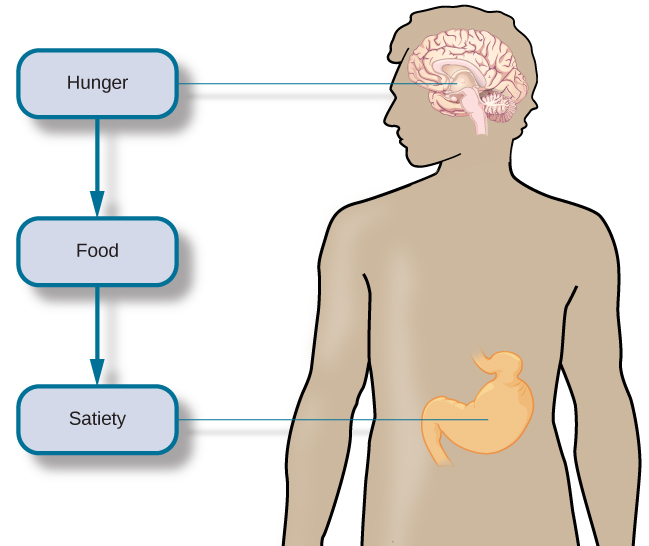

Figure 10.9図 10.9
Hunger and eating are regulated by a complex interplay of hunger and satiety signals that are integrated in the brain.
空腹と摂食は、脳で統合される空腹信号と満腹信号の複雑な相互作用によって調節されている。
Metabolism and Body Weight代謝と体重
Our body weight is affected by a number of factors, including gene-environment interactions, and the number of calories we consume versus the number of calories we burn in daily activity. If our caloric intake exceeds our caloric use, our bodies store excess energy in the form of fat. If we consume fewer calories than we burn off, then stored fat will be converted to energy. Our energy expenditure is obviously affected by our levels of activity, but our body’s metabolic rate also comes into play. A person’s metabolic rate is the amount of energy that is expended in a given period of time, and there is tremendous individual variability in our metabolic rates. People with high rates of metabolism are able to burn off calories more easily than those with lower rates of metabolism.
英語のヒント
体重は、遺伝子と環境の相互作用や、日々の活動で燃やすカロリーに対してどれだけのカロリーを摂取するかなど、多くの要因の影響を受ける。摂取カロリーが消費カロリーを上回ると、体は余分なエネルギーを脂肪の形で蓄える。燃やす量より少ないカロリーしか摂取しなければ、蓄えられた脂肪がエネルギーに変換される。エネルギーの消費量が活動の水準に左右されるのは明らかだが、体の代謝率もかかわってくる。代謝率とは、一定の時間に消費されるエネルギーの量のことであり、代謝率には非常に大きな個人差がある。代謝率の高い人は、代謝率の低い人よりも容易にカロリーを燃やすことができる。
We all experience fluctuations in our weight from time to time, but generally, most people’s weights fluctuate within a narrow margin, in the absence of extreme changes in diet and/or physical activity. This observation led some to propose a set-point theory of body weight regulation. The set-point theory asserts that each individual has an ideal body weight, or set point, which is resistant to change. This set-point is genetically predetermined and efforts to move our weight significantly from the set-point are resisted by compensatory changes in energy intake and/or expenditure (Speakman et al., 2011).
英語のヒント
誰でも体重はときどき変動するが、食事や身体活動(あるいはその両方)に極端な変化がなければ、たいていの人の体重は一般に狭い幅の中で変動する。この観察から、体重調節のセットポイント理論を提唱する者も現れた。セットポイント理論によれば、人にはそれぞれ理想の体重、すなわちセットポイントがあり、それは変化しにくい。このセットポイントは遺伝的にあらかじめ決まっており、体重をセットポイントから大きく動かそうとする努力は、エネルギーの摂取や消費(あるいはその両方)の代償的な変化によって阻まれる(Speakman et al., 2011)。
Some of the predictions generated from this particular theory have not received empirical support. For example, there are no changes in metabolic rate between individuals who had recently lost significant amounts of weight and a control group (Weinsier et al., 2000). In addition, the set-point theory fails to account for the influence of social and environmental factors in the regulation of body weight (Martin-Gronert & Ozanne, 2013; Speakman et al., 2011). Despite these limitations, set-point theory is still often used as a simple, intuitive explanation of how body weight is regulated. See Psychological Disorders for further discussion about eating disorders.
英語のヒント
この理論から導かれる予測の中には、実証的な裏づけが得られていないものもある。たとえば、最近かなりの量の体重を減らした人と統制群のあいだで、代謝率に違いは見られない(Weinsier et al., 2000)。さらに、セットポイント理論は、体重の調節における社会的要因や環境的要因の影響を説明できていない(Martin-Gronert & Ozanne, 2013; Speakman et al., 2011)。こうした限界があるにもかかわらず、セットポイント理論は今でも、体重がどのように調節されているかについての単純で直観的な説明としてよく用いられている。摂食障害についてさらに詳しくは、「心理的障害」の章を参照のこと。