第10章感情と動機づけ
Self-efficacy and Social Motives自己効力感と社会的動機
Self-efficacy is an individual’s belief in their own capability to complete a task, which may include a previous successful completion of the exact task or a similar task. Albert Bandura (1994) theorized that an individual’s sense of self-efficacy plays a pivotal role in motivating behavior. Bandura argues that motivation derives from expectations that we have about the consequences of our behaviors, and ultimately, it is the appreciation of our capacity to engage in a given behavior that will determine what we do and the future goals that we set for ourselves. For example, if you have a sincere belief in your ability to achieve at the highest level, you are more likely to take on challenging tasks and to not let setbacks dissuade you from seeing the task through to the end.
英語のヒント
自己効力感とは、ある課題をやり遂げる自分の能力についての個人の信念である。これには、まったく同じ課題や似た課題を以前にうまくやり遂げたことが含まれる場合もある。アルバート・バンデューラ(1994)は、個人の自己効力感が、行動を動機づけるうえで極めて重要な役割を果たすと理論化した。バンデューラは、動機づけは自分の行動の結果について私たちが抱く予期から生じるのであり、最終的に、私たちが何をするか、そして自分のためにどのような将来の目標を設定するかを決めるのは、ある行動を行う自分の能力についての認識なのだと論じている。たとえば、自分が最高の水準で成果を上げられると心から信じていれば、あなたは困難な課題に取り組み、挫折によって課題を最後までやり抜くのを思いとどまったりしない可能性がより高くなる。
A number of theorists have focused their research on understanding social motives (McAdams & Constantian, 1983; McClelland & Liberman, 1949; Murray et al., 1938). Among the motives they describe are needs for achievement, affiliation, and intimacy. It is the need for achievement that drives accomplishment and performance. The need for affiliation encourages positive interactions with others, and the need for intimacy causes us to seek deep, meaningful relationships. Henry Murray et al. (1938) categorized these needs into domains. For example, the need for achievement and recognition falls under the domain of ambition. Dominance and aggression were recognized as needs under the domain of human power, and play was a recognized need in the domain of interpersonal affection.
英語のヒント
多くの理論家が、社会的動機を理解することに研究の焦点を当ててきた(McAdams & Constantian, 1983; McClelland & Liberman, 1949; Murray et al., 1938)。彼らが述べる動機の中には、達成欲求、親和欲求、親密欲求がある。成果や遂行を推し進めるのは、達成欲求である。親和欲求は他者との好ましい交流を促し、親密欲求は私たちに深く意味のある関係を求めさせる。ヘンリー・マレーら(1938)は、これらの欲求を領域に分類した。たとえば、達成と承認への欲求は、野心の領域に属する。支配と攻撃は人間の権力の領域にある欲求とされ、遊びは対人的な愛情の領域の欲求として認められていた。
Maslow’s Hierarchy of Needsマズローの欲求階層
While the theories of motivation described earlier relate to basic biological drives, individual characteristics, or social contexts, Abraham Maslow (1943) proposed a hierarchy of needs that spans the spectrum of motives ranging from the biological to the individual to the social. These needs are often depicted as a pyramid (Figure 10.8).
英語のヒント
先に述べた動機づけの理論が、基本的な生物学的動因、個人の特性、社会的な文脈のいずれかにかかわるものであるのに対して、アブラハム・マズロー(1943)は、生物学的なものから個人的なもの、さらに社会的なものにまで及ぶ動機の全範囲にまたがる欲求階層を提唱した。これらの欲求は、ピラミッドとして描かれることが多い(図10.8)。
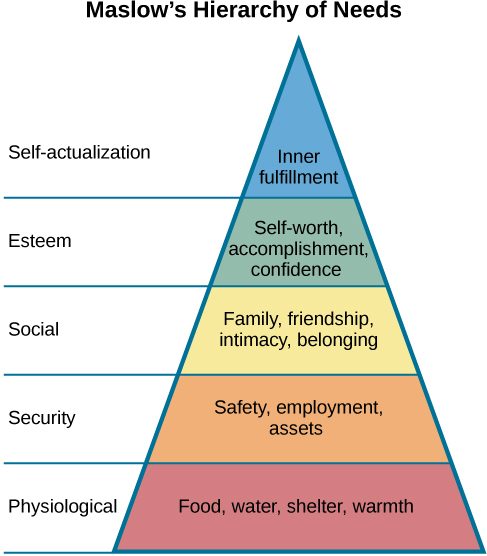

Figure 10.8図 10.8
Maslow’s hierarchy of needs is illustrated here. In some versions of the pyramid, cognitive and aesthetic needs are also included between esteem and self-actualization. Others include another tier at the top of the pyramid for self-transcendence.
マズローの欲求階層を示す。ピラミッドの版によっては、承認と自己実現のあいだに認知的欲求と美的欲求も含まれている。また、ピラミッドの頂上に、自己超越のためのもう一つの段を加えている版もある。
At the base of the pyramid are all of the physiological needs that are necessary for survival. These are followed by basic needs for security and safety, the need to be loved and to have a sense of belonging, and the need to have self-worth and confidence. The top tier of the pyramid is self-actualization, which is a need that essentially equates to achieving one’s full potential, and it can only be realized when needs lower on the pyramid have been met. To Maslow and humanistic theorists, self-actualization reflects the humanistic emphasis on positive aspects of human nature. Maslow suggested that this is an ongoing, life-long process and that only a small percentage of people actually achieve a self-actualized state (Francis & Kritsonis, 2006; Maslow, 1943).
英語のヒント
ピラミッドの底辺には、生存に必要なすべての生理的欲求がある。その上に続くのが、安心と安全への基本的な欲求、愛されたい、所属感を持ちたいという欲求、そして自尊心と自信を持ちたいという欲求である。ピラミッドの最上段は自己実現である。自己実現とは、本質的には自分の潜在能力を十分に発揮することに等しい欲求であり、ピラミッドのより下にある欲求が満たされたときにはじめて実現されうる。マズローと人間主義の理論家にとって、自己実現は、人間性の肯定的な側面を重視する人間主義の姿勢を反映したものである。マズローは、これは生涯にわたって続いていく過程であり、実際に自己実現した状態に達するのはごく少ない割合の人だけだと示唆した(Francis & Kritsonis, 2006; Maslow, 1943)。
According to Maslow (1943), one must satisfy lower-level needs before addressing those needs that occur higher in the pyramid. So, for example, if someone is struggling to find enough food to meet their nutritional requirements, it is quite unlikely that they would spend an inordinate amount of time thinking about whether others viewed them as a good person or not. Instead, all of their energies would be geared toward finding something to eat. However, it should be pointed out that Maslow’s theory has been criticized for its subjective nature and its inability to account for phenomena that occur in the real world (Leonard, 1982). Other research has more recently addressed that late in life, Maslow proposed a self-transcendence level above self-actualization—to represent striving for meaning and purpose beyond the concerns of oneself (Koltko-Rivera, 2006). For example, people sometimes make self-sacrifices in order to make a political statement or in an attempt to improve the conditions of others. Mohandas K. Gandhi, a world-renowned advocate for independence through nonviolent protest, on several occasions went on hunger strikes to protest a particular situation. People may starve themselves or otherwise put themselves in danger displaying higher-level motives beyond their own needs.
英語のヒント
マズロー(1943)によれば、人はピラミッドのより上にある欲求に取り組む前に、下の水準の欲求を満たさなければならない。たとえば、栄養上の必要を満たすだけの食物を見つけるのに苦労している人が、他者が自分を善い人間とみているかどうかを考えることに法外な時間を費やすことは、まずないだろう。むしろ、その人のエネルギーはすべて、何か食べるものを見つけることに向けられるだろう。しかし、マズローの理論は、その主観的な性質と、現実の世界で起こる現象を説明できないことについて批判されてきたことを指摘しておくべきである(Leonard, 1982)。より最近では、ほかの研究が、マズローが晩年に、自己の関心を超えた意味と目的の追求を表すものとして、自己実現の上に自己超越の段階を提唱していたことを取り上げている(Koltko-Rivera, 2006)。たとえば、人はときに、政治的な主張をするために、あるいは他者の状況を改善しようとして、自分を犠牲にすることがある。非暴力の抗議による独立を唱えたことで世界的に知られるモハンダス・K・ガンディーは、特定の状況に抗議するために、何度かハンガーストライキを行った。人は、自分自身の欲求を超えた、より高い水準の動機を示して、自らを飢えさせたり、そのほかの形で自分を危険にさらしたりすることがある。