第10章感情と動機づけ
Obesity肥満
When someone weighs more than what is generally accepted as healthy for a given height, they are considered overweight or obese. According to the Centers for Disease Control and Prevention (CDC), an adult with a body mass index (BMI) between 25 and 29.9 is considered overweight (Figure 10.10). An adult with a BMI of 30 or higher is considered obese (Centers for Disease Control and Prevention [CDC], 2012). People who are so overweight that they are at risk for death are classified as severely obese. Severe obesity is defined as having a BMI over 40. Note that although BMI has been used as a healthy weight indicator by the World Health Organization (WHO), the CDC, and other groups, its value as an assessment tool has been questioned. The BMI is most useful for studying populations, which is the work of these organizations. It is less useful in assessing an individual since height and weight measurements fail to account for important factors like fitness level. An athlete, for example, may have a high BMI because the tool doesn’t distinguish between the body’s percentage of fat and muscle in a person’s weight. BMI scales have not accounted for differences in body composition related to race or ethnicity; as a result, BMI is less useful in determining health of all people. While many healthcare professionals and organizations still utilize BMI, the American Medical Association in 2023 recommended that it be removed as a standard measure of health.
英語のヒント
ある身長に対して一般に健康とされる体重を上回っている人は、過体重または肥満とみなされる。米国疾病予防管理センター(CDC)によれば、ボディマス指数(BMI)が25から29.9の成人は過体重とみなされる(図10.10)。BMIが30以上の成人は肥満とみなされる(Centers for Disease Control and Prevention [CDC], 2012)。死亡の危険があるほど体重が多すぎる人は、高度肥満に分類される。高度肥満は、BMIが40を超えることと定義されている。ただし注意しておきたいのは、BMIは世界保健機関(WHO)やCDCなどの団体によって健康的な体重の指標として用いられてきたものの、評価の道具としての価値には疑問が投げかけられてきたことである。BMIが最も役立つのは集団を研究する場合であり、それがこうした組織の仕事である。個人を評価する場合には有用性が下がる。身長と体重の測定値では、体力の水準のような重要な要因が考慮されないからである。たとえば運動選手は、BMIが高くなることがある。BMIという道具は、体重のうち脂肪が占める割合と筋肉が占める割合を区別しないからである。BMIの尺度は、人種や民族に関連する体組成の違いを考慮してこなかった。その結果、BMIはすべての人の健康を判定するうえでは有用性が劣る。今でも多くの医療専門職や組織がBMIを用いているが、米国医師会は2023年、BMIを健康の標準的な尺度から外すよう勧告した。
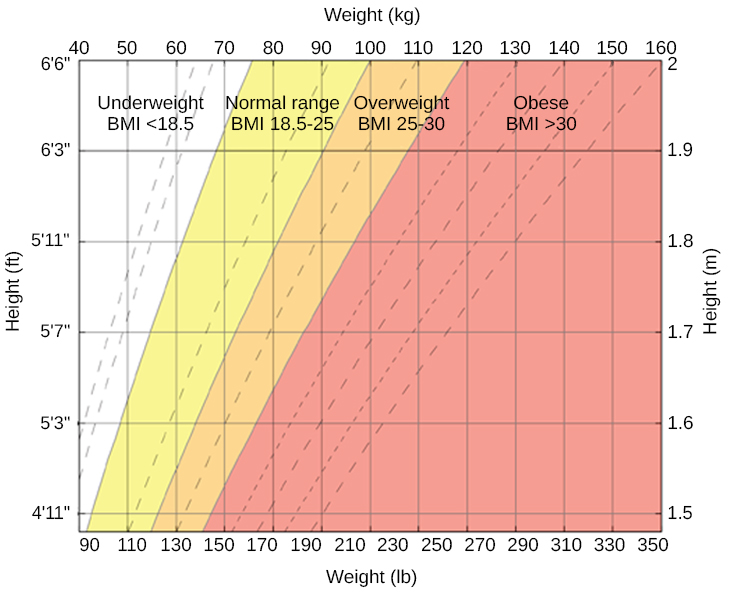
Figure 10.10図 10.10
This chart shows how adult BMI is calculated. Individuals find their height on the y-axis and their weight on the x-axis to determine their BMI. While BMI is widely used and does provide some indications of health, it does not account for differences in people's body composition. The American Medical Association has recommended it be de-emphasized as a measure of health.
この図は、成人のBMIがどのように求められるかを示している。y軸で自分の身長を、x軸で自分の体重を見つけると、自分のBMIが分かる。BMIは広く用いられており、健康についてある程度の目安を与えてくれるのは確かだが、人々の体組成の違いを考慮していない。米国医師会は、健康の尺度としてのBMIの比重を下げるよう勧告している。
Being extremely overweight or obese is a risk factor for several negative health consequences. These include, but are not limited to, an increased risk for cardiovascular disease, stroke, Type 2 diabetes, liver disease, sleep apnea, colon cancer, breast cancer, infertility, and arthritis. Given that it is estimated that in the United States around forty percent of the adult population is obese and that nearly three-quarters of adults and one in six children qualify as overweight (CDC, 2018), there is substantial interest in trying to understand how to combat this important public health concern.
英語のヒント
極度の過体重や肥満は、健康上のいくつかの悪い結果の危険因子である。その中には、心血管疾患、脳卒中、2型糖尿病、肝疾患、睡眠時無呼吸、大腸がん、乳がん、不妊、関節炎の危険の増大が含まれるが、これらに限られるわけではない。アメリカでは成人人口の約40%が肥満であり、成人の4分の3近くと子どもの6人に1人が過体重に該当すると推定されていることを踏まえ(CDC, 2018)、この重要な公衆衛生上の問題にどう立ち向かえばよいかを理解しようとする試みに、大きな関心が寄せられている。
What causes someone to be overweight or obese? You have already read that both genes and environment are important factors for determining body weight, and if more calories are consumed than expended, excess energy is stored as fat. However, socioeconomic status and the physical environment must also be considered as contributing factors (CDC, 2012). For example, an individual who lives in a neighborhood with high crime rates and few food options may never feel comfortable walking or biking to work or to the local market. This might limit the amount of physical activity in which they engage. Similarly, some people may not be able to afford healthy food options from their market, or these options may be unavailable (especially in urban areas or poorer neighborhoods); therefore, some people must rely primarily on available, inexpensive, high fat, and high calorie fast food as their primary source of nutrition.
英語のヒント
人が過体重や肥満になる原因は何だろうか。すでに読んだように、遺伝子と環境はどちらも体重を決める重要な要因であり、消費するよりも多くのカロリーを摂取すれば、余分なエネルギーは脂肪として蓄えられる。しかし、社会経済的地位と物理的環境も、寄与する要因として考慮しなければならない(CDC, 2012)。たとえば、犯罪発生率が高く食べ物の選択肢が少ない地域に住む人は、職場や近所の店まで歩いたり自転車で行ったりすることを、決して安心してできないかもしれない。そうなると、その人が行う身体活動の量が限られるかもしれない。同じように、地元の店で健康的な食べ物を買う余裕がない人もいるだろうし、そうした食べ物がそもそも手に入らないこともある(とくに都市部や貧しい地域で)。そのため、手に入りやすく安価で、脂肪とカロリーの多いファストフードに、主な栄養源としてもっぱら頼らざるをえない人もいる。
Generally, people are encouraged to try to maintain and improve health through a combination of both diet and exercise. While some people are very successful with these approaches, many are not. In cases in which a person has had no success with repeated attempts to reduce weight or is at risk for death because of obesity, bariatric surgery may be recommended. Bariatric surgery is a type of surgery specifically aimed at weight reduction, and it involves modifying the gastrointestinal system to reduce the amount of food that can be eaten and/or limiting how much of the digested food can be absorbed (Figure 10.11) (Mayo Clinic, 2013). A recent meta-analysis suggests that bariatric surgery is more effective than non-surgical treatment for obesity in the two-years immediately following the procedure, but to date, no long-term studies yet exist (Gloy et al., 2013).
英語のヒント
一般に、人は食事と運動の両方を組み合わせて健康を維持・増進しようと努めるよう勧められる。こうした方法で大きな成果をあげる人もいるが、多くの人はそうではない。減量の試みを何度繰り返しても成功しなかった場合や、肥満のために死亡の危険がある場合には、肥満外科手術が勧められることがある。肥満外科手術は、減量に特化した手術の一種であり、消化器系に手を加えて、食べられる食物の量を減らしたり、消化された食物がどれだけ吸収されうるかを制限したり(あるいはその両方を行ったり)する(図10.11)(Mayo Clinic, 2013)。最近のメタ分析は、手術の直後2年間においては、肥満外科手術のほうが肥満の非外科的な治療よりも効果が高いことを示唆している。しかし現在までのところ、長期的な研究はまだ存在しない(Gloy et al., 2013)。
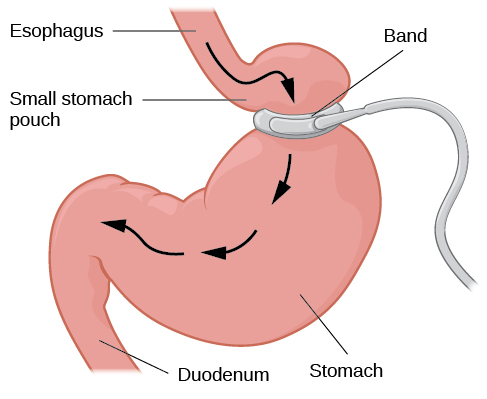


Figure 10.11図 10.11
Gastric banding surgery creates a small pouch of stomach, reducing the size of the stomach that can be used for digestion.
胃バンディング手術では、胃に小さな袋をつくり、消化に使える胃の大きさを小さくする。