第10章感情と動機づけ
Masters and Johnson’s Researchマスターズとジョンソンの研究
In 1966, William Masters and Virginia Johnson published a book detailing the results of their observations of nearly 700 people who agreed to participate in their study of physiological responses during sexual behavior. Unlike Kinsey, who used personal interviews and surveys to collect data, Masters and Johnson observed people having intercourse in a variety of positions, and they observed people masturbating, manually or with the aid of a device. While this was occurring, researchers recorded measurements of physiological variables, such as blood pressure and respiration rate, as well as measurements of sexual arousal, such as vaginal lubrication and penile tumescence (swelling associated with an erection). In total, Masters and Johnson observed nearly 10,000 sexual acts as a part of their research (Hock, 2008).
英語のヒント
1966年、ウィリアム・マスターズとヴァージニア・ジョンソンは、性行動中の生理的反応についての自分たちの研究に参加することに同意した700人近くの人々を観察し、その結果を詳しく述べた本を出版した。データを集めるのに個別面接と調査を用いたキンゼイとは違い、マスターズとジョンソンは、さまざまな体位で性交する人々を観察し、また、手で、あるいは器具を使ってマスターベーションをする人々も観察した。その間、研究者たちは、血圧や呼吸数といった生理的変数の測定値に加えて、膣の潤滑や陰茎の腫脹(勃起に伴うふくらみ)といった性的興奮の測定値も記録した。マスターズとジョンソンは、研究の一環として、合計で1万件近くの性行為を観察した(Hock, 2008)。
Based on these observations, Masters and Johnson divided the sexual response cycle into four phases that are fairly similar for most people: excitement, plateau, orgasm, and resolution (Figure 10.17). The excitement phase is the arousal phase of the sexual response cycle, and it is marked by erection of the penis or clitoris and lubrication and expansion of the vaginal canal. During plateau, the vagina swells further and blood flow to the labia minora increases, and the penis becomes fully erect and may exhibit pre-ejaculatory fluid. People experience increases in muscle tone during this time. Orgasm is marked in females by rhythmic contractions of the pelvis and uterus along with increased muscle tension. In males, pelvic contractions are accompanied by a buildup of seminal fluid near the urethra that is ultimately forced out by contractions of genital muscles, (i.e., ejaculation). Resolution is the relatively rapid return to an unaroused state accompanied by a decrease in blood pressure and muscular relaxation. The refractory period is a period of time that follows an orgasm during which an individual is incapable of experiencing another orgasm. The duration of the refractory period can vary dramatically from individual to individual with some refractory periods as short as several minutes and others as long as a day. As people age, their refractory periods tend to span longer periods of time.
英語のヒント
これらの観察に基づいて、マスターズとジョンソンは性反応周期を、ほとんどの人でかなり似通った四つの段階、すなわち興奮期、高原期、オーガズム期、消退期に分けた(図10.17)。興奮期は性反応周期のうち性的興奮が高まる段階で、陰茎または陰核の勃起と、膣の潤滑および膣腔の拡張によって特徴づけられる。高原期には、膣がさらにふくらんで小陰唇への血流が増え、陰茎は完全に勃起して、射精前の分泌液が出ることもある。この時期には筋緊張が高まる。オーガズム期は、女性では、筋緊張の高まりとともに骨盤と子宮がリズミカルに収縮することによって特徴づけられる。男性では、骨盤の収縮に伴って尿道の近くに精液がたまり、それが最終的に生殖器の筋肉の収縮によって押し出される(すなわち射精)。消退期は、血圧の低下と筋肉の弛緩を伴いながら、性的に興奮していない状態へ比較的すみやかに戻ることである。不応期とは、オーガズムに続く期間のことで、そのあいだ人はもう一度オーガズムを経験することができない。不応期の長さは人によって大きく異なり、数分ほどと短い場合もあれば、1日にも及ぶ場合もある。年齢を重ねるにつれて、不応期はより長い時間に及ぶ傾向がある。
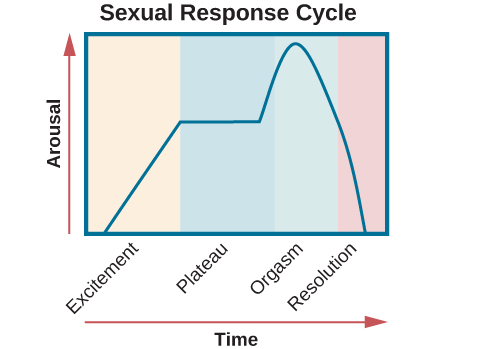
Figure 10.17図 10.17
This graph illustrates the different phases of the sexual response cycle as described by Masters and Johnson.
このグラフは、マスターズとジョンソンが記述した性反応周期のさまざまな段階を示している。
In addition to the insights that their research provided with regards to the sexual response cycle and the multi-orgasmic potential of females, Masters and Johnson also collected important information about reproductive anatomy. Their research demonstrated the oft-cited statistic of the average size of a flaccid and an erect penis (3 and 6 inches, respectively) as well as dispelling long-held beliefs about relationships between the size of an erect penis and its ability to provide sexual pleasure to a partner. Furthermore, they determined that the vagina is a very elastic structure that can conform to penises of various sizes (Hock, 2008). In a similar manner to Kinsey’s work and other studies, Masters and Johnson’s research has been criticized, built on, and in some cases proven wrong. The research represents an important element of the history of sexual research, and is not viewed as entirely accurate today.
英語のヒント
マスターズとジョンソンは、性反応周期や、女性が複数回のオーガズムに達しうることについて研究がもたらした洞察に加えて、生殖器の解剖学についても重要な情報を集めた。彼らの研究は、弛緩時と勃起時の陰茎の平均的な大きさについての、よく引用される統計値(それぞれ3インチと6インチ)を示した。また、勃起した陰茎の大きさと、パートナーに性的快感を与える能力とのあいだの関係について長く信じられてきた考えを払拭した。さらに、膣は非常に伸縮性のある構造で、さまざまな大きさの陰茎に合わせて形を変えうることを明らかにした(Hock, 2008)。キンゼイの研究やほかの研究と同じように、マスターズとジョンソンの研究も、批判され、発展の土台とされ、場合によっては誤りであることが証明されてきた。この研究は性研究の歴史の重要な一部をなしているが、今日では完全に正確なものとはみなされていない。
Sexual Orientation性的指向
As mentioned earlier, a person’s sexual orientation is their emotional, romantic, and/or erotic attraction toward other people or no people. People may identify as lesbian, gay, bisexual, pansexual, asexual, heterosexual (straight), or other sexualities. Lesbian and gay people are attracted to people of the same gender or sex; bisexual people are attracted to people of their own gender and another gender; pansexual people experience attraction without regard to sex, gender identity or gender expression; asexual people do not experience sexual attraction or have little or no interest in sexual activity; heterosexual (or straight) people experience attraction to people of a different gender or sex. Other descriptive terms may not refer to a sexual attraction, but rather a romantic one. For example, an aromantic person does not experience romantic attraction; this is different from asexuality, which refers to a lack of sexual attraction. And some sexual orientations do not refer to gender in their description (PFLAG, 2021). It is important to acknowledge and understand that many of these orientations exist on on a spectrum, and there may be no specific term to describe how an individual feels.
英語のヒント
前に述べたように、人の性的指向とは、その人が他者に対して抱く、あるいは誰に対しても抱かない、感情的、恋愛的、および/または性愛的な惹かれのことである。人は自分を、レズビアン、ゲイ、バイセクシュアル、パンセクシュアル、アセクシュアル、異性愛(ストレート)、あるいはそれ以外のセクシュアリティだと自認することがある。レズビアンやゲイの人は、同じジェンダーまたは同じ性別の人に惹かれる。バイセクシュアルの人は、自分と同じジェンダーの人と、それとは別のジェンダーの人に惹かれる。パンセクシュアルの人は、相手の性別、性自認、性表現にかかわりなく人に惹かれる。アセクシュアルの人は、性的な惹かれを経験しないか、性的な活動への関心がほとんど、あるいはまったくない。異性愛(ストレート)の人は、異なるジェンダーまたは性別の人に惹かれる。ほかの記述的な用語の中には、性的な惹かれではなく、恋愛的な惹かれを指すものもある。たとえば、アロマンティックの人は恋愛的な惹かれを経験しない。これは、性的な惹かれがないことを指すアセクシュアリティとは異なる。また、性的指向の中には、その説明の中でジェンダーに言及しないものもある(PFLAG, 2021)。これらの指向の多くはスペクトラム(連続体)の上に存在しており、個人の感じ方を表す特定の用語がない場合もあることを認め、理解することが大切である。
Some of these terms have been associated in abbreviations such as LGBTQ (lesbian, gay, bisexual, transgender, and queer or questioning). (Queer is an umbrella term that some LGBTQ people use to describe themselves; questioning refers to people in a process of discovery regarding their gender identity or sexual orientation.) In some cases, people and organizations may add "I" to represent intersex people (described below), and "A" for asexual or aromantic people (or sometimes for "allies"), as well as one "P" to describe pansexual people and sometimes another "P" to describe polysexual people. Finally, some people and organizations add a plus sign (+) to represent other possible identities or orientations. Sexuality and gender terminology are constantly changing, and may mean different things to different people; they are not universal, and each individual defines them for themselves (UC Davis LGBTQIA Resource Center 2020).
英語のヒント
これらの用語のいくつかは、LGBTQ(レズビアン、ゲイ、バイセクシュアル、トランスジェンダー、クィアまたはクエスチョニング)のような略語にまとめられてきた。(クィアは、一部のLGBTQの人々が自分を表すのに使う包括的な用語である。クエスチョニングは、自分の性自認や性的指向について探っている過程にある人々を指す。)場合によっては、人々や団体が、インターセックスの人々(後述)を表す「I」や、アセクシュアルやアロマンティックの人々(あるいは、ときに「アライ」)を表す「A」を加えたり、パンセクシュアルの人々を表す「P」を一つ、ときにはポリセクシュアルの人々を表すもう一つの「P」を加えたりすることもある。最後に、一部の人々や団体は、それ以外のありうるアイデンティティや指向を表すためにプラス記号(+)を加える。セクシュアリティとジェンダーにかかわる用語はたえず変化しており、人によって異なる意味を持つことがある。それらは普遍的なものではなく、一人ひとりが自分自身のために定義するものである(UC Davis LGBTQIA Resource Center 2020)。



Figure 10.18図 10.18
Between 3% and 10% of the adult population identifies as gay or lesbian. (credit: Till Krech)
成人人口の3%から10%が、ゲイまたはレズビアンと自認している。(出典:Till Krech)
For many years, people—including scientists—believed that sexual orientation was largely determined by socialization and familial experiences. However, research has consistently demonstrated that the family backgrounds and experiences are very similar among straight people and LGBTQ people (Bell, Weinberg, & Hammersmith, 1981; Ross & Arrindell, 1988).
英語のヒント
長年にわたって、人々は(科学者も含めて)、性的指向は主に社会化と家庭での経験によって決まると信じていた。しかし研究は一貫して、ストレートの人々とLGBTQの人々とで、家庭環境や経験がよく似ていることを示してきた(Bell, Weinberg, & Hammersmith, 1981; Ross & Arrindell, 1988)。
Genetic and biological mechanisms have also been proposed, and the balance of research evidence suggests that sexual orientation has an underlying biological component. For instance, over the past 25 years, research has demonstrated gene-level contributions to sexual orientation (Bailey & Pillard, 1991; Hamer, Hu, Magnuson, Hu, & Pattatucci, 1993; Rodriguez-Larralde & Paradisi, 2009), with some researchers estimating that genes account for at least half of the variability seen in human sexual orientation (Pillard & Bailey, 1998). Other studies report differences in brain structure and function among those with different sexual orientations (Allen & Gorski, 1992; Byne et al., 2001; Hu et al., 2008; LeVay, 1991; Ponseti et al., 2006; Rahman & Wilson, 2003a; Swaab & Hofman, 1990), and even differences in basic body structure and function have been observed (Hall & Kimura, 1994; Lippa, 2003; Loehlin & McFadden, 2003; McFadden & Champlin, 2000; McFadden & Pasanen, 1998; Rahman & Wilson, 2003b). In aggregate, the data suggest that to a significant extent, sexual orientations are something with which we are born.
英語のヒント
遺伝的・生物学的なしくみも提唱されており、研究による証拠を総合すると、性的指向には根底に生物学的な要素があることが示唆される。たとえば、過去25年のあいだに、研究は性的指向に対する遺伝子レベルの寄与を示してきた(Bailey & Pillard, 1991; Hamer, Hu, Magnuson, Hu, & Pattatucci, 1993; Rodriguez-Larralde & Paradisi, 2009)。研究者の中には、人間の性的指向に見られるばらつきの少なくとも半分は遺伝子によって説明される、と推定する者もいる(Pillard & Bailey, 1998)。ほかの研究は、性的指向の異なる人々のあいだで、脳の構造と機能に違いがあることを報告しており(Allen & Gorski, 1992; Byne et al., 2001; Hu et al., 2008; LeVay, 1991; Ponseti et al., 2006; Rahman & Wilson, 2003a; Swaab & Hofman, 1990)、基本的な身体の構造と機能の違いさえ観察されている(Hall & Kimura, 1994; Lippa, 2003; Loehlin & McFadden, 2003; McFadden & Champlin, 2000; McFadden & Pasanen, 1998; Rahman & Wilson, 2003b)。全体として見ると、これらのデータは、性的指向がかなりの程度まで生まれつきのものであることを示唆している。