第10章感情と動機づけ
10.3 Sexual Behavior, Sexuality, and Gender Identity10.3 性行動、セクシュアリティ、性自認
Learning Objectives学習目標
By the end of this section, you will be able to:
この節を学び終えると、次のことができるようになる。
- Understand basic biological mechanisms regulating sexual behavior and motivation性行動と性的動機づけを調節する基本的な生物学的しくみを理解する
- Appreciate the importance of Alfred Kinsey’s research on human sexuality人間のセクシュアリティについてのアルフレッド・キンゼイの研究の重要性を正しく理解する
- Recognize the contributions that William Masters and Virginia Johnson’s research made to our understanding of the sexual response cycle性反応周期についての私たちの理解に、ウィリアム・マスターズとヴァージニア・ジョンソンの研究がもたらした貢献を認識する
- Define sexual orientation and gender identity性的指向と性自認を定義する
Like food, sex is an important part of many people's lives. From an evolutionary perspective, the reason is obvious—perpetuation of the species. Sexual behavior in humans, however, involves much more than reproduction. This section provides an overview of research that has been conducted on human sexual behavior and motivation. This section will close with a discussion of issues related to gender identity and expression and sexual orientation.
英語のヒント
食べ物と同じように、セックスは多くの人の生活の重要な一部である。進化の観点から見れば、その理由は明らかで、種を存続させるためである。しかし、人間の性行動は生殖よりもはるかに多くのことにかかわっている。この節では、人間の性行動と性的動機づけについて行われてきた研究を概観する。最後に、性自認と性表現、そして性的指向にかかわる問題を論じて、この節を締めくくる。
Physiological Mechanisms of Sexual Behavior and Motivation性行動と性的動機づけの生理的なしくみ
Much of what we know about the physiological mechanisms that underlie sexual behavior and motivation comes from animal research. As you’ve learned, the hypothalamus plays an important role in motivated behaviors, and sex is no exception. In fact, lesions to an area of the hypothalamus called the medial preoptic area completely disrupt a male rat’s ability to engage in sexual behavior. Surprisingly, medial preoptic lesions do not change how hard a male rat is willing to work to gain access to a sexually receptive female (Figure 10.14). This suggests that the ability to engage in sexual behavior and the motivation to do so may be mediated by neural systems distinct from one another.
英語のヒント
性行動と性的動機づけの根底にある生理的なしくみについて私たちが知っていることの多くは、動物研究から得られたものである。すでに学んだように、視床下部は動機づけられた行動において重要な役割を果たしており、性も例外ではない。実際、視床下部の内側視索前野と呼ばれる領域の損傷は、雄のラットが性行動を行う能力を完全に損なう。驚いたことに、内側視索前野を損傷しても、性的受容状態にある雌に近づくために雄のラットがどれほど懸命に働く気があるかは変わらない(図10.14)。このことから、性行動を行う能力と、性行動をしようとする動機づけとは、互いに別々の神経系によって媒介されているのかもしれない、と考えられる。
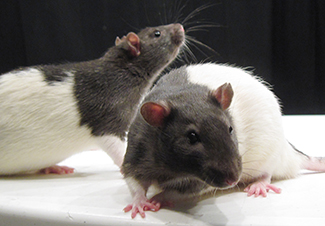
Figure 10.14図 10.14
A male rat that cannot engage in sexual behavior still seeks receptive females, suggesting that the ability to engage in sexual behavior and the motivation to do so are mediated by different systems in the brain. (credit: Jason Snyder)
性行動を行うことができない雄のラットも、なお受容状態にある雌を求める。このことは、性行動を行う能力と、性行動をしようとする動機づけとが、脳の異なるシステムによって媒介されていることを示唆している。(出典:Jason Snyder)
Animal research suggests that limbic system structures such as the amygdala and nucleus accumbens are especially important for sexual motivation. Damage to these areas results in a decreased motivation to engage in sexual behavior, while leaving the ability to do so intact (Figure 10.15) (Everett, 1990). Similar dissociations of sexual motivation and sexual ability have also been observed in the female rat (Becker, Rudick, & Jenkins, 2001; Jenkins & Becker, 2001).
英語のヒント
動物研究は、扁桃体や側坐核といった大脳辺縁系の構造が、性的動機づけにとってとくに重要であることを示唆している。これらの領域が損傷を受けると、性行動をしようとする動機づけは低下するが、性行動を行う能力はそのまま保たれる(図10.15)(Everett, 1990)。性的動機づけと性的能力の同様の解離は、雌のラットでも観察されている(Becker, Rudick, & Jenkins, 2001; Jenkins & Becker, 2001)。
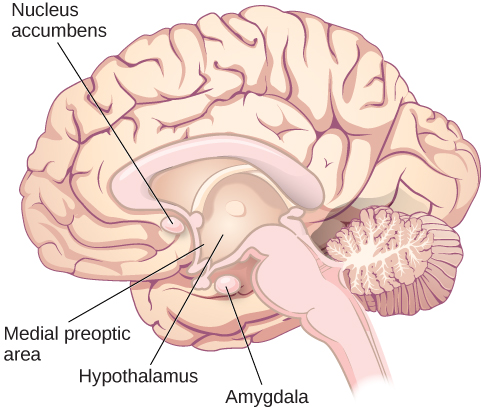
Figure 10.15図 10.15
The medial preoptic area, an area of the hypothalamus, is involved in the ability to engage in sexual behavior, but it does not affect sexual motivation. In contrast, the amygdala and nucleus accumbens are involved in motivation for sexual behavior, but they do not affect the ability to engage in it.
視床下部の一領域である内側視索前野は、性行動を行う能力にかかわっているが、性的動機づけには影響しない。これに対して、扁桃体と側坐核は性行動への動機づけにかかわっているが、性行動を行う能力には影響しない。
Although human sexual behavior is much more complex than that seen in rats, some parallels between animals and humans can be drawn from this research. The worldwide popularity of drugs used to treat erectile dysfunction (Conrad, 2005) speaks to the fact that sexual motivation and the ability to engage in sexual behavior can also be dissociated in humans. Moreover, disorders that involve abnormal hypothalamic function are often associated with hypogonadism (reduced function of the gonads) and reduced sexual function (e.g., Prader-Willi syndrome). Given the hypothalamus’s role in endocrine function, it is not surprising that hormones secreted by the endocrine system also play important roles in sexual motivation and behavior. For example, many animals show no sign of sexual motivation in the absence of the appropriate combination of sex hormones from their gonads. While this is not the case for humans, there is considerable evidence that sexual motivation for all genders varies as a function of circulating testosterone levels (Bhasin, Enzlin, Coviello, & Basson, 2007; Carter, 1992; Sherwin, 1988).
英語のヒント
人間の性行動はラットに見られる性行動よりもはるかに複雑だが、この研究から、動物と人間のあいだにいくつかの共通点を見いだすことはできる。勃起不全の治療に使われる薬が世界的に人気を集めていること(Conrad, 2005)は、人間でも性的動機づけと性行動を行う能力とが切り離されうることを物語っている。さらに、視床下部の機能の異常を伴う障害は、しばしば性腺機能低下症(生殖腺の機能の低下)や性機能の低下と関連している(例:プラダー・ウィリ症候群)。視床下部が内分泌機能において果たす役割を考えれば、内分泌系から分泌されるホルモンもまた、性的動機づけと性行動に重要な役割を果たしているのは驚くにあたらない。たとえば多くの動物は、生殖腺から出る性ホルモンが適切な組み合わせでそろっていないと、性的動機づけの兆しをまったく見せない。人間ではそうではないが、すべての性別において、性的動機づけが血中を循環するテストステロンの濃度に応じて変化することを示す、かなりの証拠がある(Bhasin, Enzlin, Coviello, & Basson, 2007; Carter, 1992; Sherwin, 1988)。
Kinsey’s Researchキンゼイの研究
Before the late 1940s, access to reliable, empirically-based information on sex was limited. Physicians were considered authorities on all issues related to sex, despite the fact that they had little to no training in these issues, and it is likely that most of what people knew about sex had been learned either through their own experiences or by talking with their peers. Convinced that people would benefit from a more open dialogue on issues related to human sexuality, Dr. Alfred Kinsey of Indiana University initiated large-scale survey research on the topic (Figure 10.16). The results of some of these efforts were published in two books—Sexual Behavior in the Human Male and Sexual Behavior in the Human Female—which were published in 1948 and 1953, respectively (Bullough, 1998).
英語のヒント
1940年代後半より前には、性についての信頼できる、実証的な根拠に基づく情報を手に入れる機会は限られていた。医師は、性にかかわる問題についてほとんど、あるいはまったく訓練を受けていなかったにもかかわらず、性にかかわるあらゆる問題の権威とみなされていた。そして、人々が性について知っていたことの大半は、自分自身の経験を通して、あるいは仲間と話すことによって学んだものだった可能性が高い。人間のセクシュアリティにかかわる問題について、より開かれた対話があれば人々のためになると確信して、インディアナ大学のアルフレッド・キンゼイ博士は、この主題について大規模な調査研究を始めた(図10.16)。こうした取り組みの成果の一部は、『人間における男性の性行動』と『人間における女性の性行動』の2冊の本として、それぞれ1948年と1953年に出版された(Bullough, 1998)。



Figure 10.16図 10.16
In 1947, Alfred Kinsey established The Kinsey Institute for Research, Sex, Gender and Reproduction at Indiana University, shown here in 2011. The Kinsey Institute has continued as a research site of important psychological studies for decades.
1947年、アルフレッド・キンゼイはインディアナ大学にキンゼイ性・ジェンダー・生殖研究所を設立した。写真は2011年のもの。キンゼイ研究所は数十年にわたって、重要な心理学研究の拠点であり続けてきた。
At the time, the Kinsey reports were quite sensational. Never before had the American public seen its private sexual behavior become the focus of scientific scrutiny on such a large scale. The books, which were filled with statistics and scientific lingo, sold remarkably well to the general public, and people began to engage in open conversations about human sexuality. As you might imagine, not everyone was happy that this information was being published. In fact, these books were banned in some countries. Ultimately, the controversy resulted in Kinsey losing funding that he had secured from the Rockefeller Foundation to continue his research efforts (Bancroft, 2004).
英語のヒント
当時、キンゼイ報告は大きな反響を呼んだ。アメリカの人々が、自分たちの私的な性行動がこれほど大規模に科学的な精査の対象になるのを目にしたのは、それが初めてだった。統計と科学の専門用語で埋め尽くされたこれらの本は、一般の人々に驚くほどよく売れ、人々は人間のセクシュアリティについて率直に語り合うようになった。想像がつくように、この情報が出版されることを誰もが喜んだわけではない。実際、これらの本はいくつかの国で発禁となった。最終的に、この論争のために、キンゼイは研究活動を続けるためにロックフェラー財団から確保していた資金を失うことになった(Bancroft, 2004)。
Although Kinsey’s research has been widely criticized as being riddled with sampling and statistical errors (Jenkins, 2010), there is little doubt that this research was very influential in shaping future research on human sexual behavior and motivation. Kinsey described a remarkably diverse range of sexual behaviors and experiences reported by the volunteers participating in his research. Behaviors that had once been considered exceedingly rare or problematic were demonstrated to be much more common and innocuous than previously imagined (Bancroft, 2004; Bullough, 1998).
英語のヒント
キンゼイの研究は、標本抽出と統計の誤りだらけだと広く批判されてきた(Jenkins, 2010)が、この研究が、人間の性行動と性的動機づけについてのその後の研究を形づくるうえで非常に大きな影響力を持っていたことは、ほとんど疑いがない。キンゼイは、研究に参加したボランティアが報告した、驚くほど多様な性行動と性経験を記述した。かつてはきわめてまれ、あるいは問題があるとみなされていた行動が、それまで想像されていたよりもはるかにありふれた、害のないものであることが示された(Bancroft, 2004; Bullough, 1998)。
Among the results of Kinsey’s research were the findings that women are as interested and experienced in sex as men, that both males and females masturbate without adverse health consequences, and that relationships and sexual acts between people of the same sex and/or the same gender are fairly common (Bancroft, 2004). Kinsey also developed a continuum known as the Kinsey scale that is still commonly used today to categorize an individual’s sexual orientation, which is an individual’s emotional, romantic, and erotic attractions to other people or no people (Jenkins, 2010).
英語のヒント
キンゼイの研究の結果には、次のような知見があった。女性は男性と同じくらい性に関心があり、性経験もあること、男性も女性もマスターベーションをしており、それによって健康に悪影響が生じることはないこと、そして、同じ性別および/または同じジェンダーの人どうしの関係や性行為は、かなりよく見られることである(Bancroft, 2004)。キンゼイはまた、キンゼイ尺度として知られる連続体を考案した。この尺度は、個人の性的指向を分類するために今日でもよく使われている。性的指向とは、個人が他者に対して抱く、あるいは誰に対しても抱かない、感情的、恋愛的、性愛的な惹かれのことである(Jenkins, 2010)。