第10章感情と動機づけ
10.1 Motivation10.1 動機づけ
Learning Objectives学習目標
By the end of this section, you will be able to:
この節を学び終えると、次のことができるようになる。
- Define intrinsic and extrinsic motivation内発的動機づけと外発的動機づけを定義する
- Understand that instincts, drive reduction, self-efficacy, and social motives have all been proposed as theories of motivation本能、動因低減、自己効力感、社会的動機が、いずれも動機づけの理論として提唱されてきたことを理解する
- Explain the basic concepts associated with Maslow’s hierarchy of needsマズローの欲求階層にかかわる基本的な概念を説明する
Why do we do the things we do? What motivations underlie our behaviors? Motivation describes the wants or needs that direct behavior toward a goal. In addition to biological motives, motivations can be intrinsic (arising from internal factors) or extrinsic (arising from external factors) (Figure 10.2). Intrinsically motivated behaviors are performed because of the sense of personal satisfaction that they bring, while extrinsically motivated behaviors are performed in order to receive something from others.
英語のヒント
私たちはなぜ、自分のしていることをするのだろうか。私たちの行動の根底には、どのような動機があるのだろうか。動機づけとは、行動をある目標へと方向づける願望や欲求のことである。動機づけには、生物学的な動機のほかに、内発的なもの(内的な要因から生じるもの)と外発的なもの(外的な要因から生じるもの)がありうる(図10.2)。内発的に動機づけられた行動は、それがもたらす個人的な満足感のために行われる。一方、外発的に動機づけられた行動は、他者から何かを受け取るために行われる。
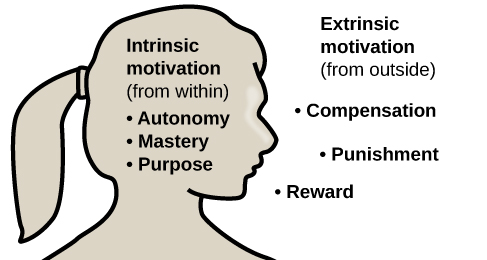
Figure 10.2図 10.2
Intrinsic motivation comes from within the individual, while extrinsic motivation comes from outside the individual.
内発的動機づけは個人の内側から生じ、外発的動機づけは個人の外側から生じる。
Think about why you are pursuing an education. Are you here because you enjoy learning and want to pursue an education to make yourself a more well-rounded individual? If so, then you are intrinsically motivated. However, if you are here because you want to get a college degree to make yourself more marketable for a high-paying career or to satisfy the demands of your parents, then your motivation is more extrinsic in nature.
英語のヒント
あなたがなぜ教育を受けているのかを考えてみよう。あなたがここにいるのは、学ぶことが楽しく、教育を受けて自分をより幅広い素養を持つ人間にしたいからだろうか。そうであれば、あなたは内発的に動機づけられている。しかし、ここにいるのが、高収入の職に向けて自分の市場価値を高めるため、あるいは親の要求を満たすために大学の学位を取りたいからであれば、あなたの動機づけはどちらかといえば外発的な性質のものである。
In reality, our motivations are often a mix of both intrinsic and extrinsic factors, but the nature of the mix of these factors might change over time (often in ways that seem counter-intuitive). There is an old adage: “Choose a job that you love, and you will never have to work a day in your life,” meaning that if you enjoy your occupation, work doesn’t seem like . . . well, work. Some research suggests that this isn’t necessarily the case (Daniel & Esser, 1980; Deci, 1972; Deci, Koestner, & Ryan, 1999). According to this research, receiving some sort of extrinsic reinforcement (i.e., getting paid) for engaging in behaviors that we enjoy leads to those behaviors being thought of as work no longer providing that same enjoyment. As a result, we might spend less time engaging in these reclassified behaviors in the absence of any extrinsic reinforcement. For example, Odessa loves baking, so in her free time, she bakes for fun. Oftentimes, after stocking shelves at her grocery store job, she whips up pastries in the evenings because she enjoys baking. When a coworker in the store’s bakery department leaves his job, Odessa applies for his position and gets transferred to the bakery department. Although she enjoys what she does in her new job, after a few months, she no longer has much desire to concoct tasty treats in her free time. Baking has become work in a way that changes her motivation to do it (Figure 10.3). What Odessa has experienced is called the overjustification effect—intrinsic motivation is diminished when extrinsic motivation is given. This can lead to extinguishing the intrinsic motivation and creating a dependence on extrinsic rewards for continued performance (Deci et al., 1999).
英語のヒント
実際には、私たちの動機づけは内発的な要因と外発的な要因の両方が混ざり合ったものであることが多い。しかし、それらの要因の混ざり方の性質は、時間とともに(しばしば直観に反するような形で)変わるかもしれない。昔から「好きな仕事を選べば、一生のうち一日たりとも働かなくてすむ」という格言がある。自分の職業を楽しんでいれば、仕事は……そう、仕事のようには感じられない、という意味である。必ずしもそうとは限らないことを示唆する研究もある(Daniel & Esser, 1980; Deci, 1972; Deci, Koestner, & Ryan, 1999)。こうした研究によれば、自分が楽しんでいる行動をすることに対して何らかの外的な強化を受ける(つまり、お金をもらう)と、その行動は仕事とみなされるようになり、もはや以前と同じ楽しみをもたらさなくなる。その結果、外的な強化がまったくない状況では、このように分類し直された行動に費やす時間が減るかもしれない。たとえば、オデッサはパンやお菓子を焼くのが大好きで、暇な時間には楽しみのために焼いている。食料品店の仕事で商品を棚に並べたあと、夕方にペストリーを手早く作ることがよくある。焼くことが楽しいからである。店のベーカリー部門の同僚が仕事を辞めると、オデッサはその職に応募し、ベーカリー部門に異動になる。新しい仕事でしていることは楽しいのだが、数か月たつと、暇な時間においしいお菓子をこしらえたいという気持ちはもうあまりなくなってしまう。焼くことが仕事になり、そのことが、焼こうとする彼女の動機づけを変えてしまったのである(図10.3)。オデッサが経験したことは過剰正当化効果と呼ばれる。外発的動機づけが与えられると、内発的動機づけが弱まるという現象である。これは、内発的動機づけを消し去り、行動を続けるのに外的な報酬に依存する状態をつくり出すことにつながりうる(Deci et al., 1999)。



Figure 10.3図 10.3
Research suggests that when something we love to do, like icing cakes, becomes our job, our intrinsic and extrinsic motivations to do it may change. (credit: Agustín Ruiz)
研究が示唆するところでは、ケーキにアイシングを施すことのように、大好きなことが仕事になると、それをしようとする私たちの内発的動機づけと外発的動機づけは変わるかもしれない。(出典:Agustín Ruiz)
Other studies suggest that intrinsic motivation may not be so vulnerable to the effects of extrinsic reinforcements, and in fact, reinforcements such as verbal praise might actually increase intrinsic motivation (Arnold, 1976; Cameron & Pierce, 1994). In that case, Odessa’s motivation to bake in her free time might remain high if, for example, customers regularly compliment her baking or cake decorating skills.
英語のヒント
ほかの研究は、内発的動機づけは外的な強化の影響をそれほど受けやすくはないかもしれず、実際、言葉による賞賛のような強化はむしろ内発的動機づけを高めるかもしれないことを示唆している(Arnold, 1976; Cameron & Pierce, 1994)。その場合、たとえば客がオデッサの焼き菓子作りやケーキのデコレーションの腕前をたびたびほめてくれるなら、暇な時間に焼こうとする彼女の動機づけは高いままであるかもしれない。
These apparent discrepancies in the researchers’ findings may be understood by considering several factors. For one, physical reinforcement (such as money) and verbal reinforcement (such as praise) may affect an individual in very different ways. In fact, tangible rewards (i.e., money) tend to have more negative effects on intrinsic motivation than do intangible rewards (i.e., praise). Furthermore, the expectation of the extrinsic motivator by an individual is crucial: If the person expects to receive an extrinsic reward, then intrinsic motivation for the task tends to be reduced. If, however, there is no such expectation, and the extrinsic motivation is presented as a surprise, then intrinsic motivation for the task tends to persist (Deci et al., 1999).
英語のヒント
研究者たちの知見に見られるこうした一見した食い違いは、いくつかの要因を考えることで理解できるかもしれない。一つには、物質的な強化(お金など)と言葉による強化(ほめ言葉など)とでは、個人に与える影響がまったく異なるかもしれない。実際、有形の報酬(つまりお金)は、無形の報酬(つまりほめ言葉)よりも、内発的動機づけに否定的な影響を及ぼす傾向がある。さらに、本人が外的な動機づけ要因を予期しているかどうかが決定的に重要である。外的な報酬を受け取ると予期していれば、その課題に対する内発的動機づけは低下する傾向がある。しかし、そうした予期がなく、外発的動機づけが思いがけない形で与えられる場合には、その課題に対する内発的動機づけは持続する傾向がある(Deci et al., 1999)。
In addition, culture may influence motivation. For example, in collectivistic cultures, it is common to do things for your family members because the emphasis is on the group and what is best for the entire group, rather than what is best for any one individual (Nisbett, Peng, Choi, & Norenzayan, 2001). This focus on others provides a broader perspective that takes into account both situational and cultural influences on behavior; thus, a more nuanced explanation of the causes of others’ behavior becomes more likely. (You will learn more about collectivistic and individualistic cultures when you learn about social psychology.)
英語のヒント
さらに、文化が動機づけに影響を与えることもある。たとえば集団主義文化では、家族のために何かをするのはよくあることである。重点が置かれるのは集団と、集団全体にとって何が最善かであり、特定の一個人にとって何が最善かではないからである(Nisbett, Peng, Choi, & Norenzayan, 2001)。このように他者に焦点を当てることは、行動に対する状況の影響と文化の影響の両方を考慮に入れた、より広い視点をもたらす。したがって、他者の行動の原因について、よりきめ細かな説明がなされる可能性が高くなる。(集団主義文化と個人主義文化については、社会心理学について学ぶときにさらに詳しく学ぶ。)
In educational settings, students are more likely to experience intrinsic motivation to learn when they feel a sense of belonging and respect in the classroom. This internalization can be enhanced if the evaluative aspects of the classroom are de-emphasized and if students feel that they exercise some control over the learning environment. Furthermore, providing students with activities that are challenging, yet doable, along with a rationale for engaging in various learning activities can enhance intrinsic motivation for those tasks (Niemiec & Ryan, 2009). Consider Hakim, a first-year law student with two courses this semester: Family Law and Criminal Law. The Family Law professor has a rather intimidating classroom: He likes to put students on the spot with tough questions, which often leaves students feeling belittled or embarrassed. Grades are based exclusively on quizzes and exams, and the instructor posts results of each test on the classroom door. In contrast, the Criminal Law professor facilitates classroom discussions and respectful debates in small groups. The majority of the course grade is not exam-based, but centers on a student-designed research project on a crime issue of the student’s choice. Research suggests that Hakim will be less intrinsically motivated in his Family Law course, where students are intimidated in the classroom setting, and there is an emphasis on teacher-driven evaluations. Hakim is likely to experience a higher level of intrinsic motivation in his Criminal Law course, where the class setting encourages inclusive collaboration and a respect for ideas, and where students have more influence over their learning activities.
英語のヒント
教育の場では、学生は教室の中で所属感と尊重を感じているときに、学ぼうとする内発的動機づけを経験する可能性が高くなる。この内在化は、教室での評価の側面があまり強調されず、学生が学習環境をある程度自分で制御していると感じられる場合に強まりうる。さらに、難しいがやり遂げられる活動を、さまざまな学習活動に取り組む理由とともに学生に与えることで、それらの課題に対する内発的動機づけが高まりうる(Niemiec & Ryan, 2009)。ハキムを例に考えてみよう。ハキムは法科大学院の1年生で、今学期は家族法と刑法の二つの科目を履修している。家族法の教授の教室は、かなり威圧的な雰囲気である。教授は難しい質問で学生をその場で問い詰めるのを好み、そのせいで学生はしばしば、見下されたように感じたり、恥ずかしい思いをしたりする。成績は小テストと試験だけで決まり、教員は毎回のテストの結果を教室のドアに貼り出す。これに対して刑法の教授は、教室での話し合いや、少人数のグループでの互いを尊重した討論の進行役を務める。科目の成績の大部分は試験に基づくものではなく、学生が自分で選んだ犯罪問題について、学生自身が設計する研究プロジェクトが中心となる。研究が示唆するところでは、ハキムは家族法の授業では内発的動機づけがより低くなるだろう。この授業では、学生は教室の場で萎縮させられ、教員主導の評価に重点が置かれている。ハキムは刑法の授業で、より高い水準の内発的動機づけを経験する可能性が高い。この授業では、授業の場が誰も排除しない協力と考えの尊重を促しており、学生は自分の学習活動により大きな影響力を持っている。