第10章感情と動機づけ
Theories About Motivation動機づけについての理論
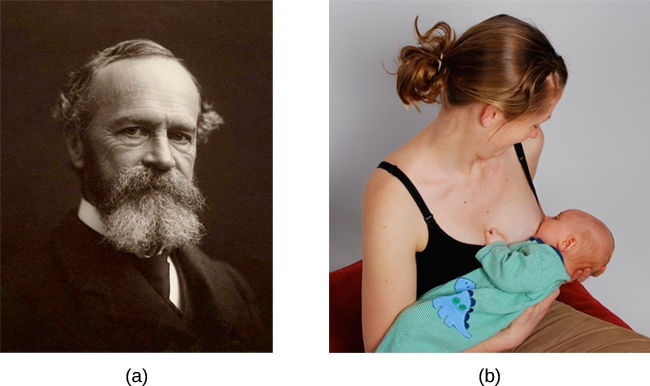
William James (1842–1910) was an important contributor to early research into motivation, and he is often referred to as the father of psychology in the United States. James theorized that behavior was driven by a number of instincts, which aid survival (Figure 10.4). From a biological perspective, an instinct is a species-specific pattern of behavior that is not learned. There was, however, considerable controversy among James and his contemporaries over the exact definition of instinct. James proposed several dozen special human instincts, but many of his contemporaries had their own lists that differed. A mother’s protection of her baby, the urge to lick sugar, and hunting prey were among the human behaviors proposed as true instincts during James’s era. This view—that human behavior is driven by instincts—received a fair amount of criticism because of the undeniable role of learning in shaping all sorts of human behavior. In fact, as early as the 1900s, some instinctive behaviors were experimentally demonstrated to result from associative learning (recall when you learned about Watson’s conditioning of fear response in “Little Albert”) (Faris, 1921).
英語のヒント
ウィリアム・ジェームズ(1842〜1910)は、動機づけについての初期の研究に重要な貢献をした人物であり、アメリカにおける心理学の父と呼ばれることが多い。ジェームズは、行動は、生存を助けるいくつもの本能によって動かされていると理論化した(図10.4)。生物学的観点からいえば、本能とは、学習されたものではない、種に特有の行動パターンである。しかし、本能の正確な定義については、ジェームズと同時代の研究者たちのあいだでかなりの論争があった。ジェームズは人間の本能を個別に数十個提唱したが、同時代の研究者の多くは、それとは異なる独自のリストを持っていた。母親がわが子を守ること、砂糖をなめたいという衝動、獲物を狩ることは、ジェームズの時代に真の本能として提唱された人間の行動の一部だった。人間の行動は本能によって動かされるというこの見方は、かなりの批判を受けた。人間のあらゆる種類の行動を形づくるうえで学習が役割を果たしていることは、否定できないからである。実際、早くも1900年代には、本能的な行動の一部が連合学習から生じることが、実験によって示されていた(ワトソンが「アルバート坊や」に恐怖反応を条件づけたことについて学んだのを思い出そう)(Faris, 1921)。
OpenStax, Rice University; Psychology 2e. (credit b: modification of work by "Mothering Touch"/Flickr) · CC BY 4.0 · Source出典
Figure 10.4図 10.4
(a) William James proposed the instinct theory of motivation, asserting that behavior is driven by instincts. (b) In humans, instincts may include behaviors such as an infant’s rooting for a nipple and sucking. (credit b: modification of work by "Mothering Touch"/Flickr)
(a)ウィリアム・ジェームズは動機づけの本能理論を提唱し、行動は本能によって動かされると主張した。(b)人間の本能には、乳児が乳首を探って口を寄せ、吸うといった行動が含まれるかもしれない。(出典b:"Mothering Touch"/Flickrの作品を改変)
Another early theory of motivation proposed that the maintenance of homeostasis is particularly important in directing behavior. You may recall from your earlier reading that homeostasis is the tendency to maintain a balance, or optimal level, within a biological system. In a body system, a control center (which is often part of the brain) receives input from receptors (which are often complexes of neurons). The control center directs effectors (which may be other neurons) to correct any imbalance detected by the control center.
英語のヒント
動機づけについてのもう一つの初期の理論は、恒常性の維持が、行動を方向づけるうえでとりわけ重要だと提唱した。以前に読んだ内容を覚えているかもしれないが、恒常性とは、生物学的なシステムの中で均衡、すなわち最適な水準を保とうとする傾向である。体のシステムでは、制御中枢(多くの場合、脳の一部)が受容器(多くの場合、ニューロンの複合体)から入力を受け取る。制御中枢は効果器(ほかのニューロンのこともある)に、制御中枢が検出したあらゆる不均衡を正すよう指示する。
According to the drive theory of motivation, deviations from homeostasis create physiological needs. These needs result in psychological drive states that direct behavior to meet the need and, ultimately, bring the system back to homeostasis. For example, if it’s been a while since you ate, your blood sugar levels will drop below normal. This low blood sugar will induce a physiological need and a corresponding drive state (i.e., hunger) that will direct you to seek out and consume food (Figure 10.5). Eating will eliminate the hunger, and, ultimately, your blood sugar levels will return to normal. Interestingly, drive theory also emphasizes the role that habits play in the type of behavioral response in which we engage. A habit is a pattern of behavior in which we regularly engage. Once we have engaged in a behavior that successfully reduces a drive, we are more likely to engage in that behavior whenever faced with that drive in the future (Graham & Weiner, 1996).
英語のヒント
動機づけの動因理論によれば、恒常性からの逸脱が生理的欲求を生み出す。こうした欲求は心理的な動因状態をもたらし、その動因状態が、欲求を満たすように行動を方向づけ、最終的にはシステムを恒常性へと戻す。たとえば、最後に食事をしてからしばらくたつと、血糖値は正常より低くなる。この低血糖が、生理的欲求と、それに対応する動因状態(つまり空腹)を引き起こし、その動因状態によって、あなたは食物を探し求めて食べるよう方向づけられる(図10.5)。食べることで空腹はなくなり、最終的に血糖値は正常に戻る。興味深いことに、動因理論は、私たちがとる行動反応の種類に対して習慣が果たす役割も強調している。習慣とは、私たちがいつも決まって行う行動のパターンである。ある動因をうまく低減させる行動をいったんとると、将来その動因に直面するたびに、その行動をとる可能性が高くなる(Graham & Weiner, 1996)。

OpenStax, Rice University; Psychology 2e. (credit "left": modification of work by "Gracie and Viv"/Flickr; credit "center": modification of work by Steven Depolo; credit "right": modification of work by Monica Renata) · CC BY 4.0 · Source出典
Figure 10.5図 10.5
Hunger and subsequent eating are the result of complex physiological processes that maintain homeostasis. (credit "left": modification of work by "Gracie and Viv"/Flickr; credit "center": modification of work by Steven Depolo; credit "right": modification of work by Monica Renata)
空腹と、それに続く食事は、恒常性を保つ複雑な生理的過程の結果である。(出典「左」:"Gracie and Viv"/Flickrの作品を改変、出典「中央」:Steven Depoloの作品を改変、出典「右」:Monica Renataの作品を改変)
Extensions of drive theory take into account levels of arousal as potential motivators. As you recall from your study of learning, these theories assert that there is an optimal level of arousal that we all try to maintain (Figure 10.6). If we are underaroused, we become bored and will seek out some sort of stimulation. On the other hand, if we are overaroused, we will engage in behaviors to reduce our arousal (Berlyne, 1960). Most students have experienced this need to maintain optimal levels of arousal over the course of their academic career. Think about how much stress students experience toward the end of spring semester. They feel overwhelmed with seemingly endless exams, papers, and major assignments that must be completed on time. They probably yearn for the rest and relaxation that awaits them over the extended summer break. However, once they finish the semester, it doesn’t take too long before they begin to feel bored. Generally, by the time the next semester is beginning in the fall, many students are quite happy to return to school. This is an example of how arousal theory works.
英語のヒント
動因理論を拡張した理論は、覚醒の水準を、動機づけの要因となりうるものとして考慮に入れる。学習について学んだことを覚えているだろうが、これらの理論は、私たちが誰でも保とうとする最適な覚醒水準がある、と主張する(図10.6)。覚醒が低すぎると、私たちは退屈し、何らかの刺激を求めるようになる。反対に、覚醒が高すぎると、覚醒を下げるための行動をとる(Berlyne, 1960)。ほとんどの学生は、学業を続けるなかで、最適な覚醒水準を保とうとするこの欲求を経験したことがある。春学期の終わりが近づくころ、学生がどれほど大きなストレスを経験するかを考えてみよう。期限どおりに仕上げなければならない試験、レポート、大きな課題がいつまでも続くように思え、学生は圧倒されていると感じる。長い夏休みのあいだに待っている休息とくつろぎを、おそらく待ち焦がれていることだろう。しかし、学期が終わると、それほどたたないうちに退屈を感じはじめる。一般に、秋に次の学期が始まるころには、多くの学生がとても喜んで学校に戻る。これは、覚醒理論がどのように働くかを示す一例である。
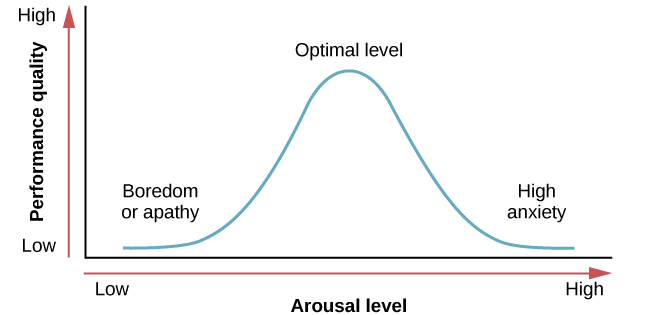
Figure 10.6図 10.6
The concept of optimal arousal in relation to performance on a task is depicted here. Performance is maximized at the optimal level of arousal, and it tapers off during under- and overarousal.
課題の遂行との関係における、最適覚醒の概念を示す。遂行は最適な覚醒水準で最大になり、覚醒が低すぎるときと高すぎるときには次第に低下する。
So what is the optimal level of arousal? What level leads to the best performance? Research shows that moderate arousal is generally best; when arousal is very high or very low, performance tends to suffer (Yerkes & Dodson, 1908). Think of your arousal level regarding taking an exam for this class. If your level is very low, such as boredom and apathy, your performance will likely suffer. Similarly, a very high level, such as extreme anxiety, can be paralyzing and hinder performance. Consider the example of a softball team facing a tournament. They are favored to win their first game by a large margin, so they go into the game with a lower level of arousal and get beat by a less skilled team.
英語のヒント
では、最適な覚醒水準とはどのくらいなのだろうか。どの水準が最もよい遂行につながるのだろうか。研究によれば、一般には中程度の覚醒が最もよい。覚醒が非常に高いときや非常に低いときには、遂行は損なわれる傾向がある(Yerkes & Dodson, 1908)。この授業の試験を受けることについての、あなたの覚醒水準を考えてみよう。退屈や無気力のように水準が非常に低ければ、遂行はおそらく損なわれるだろう。同様に、極度の不安のような非常に高い水準は、身をすくませ、遂行を妨げることがある。トーナメントを控えたソフトボールチームの例を考えてみよう。チームは初戦で大差で勝つと予想されているので、低めの覚醒水準で試合に臨み、自分たちより技量の劣るチームに負けてしまう。
But optimal arousal level is more complex than a simple answer that the middle level is always best. Researchers Robert Yerkes (pronounced “Yerk-EES”) and John Dodson discovered that the optimal arousal level depends on the complexity and difficulty of the task to be performed (Figure 10.7). This relationship is known as the Yerkes-Dodson law, which holds that a simple task is performed best when arousal levels are relatively high and complex tasks are best performed when arousal levels are lower.
英語のヒント
しかし、最適な覚醒水準は、中程度の水準が常に最もよいという単純な答えよりも複雑である。研究者のロバート・ヤーキーズ(「Yerk-EES」と発音する)とジョン・ドッドソンは、最適な覚醒水準が、行う課題の複雑さと難しさによって決まることを発見した(図10.7)。この関係はヤーキーズ=ドッドソンの法則として知られている。この法則によれば、単純な課題は覚醒水準が比較的高いときに最もよく遂行され、複雑な課題は覚醒水準がより低いときに最もよく遂行される。
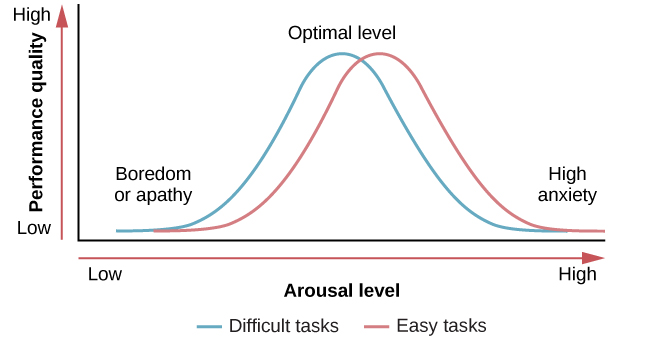


Figure 10.7図 10.7
Task performance is best when arousal levels are in a middle range, with difficult tasks best performed under lower levels of arousal and simple tasks best performed under higher levels of arousal.
課題の遂行は、覚醒水準が中程度の範囲にあるときに最もよい。難しい課題は低めの覚醒水準のもとで、単純な課題は高めの覚醒水準のもとで最もよく遂行される。