第10章感情と動機づけ
Hippocampus海馬
As mentioned earlier, the hippocampus is also involved in emotional processing. Like the amygdala, research has demonstrated that hippocampal structure and function are linked to a variety of mood and anxiety disorders. Individuals suffering from posttraumatic stress disorder (PTSD) show marked reductions in the volume of several parts of the hippocampus, which may result from decreased levels of neurogenesis and dendritic branching (the generation of new neurons and the generation of new dendrites in existing neurons, respectively) (Wang et al., 2010). While it is impossible to make a causal claim with correlational research like this, studies have demonstrated behavioral improvements and hippocampal volume increases following either pharmacological or cognitive-behavioral therapy in individuals suffering from PTSD (Bremner & Vermetten, 2004; Levy-Gigi, Szabó, Kelemen, & Kéri, 2013).
英語のヒント
先に述べたように、海馬もまた感情の処理にかかわっている。扁桃体と同様に、海馬の構造と機能もさまざまな気分障害や不安障害と関連していることが、研究によって実証されている。心的外傷後ストレス障害(PTSD)に苦しむ人々では、海馬のいくつかの部位の体積が著しく減少している。これは、神経新生と樹状突起の分枝(それぞれ、新しいニューロンの生成と、既存のニューロンにおける新しい樹状突起の生成)の水準が低下した結果であるかもしれない(Wang et al., 2010)。このような相関研究から因果関係を主張することはできないが、PTSDに苦しむ人々において、薬物療法か認知行動療法のいずれかを受けた後に、行動の改善と海馬の体積の増加が見られることを実証した研究がある(Bremner & Vermetten, 2004; Levy-Gigi, Szabó, Kelemen, & Kéri, 2013)。
Facial Expression and Recognition of Emotions顔の表情と感情の認識
Culture can impact the way in which people display emotion. A cultural display rule is one of a collection of culturally specific standards that govern the types and frequencies of displays of emotions that are acceptable (Malatesta & Haviland, 1982). Therefore, people from varying cultural backgrounds can have very different cultural display rules of emotion. For example, research has shown that individuals from the United States express negative emotions like fear, anger, and disgust both alone and in the presence of others, while Japanese individuals only do so while alone (Matsumoto, 1990). Furthermore, individuals from cultures that tend to emphasize social cohesion are more likely to engage in suppression of emotional reaction so they can evaluate which response is most appropriate in a given context (Matsumoto, Yoo, & Nakagawa, 2008).
英語のヒント
文化は、人々が感情を表に出すしかたに影響しうる。文化的表示規則とは、どのような種類の感情表出を、どのくらいの頻度で行うことが受け入れられるかを定める、文化に特有の基準の集まりの一つである(Malatesta & Haviland, 1982)。そのため、文化的背景の異なる人々は、感情の文化的表示規則が大きく異なることがある。たとえば研究によれば、アメリカ出身の人々は、恐怖、怒り、嫌悪といった否定的な感情を、一人のときにも他人がいるところでも表に出すのに対し、日本人は一人のときにしかそうしない(Matsumoto, 1990)。さらに、社会的なまとまりを重視する傾向のある文化の人々は、ある文脈でどの反応が最も適切かを見極められるように、感情的な反応を抑える可能性が高い(Matsumoto, Yoo, & Nakagawa, 2008)。
Other distinct cultural characteristics might be involved in emotionality. For instance, there may be gender differences involved in emotional processing. While research into gender differences in emotional display is equivocal, there is some evidence that people of different genders may differ in regulation of emotions (McRae, Ochsner, Mauss, Gabrieli, & Gross, 2008).
英語のヒント
ほかの独自の文化的特徴も、情動性にかかわっているかもしれない。たとえば、感情の処理には性差がかかわっている可能性がある。感情表出の性差についての研究は結論がはっきりしないが、性別の異なる人々は感情の制御のしかたが異なるかもしれないことを示す証拠もいくつかある(McRae, Ochsner, Mauss, Gabrieli, & Gross, 2008)。
Paul Ekman (1972) researched a New Guinea man who was living in a preliterate culture using stone implements, and which was isolated and had never seen any outsiders before. Ekman asked the man to show what his facial expression would be if: (1) friends visited, (2) his child had just died, (3) he was about to fight, (4) he stepped on a smelly dead pig. After Ekman’s return from New Guinea, he researched facial expressions for more than four decades. Despite different emotional display rules, our ability to recognize and produce facial expressions of emotion appears to be universal. In fact, even congenitally blind individuals produce the same facial expression of emotions, despite their never having the opportunity to observe these facial displays of emotion in other people. This would seem to suggest that the pattern of activity in facial muscles involved in generating emotional expressions is universal, and indeed, this idea was suggested in the late 19th century in Charles Darwin’s book The Expression of Emotions in Man and Animals (1872). In fact, there is substantial evidence for seven universal emotions that are each associated with distinct facial expressions. These include: happiness, surprise, sadness, fright, disgust, contempt, and anger (Figure 10.24) (Ekman & Keltner, 1997).
英語のヒント
ポール・エクマン(1972)は、石器を使う無文字の文化の中で暮らしていたニューギニアの男性を研究した。その文化は外界から孤立しており、それまで外部の人間を一人も見たことがなかった。エクマンはその男性に、次のような場合にどんな顔の表情になるかをして見せるよう求めた。(1)友人が訪ねてきたとき、(2)自分の子どもが死んだばかりのとき、(3)今にも戦おうとしているとき、(4)悪臭を放つ死んだブタを踏んだとき。ニューギニアから戻った後、エクマンは40年以上にわたって顔の表情を研究した。感情の表示規則は異なっていても、感情の顔の表情を認識し、つくり出す私たちの能力は普遍的であるように見える。実際、生まれつき目の見えない人でさえ、他人の顔に表れる感情の表出を観察する機会が一度もなかったにもかかわらず、同じ感情の表情をつくり出す。このことは、感情の表出を生み出すのにかかわる顔の筋肉の活動パターンが普遍的であることを示唆しているように思われる。そして実際、この考えは19世紀後半に、チャールズ・ダーウィンの著書『人及び動物の表情について』(1872)で示されていた。実際、それぞれがはっきり異なる顔の表情と結びついた、七つの普遍的な感情については、十分な証拠がある。それは、幸福、驚き、悲しみ、恐怖、嫌悪、軽蔑、怒りである(図10.24)(Ekman & Keltner, 1997)。
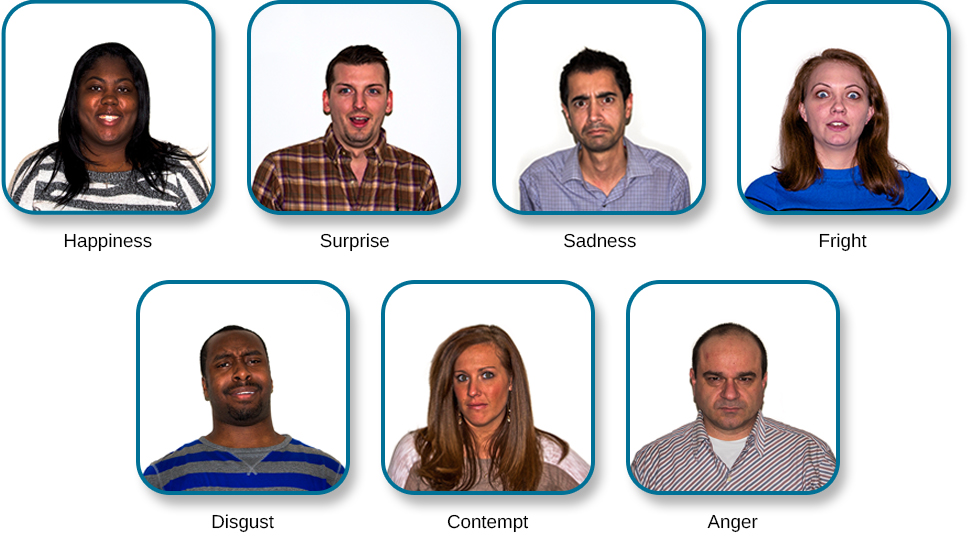
OpenStax, Rice University; Psychology 2e. (credit: modification of work by Cory Zanker) · CC BY 4.0 · Source出典

Figure 10.24図 10.24
The seven universal facial expressions of emotion are shown. (credit: modification of work by Cory Zanker)
感情を表す七つの普遍的な顔の表情を示す。(出典:Cory Zankerの作品を改変)
Of course, emotion is not only displayed through facial expression. We also use the tone of our voices, various behaviors, and body language to communicate information about our emotional states. Body language is the expression of emotion in terms of body position or movement. Research suggests that we are quite sensitive to the emotional information communicated through body language, even if we’re not consciously aware of it (de Gelder, 2006; Tamietto et al., 2009).
英語のヒント
もちろん、感情は顔の表情だけを通して表されるわけではない。私たちは、声の調子やさまざまな行動、ボディランゲージも使って、自分の感情の状態についての情報を伝えている。ボディランゲージとは、体の姿勢や動きによる感情の表出である。研究は、私たちが、たとえ意識的には気づいていなくても、ボディランゲージを通して伝えられる感情的な情報にかなり敏感であることを示唆している(de Gelder, 2006; Tamietto et al., 2009)。