第2章一次元の運動Motion in One Dimension原書 p.55–96
2.1 Relative Motion, Distance, and Displacement2.1 相対運動、道のり、変位
SECTION LEARNING OBJECTIVES By the end of this section, you will be able to do the following:
この節の学習目標 この節を終えると、次のことができるようになる。
• Describe motion in different reference frames• Define distance and displacement, and distinguish between the two• Solve problems involving distance and displacement
・異なる基準系での運動を記述する・道のりと変位を定義し、両者を区別する・道のりと変位に関する問題を解く
Section Key Termsこの節の重要語
displacementdistancekinematicsmagnitudepositionreference framescalarvector
変位道のり運動学大きさ位置基準系スカラーベクトル
Defining Motion運動を定義する
Our study of physics opens with kinematics—the study of motion without considering its causes. Objects are in motion everywhere you look. Everything from a tennis game to a space-probe flyby of the planet Neptune involves motion. When you are resting, your heart moves blood through your veins. Even in inanimate objects, atoms are always moving.
物理学の学習は運動学から始まる。運動学とは、運動の原因には立ち入らず、物体がどのように動くかを記述する学問である。私たちの周囲には、いたるところに運動がある。テニスの試合にも、海王星の近くを通過する探査機にも運動が関わっている。休んでいるときも、心臓は血液を血管へ送り出している。生命のない物体の内部でも、原子は絶えず動いている。
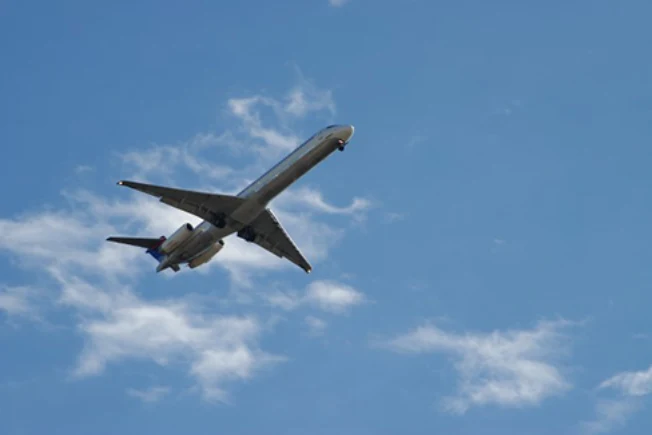
How do you know something is moving? The location of an object at any particular time is its position. More precisely, you need to specify its position relative to a convenient reference frame. Earth is often used as a reference frame, and we often describe the position of an object as it relates to stationary objects in that reference frame. For example, a rocket launch would be described in terms of the position of the rocket with respect to Earth as a whole, while a professor’s position could be described in terms of where she is in relation to the nearby white board. In other cases, we use reference frames that are not stationary but are in motion relative to Earth. To describe the position of a person in an airplane, for example, we use the airplane, not Earth, as the reference frame. (See Figure 2.2.) Thus, you can only know how fast and in what direction an object's position is changing against a background of something else that is either not moving or moving with a known speed and direction. The reference frame is the coordinate system from which the positions of objects are described.
何かが動いているとどうしてわかるのか。ある時刻における物体の場所が、その位置である。もっと正確に言えば、都合のよい基準系に対する位置を定める必要がある。地球はしばしば基準系として使われ、私たちはその基準系の中で静止した物との関係で物体の位置を述べることが多い。たとえばロケットの打ち上げなら、地球全体に対するロケットの位置として記述されるだろうし、教師の位置なら、近くのホワイトボードとの関係で述べられるだろう。場合によっては、静止しておらず地球に対して動いている基準系を使うこともある。たとえば飛行機の中の人の位置を述べるには、地球ではなく飛行機を基準系にする(図2.2を見よ)。つまり、物体の位置がどれくらいの速さで、どの向きに変わっているかを知るには、動いていない何か、あるいは速さと向きが分かっている何かを背景に置くしかない。基準系とは、物体の位置を記述するもとになる座標系のことである。
Your classroom can be used as a reference frame. In the classroom, the walls are not moving. Your motion as you walk to the door, can be measured against the stationary background of the classroom walls. You can also tell if other things in the classroom are moving, such as your classmates entering the classroom or a book falling off a desk. You can also tell in what direction something is moving in the classroom. You might say, “The teacher is moving toward the door.” Your reference frame allows you to determine not only that something is moving but also the direction of motion.
教室を基準系として使うことができる。教室の中で壁は動かない。あなたが戸口へ歩いていく運動は、動かない教室の壁を背景にして測れる。教室に入ってくる級友や、机から落ちる本など、教室の中の他のものが動いているかどうかもわかる。教室の中で何がどちらの向きに動いているかもわかる。「先生が戸口のほうへ動いている」と言えるだろう。基準系があるから、何かが動いていることだけでなく、その向きまで決められるのである。
You could also serve as a reference frame for others’ movement. If you remained seated as your classmates left the room, you would measure their movement away from your stationary location. If you and your classmates left the room together, then your perspective of their motion would be change. You, as the reference frame, would be moving in the same direction as your other moving classmates. As you will learn in the Snap Lab, your description of motion can be quite different when viewed from different reference frames.
あなた自身が、他人の運動の基準系になることもできる。級友たちが教室を出ていく間あなたが座ったままなら、あなたは、動かない自分の位置から遠ざかっていく彼らの運動を測ることになる。もし級友たちと一緒に教室を出れば、彼らの運動の見え方は変わる。基準系であるあなたは、動いている級友たちと同じ向きに動いていることになる。身近な実験で学ぶように、運動の記述は、どの基準系から見るかによってまるで違ったものになりうる。
SNAP LAB身近な実験Looking at Motion from Two Reference Frames二つの基準系から運動を見る
In this activity you will look at motion from two reference frames. Which reference frame is correct?
この活動では、二つの基準系から運動を眺める。どちらの基準系が正しいのだろうか。
• Choose an open location with lots of space to spread out so there is less chance of tripping or falling due to a collision and/or loose basketballs.
・衝突したりバスケットボールが転がったりしてつまずいたり転んだりする危険が少ないよう、広く散らばれる開けた場所を選ぶこと。
• 1 basketball
・バスケットボール1個
Procedure手順
1. Work with a partner. Stand a couple of meters away from your partner. Have your partner turn to the side so that you are looking at your partner’s profile. Have your partner begin bouncing the basketball while standing in place. Describe the motion of the ball.2. Next, have your partner again bounce the ball, but this time your partner should walk forward with the bouncing ball. You will remain stationary. Describe the ball's motion.3. Again have your partner walk forward with the bouncing ball. This time, you should move alongside your partner while continuing to view your partner’s profile. Describe the ball's motion.4. Switch places with your partner, and repeat Steps 1–3.
1. 二人一組で行う。相手から数メートル離れて立つ。相手には横を向いてもらい、あなたが相手の横顔を見る形にする。相手にはその場に立ったままバスケットボールをつかせる。ボールの運動を述べよ。2. 次に、相手にもう一度ボールをつかせるが、今度はボールをつきながら前へ歩いてもらう。あなたはその場に立ったままでいる。ボールの運動を述べよ。3. もう一度、相手にボールをつきながら前へ歩いてもらう。今度はあなたも相手の横顔を見続けながら、相手と並んで動く。ボールの運動を述べよ。4. 相手と役を交代し、手順1〜3を繰り返す。
GRASP CHECK How do the different reference frames affect how you describe the motion of the ball?
理解の確認 基準系が違うと、ボールの運動の記述はどう変わるか。
a. The motion of the ball is independent of the reference frame and is same for different reference frames.b. The motion of the ball is independent of the reference frame and is different for different reference frames.c. The motion of the ball is dependent on the reference frame and is same for different reference frames.d. The motion of the ball is dependent on the reference frames and is different for different reference frames.
a. ボールの運動は基準系によらず、どの基準系でも同じである。b. ボールの運動は基準系によらないが、基準系が違えば違って見える。c. ボールの運動は基準系によるが、どの基準系でも同じである。d. ボールの運動は基準系によっており、基準系が違えば違って見える。
The idea that a description of motion depends on the reference frame of the observer has been known for hundreds of years. The 17th-century astronomer Galileo Galilei (Figure 2.3) was one of the first scientists to explore this idea.
運動の記述が観測者の基準系に依存するという考えは、何百年も前から知られていた。17世紀の天文学者ガリレオ・ガリレイ(図2.3)は、この考えを探究した最初期の科学者の一人である。
Galileo suggested the following thought experiment: Imagine a windowless ship moving at a constant speed and direction along a perfectly calm sea. Is there a way that a person inside the ship can determine whether the ship is moving? You can extend this thought experiment by also imagining a person standing on the shore. How can a person on the shore determine whether the ship is moving?
ガリレオは次のような思考実験を示した。まったく波のない海を、一定の速さと向きで進む窓のない船を想像してほしい。船の中にいる人が、船が動いているかどうかを判定する方法はあるだろうか。この思考実験は、岸に立つ人を加えることで広げられる。岸にいる人は、船が動いているかどうかをどうやって判定できるだろうか。
Galileo came to an amazing conclusion. Only by looking at each other can a person in the ship or a person on shore describe the motion of one relative to the other. In addition, their descriptions of motion would be symmetric or opposite. A person inside the ship would describe the person on the land as moving past the ship. The person on shore would describe the ship and the person inside it as moving past. Galileo realized that observers moving at a constant speed and direction relative to each other describe motion in the same way. Galileo had discovered that a description of motion is only meaningful if you specify a reference frame.
ガリレオは驚くべき結論に達した。船の中の人も岸の人も、互いを見ることによってのみ、相手に対する自分の運動を述べられる。しかも二人の運動の記述は、対称、すなわち互いに逆になる。船の中の人は、岸の人が船のそばを通り過ぎていくと述べるだろう。岸の人は、船とその中の人が通り過ぎていくと述べるだろう。ガリレオは、互いに一定の速さと向きで動いている観測者たちは、運動を同じしかたで記述することに気づいた。ガリレオが発見したのは、運動の記述は基準系を定めて初めて意味を持つ、ということだった。
Imagine standing on a platform watching a train pass by. According to Galileo’s conclusions, how would your description of motion and the description of motion by a person riding on the train compare?
プラットフォームに立って列車が通り過ぎるのを見ているとしよう。ガリレオの結論によれば、あなたの運動の記述と、列車に乗っている人の記述は、どう対応するか。
a. I would see the train as moving past me, and a person on the train would see me as stationary.b. I would see the train as moving past me, and a person on the train would see me as moving past the train.c. I would see the train as stationary, and a person on the train would see me as moving past the train.d. I would see the train as stationary, and a person on the train would also see me as stationary.
a. 私には列車が自分のそばを通り過ぎるように見え、列車の人には私が静止して見える。b. 私には列車が自分のそばを通り過ぎるように見え、列車の人には私が列車のそばを通り過ぎるように見える。c. 私には列車が静止して見え、列車の人には私が列車のそばを通り過ぎるように見える。d. 私には列車が静止して見え、列車の人にも私が静止して見える。
Distance vs. Displacement As we study the motion of objects, we must first be able to describe the object’s position. Before your parent drives you to school, the car is sitting in your driveway. Your driveway is the starting position for the car. When you reach your high school, the car has changed position. Its new position is your school.
道のりと変位 物体の運動を調べるには、まずその物体の位置を記述できなければならない。親の車で学校へ送ってもらう前、車は家の私道に止まっている。私道が車の出発位置である。高校に着いたとき、車の位置は変わっている。新しい位置はあなたの学校である。
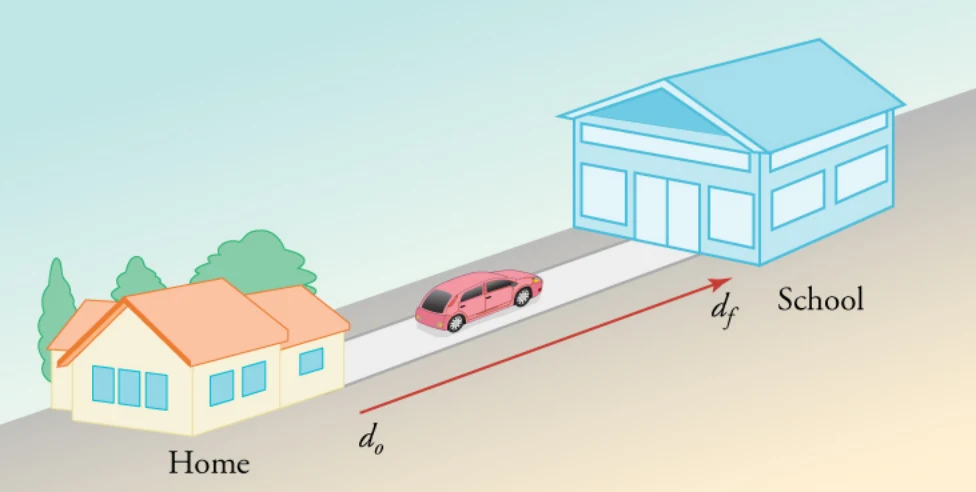
Physicists use variables to represent terms. We will use d to represent car’s position. We will use a subscript to differentiate between the initial position, d0, and the final position, df. In addition, vectors, which we will discuss later, will be in bold or will have an arrow above the variable. Scalars will be italicized.
物理学者は用語を変数で表す。ここでは車の位置をdで表す。初めの位置d0と終わりの位置dfを区別するために添字を使う。さらに、あとで扱うベクトルは太字にするか、変数の上に矢印を付けて表す。スカラーは斜体にする。
TIPS FOR SUCCESS In some books, x or s is used instead of d to describe position. In d0, said d naught, the subscript 0 stands for initial. When we begin to talk about two-dimensional motion, sometimes other subscripts will be used to describe horizontal position, dx, or vertical position, dy. So, you might see references to d0x and dfy.
学習のポイント 本によっては、位置を表すのにdではなくxやsを使う。d0(「ディー・ノート」と読む)の添字0は初め(initial)を表す。二次元の運動を扱うようになると、水平方向の位置dx、鉛直方向の位置dyのように、別の添字を使うこともある。だからd0xやdfyといった書き方を見かけることもある。
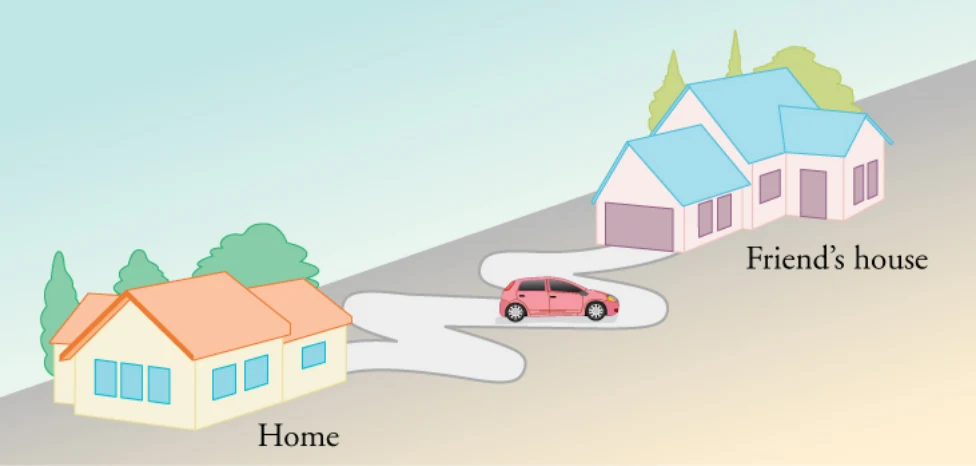
Now imagine driving from your house to a friend's house located several kilometers away. How far would you drive? The distance an object moves is the length of the path between its initial position and its final position. The distance you drive to your friend's house depends on your path. As shown in Figure 2.5, distance is different from the length of a straight line between two points. The distance you drive to your friend's house is probably longer than the straight line between the two houses.
今度は、数キロメートル離れた友人の家まで車で行くところを想像してほしい。どれだけ走ることになるだろうか。物体が動いた道のりとは、初めの位置と終わりの位置を結ぶ経路の長さのことである。友人の家まで走る道のりは、どの道を通るかによって変わる。図2.5に示すように、道のりは2点を結ぶ直線の長さとは違う。友人の家まで車で走る道のりは、二軒を結ぶ直線よりおそらく長い。
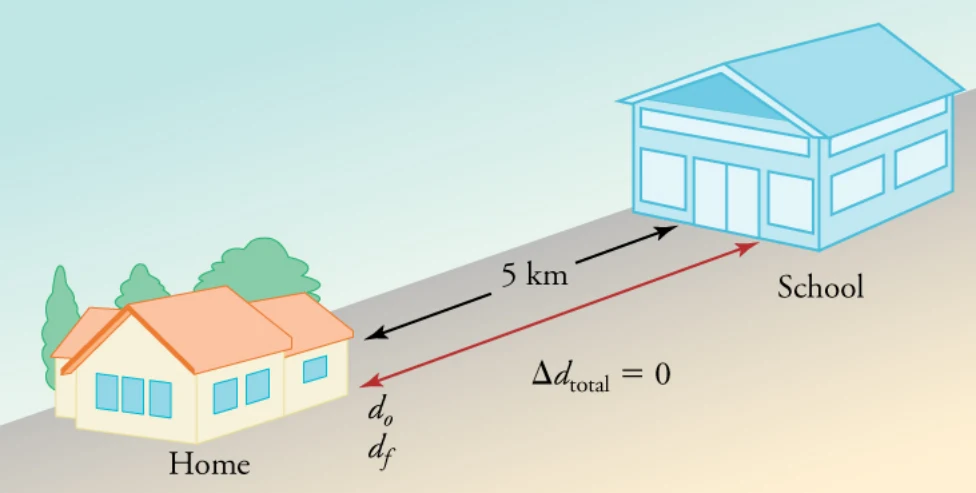
We often want to be more precise when we talk about position. The description of an object’s motion often includes more than just the distance it moves. For instance, if it is a five kilometer drive to school, the distance traveled is 5 kilometers. After dropping you off at school and driving back home, your parent will have traveled a total distance of 10 kilometers. The car and your parent will end up in the same starting position in space. The net change in position of an object is its displacement, or The Greek letter delta, , means change in.
位置について語るときは、もっと厳密でありたいことが多い。物体の運動の記述には、動いた道のり以上のものが含まれることが多い。たとえば学校まで5キロメートルの道のりなら、進んだ道のりは5キロメートルである。あなたを学校で降ろして家に帰れば、親は合計10キロメートルの道のりを進んだことになる。車も親も、空間の中では出発したのと同じ位置に戻る。物体の位置の正味の変化が変位であり、で表す。ギリシャ文字のデルタは「〜の変化」を意味する。
SNAP LAB身近な実験Distance vs. Displacement道のりと変位
In this activity you will compare distance and displacement. Which term is more useful when making measurements?
この活動では道のりと変位を比べる。測定をするとき、どちらの語がより役に立つだろうか。
• 1 recorded song available on a portable device• 1 tape measure• 3 pieces of masking tape• A room (like a gym) with a wall that is large and clear enough for all pairs of students to walk back and forth without running into each other.
・携帯機器に入れた録音された曲1曲・巻き尺1本・マスキングテープ3片・生徒の組全員が互いにぶつからずに行き来できるだけの、大きく開けた壁のある部屋(体育館など)
Procedure手順
1. One student from each pair should stand with their back to the longest wall in the classroom. Students should stand at least 0.5 meters away from each other. Mark this starting point with a piece of masking tape.
1. 各組の一人が、教室でいちばん長い壁に背を向けて立つ。生徒どうしは少なくとも0.5メートル離れて立つこと。この出発点をマスキングテープで印す。
2. The second student from each pair should stand facing their partner, about two to three meters away. Mark this point with a second piece of masking tape.3. Student pairs line up at the starting point along the wall.4. The teacher turns on the music. Each pair walks back and forth from the wall to the second marked point until the music stops playing. Keep count of the number of times you walk across the floor.5. When the music stops, mark your ending position with the third piece of masking tape.6. Measure from your starting, initial position to your ending, final position.7. Measure the length of your path from the starting position to the second marked position. Multiply this measurement by the total number of times you walked across the floor. Then add this number to your measurement from step 6.8. Compare the two measurements from steps 6 and 7.
2. 各組のもう一人は、相手と向かい合って2〜3メートル離れて立つ。この点を2片目のマスキングテープで印す。3. 各組は壁沿いの出発点に並ぶ。4. 先生が音楽をかける。各組は、音楽が止まるまで壁から2番目の印まで往復して歩く。床を横切った回数を数えておくこと。5. 音楽が止まったら、終わりの位置を3片目のマスキングテープで印す。6. 初めの位置から終わりの位置までを測る。7. 出発点から2番目の印までの経路の長さを測る。この値に、床を横切った合計回数を掛ける。そのうえで、手順6で測った値を足す。8. 手順6と手順7の二つの測定値を比べる。
1. Which measurement is your total distance traveled?2. Which measurement is your displacement?3. When might you want to use one over the other?a. Measurement of the total length of your path from the starting position to the final position gives the distance traveled, and the measurement from your initial position to your final position is the displacement. Use distance to describe the total path between starting and ending points,and use displacement to describe the shortest path between starting and ending points.b. Measurement of the total length of your path from the starting position to the final position is distance traveled, and the measurement from your initial position to your final position is displacement. Use distance to describe the shortest path between starting and ending points, and use displacement to describe the total path between starting and ending points.c. Measurement from your initial position to your final position is distance traveled, and the measurement of the total length of your path from the starting position to the final position is displacement. Use distance to describe the total path between starting and ending points, and use displacement to describe the shortest path between starting and ending points.d. Measurement from your initial position to your final position is distance traveled, and the measurement of the total length of your path from the starting position to the final position is displacement. Use distance to describe the shortest path between starting and ending points, and use displacement to describe the total path between starting and ending points.
1. あなたが進んだ道のりの合計はどちらの測定値か。2. あなたの変位はどちらの測定値か。3. どんなときに一方をもう一方より使いたくなるか。a. 出発点から終わりの位置までの経路の全長を測ったものが進んだ道のりであり、初めの位置から終わりの位置までを測ったものが変位である。始点と終点の間の経路全体を述べるには道のりを、始点と終点の間の最短の道筋を述べるには変位を使う。b. 出発点から終わりの位置までの経路の全長が進んだ道のりであり、初めの位置から終わりの位置までを測ったものが変位である。始点と終点の間の最短の道筋を述べるには道のりを、経路全体を述べるには変位を使う。c. 初めの位置から終わりの位置までを測ったものが進んだ道のりであり、経路の全長が変位である。始点と終点の間の経路全体を述べるには道のりを、最短の道筋を述べるには変位を使う。d. 初めの位置から終わりの位置までを測ったものが進んだ道のりであり、経路の全長が変位である。始点と終点の間の最短の道筋を述べるには道のりを、経路全体を述べるには変位を使う。
If you are describing only your drive to school and the route is a straight line, then the distance traveled and the displacement are the same—5 kilometers. When you are describing the entire round trip, distance and displacement are different. When you describe distance, you only include the magnitude, the size or amount, of the distance traveled. However, when you describe the displacement, you take into account both the magnitude of the change in position and the direction of movement.
学校へ行く道だけを述べていて、その道が直線なら、進んだ道のりと変位は同じ5キロメートルになる。往復全体を述べるときには、道のりと変位は違ってくる。道のりを述べるときは、進んだ道のりの大きさ、すなわちその量だけを含める。しかし変位を述べるときには、位置の変化の大きさと運動の向きの両方を考えに入れる。
In our previous example, the car travels a total of 10 kilometers, but it drives five of those kilometers forward toward school and five of those kilometers back in the opposite direction. If we ascribe the forward direction a positive (+) and the opposite direction a negative (–), then the two quantities will cancel each other out when added together.
先ほどの例では、車は合計10キロメートル進むが、そのうち5キロメートルは学校へ向かう向きに、残り5キロメートルは反対の向きに走っている。前向きを正(+)、反対向きを負(−)とすれば、二つの量は足し合わせたときに打ち消し合う。
A quantity, such as distance, that has magnitude (i.e., how big or how much) and sometimes a sign (e.g., electric charge, temperature in Celsius, or component of a vector) but does not take into account direction is called a scalar. A quantity, such as displacement, that has both magnitude and direction is called a vector. A vector with magnitude zero is a special case of a vector that has no direction.
道のりのように、向きを伴わず大きさで表される量をスカラーという。スカラーには、電荷やセルシウス温度、ベクトルの各成分のように、正負の符号をとるものもある。変位のように、大きさと向きを持つ量をベクトルという。大きさが0のベクトルは例外で、その向きは定まらない。
Vectors & Scalars This video (https://openstax.org/l/28vectorscalar) introduces and differentiates between vectors and scalars. It also introduces quantities that we will be working with during the study of kinematics.
ベクトルとスカラー この動画(https://openstax.org/l/28vectorscalar)は、ベクトルとスカラーを紹介し、両者の違いを説明する。運動学を学ぶ間に扱う量も紹介されている。
Intro to vectors & scalars | One-dimensional motion | Physics | Khan Academy (https://openstax.org/l/ 28vectorscalar)
ベクトルとスカラーの入門|一次元の運動|物理|カーンアカデミー(https://openstax.org/l/28vectorscalar)
How does this video (http://openstax.org/l/28vectorscalar) help you understand the difference between distance and displacement? Describe the differences between vectors and scalars using physical quantities as examples.
この動画(http://openstax.org/l/28vectorscalar)は、道のりと変位の違いを理解するのにどう役立つか。物理量を例に使って、ベクトルとスカラーの違いを述べよ。
a. It explains that distance is a vector and direction is important, whereas displacement is a scalar and it has no direction attached to it.b. It explains that distance is a scalar and direction is important, whereas displacement is a vector and it has no direction attached to it.c. It explains that distance is a scalar and it has no direction attached to it, whereas displacement is a vector and direction is important.d. It explains that both distance and displacement are scalar and no directions are attached to them.
a. 道のりはベクトルで向きが重要であり、変位はスカラーで向きを持たない、と説明している。b. 道のりはスカラーで向きが重要であり、変位はベクトルで向きを持たない、と説明している。c. 道のりはスカラーで向きを持たず、変位はベクトルで向きが重要である、と説明している。d. 道のりも変位もスカラーで、どちらも向きを持たない、と説明している。
Displacement Problems Hopefully you now understand the conceptual difference between distance and displacement. Understanding concepts is half the battle in physics. The other half is math. A stumbling block to new physics students is trying to wade through the math of physics while also trying to understand the associated concepts. This struggle may lead to misconceptions and answers that make no sense. Once the concept is mastered, the math is far less confusing.
変位の問題道のりと変位の違いは理解できただろうか。物理を学ぶには、概念の理解と数学による計算の両方が必要になる。初めて学ぶ人は、概念がまだ曖昧なまま計算も進めようとして、つまずきやすい。その結果、誤解したまま計算したり、物理的に意味のない答えを出したりしてしまう。まず概念を理解すれば、式や計算もずっと見通しよく扱える。
So let’s review and see if we can make sense of displacement in terms of numbers and equations. You can calculate an object's displacement by subtracting its original position, d0, from its final position df. In math terms that means
では復習して、変位を数と式の言葉で理解できるか見てみよう。物体の変位は、終わりの位置dfから初めの位置d0を引けば計算できる。数式で書けば次のようになる。
If the final position is the same as the initial position, then .
終わりの位置が初めの位置と同じなら、となる。
To assign numbers and/or direction to these quantities, we need to define an axis with a positive and a negative direction. We also need to define an origin, or O. In Figure 2.6, the axis is in a straight line with home at zero and school in the positive direction. If we left home and drove the opposite way from school, motion would have been in the negative direction. We would have assigned it a negative value. In the round-trip drive, df and d0 were both at zero kilometers. In the one way trip to school, df was at 5 kilometers and d0 was at zero km. So, was 5 kilometers.
これらの量に数や向きを割り当てるには、正の向きと負の向きを持つ軸を定めなければならない。原点Oも定める必要がある。図2.6では軸は直線で、家が0、学校が正の向きにある。家を出て学校と反対の方向へ走ったなら、運動は負の向きになり、負の値を与えることになる。往復の運転では、dfもd0もどちらも0キロメートルだった。学校までの片道では、dfが5キロメートル、d0が0キロメートルだった。したがっては5キロメートルだった。
TIPS FOR SUCCESS You may place your origin wherever you would like. You have to make sure that you calculate all distances consistently from your zero and you define one direction as positive and the other as negative. Therefore, it makes sense to choose the easiest axis, direction, and zero. In the example above, we took home to be zero because it allowed us to avoid having to interpret a solution with a negative sign.
学習のポイント 原点はどこに置いてもよい。自分が決めた0からすべての距離を一貫して測り、一方の向きを正、もう一方を負と定めさえすればよい。だから、いちばん扱いやすい軸・向き・原点を選ぶのが理にかなっている。上の例で家を0としたのは、そうすれば負の符号の付いた答えを解釈せずに済むからである。
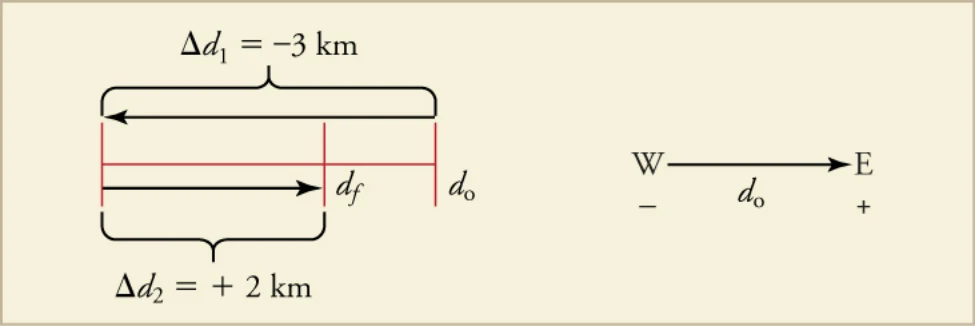
Calculating Distance and Displacement A cyclist rides 3 km west and then turns around and rides 2 km east. (a) What is her displacement? (b) What distance does she ride? (c) What is the magnitude of her displacement?
道のりと変位を計算する ある自転車乗りが西に3 km走り、向きを変えて東に2 km走る。(a)彼女の変位はいくらか。(b)進んだ道のりはいくらか。(c)変位の大きさはいくらか。
Strategy方針
To solve this problem, we need to find the difference between the final position and the initial position while taking care to note the direction on the axis. The final position is the sum of the two displacements, and .
この問題を解くには、軸の向きに注意しながら、終わりの位置と初めの位置の差を求めればよい。終わりの位置は、二つの変位との和である。
Solution解答
a. Displacement: The rider’s displacement is .b. Distance: The distance traveled is 3 km + 2 km = 5 km.
a. 変位:この人の変位はである。b. 道のり:進んだ道のりは3 km + 2 km = 5 kmである。
c. The magnitude of the displacement is 1 km. Discussion
c. 変位の大きさは1 kmである。 考察
The displacement is negative because we chose east to be positive and west to be negative. We could also have described the displacement as 1 km west. When calculating displacement, the direction mattered, but when calculating distance, the direction did not matter. The problem would work the same way if the problem were in the north–south or y-direction.
東を正、西を負としたので、変位は負になっている。この変位を「西へ1 km」と述べてもよかった。変位の計算では向きが効いたが、道のりの計算では向きは関係しなかった。問題が南北方向、すなわちy方向であっても、まったく同じように解ける。
TIPS FOR SUCCESS Physicists like to use standard units so it is easier to compare notes. The standard units for calculations are called SI units (International System of Units). SI units are based on the metric system. The SI unit for displacement is the meter (m), but sometimes you will see a problem with kilometers, miles, feet, or other units of length. If one unit in a problem is an SI unit and another is not, you will need to convert all of your quantities to the same system before you can carry out the calculation.
学習のポイント 物理学者は、互いの測定結果を比較しやすくするために、共通の単位を使う。計算に使う標準的な単位はSI単位(国際単位系)と呼ばれる。SI単位はメートル法にもとづく。変位のSI単位はメートル(m)だが、問題によってはキロメートル、マイル、フィートなど他の長さの単位が出てくることもある。問題の中の一方の単位がSI単位で他方がそうでないなら、計算に取りかかる前にすべての量を同じ系に換算する必要がある。
Practice Problems練習問題
1On an axis in which moving from right to left is positive, what is the displacement and distance of a student who walks 32 m to the right and then 17 m to the left?
1右から左へ動くのを正とする軸をとったとき、右へ32 m歩き、次に左へ17 m歩いた生徒の変位と道のりはいくらか。
a. Displacement is -15 m and distance is -49 m.b. Displacement is -15 m and distance is 49 m.c. Displacement is 15 m and distance is -49 m.d. Displacement is 15 m and distance is 49 m.
a. 変位は−15 m、道のりは−49 m。b. 変位は−15 m、道のりは49 m。c. 変位は15 m、道のりは−49 m。d. 変位は15 m、道のりは49 m。
2Tiana jogs 1.5 km along a straight path and then turns and jogs 2.4 km in the opposite direction. She then turns back and jogs 0.7 km in the original direction. Let Tiana’s original direction be the positive direction. What are the displacement and distance she jogged?
2ティアナは直線の道を1.5 km走り、向きを変えて反対向きに2.4 km走った。それからまた向きを変え、もとの向きに0.7 km走った。ティアナのもとの向きを正の向きとする。彼女の変位と道のりはいくらか。
a. Displacement is 4.6 km,and distance is -0.2 km.b. Displacement is -0.2 km, and distance is 4.6 km.c. Displacement is 4.6 km, and distance is +0.2 km.d. Displacement is +0.2 km, and distance is 4.6 km.
a. 変位は4.6 km、道のりは−0.2 km。b. 変位は−0.2 km、道のりは4.6 km。c. 変位は4.6 km、道のりは+0.2 km。d. 変位は+0.2 km、道のりは4.6 km。
Physicists make calculations all the time, but they do not always get the right answers. In 1998, NASA, the National Aeronautics and Space Administration, launched the Mars Climate Orbiter, shown in Figure 2.7, a $125-million-dollar satellite designed to monitor the Martian atmosphere. It was supposed to orbit the planet and take readings from a safe distance. The American scientists made calculations in English units (feet, inches, pounds, etc.) and forgot to convert their answers to the standard metric SI units. This was a very costly mistake. Instead of orbiting the planet as planned, the Mars Climate Orbiter ended up flying into the Martian atmosphere. The probe disintegrated. It was one of the biggest embarrassments in NASA’s history.
物理学者はいつも計算をしているが、いつも正しい答えを出せるわけではない。1998年、アメリカ航空宇宙局(NASA)は、火星の大気を観測するために作られた1億2500万ドルの人工衛星、マーズ・クライメート・オービター(図2.7)を打ち上げた。この衛星は火星を周回し、安全な距離から観測するはずだった。アメリカの科学者たちはヤード・ポンド法の単位(フィート、インチ、ポンドなど)で計算し、答えを標準のメートル法のSI単位に換算するのを忘れた。これはきわめて高くついた失敗だった。予定どおり惑星を周回するかわりに、マーズ・クライメート・オービターは火星大気に突入してしまった。探査機は分解した。NASAの歴史の中でも最大級の失態の一つである。
3In 1999 the Mars Climate Orbiter crashed because calculation were performed in English units instead of SI units. At one point the orbiter was just 187,000 feet above the surface, which was too close to stay in orbit. What was the height of the orbiter at this time in kilometers? (Assume 1 meter equals 3.281 feet.)
31999年、マーズ・クライメート・オービターは、計算がSI単位ではなくヤード・ポンド法の単位で行われたために墜落した。ある時点で、この衛星は表面からわずか187,000フィートの高さにあり、軌道にとどまるには近すぎた。このときの衛星の高さはキロメートルでいくらか。(1メートル=3.281フィートとする。)
a. 16 kmb. 18 km
a. 16 kmb. 18 km
c. 57 kmd. 614 km
c. 57 kmd. 614 km
Check Your Understanding理解の確認
4What does it mean when motion is described as relative?a. It means that motion of any object is described relative to the motion of Earth.b. It means that motion of any object is described relative to the motion of any other object.c. It means that motion is independent of the frame of reference.d. It means that motion depends on the frame of reference selected.
4運動が「相対的」だと言われるのはどういう意味か。a. どんな物体の運動も地球の運動に対して記述される、という意味。b. どんな物体の運動も、他のどれか一つの物体の運動に対して記述される、という意味。c. 運動は基準系によらない、という意味。d. 運動は選んだ基準系による、という意味。
5If you and a friend are standing side-by-side watching a soccer game, would you both view the motion from the same reference frame?
5あなたと友人が並んで立ってサッカーの試合を見ているとき、二人は同じ基準系から運動を見ていることになるか。
a. Yes, we would both view the motion from the same reference point because both of us are at rest in
a. なる。二人とも地球の基準系の中で静止しているから、
Earth’s frame of reference.b. Yes, we would both view the motion from the same reference point because both of us are observing the motion from two points on the same straight line.c. No, we would both view the motion from different reference points because motion is viewed from two different points; the reference frames are similar but not the same.d. No, we would both view the motion from different reference points because response times may be different; so, the motion observed by both of us would be different.
同じ基準点から運動を見ていることになる。b. なる。二人とも同じ直線上の2点から運動を見ているから、同じ基準点から見ていることになる。c. ならない。二つの違う点から運動を見ているので、基準系は似ているが同じではない。d. ならない。反応の速さが違いうるので、二人が観測する運動は違ったものになる。
6What is the difference between distance and displacement? a. Distance has both magnitude and direction, while displacement has magnitude but no direction.
6道のりと変位の違いは何か。 a. 道のりは大きさと向きの両方を持ち、変位は大きさを持つが向きを持たない。
b. Distance has magnitude but no direction, while displacement has both magnitude and direction.c. Distance has magnitude but no direction, while displacement has only direction.d. There is no difference. Both distance and displacement have magnitude and direction.
b. 道のりは大きさを持つが向きを持たず、変位は大きさと向きの両方を持つ。c. 道のりは大きさを持つが向きを持たず、変位は向きだけを持つ。d. 違いはない。道のりも変位も大きさと向きを持つ。
7Which statement correctly describes a race car's distance traveled and magnitude of displacement during a one-lap car race around an oval track?
7楕円形のコースを1周するレースで、レーシングカーの進んだ道のりと変位の大きさを正しく述べているのはどれか。
a. The perimeter of the race track is the distance; the shortest distance between the start line and the finish line is the magnitude of displacement.b. The perimeter of the race track is the magnitude of displacement; the shortest distance between the start and finish line is the distance.c. The perimeter of the race track is both the distance and magnitude of displacement.d. The shortest distance between the start and the finish line is the magnitude of the displacement vector.
a. コースの周長が道のりであり、スタート線とゴール線の間の最短距離が変位の大きさである。b. コースの周長が変位の大きさであり、スタート線とゴール線の間の最短距離が道のりである。c. コースの周長が道のりでもあり変位の大きさでもある。d. スタート線とゴール線の間の最短距離が変位ベクトルの大きさである。
8Why is it important to specify a reference frame when describing motion?a. Because Earth is continuously in motion; an object at rest on Earth will be in motion when viewed from outer space.b. Because the position of a moving object can be defined only when there is a fixed reference frame.
8運動を記述するとき、基準系を定めることが大切なのはなぜか。a. 地球はたえず動いており、地球上で静止している物体も宇宙空間から見れば動いているから。b. 動いている物体の位置は、固定された基準系があって初めて定められるから。
c. Because motion is a relative term; it appears differently when viewed from different reference frames.d. Because motion is always described in Earth’s frame of reference; if another frame is used, it has to be specified with each situation.
c. 運動は相対的なものであり、違う基準系から見れば違って見えるから。d. 運動はつねに地球の基準系で記述されるものであり、別の系を使うならその都度断らねばならないから。