第2章一次元の運動Motion in One Dimension原書 p.55–96
Chapter Review章のまとめ
Concept Items概念の問題
2.1 Relative Motion, Distance, and Displacement 1Can one-dimensional motion be described with a zero distance traveled but nonzero displacement. Conversely, can it be described with zero displacement but a nonzero distance traveled?
2.1 相対運動、道のり、変位 1進んだ道のりが0で変位が0でない一次元の運動は記述できるか。逆に、変位が0で進んだ道のりが0でない運動は記述できるか。
a. One-dimensional motion can have zero distance traveled with a nonzero displacement. Displacement has both magnitude and direction; it can also have zero displacement with nonzero distance traveled because distance traveled has only magnitude.b. One-dimensional motion can have zero distance traveled with a nonzero displacement. Displacement has both magnitude and direction, but it cannot have zero displacement with nonzero distance traveled because distance has only magnitude.c. One-dimensional motion cannot have zero distance traveled with a nonzero displacement. Displacement has both magnitude and direction, but it can have zero displacement with nonzero distance traveled because distance has only magnitude and any motion will be the distance it moves.d. One-dimensional motion cannot have zero distance traveled with a nonzero displacement. Displacement has both magnitude and direction; it cannot have zero displacement with nonzero distance traveled because distance has only magnitude.
a. 一次元の運動では、道のり0で変位が0でないことがありうる。変位は大きさと向きを持つ。また、道のりは大きさしか持たないので、変位0で道のりが0でないこともありうる。b. 一次元の運動では、道のり0で変位が0でないことがありうる。変位は大きさと向きを持つが、道のりは大きさしか持たないので、変位0で道のりが0でないことはありえない。c. 一次元の運動では、道のり0で変位が0でないことはありえない。変位は大きさと向きを持つが、道のりは大きさしか持たず、どんな運動もその動いた分が道のりになるので、変位0で道のりが0でないことはありうる。d. 一次元の運動では、道のり0で変位が0でないことはありえない。変位は大きさと向きを持つ。道のりは大きさしか持たないので、変位0で道のりが0でないこともありえない。
2In which example would you be correct in describing an object in motion while your friend would also be correct in describing that same object as being at rest?
2あなたがある物体を「動いている」と述べても、友人が同じ物体を「静止している」と述べても、どちらも正しいのはどの例か。
a. You are driving a car toward the east and your friend drives past you in the opposite direction with the same speed. In your frame of reference, you will be in motion. In your friend’s frame of reference, you will be at rest.b. You are driving a car toward the east and your friend is standing at the bus stop. In your frame of reference, you will be in
a. あなたは東へ向かって車を運転しており、友人は同じ速さで反対向きにあなたの横を通り過ぎる。あなたの基準系ではあなたは動いている。友人の基準系ではあなたは静止している。b. あなたは東へ向かって車を運転しており、友人はバス停に立っている。あなたの基準系では
motion. In your friend’s frame of reference, you will be at rest.c. You are driving a car toward the east and your friend is standing at the bus stop. In your frame of reference, your friend will be moving toward the west. In your friend’s frame of reference, he will be at rest.d. You are driving a car toward the east and your friend is standing at the bus stop. In your frame of reference, your friend will be moving toward the east. In your friend’s frame of reference, he will be at rest.
あなたは動いている。友人の基準系ではあなたは静止している。c. あなたは東へ向かって車を運転しており、友人はバス停に立っている。あなたの基準系では友人は西へ動いている。友人の基準系では友人は静止している。d. あなたは東へ向かって車を運転しており、友人はバス停に立っている。あなたの基準系では友人は東へ動いている。友人の基準系では友人は静止している。
3What does your car’s odometer record?a. displacementb. distance
3車の走行距離計が記録しているのは何か。a. 変位b. 道のり
c. both distance and displacementd. the sum of distance and displacement
c. 道のりと変位の両方d. 道のりと変位の和
2.2 Speed and Velocity 4In the definition of velocity, what physical quantity is changing over time?
2.2 速さと速度 4速度の定義において、時間とともに変化している物理量は何か。
a. speedb. distance
a. 速さb. 道のり
c. magnitude of displacementd. position vector
c. 変位の大きさd. 位置ベクトル
5Which of the following best describes the relationship between instantaneous velocity and instantaneous speed?
5瞬間速度と瞬間の速さの関係を最もよく述べているのはどれか。
a. Both instantaneous speed and instantaneous velocity are the same, even when there is a change in direction.b. Instantaneous speed and instantaneous velocity cannot be the same, even if there is no change in the direction of motion.c. The magnitude of instantaneous velocity is equal to instantaneous speed.d. The magnitude of instantaneous velocity is always greater than instantaneous speed.
a. 向きが変わる場合でも、瞬間の速さと瞬間速度は同じである。b. 運動の向きが変わらない場合でも、瞬間の速さと瞬間速度は同じにはなりえない。c. 瞬間速度の大きさは瞬間の速さに等しい。d. 瞬間速度の大きさはつねに瞬間の速さより大きい。
2.3 Position vs. Time Graphs 6Use the graph to describe what the runner’s motion looks like.
2.3 位置–時間グラフ 6グラフを使って、走者の運動がどんなものかを述べよ。
How are average velocity for only the first four seconds and instantaneous velocity related? What is the runner's net displacement over the time shown?a. The net displacement is 12 m and the average velocity is equal to the instantaneous velocity.b. The net displacement is 12 m and the average velocity is two times the instantaneous velocity.c. The net displacement is 10 + 12 = 22 m and the average velocity is equal to the instantaneous velocity.d. The net displacement is 10 + 12 = 22 m and the average velocity is two times the instantaneous velocity.
最初の4秒間だけの平均速度と、瞬間速度はどう関係しているか。示された時間にわたる走者の正味の変位はいくらか。a. 正味の変位は12 mで、平均速度は瞬間速度に等しい。b. 正味の変位は12 mで、平均速度は瞬間速度の2倍である。c. 正味の変位は10 + 12 = 22 mで、平均速度は瞬間速度に等しい。d. 正味の変位は10 + 12 = 22 mで、平均速度は瞬間速度の2倍である。
7A position vs. time graph of a frog swimming across a pond has two distinct straight-line sections. The slope of the first section is . The slope of the second section is . If each section lasts , then what is the frog’s total average velocity?
7池を泳いで渡るカエルの位置–時間グラフは、はっきり異なる二つの直線部分からなる。前半の傾きは、後半の傾きはである。各部分がそれぞれ続くとすると、カエルの全体の平均速度はいくらか。
Critical Thinking Items批判的に考える問題
2.1 Relative Motion, Distance, and Displacement 9Two boats are traveling at equal and opposite velocities when they pass each other. How would the captain of each boat describe the motion of the other boat?
2.1 相対運動、道のり、変位 9二隻の船が、大きさが等しく向きが逆の速度で航行し、すれ違う。各船の船長は、相手の船の運動をどう述べるか。
a. Each captain would describe other boat’s motion the same because motion is independent of reference frame.b. Each captain will describe other boat’s motion as moving in the backward direction because they are in their own reference frames.c. Each captain would describe the boats as
a. 運動は基準系によらないので、どちらの船長も相手の船の運動を同じように述べる。b. 各船長は自分の基準系にいるので、相手の船が後ろ向きに動いていると述べる。c. 運動は相対的な語なので、
Describe the acceleration of the ship based on the graph.
グラフにもとづいて、この船の加速のようすを述べよ。
a. The ship is moving in the forward direction at a steady rate. Then it accelerates in the forward direction and then decelerates.b. The ship is moving in the forward direction at a steady rate. Then it turns around and starts decelerating, while traveling in the reverse direction. It then accelerates, but slowly.c. The ship is moving in the forward direction at a steady rate. Then it decelerates in the forward direction, and then continues to slow down in the forward direction, but with more deceleration.d. The ship is moving in the forward direction at a steady rate. Then it decelerates in the forward direction, and then continues to slow down in the forward direction, but with less deceleration.
a. 船は一定の割合で前進している。それから前向きに加速し、その後減速する。b. 船は一定の割合で前進している。それから向きを変え、後ろ向きに進みながら減速し始める。その後ゆっくりと加速する。c. 船は一定の割合で前進している。それから前向きに減速し、さらに前向きのまま、より大きな減速で速さを落とし続ける。d. 船は一定の割合で前進している。それから前向きに減速し、さらに前向きのまま、より小さな減速で速さを落とし続ける。
moving differently because motion is a relative term. d. Each captain would describe the other boat’s motion perpendicularly because they will perceive them as moving opposite to each other.
両船長は互いの船が違う動きをしていると述べる。 d. 互いに反対に動いていると知覚するので、各船長は相手の船の運動を垂直に交わるものとして述べる。
10Passenger A sits inside a moving train and throws a ball vertically upward. How would the motion of the ball be described by a fellow train passenger B and an observer C who is standing on the platform outside the train?
10乗客Aが走行中の列車の中でボールを鉛直に上へ投げる。同じ列車の乗客Bと、列車の外のプラットフォームに立つ観測者Cは、それぞれボールの運動をどう述べるか。
a. Passenger B sees that the ball has vertical, but no horizontal, motion. Observer C sees
a. 乗客Bにはボールが鉛直方向にだけ動き、水平方向には動いていないように見える。観測者Cには
the ball has vertical as well as horizontal motion.b. Passenger B sees the ball has vertical as well as horizontal motion. Observer C sees the ball has the vertical, but no horizontal, motion.c. Passenger B sees the ball has horizontal but no vertical motion. Observer C sees the ball has vertical as well as horizontal motion.d. Passenger B sees the ball has vertical as well as horizontal motion. Observer C sees the ball has horizontalbut no vertical motion.
ボールが鉛直方向にも水平方向にも動いているように見える。b. 乗客Bにはボールが鉛直方向にも水平方向にも動いて見える。観測者Cにはボールが鉛直方向にだけ動き、水平方向には動いていないように見える。c. 乗客Bにはボールが水平方向にだけ動き、鉛直方向には動いていないように見える。観測者Cにはボールが鉛直方向にも水平方向にも動いているように見える。d. 乗客Bにはボールが鉛直方向にも水平方向にも動いて見える。観測者Cにはボールが水平方向にだけ動き、鉛直方向には動いていないように見える。
2.2 Speed and Velocity 11Is it possible to determine a car’s instantaneous velocity from just the speedometer reading?
2.2 速さと速度 11速度計の読みだけから、車の瞬間速度を決められるか。
a. No, it reflects speed but not the direction.b. No, it reflects the average speed of the car.c. Yes, it sometimes reflects instantaneous velocity of the car.d. Yes, it always reflects the instantaneous velocity of the car.
a. 決められない。速度計は速さを示すが向きを示さないから。b. 決められない。速度計は車の平均の速さを示すから。c. 決められる。速度計は車の瞬間速度を示すことがあるから。d. 決められる。速度計はつねに車の瞬間速度を示すから。
12Terri, Aaron, and Jamal all walked along straight paths. Terri walked 3.95 km north in 48 min. Aaron walked 2.65 km west in 31 min. Jamal walked 6.50 km south in 81 min. Which of the following correctly ranks the three boys in order from lowest to highest average speed?
12テリー、アーロン、ジャマルはいずれも一直線の道を歩いた。テリーは北へ3.95 kmを48分で、アーロンは西へ2.65 kmを31分で、ジャマルは南へ6.50 kmを81分で歩いた。三人を平均の速さの小さい順に正しく並べているのはどれか。
a. Jamal, Terri, Aaronb. Jamal, Aaron, Terric. Terri, Jamal, Aarond. Aaron, Terri, Jamal
a. ジャマル、テリー、アーロンb. ジャマル、アーロン、テリーc. テリー、ジャマル、アーロンd. アーロン、テリー、ジャマル
13Rhianna and Logan start at the same point and walk in the same direction. If Rhianna’s average velocity is vavg,R and she walks for half of Logan’s time, what is Logan’s velocity vavg,L if he walks three times as far?
13リアーナとローガンは同じ地点から同じ向きに歩き出す。リアーナの平均速度がvavg,Rで、彼女はローガンの半分の時間だけ歩いたとする。ローガンが3倍の距離を歩いたとすると、ローガンの速度vavg,Lはいくらか。
2.3 Position vs. Time Graphs 14Explain how you can use the graph of position vs.
2.3 位置–時間グラフ 14位置–時間グラフを使って、速度の
time to describe the change in velocity over time.
時間変化をどう述べられるかを説明せよ。
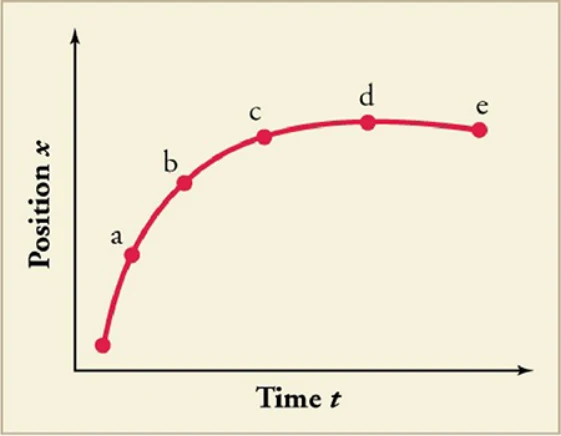
Identify the time (ta, tb, tc, td, or te) at which at which the instantaneous velocity is greatest, the time at which it is zero, and the time at which it is negative.
瞬間速度が最も大きい時刻、0である時刻、負である時刻を、(ta, tb, tc, td, te)の中から選べ。
2.4 Velocity vs. Time Graphs 15Identify the time, or times, at which the instantaneous velocity is greatest, and the time, or times, at which it is negative. A sketch of velocity vs. time derived from the figure will aid in arriving at the correct answers.
2.4 速度–時間グラフ 15瞬間速度が最も大きい時刻と、負である時刻を挙げよ。図から速度–時間の概形を描いてみると、正しい答えにたどり着きやすい。
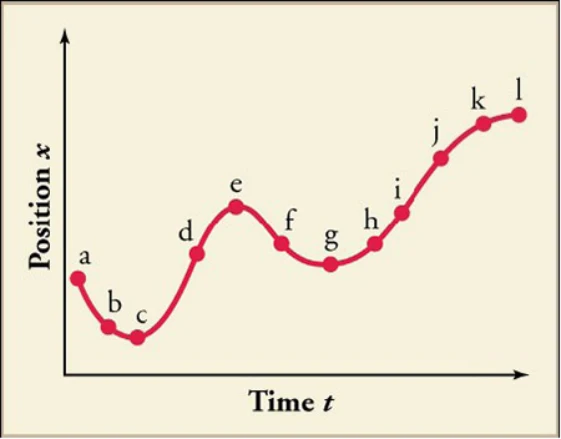
a. The instantaneous velocity is greatest at f, and it is negative at d, h, I, j, and k.b. The instantaneous velocity is greatest at e, and it is negative at a, b, and f.c. The instantaneous velocity is greatest at f, and it is negative at d, h, I, j, and kd. The instantaneous velocity is greatest at d, and it is negative at a, b, and f.
a. 瞬間速度はfで最大で、d、h、i、j、kで負である。b. 瞬間速度はeで最大で、a、b、fで負である。c. 瞬間速度はfで最大で、d、h、i、j、kで負である。d. 瞬間速度はdで最大で、a、b、fで負である。
Problems問題
2.1 Relative Motion, Distance, and Displacement 16In a coordinate system in which the direction to the right is positive, what are the distance and displacement of a person who walks to the left, to the right, and then to the left?a. Distance is and displacement is .b. Distance is and displacement is .c. Distance is and displacement is .d. Distance is and displacement is .
2.1 相対運動、道のり、変位 16右向きを正とする座標系で、左へ、右へ、さらに左へ歩いた人の道のりと変位はいくらか。a. 道のりは、変位は。b. 道のりは、変位は。c. 道のりは、変位は。d. 道のりは、変位は。
17Billy drops a ball from a height of 1 m. The ball bounces back to a height of 0.8 m, then bounces again to a height of 0.5 m, and bounces once more to a height of 0.2 m. Up is the positive direction. What are the total displacement of the ball and the total distance traveled by the ball?
17ビリーが高さ1 mからボールを落とす。ボールは0.8 mの高さまで跳ね返り、次に0.5 m、さらにもう一度0.2 mの高さまで跳ね返る。上向きを正とする。ボールの全変位と、ボールが進んだ道のりの合計はいくらか。
a. The displacement is equal to –4 m and the distance is equal to 4 m.b. The displacement is equal to –1 m and the distance is equal to 1 mc. The displacement is equal to 4 m and the distance is equal to 1 m.d. The displacement is equal to –1 m and the distance is equal to 4 m.
a. 変位は−4 mで、道のりは4 mである。b. 変位は−1 mで、道のりは1 mである。c. 変位は4 mで、道のりは1 mである。d. 変位は−1 mで、道のりは4 mである。
2.2 Speed and Velocity 18You sit in a car that is moving at an average speed of 86.4 km/h. During the 3.3 s that you glance out the window, how far has the car traveled?
2.2 速さと速度 18あなたは平均の速さ86.4 km/hで走る車に乗っている。窓の外に目をやった3.3秒の間に、車はどれだけ進んだか。
a. 7.27 mb. 79.2 mc. 285 kmd. 1026 m
a. 7.27 mb. 79.2 mc. 285 kmd. 1026 m
2.3 Position vs. Time Graphs 19Using the graph, what is the average velocity for the whole 10 seconds?
2.3 位置–時間グラフ 19グラフを使って、10秒全体の平均速度を求めよ。
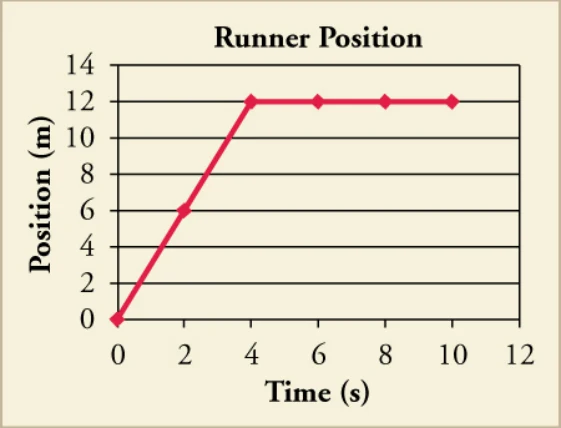
a. The total average velocity is 0 m/s.b. The total average velocity is 1.2 m/s.c. The total average velocity is 1.5 m/s.d. The total average velocity is 3.0 m/s.
a. 全体の平均速度は0 m/sである。b. 全体の平均速度は1.2 m/sである。c. 全体の平均速度は1.5 m/sである。d. 全体の平均速度は3.0 m/sである。
20A train starts from rest and speeds up for 15 minutes until it reaches a constant velocity of 100 miles/hour. It stays at this speed for half an hour. Then it slows down for another 15 minutes until it is still. Which of the following correctly describes the position vs time graph of the train’s journey?
20ある列車が静止から動き出し、15分かけて時速100マイルの一定の速度に達する。その速さを30分保つ。それからさらに15分かけて減速し、停止する。この列車の行程の位置–時間グラフを正しく述べているのはどれか。
a. The first 15 minutes is a curve that is concave upward, the middle portion is a straight line with slope 100 miles/hour, and the last portion is a concave downward curve.b. The first 15 minutes is a curve that is concave downward, the middle portion is a straight line with slope 100 miles/hour, and the last portion is a concave upward curve.c. The first 15 minutes is a curve that is concave upward, the middle portion is a straight line with slope zero, and the last portion is a concave downward curve.d. The first 15 minutes is a curve that is concave downward, the middle portion is a straight line with slope zero, and the last portion is a concave upward curve.
a. 最初の15分は下に凸の曲線、中間は傾き100マイル毎時の直線、最後は上に凸の曲線。b. 最初の15分は上に凸の曲線、中間は傾き100マイル毎時の直線、最後は下に凸の曲線。c. 最初の15分は下に凸の曲線、中間は傾き0の直線、最後は上に凸の曲線。d. 最初の15分は上に凸の曲線、中間は傾き0の直線、最後は下に凸の曲線。
2.4 Velocity vs. Time Graphs 21You are characterizing the motion of an object by measuring the location of the object at discrete moments in time. What is the minimum number of data points you would need to estimate the average acceleration of the object?
2.4 速度–時間グラフ 21ある物体の位置を、とびとびの時刻に測ることで、その運動を特徴づけようとしている。物体の平均加速度を見積もるには、最低いくつのデータ点が必要か。
a. 1
a. 1
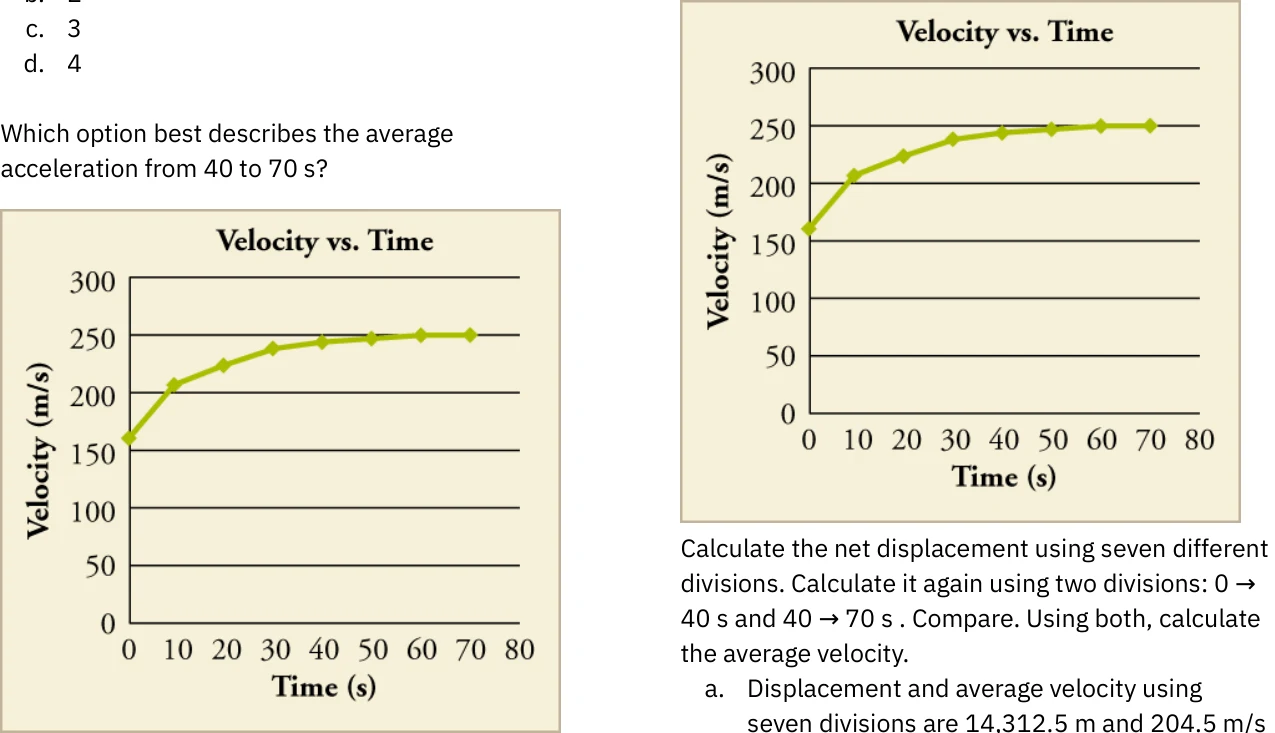
23The graph shows velocity vs. time.
23このグラフは速度と時間の関係を示している。
a. It is negative and smaller in magnitude than the initial acceleration.b. It is negative and larger in magnitude than the initial acceleration.c. It is positive and smaller in magnitude than the initial acceleration.d. It is positive and larger in magnitude than the initial acceleration.
a. 負であり、大きさは初めの加速度より小さい。b. 負であり、大きさは初めの加速度より大きい。c. 正であり、大きさは初めの加速度より小さい。d. 正であり、大きさは初めの加速度より大きい。
a. Displacement and average velocity using seven divisions are 14,312.5 m and 204.5 m/s while with two divisions are 15,500 m and 221.4 m/s respectively.b. Displacement and average velocity using seven divisions are 15,500 m and 221.4 m/s while with two divisions are 14,312.5 m and 204.5 m/s respectively.c. Displacement and average velocity using seven divisions are 15,500 m and 204.5 m/s while with two divisions are 14,312.5 m and 221.4 m/s respectively.d. Displacement and average velocity using seven divisions are 14,312.5 m and 221.4 m/s while with two divisions are 15,500 m and 204.5 m/s respectively.
a. 7分割で求めた変位と平均速度は14,312.5 mと204.5 m/s、2分割では15,500 mと221.4 m/sである。b. 7分割で求めた変位と平均速度は15,500 mと221.4 m/s、2分割では14,312.5 mと204.5 m/sである。c. 7分割で求めた変位と平均速度は15,500 mと204.5 m/s、2分割では14,312.5 mと221.4 m/sである。d. 7分割で求めた変位と平均速度は14,312.5 mと221.4 m/s、2分割では15,500 mと204.5 m/sである。
Performance Task実践課題
2.4 Velocity vs. Time Graphs 24The National Mall in Washington, DC, is a national park containing most of the highly treasured memorials and museums of the United States. However, the National Mall also hosts many events and concerts. The map below shows the area for a benefit concert during which the president will speak. The concert stage is near the Lincoln Memorial. The seats and standing room for the crowd will stretch from the stage east to near the Washington Monument, as shown on the map. You are planning the logistics for the concert. Use the map scale to measure any distances needed to make the calculations below.
2.4 速度–時間グラフ 24ワシントンD.C.のナショナル・モールは、アメリカの最も大切にされている記念碑や博物館の多くを含む国立公園である。しかしナショナル・モールでは、多くの催しやコンサートも開かれる。下の地図は、大統領が演説するチャリティー・コンサートの会場を示している。ステージはリンカーン記念堂の近くにある。観客の座席と立ち見の区画は、地図に示すとおり、ステージから東へワシントン記念塔の近くまで広がる。あなたはこのコンサートの実務を計画している。地図の縮尺を使って、以下の計算に必要な距離を測ること。
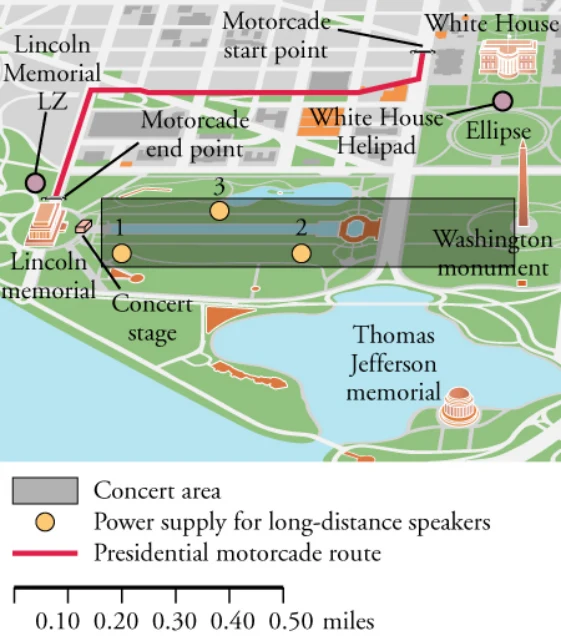
The park has three new long-distance speakers. They would like to use these speakers to broadcast the concert audio to other parts of the National Mall. The speakers can project sound up to 0.35 miles away but they must be connected to one of the power supplies within the concert area. What is the
この公園には長距離用のスピーカーが3台新しく入った。これを使って、ナショナル・モールの他の場所にもコンサートの音声を流したいという。スピーカーは0.35マイル先まで音を届けられるが、コンサート会場内のいずれかの電源につながねばならない。