第5章二次元の運動Motion in Two Dimensions原書 p.151–204
CHAPTER OUTLINE章の構成
5.1 Vector Addition and Subtraction: Graphical Methods5.2 Vector Addition and Subtraction: Analytical Methods5.3 Projectile Motion5.4 Inclined Planes5.5 Simple Harmonic Motion
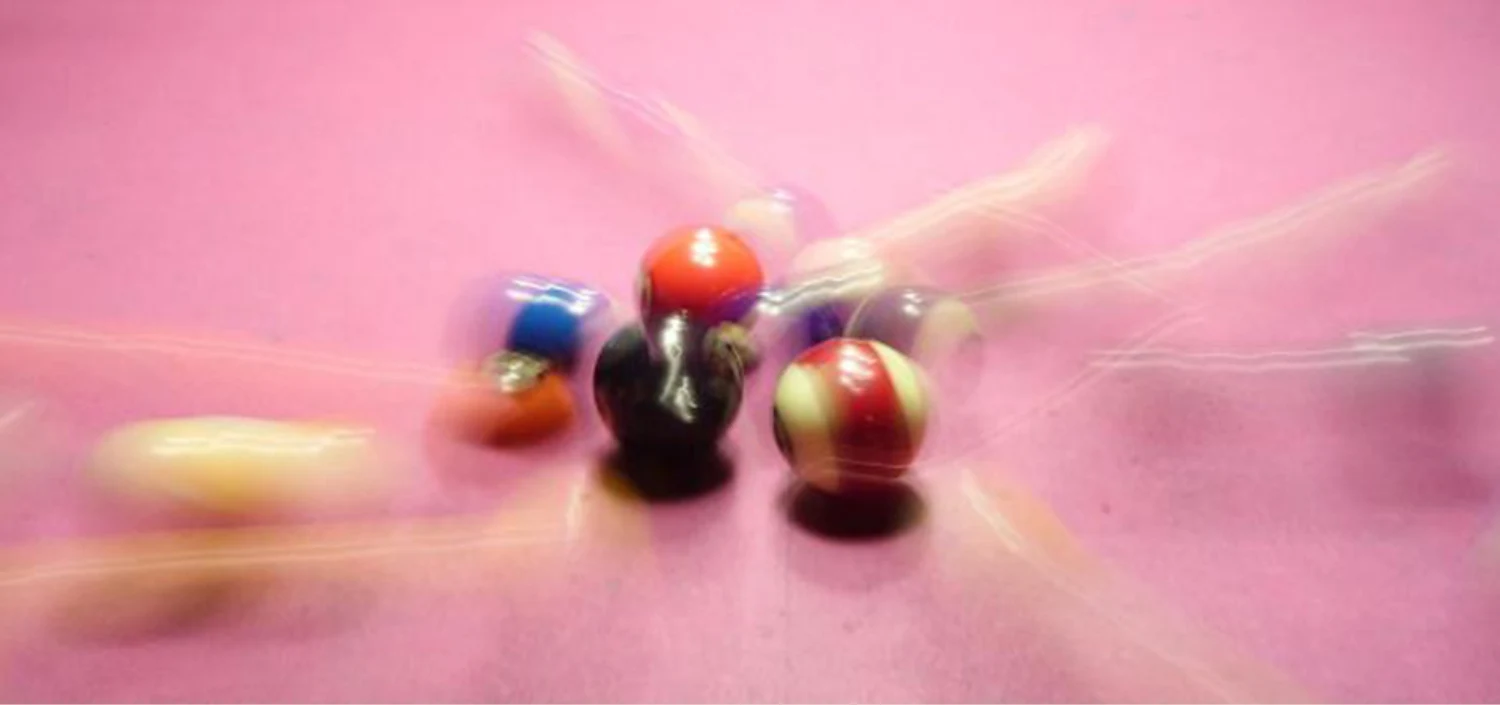
INTRODUCTION In Chapter 2, we learned to distinguish between vectors and scalars; the difference being that a vector has magnitude and direction, whereas a scalar has only magnitude and possibly sign. We learned how to deal with vectors in physics by working straightforward one-dimensional vector problems, which may be treated mathematically in the same as scalars. In this chapter, we’ll use vectors to expand our understanding of forces and motion into two dimensions. Most real-world physics problems (such as with the game of pool pictured here) are, after all, either two- or three-dimensional problems and physics is most useful when applied to real physical scenarios. We start by learning the practical skills of graphically adding and subtracting vectors (by using drawings) and analytically (with math). Once we’re able to work with two-dimensional vectors, we apply these skills to problems of projectile motion, inclined planes, and harmonic motion.
はじめに 第2章で、ベクトルとスカラーの区別を学んだ。違いは、ベクトルが大きさと向きを持つのに対し、スカラーは大きさと、場合によっては符号しか持たないことである。物理でのベクトルの扱い方は、素直な一次元のベクトルの問題を解くことで学んだ。一次元なら、数学のうえではスカラーと同じように扱える。この章では、ベクトルを使って力と運動の理解を二次元へ広げる。現実世界の物理の問題は(ここに写っているビリヤードのように)結局のところ二次元か三次元であり、物理は実際の物理的な場面に当てはめてこそ最も役に立つ。まず、ベクトルを図で(絵を描いて)、また解析的に(数式で)足し引きする実際的な技を学ぶ。二次元のベクトルを扱えるようになったら、その技を放物運動、斜面、調和振動の問題に応用する。