第5章二次元の運動Motion in Two Dimensions原書 p.151–204
5.2 Vector Addition and Subtraction: Analytical Methods5.2 ベクトルの加減:解析的な方法
SECTION LEARNING OBJECTIVES By the end of this section, you will be able to do the following:
この節の学習目標 この節を終えると、次のことができるようになる。
• Define components of vectors• Describe the analytical method of vector addition and subtraction• Use the analytical method of vector addition and subtraction to solve problems
・ベクトルの成分を定義する・ベクトルの加減の解析的な方法を述べる・ベクトルの加減の解析的な方法を使って問題を解く
Section Key Termsこの節の重要語
analytical methodcomponent (of a two-dimensional vector)
解析的な方法(二次元ベクトルの)成分
Components of Vectorsベクトルの成分
For the analytical method of vector addition and subtraction, we use some simple geometry and trigonometry, instead of using a ruler and protractor as we did for graphical methods. However, the graphical method will still come in handy to visualize the problem by drawing vectors using the head-to-tail method. The analytical method is more accurate than the graphical method, which is limited by the precision of the drawing. For a refresher on the definitions of the sine, cosine, and tangent of an angle, see Figure 5.17.
ベクトルの加減の解析的な方法では、図による方法で使った定規と分度器のかわりに、簡単な幾何と三角比を使う。とはいえ、頭尾法でベクトルを描いて問題を思い描くのに、図による方法はやはり役に立つ。解析的な方法は、作図の精度に縛られる図の方法より正確である。角の正弦・余弦・正接の定義を確かめたければ図5.17を見よ。
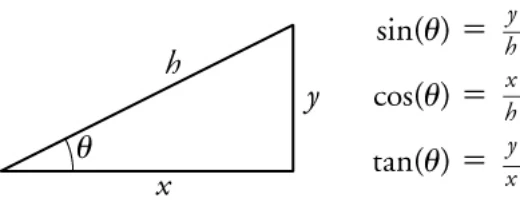
Since, by definition, , we can find the length x if we know h and by using . Similarly, we can find the length of y by using . These trigonometric relationships are useful for adding vectors.
定義によりなので、hとが分かっていればによって長さxを求められる。同じようにによってyの長さを求められる。これらの三角比の関係は、ベクトルを足すのに役立つ。
When a vector acts in more than one dimension, it is useful to break it down into its x and y components. For a two-dimensional vector, a component is a piece of a vector that points in either the x- or y-direction. Every 2-d vector can be expressed as a sum of its x and y components.
ベクトルが複数の方向にはたらくときは、それをx成分とy成分に分けると便利である。二次元のベクトルについて、成分とは、x方向またはy方向を向いたベクトルの一部分である。二次元のベクトルはすべて、そのx成分とy成分の和として表せる。
For example, given a vector like in Figure 5.18, we may want to find what two perpendicular vectors, and , add to produce it. In this example, and form a right triangle, meaning that the angle between them is 90 degrees. This is a common situation in physics and happens to be the least complicated situation trigonometrically.
たとえば図5.18ののようなベクトルが与えられたとき、それを作り出す互いに垂直な二つのベクトルとが何かを知りたくなる。この例ではとが直角三角形をなす。つまり両者のなす角は90度である。これは物理でよくある状況であり、しかも三角比のうえで最も簡単な場合である。
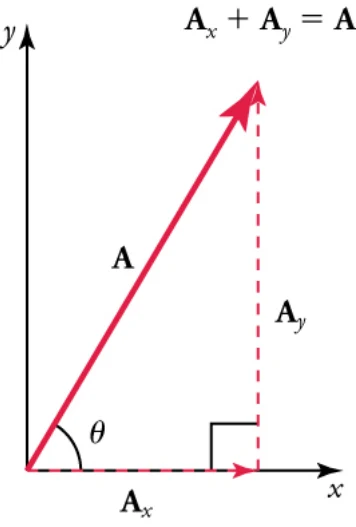
and are defined to be the components of along the x- and y-axes. The three vectors, , , and , form a right triangle.
とは、のx軸方向とy軸方向の成分と定義される。三つのベクトル、、は直角三角形をなす。
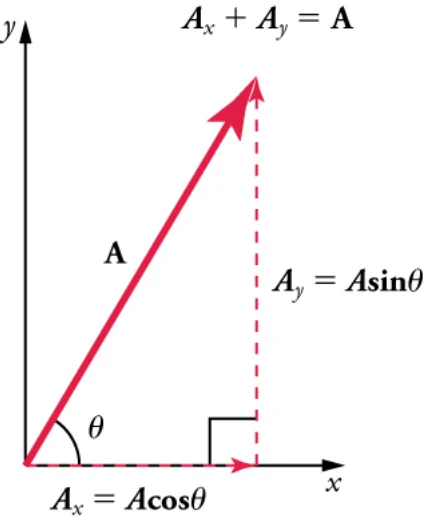
If the vector is known, then its magnitude (its length) and its angle (its direction) are known. To find and , its x- and y-components, we use the following relationships for a right triangle:
ベクトルが分かっていれば、その大きさ(長さ)と角(向き)が分かっている。そのx成分とy成分、を求めるには、直角三角形についての次の関係を使う。
and
また、
where is the magnitude of A in the x-direction, is the magnitude of A in the y-direction, and is the angle of the resultant with respect to the x-axis, as shown in Figure 5.19.
ここではAのx方向の大きさ、はAのy方向の大きさ、は図5.19に示すとおり、合成のx軸に対する角である。
Suppose, for example, that is the vector representing the total displacement of the person walking in a city, as illustrated in Figure 5.20.
たとえば図5.20のように、が街を歩く人の全変位を表すベクトルだとしよう。
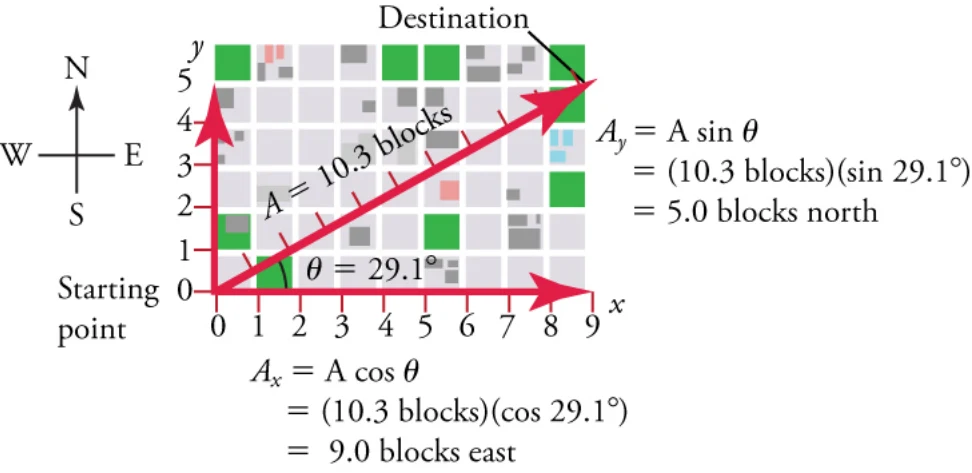
Then A = 10.3 blocks and , so that
このとき A = 10.3ブロック、なので、次が得られる。
This magnitude indicates that the walker has traveled 9 blocks to the east—in other words, a 9-block eastward displacement. Similarly,
この大きさは、歩いた人が東へ9ブロック進んだこと、言い換えれば東向きに9ブロックの変位を持つことを示している。同じように、
indicating that the walker has traveled 5 blocks to the north—a 5-block northward displacement.
となり、歩いた人が北へ5ブロック、すなわち北向きに5ブロックの変位を持つことを示している。
Analytical Method of Vector Addition and Subtractionベクトルの加減の解析的な方法
Calculating a resultant vector (or vector addition) is the reverse of breaking the resultant down into its components. If the perpendicular components and of a vector are known, then we can find analytically. How do we do this? Since, by definition,
合成ベクトルを計算すること(ベクトルの加法)は、合成を成分に分解することの逆である。ベクトルの互いに垂直な成分とが分かっていれば、を解析的に求められる。どうやるのか。定義により、
we solve for to find the direction of the resultant.
なので、について解けば合成の向きが求まる。
Note that gives an angle in the first quadrant if and in the fourth quadrant if . If, in fact, both and are negative, or if is negative and positive, then , measured from the positive
は、のときは第1象限の角を、のときは第4象限の角を与えることに注意しよう。もしとがどちらも負であるか、が負で他方のが正であるなら、正のの向きから測ったは
direction, is .
となる。
Since this is a right triangle, the Pythagorean theorem (x2 + y2 = h2) for finding the hypotenuse applies. In this case, it becomes
これは直角三角形なので、斜辺を求めるピタゴラスの定理(x2 + y2 = h2)が使える。この場合それは次のようになる。
Solving for A gives
Aについて解くと、次が得られる。
In summary, to find the magnitude and direction of a vector from its perpendicular components and , as illustrated in Figure 5.21, we use the following relationships:
まとめると、図5.21に示すとおり、互いに垂直な成分とからベクトルの大きさと向きを求めるには、次の関係を使う。
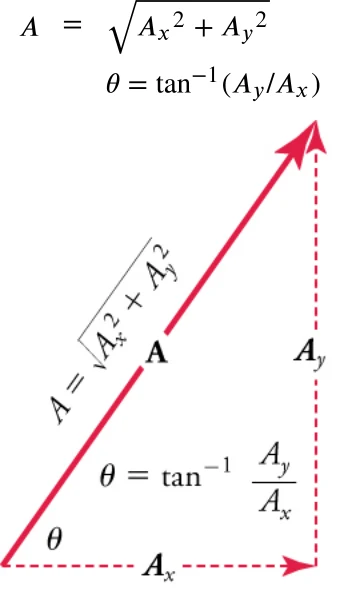
Sometimes, the vectors added are not perfectly perpendicular to one another. An example of this is the case below, where the vectors and are added to produce the resultant as illustrated in Figure 5.22.
足し合わせるベクトルが、互いに完全に垂直とは限らないこともある。その例が次の場合で、図5.22のように、ベクトルとを足して合成を作る。
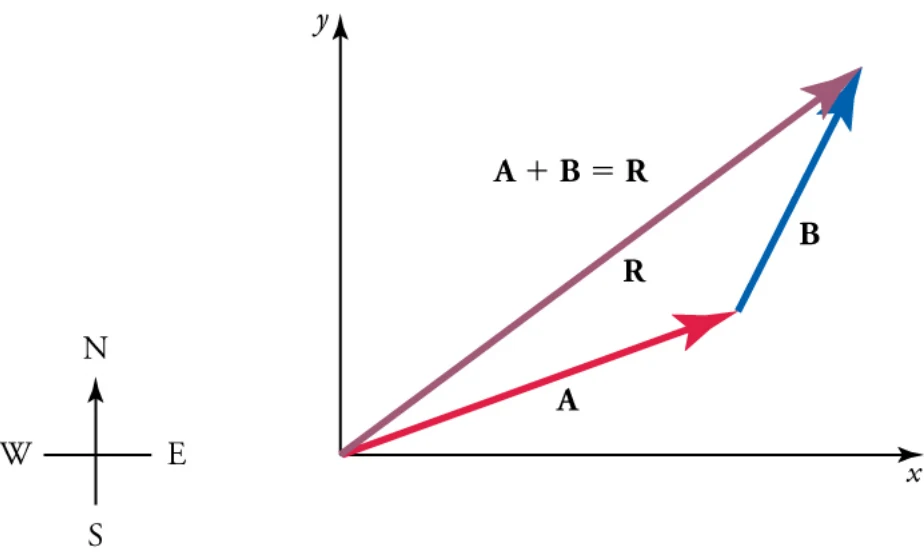
If and represent two legs of a walk (two displacements), then is the total displacement. The person taking the walk ends up at the tip of . There are many ways to arrive at the same point. The person could have walked straight ahead first in the x-direction and then in the y-direction. Those paths are the x- and y-components of the resultant, and If we know and , we can find and using the equations and
とが歩行の二つの区間(二つの変位)を表すなら、が全変位である。歩いた人はの先端に着く。同じ点に達する道筋はいくつもある。その人はまずx方向にまっすぐ進み、それからy方向に進むこともできた。その道筋が合成のx成分とy成分、すなわちとである。とが分かっていれば、式と次の式を使ってとを求められる。
1. Draw in the x and y components of each vector (including the resultant) with a dashed line. Use the equations and to find the components. In Figure 5.23, these components are , , , and Vector makes an angle of with the x-axis, and vector makes and angle of with its own x-axis (which is slightly above the x-axis used by vector A).
1. 各ベクトル(合成も含む)のx成分とy成分を破線で描き入れる。式とを使って成分を求める。図5.23では、これらの成分は、、、である。ベクトルはx軸との角をなし、ベクトルはそれ自身のx軸(ベクトルAが使うx軸よりわずかに上)との角をなす。
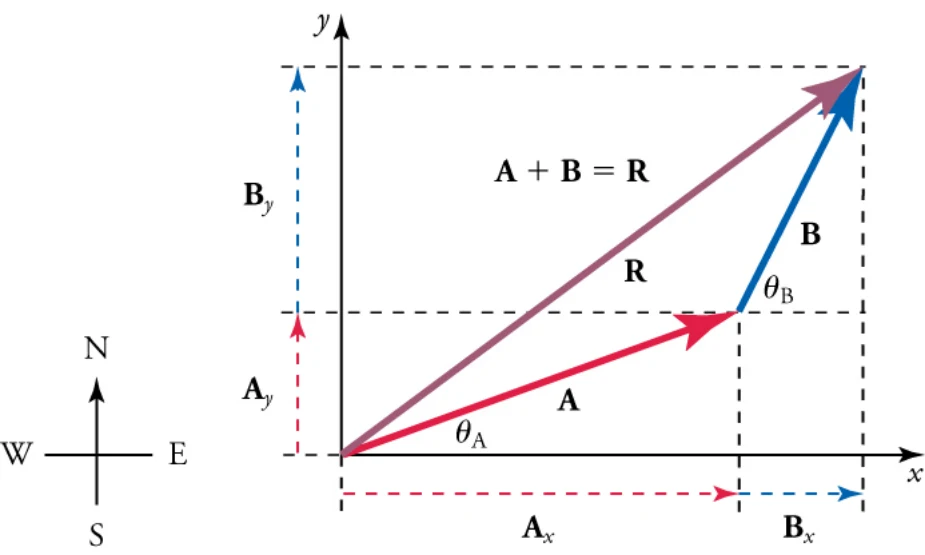
2. Find the x component of the resultant by adding the x component of the vectors
2. 各ベクトルのx成分を足して、合成のx成分を求める。
and find the y component of the resultant (as illustrated in Figure 5.24) by adding the y component of the vectors.
また図5.24のように、各ベクトルのy成分を足して合成のy成分を求める。
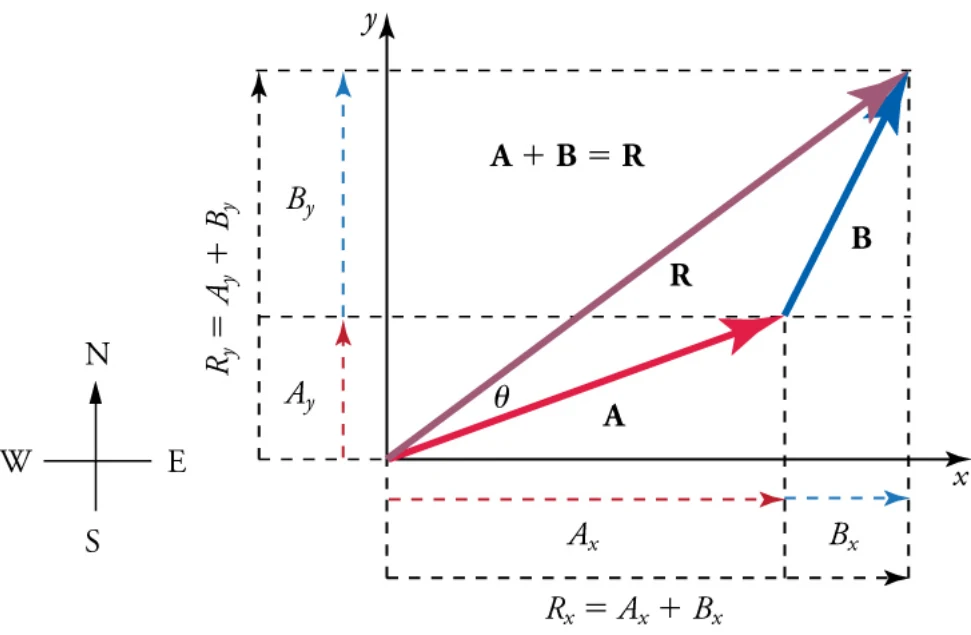
Now that we know the components of we can find its magnitude and direction.
の成分が分かったので、その大きさと向きを求められる。
3. To get the magnitude of the resultant R, use the Pythagorean theorem.
3. 合成Rの大きさを得るには、ピタゴラスの定理を使う。
4. To get the direction of the resultant
4. 合成の向きを得るには、
Classifying Vectors and Quantities Example This video contrasts and compares three vectors in terms of their magnitudes, positions, and directions.
ベクトルと量を分類する例 この動画は、三つのベクトルを大きさ・位置・向きの点で比べる。
Classifying vectors and quantities example | Vectors | Precalculus | Khan Academy (https://www.youtube.com/ embed/Yp0EhcVBxNU)
ベクトルと量を分類する例|ベクトル|微積分入門|カーンアカデミー(https://www.youtube.com/embed/Yp0EhcVBxNU)
Three vectors, , , and , have the same magnitude of . Vector points to the northeast. Vector points to the southwest exactly opposite to vector . Vector points in the northwest. If the vectors , , and were added together, what would be the magnitude of the resultant vector? Why?
三つのベクトル、、は、いずれも大きさである。ベクトルは北東を指す。ベクトルはベクトルのちょうど逆、南西を指す。もう一つのベクトルは北西を指す。、を含むこれらのベクトルを足し合わせたら、合成ベクトルの大きさはいくらになるか。またそれはなぜか。
a. . All of them will cancel each other out.b. . Two of them will cancel each other out.c. . Two of them will add together to give the resultant.d. units. All of them will add together to give the resultant.
a. 。すべてが互いに打ち消し合うから。b. 。二つが互いに打ち消し合うから。c. 。二つが足し合わさって合成を与えるから。d. 単位。すべてが足し合わさって合成を与えるから。
TIPS FOR SUCCESS In the video, the vectors were represented with an arrow above them rather than in bold. This is a common notation in math classes.
学習のポイント 動画では、ベクトルは太字ではなく上に矢印を付けて表されていた。これは数学の授業でよく使われる書き方である。
Using the Analytical Method of Vector Addition and Subtraction to Solve Problemsベクトルの加減の解析的な方法で問題を解く
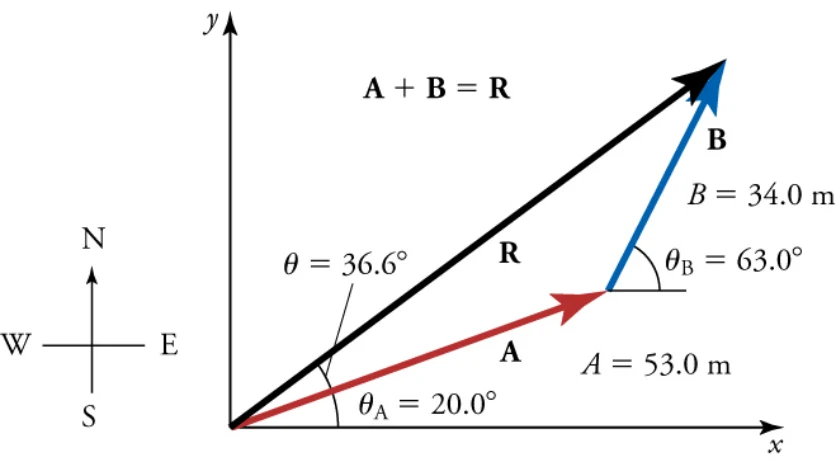
Figure 5.25 uses the analytical method to add vectors.
図5.25は、解析的な方法でベクトルを足す例である。
An Accelerating Subway Train加速する地下鉄の列車
Add the vector to the vector shown in Figure 5.25, using the steps above. The x-axis is along the east–west direction, and the y-axis is along the north–south directions. A person first walks in a direction north of east, represented by vector The person then walks in a direction north of east, represented by vector
上の手順に従って、図5.25のベクトルにベクトルを足せ。x軸は東西の向き、y軸は南北の向きである。ある人がまず東から北への向きに歩く。これをベクトルで表す。次にその人は東から北への向きに歩く。これをベクトルで表す。
Strategy方針
The components of and along the x- and y-axes represent walking due east and due north to get to the same ending point. We will solve for these components and then add them in the x-direction and y-direction to find the resultant.
とのx軸方向とy軸方向の成分は、同じ終点に達するために真東と真北へ歩くことに相当する。これらの成分を求め、x方向どうし、y方向どうしを足して合成を求める。
Solution解答
First, we find the components of and along the x- and y-axes. From the problem, we know that = , and . We find the x-components by using , which gives
まずとのx軸方向とy軸方向の成分を求める。問題から = 、と分かっている。x成分はを使って求める。すると次が得られる。
and
また、
Similarly, the y-components are found using
同じように、y成分は次を使って求める。
and
また、
The x- and y-components of the resultant are
合成のx成分とy成分は次のようになる。
and
また、
Now we can find the magnitude of the resultant by using the Pythagorean theorem
これで、ピタゴラスの定理を使って合成の大きさを求められる。
so that
したがって、
Finally, we find the direction of the resultant
最後に、合成の向きを求める。
This is
これは、
Discussion考察
This example shows vector addition using the analytical method. Vector subtraction using the analytical method is very similar. It is just the addition of a negative vector. That is, . The components of – are the negatives of the components of . Therefore, the x- and y-components of the resultant are
この例は、解析的な方法によるベクトルの加法を示している。解析的な方法によるベクトルの減法もよく似ている。負のベクトルを足すだけである。すなわちである。−の成分は、の成分の符号を変えたものである。したがって合成のx成分とy成分は次のようになる。
and
また、
and the rest of the method outlined above is identical to that for addition.
そして残りの手順は、上に述べた加法の場合とまったく同じである。
Practice Problems練習問題
5What is the magnitude of a vector whose x-component is 4 cm and whose y-component is 3 cm?a. 1 cmb. 5 cm
5x成分が4 cm、y成分が3 cmのベクトルの大きさはいくらか。a. 1 cmb. 5 cm
c. 7 cmd. 25 cm
c. 7 cmd. 25 cm
6What is the magnitude of a vector that makes an angle of 30° to the horizontal and whose x-component is 3 units?
6水平と30°の角をなし、x成分が3単位のベクトルの大きさはいくらか。
a. 2.61 unitsb. 3.00 unitsc. 3.46 unitsd. 6.00 units
a. 2.61単位b. 3.00単位c. 3.46単位d. 6.00単位
Atmospheric science is a physical science, meaning that it is a science based heavily on physics. Atmospheric science includes meteorology (the study of weather) and climatology (the study of climate). Climate is basically the average weather over a longer time scale. Weather changes quickly over time, whereas the climate changes more gradually.
大気科学は物質科学の一つであり、物理に大きく依存する科学である。大気科学には気象学(天気を扱う学問)と気候学(気候を扱う学問)が含まれる。気候とは、要するにより長い時間尺度で平均した天気である。天気は時間とともに速く変わるが、気候はもっとゆるやかに変わる。
The movement of air, water and heat is vitally important to climatology and meteorology. Since motion is such a major factor in weather and climate, this field uses vectors for much of its math.
空気・水・熱の移動は、気候学と気象学にとってきわめて重要である。運動が天気と気候の大きな要素である以上、この分野では数学の多くにベクトルが使われる。
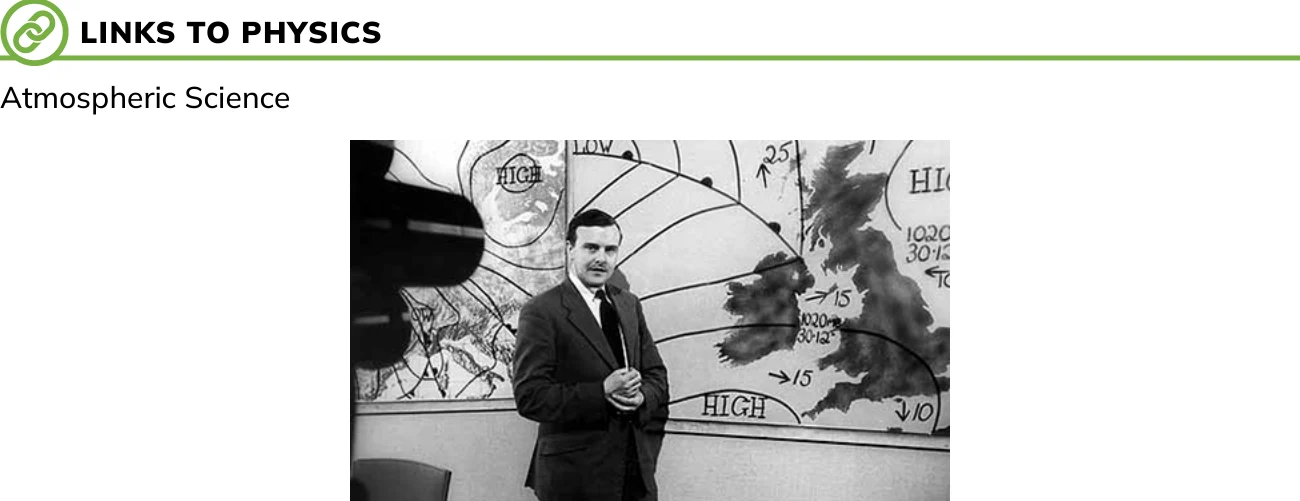
Vectors are used to represent currents in the ocean, wind velocity and forces acting on a parcel of air. You have probably seen a weather map using vectors to show the strength (magnitude) and direction of the wind.
ベクトルは、海流、風の速度、ある空気の塊にはたらく力を表すのに使われる。風の強さ(大きさ)と向きを示すのにベクトルを使った天気図を、おそらく見たことがあるだろう。
Vectors used in atmospheric science are often three-dimensional. We won’t cover three-dimensional motion in this text, but to go from two-dimensions to three-dimensions, you simply add a third vector component. Three-dimensional motion is represented as a combination of x-, y- and z components, where z is the altitude.
大気科学で使われるベクトルは、しばしば三次元である。本書では三次元の運動は扱わないが、二次元から三次元へ進むには、三つ目のベクトル成分を加えるだけでよい。三次元の運動は、x、y、z成分の組み合わせとして表される。ここでzは高度である。
Vector calculus combines vector math with calculus, and is often used to find the rates of change in temperature, pressure or wind speed over time or distance. This is useful information, since atmospheric motion is driven by changes in pressure or temperature. The greater the variation in pressure over a given distance, the stronger the wind to try to correct that imbalance. Cold air tends to be more dense and therefore has higher pressure than warm air. Higher pressure air rushes into a region of lower pressure and gets deflected by the spinning of the Earth, and friction slows the wind at Earth’s surface.
ベクトル解析はベクトルの数学と微積分を組み合わせたもので、温度・気圧・風速が時間や距離に対して変化する割合を求めるのによく使われる。これは役に立つ情報である。大気の運動は気圧や温度の変化によって駆動されるからだ。ある距離のあいだの気圧の変化が大きいほど、その不均衡を正そうとする風は強くなる。冷たい空気は密度が大きい傾向があり、したがって暖かい空気より気圧が高い。気圧の高い空気は気圧の低い領域へ流れ込み、地球の自転によって曲げられ、地表では摩擦によって風が弱められる。
Finding how wind changes over distance and multiplying vectors lets meteorologists, like the one shown in Figure 5.26, figure out how much rotation (spin) there is in the atmosphere at any given time and location. This is an important tool for tornado prediction. Conditions with greater rotation are more likely to produce tornadoes.
風が距離に沿ってどう変わるかを求め、ベクトルを掛け合わせることで、図5.26のような気象学者は、ある時刻・ある場所の大気にどれだけの回転(渦)があるかを割り出せる。これは竜巻の予測にとって重要な道具である。回転が大きい条件ほど、竜巻を生みやすい。
Why are vectors used so frequently in atmospheric science?
大気科学でベクトルがこれほど頻繁に使われるのはなぜか。
a. Vectors have magnitude as well as direction and can be quickly solved through scalar algebraic operations.b. Vectors have magnitude but no direction, so it becomes easy to express physical quantities involved in the atmospheric science.c. Vectors can be solved very accurately through geometry, which helps to make better predictions in atmospheric science.d. Vectors have magnitude as well as direction and are used in equations that describe the three dimensional motion of the atmosphere.
a. ベクトルは大きさと向きを持ち、スカラーの代数演算で手早く解けるから。b. ベクトルは大きさを持つが向きを持たないので、大気科学に関わる物理量を表しやすいから。c. ベクトルは幾何によってきわめて正確に解けるので、大気科学のより良い予測に役立つから。d. ベクトルは大きさと向きを持ち、大気の三次元の運動を記述する式に使われるから。
Check Your Understanding理解の確認
7Between the analytical and graphical methods of vector additions, which is more accurate? Why? a. The analytical method is less accurate than the graphical method, because the former involves geometry and trigonometry.b. The analytical method is more accurate than the graphical method, because the latter involves some extensive calculations.c. The analytical method is less accurate than the graphical method, because the former includes drawing all figures to the right scale.d. The analytical method is more accurate than the graphical method, because the latter is limited by the precision of the drawing.
7ベクトルの加法の解析的な方法と図による方法では、どちらが正確か。それはなぜか。 a. 解析的な方法のほうが図による方法より不正確である。前者は幾何と三角比を使うから。b. 解析的な方法のほうが図による方法より正確である。後者はかなり大がかりな計算を伴うから。c. 解析的な方法のほうが図による方法より不正確である。前者はすべての図を正しい縮尺で描くことを含むから。d. 解析的な方法のほうが図による方法より正確である。後者は作図の精度に縛られるから。
8What is a component of a two dimensional vector?a. A component is a piece of a vector that points in either the x or y direction.b. A component is a piece of a vector that has half of the magnitude of the original vector.
8二次元ベクトルの成分とは何か。a. 成分とは、x方向またはy方向を向いたベクトルの一部分である。b. 成分とは、もとのベクトルの半分の大きさを持つベクトルの一部分である。
c. A component is a piece of a vector that points in the direction opposite to the original vector.d. A component is a piece of a vector that points in the same direction as original vector but with double of its magnitude.
c. 成分とは、もとのベクトルと逆向きを指すベクトルの一部分である。d. 成分とは、もとのベクトルと同じ向きを指し、その2倍の大きさを持つベクトルの一部分である。
9How can we determine the global angle (measured counter-clockwise from positive ) if we know and ?
9とが分かっているとき、全体の角(正のから反時計回りに測る)をどう決めればよいか。
10How can we determine the magnitude of a vector if we know the magnitudes of its components?
10成分の大きさが分かっているとき、ベクトルの大きさをどう決めればよいか。