第5章二次元の運動Motion in Two Dimensions原書 p.151–204
5.1 Vector Addition and Subtraction: Graphical Methods5.1 ベクトルの加減:図による方法
SECTION LEARNING OBJECTIVES By the end of this section, you will be able to do the following:
この節の学習目標 この節を終えると、次のことができるようになる。
• Describe the graphical method of vector addition and subtraction• Use the graphical method of vector addition and subtraction to solve physics problems
・ベクトルの加減の図による方法を述べる・ベクトルの加減の図による方法を使って物理の問題を解く
Section Key Termsこの節の重要語
graphical methodhead (of a vector)head-to-tail methodresultantresultant vectortailvector additionvector subtraction
図による方法(ベクトルの)頭頭尾法合成合成ベクトル尾ベクトルの加法ベクトルの減法
The Graphical Method of Vector Addition and Subtractionベクトルの加減の図による方法
Recall that a vector is a quantity that has magnitude and direction. For example, displacement, velocity, acceleration, and force are all vectors. In one-dimensional or straight-line motion, the direction of a vector can be given simply by a plus or minus sign. Motion that is forward, to the right, or upward is usually considered to be positive (+); and motion that is backward, to the left, or downward is usually considered to be negative (−).
ベクトルは大きさと向きを持つ量であり、変位・速度・加速度・力はその例である。直線上の一次元の運動では、座標軸の正の向きを決めれば、成分の正負だけでベクトルの向きを表せる。通常は前・右・上を正(+)、後ろ・左・下を負(−)とするが、これは座標軸の選び方による約束である。
In two dimensions, a vector describes motion in two perpendicular directions, such as vertical and horizontal. For vertical and horizontal motion, each vector is made up of vertical and horizontal components. In a one-dimensional problem, one of the components simply has a value of zero. For two-dimensional vectors, we work with vectors by using a frame of reference such as a coordinate system. Just as with one-dimensional vectors, we graphically represent vectors with an arrow having a length proportional to the vector’s magnitude and pointing in the direction that the vector points.
二次元では、ベクトルは鉛直と水平のような、互いに垂直な二方向の運動を表す。鉛直・水平の運動では、各ベクトルは鉛直成分と水平成分からなる。一次元の問題では、一方の成分が0になるだけのことである。二次元のベクトルでは、座標系のような基準系を使ってベクトルを扱う。一次元のベクトルと同じく、図の上では、長さがベクトルの大きさに比例し、ベクトルの向きを指す矢印でベクトルを表す。
Figure 5.2 shows a graphical representation of a vector; the total displacement for a person walking in a city. The person first walks nine blocks east and then five blocks north. Her total displacement does not match her path to her final destination. The displacement simply connects her starting point with her ending point using a straight line, which is the shortest distance. We use the notation that a boldface symbol, such as D, stands for a vector. Its magnitude is represented by the symbol in italics, D, and its direction is given by an angle represented by the symbol Note that her displacement would be the same if she had begun by first walking five blocks north and then walking nine blocks east.
図5.2は、ベクトルを図で表したもの、すなわち街を歩く人の全変位である。この人はまず東へ9ブロック歩き、次に北へ5ブロック歩く。彼女の全変位は、目的地までたどった道筋とは一致しない。変位は出発点と到着点を直線、すなわち最短の道筋で結ぶだけである。ベクトルはDのような太字の記号で表す約束にする。その大きさは斜体の記号Dで表し、向きは記号で表す角で与える。先に北へ5ブロック、次に東へ9ブロック歩いていても、変位は同じになることに注意しよう。
TIPS FOR SUCCESS In this text, we represent a vector with a boldface variable. For example, we represent a force with the vector F, which has both magnitude and direction. The magnitude of the vector is represented by the variable in italics, F, and the direction of the variable is given by the angle
学習のポイント 本書ではベクトルを太字の変数で表す。たとえば力は、大きさと向きの両方を持つベクトルFで表す。ベクトルの大きさは斜体の変数Fで表し、向きは角で与える。
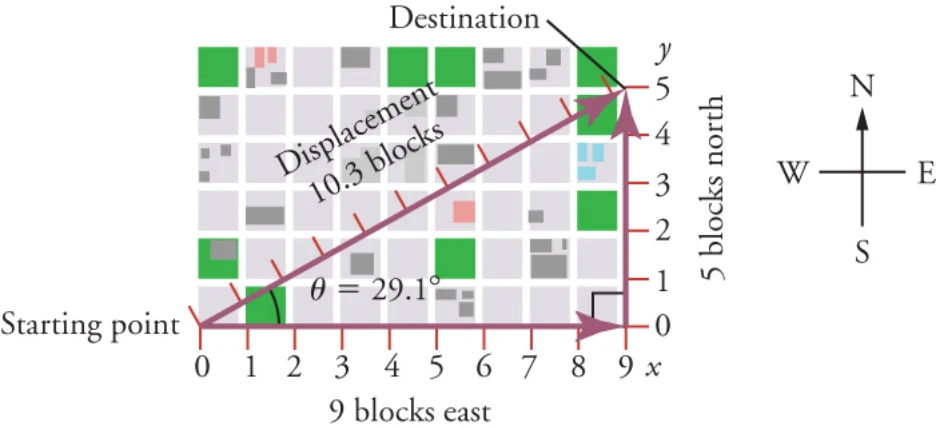
The head-to-tail method is a graphical way to add vectors. The tail of the vector is the starting point of the vector, and the head (or tip) of a vector is the pointed end of the arrow. The following steps describe how to use the head-to-tail method for graphical vector addition.
頭尾法は、ベクトルを図で足すやり方である。ベクトルの尾はベクトルの始点、頭(先端)は矢印のとがった端である。図によるベクトルの加法に頭尾法を使う手順は、次のとおりである。
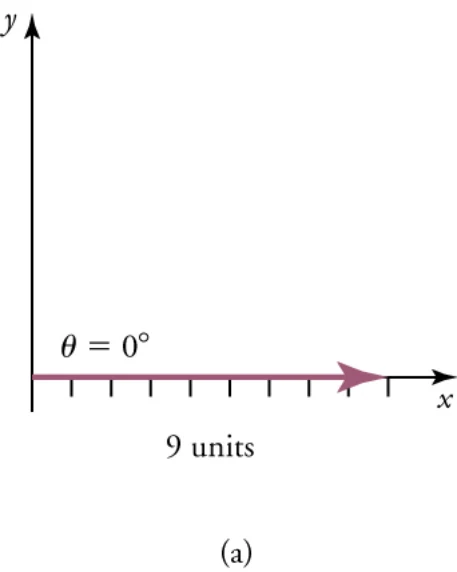
1. Let the x-axis represent the east-west direction. Using a ruler and protractor, draw an arrow to represent the first vector (nine blocks to the east), as shown in Figure 5.3(a).
1. x軸を東西の向きとする。定規と分度器を使って、一つ目のベクトル(東へ9ブロック)を表す矢印を描く。図5.3(a)を見よ。
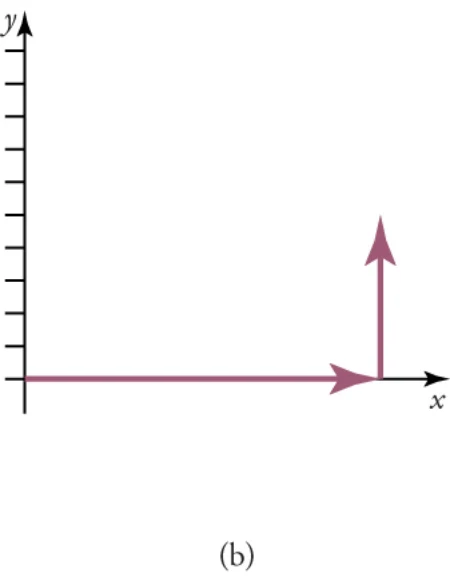
2. Let the y-axis represent the north-south direction. Draw an arrow to represent the second vector (five blocks to the north). Place the tail of the second vector at the head of the first vector, as shown in Figure 5.4(b).
2. y軸を南北の向きとする。二つ目のベクトル(北へ5ブロック)を表す矢印を描く。図5.4(b)のように、二つ目のベクトルの尾を一つ目のベクトルの頭に置く。
3. If there are more than two vectors, continue to add the vectors head-to-tail as described in step 2. In this example, we have only two vectors, so we have finished placing arrows tip to tail.4. Draw an arrow from the tail of the first vector to the head of the last vector, as shown in Figure 5.5(c). This is the resultant, or the sum, of the vectors.
3. ベクトルが三つ以上あるなら、手順2と同じように頭と尾をつないで足していく。この例ではベクトルが二つだけなので、矢印を継ぐ作業はここで終わりである。4. 図5.5(c)のように、一つ目のベクトルの尾から最後のベクトルの頭へ矢印を描く。これが合成、すなわちベクトルの和である。
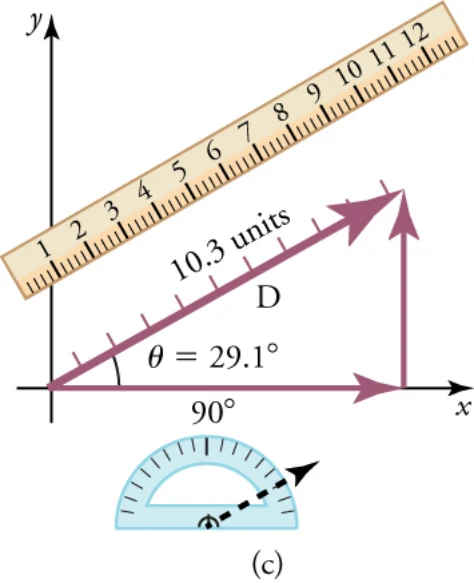
5. To find the magnitude of the resultant, measure its length with a ruler. When we deal with vectors analytically in the next section, the magnitude will be calculated by using the Pythagorean theorem.6. To find the direction of the resultant, use a protractor to measure the angle it makes with the reference direction (in this case, the x-axis). When we deal with vectors analytically in the next section, the direction will be calculated by using trigonometry to find the angle.
5. 合成の大きさを求めるには、定規でその長さを測る。次の節でベクトルを解析的に扱うときは、大きさをピタゴラスの定理で計算する。6. 合成の向きを求めるには、分度器で基準の向き(この場合はx軸)との角を測る。次の節でベクトルを解析的に扱うときは、向きを三角比で計算して角を求める。
Visualizing Vector Addition Examples This video shows four graphical representations of vector addition and matches them to the correct vector addition formula.
ベクトルの加法を目で見る例 この動画は、ベクトルの加法を図で表した四つの例を示し、それぞれを正しいベクトルの加法の式と対応づける。
RICPHY1XT315-V016000 (https://openstax.org/l/02addvector)
RICPHY1XT315-V016000(https://openstax.org/l/02addvector)
There are two vectors and . The head of vector touches the tail of vector . The addition of vectors and
二つのベクトルとがある。ベクトルの頭がベクトルの尾に接している。ベクトルと
gives a resultant vector . Can the addition of these two vectors can be represented by the following two equations? ; a. Yes, if we add the same two vectors in a different order it will still give the same resultant vector.b. No, the resultant vector will change if we add the same vectors in a different order.
の和は、合成ベクトルを与える。この二つのベクトルの和は、次の二つの式で表せるか。 ; a. 表せる。同じ二つのベクトルを違う順序で足しても、同じ合成ベクトルになるから。b. 表せない。同じベクトルでも足す順序を変えれば合成ベクトルは変わるから。
Vector subtraction is done in the same way as vector addition with one small change. We add the first vector to the negative of the vector that needs to be subtracted. A negative vector has the same magnitude as the original vector, but points in the opposite direction (as shown in Figure 5.6). Subtracting the vector B from the vector A, which is written as A − B, is the same as A + (−B). Since it does not matter in what order vectors are added, A − B is also equal to (−B) + A. This is true for scalars as well as vectors. For example, 5 – 2 = 5 + (−2) = (−2) + 5.
ベクトルの減法は、加法と同じやり方に一つ小さな変更を加えるだけである。一つ目のベクトルに、引きたいベクトルの負のベクトルを足せばよい。負のベクトルは、もとのベクトルと大きさが同じで、向きが逆である(図5.6を見よ)。ベクトルAからベクトルBを引くこと、すなわちA − Bは、A + (−B)と同じである。ベクトルは足す順序によらないので、A − Bは(−B) + Aにも等しい。これはスカラーでもベクトルでも成り立つ。たとえば 5 − 2 = 5 + (−2) = (−2) + 5 である。
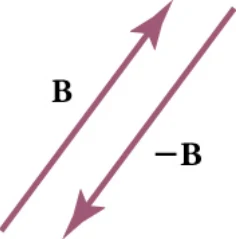
Global angles are calculated in the counterclockwise direction. The clockwise direction is considered negative. For example, an angle of south of west is the same as the global angle which can also be expressed as from the positive x-axis.
全体の角は反時計回りに測る。時計回りは負とする。たとえば西から南への角は、全体の角と同じであり、これはx軸の正の向きから測った角としても表せる。
Using the Graphical Method of Vector Addition and Subtraction to Solve Physics Problemsベクトルの加減の図による方法で物理の問題を解く
Now that we have the skills to work with vectors in two dimensions, we can apply vector addition to graphically determine the resultant vector, which represents the total force. Consider an example of force involving two ice skaters pushing a third as seen in Figure 5.7.
これで二次元のベクトルを扱う技が身についたので、ベクトルの加法を使って、全体の力を表す合成ベクトルを図から求められる。図5.7のように、二人のスケーターが三人目を押す力の例を考えよう。
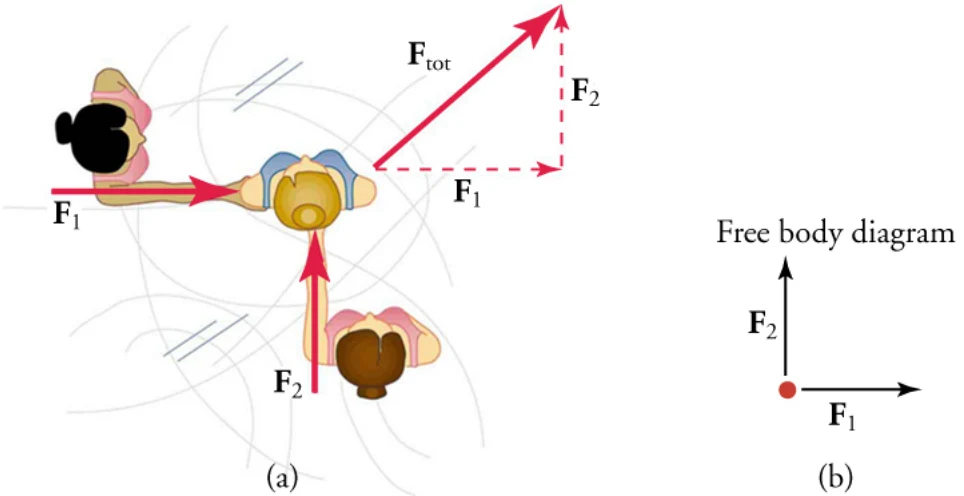
In problems where variables such as force are already known, the forces can be represented by making the length of the vectors proportional to the magnitudes of the forces. For this, you need to create a scale. For example, each centimeter of vector length could represent 50 N worth of force. Once you have the initial vectors drawn to scale, you can then use the head-to-tail method to draw the resultant vector. The length of the resultant can then be measured and converted back to the original units using the scale you created.
力などの変数がすでに分かっている問題では、ベクトルの長さを力の大きさに比例させて力を表せる。そのためには縮尺を決める必要がある。たとえばベクトルの長さ1センチメートルを50 Nの力に対応させる、というふうにする。縮尺どおりに初めのベクトルを描いたら、頭尾法で合成ベクトルを描ける。そのうえで合成の長さを測り、決めた縮尺を使ってもとの単位に戻せばよい。
You can tell by looking at the vectors in the free-body diagram in Figure 5.7 that the two skaters are pushing on the third skater with equal-magnitude forces, since the length of their force vectors are the same. Note, however, that the forces are not equal because they act in different directions. If, for example, each force had a magnitude of 400 N, then we would find the magnitude of the total external force acting on the third skater by finding the magnitude of the resultant vector. Since the forces act at a right angle to one another, we can use the Pythagorean theorem. For a triangle with sides a, b, and c, the Pythagorean theorem tells us that
図5.7の自由物体図のベクトルを見れば、二人のスケーターが三人目を同じ大きさの力で押していることが分かる。力のベクトルの長さが同じだからである。ただし、二つの力は向きが違うので等しくはないことに注意しよう。たとえば各々の力の大きさが400 Nなら、三人目のスケーターにはたらく全体の外力の大きさは、合成ベクトルの大きさを求めればよい。二つの力は互いに直角にはたらいているので、ピタゴラスの定理が使える。辺a、b、cを持つ三角形について、ピタゴラスの定理は次を教える。
Applying this theorem to the triangle made by F1, F2, and Ftot in Figure 5.7, we get
図5.7のF1、F2、Ftotが作る三角形にこの定理を当てはめると、次が得られる。
or
すなわち、
Note that, if the vectors were not at a right angle to each other to one another), we would not be able to use the Pythagorean theorem to find the magnitude of the resultant vector. Another scenario where adding two-dimensional vectors is necessary is for velocity, where the direction may not be purely east-west or north-south, but some combination of these two directions. In the next section, we cover how to solve this type of problem analytically. For now let’s consider the problem graphically.
もし二つのベクトルが互いに直角でなければ(でなければ)、ピタゴラスの定理で合成ベクトルの大きさを求めることはできないことに注意しよう。二次元のベクトルを足す必要がある別の場面が速度である。速度の向きは純粋に東西や南北とは限らず、その二つの組み合わせでありうる。次の節では、この種の問題を解析的に解く方法を扱う。今は図で考えてみよう。
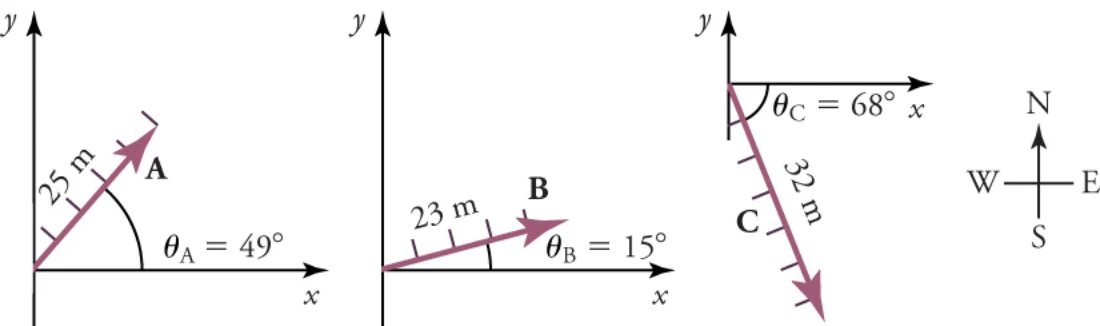
Adding Vectors Graphically by Using the Head-to-Tail Method: A Woman Takes a Walk Use the graphical technique for adding vectors to find the total displacement of a person who walks the following three paths (displacements) on a flat field. First, she walks 25 m in a direction north of east. Then, she walks 23 m heading north of east. Finally, she turns and walks 32 m in a direction south of east.Strategy
頭尾法でベクトルを図から足す:ある女性の散歩 ベクトルを足す図の技法を使って、平らな野原で次の三つの道筋(変位)を歩いた人の全変位を求めよ。まず東から北への向きに25 m歩く。次に東から北への向きに23 m歩く。最後に向きを変え、東から南への向きに32 m歩く。方針
Graphically represent each displacement vector with an arrow, labeling the first A, the second B, and the third C. Make the lengths proportional to the distance of the given displacement and orient the arrows as specified relative to an east-west line. Use the head-to-tail method outlined above to determine the magnitude and direction of the resultant displacement, which we’ll call R.
それぞれの変位ベクトルを矢印で図示し、一つ目をA、二つ目をB、三つ目をCとする。長さを与えられた変位の距離に比例させ、東西の線に対して指定されたとおりの向きに矢印を置く。上に述べた頭尾法を使って、合成変位(これをRと呼ぶ)の大きさと向きを求める。
Solution解答
(1) Draw the three displacement vectors, creating a convenient scale (such as 1 cm of vector length on paper equals 1 m in the problem), as shown in Figure 5.8.
(1)図5.8のように、都合のよい縮尺(たとえば紙の上のベクトルの長さ1 cmが問題の1 mに対応する)を決めて、三つの変位ベクトルを描く。
(2) Place the vectors head to tail, making sure not to change their magnitude or direction, as shown in Figure 5.9.
(2)図5.9のように、大きさと向きを変えないよう気をつけながら、ベクトルの頭と尾をつないで置く。
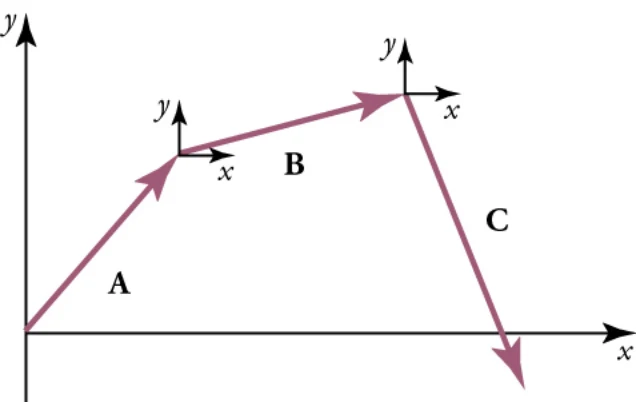
(3) Draw the resultant vector R from the tail of the first vector to the head of the last vector, as shown in Figure 5.10.
(3)図5.10のように、一つ目のベクトルの尾から最後のベクトルの頭へ、合成ベクトルRを描く。
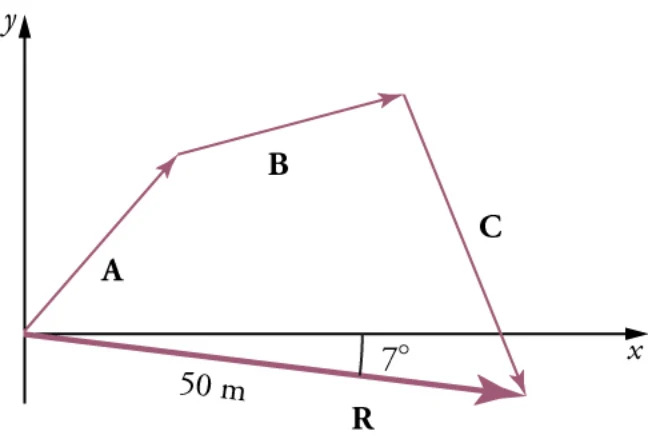
(4) Use a ruler to measure the magnitude of R, remembering to convert back to the units of meters using the scale. Use a protractor to measure the direction of R. While the direction of the vector can be specified in many ways, the easiest way is to measure the angle between the vector and the nearest horizontal or vertical axis. Since R is south of the eastward pointing axis (the x-axis), we flip the protractor upside down and measure the angle between the eastward axis and the vector, as illustrated in Figure 5.11.
(4)定規でRの大きさを測る。縮尺を使ってメートルの単位に戻すのを忘れずに。分度器でRの向きを測る。ベクトルの向きはいろいろに指定できるが、いちばん簡単なのは、ベクトルと最も近い水平または鉛直の軸との角を測ることである。Rは東を指す軸(x軸)より南にあるので、図5.11のように分度器を裏返して、東の軸とベクトルの間の角を測る。
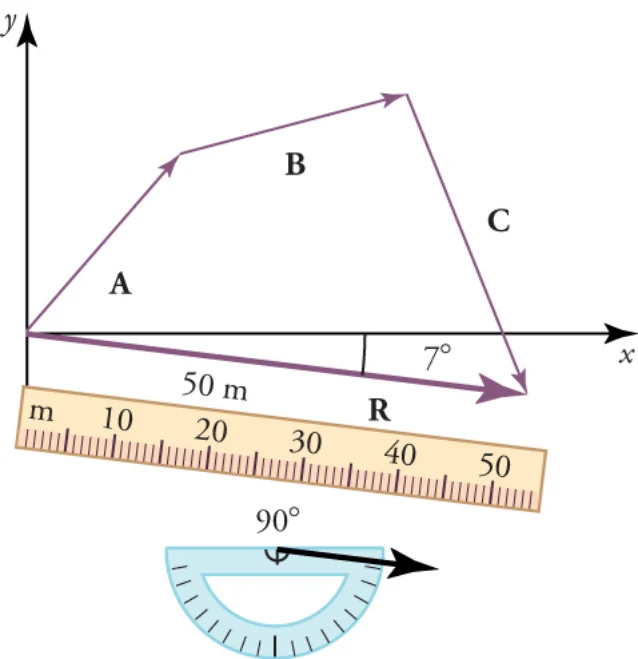
In this case, the total displacement R has a magnitude of 50 m and points south of east. Using its magnitude and direction, this vector can be expressed as
この場合、全変位Rは大きさ50 mで、東から南への向きを指す。大きさと向きを使えば、このベクトルは次のように表せる。
and
また、
Discussion考察
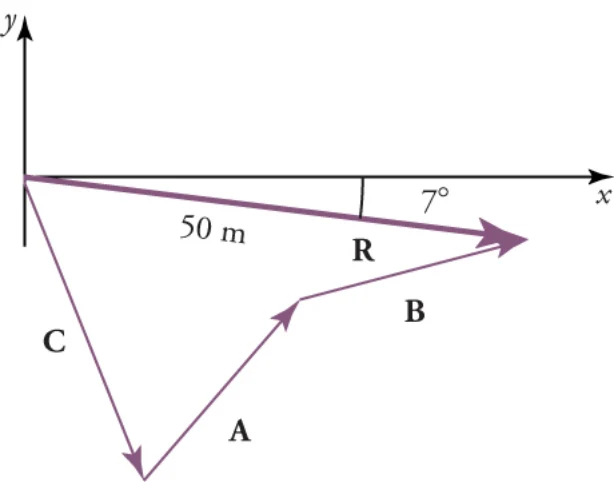
The head-to-tail graphical method of vector addition works for any number of vectors. It is also important to note that it does not matter in what order the vectors are added. Changing the order does not change the resultant. For example, we could add the vectors as shown in Figure 5.12, and we would still get the same solution.
頭尾法によるベクトルの加法の図的な方法は、ベクトルが何本あっても使える。また、ベクトルを足す順序は関係ないことも大切である。順序を変えても合成は変わらない。たとえば図5.12のように足しても、同じ答えが得られる。
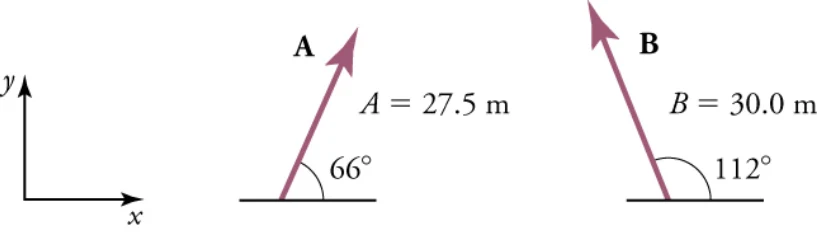
Subtracting Vectors Graphically: A Woman Sailing a Boat A woman sailing a boat at night is following directions to a dock. The instructions read to first sail 27.5 m in a direction north of east from her current location, and then travel 30.0 m in a direction north of east (or west of north). If the woman makes a mistake and travels in the opposite direction for the second leg of the trip, where will she end up? The two legs of the woman’s trip are illustrated in Figure 5.13.
ベクトルを図で引く:ボートを操る女性 夜、ボートを操るある女性が、桟橋への指示に従っている。指示には、まず今いる場所から東から北への向きに27.5 m進み、次に東から北への向き(すなわち北から西への向き)に30.0 m進め、とある。この女性が間違えて、二区間目を逆向きに進んでしまったら、どこにたどり着くか。この女性の旅の二区間を図5.13に示す。
Strategy方針
We can represent the first leg of the trip with a vector A, and the second leg of the trip that she was supposed to take with a vector B. Since the woman mistakenly travels in the opposite direction for the second leg of the journey, the vector for second leg of the trip she actually takes is −B. Therefore, she will end up at a location A + (−B), or A − B. Note that −B has the same magnitude as B (30.0 m), but is in the opposite direction, south of east, as illustrated in Figure 5.14.
旅の一区間目をベクトルA、彼女が進むはずだった二区間目をベクトルBで表せる。彼女は二区間目を誤って逆向きに進んだので、実際に進んだ二区間目のベクトルは−Bである。したがって彼女はA + (−B)、すなわちA − Bの場所にたどり着く。−BはBと同じ大きさ(30.0 m)だが、向きが逆で、図5.14に示すとおり東から南への向きであることに注意しよう。
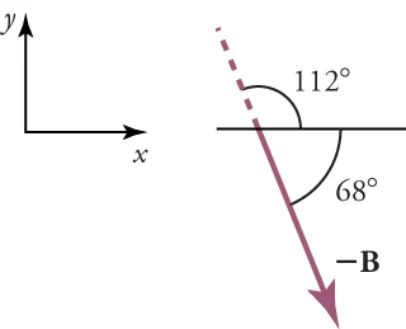
We use graphical vector addition to find where the woman arrives A + (−B).
図によるベクトルの加法を使って、女性がたどり着くA + (−B)を求める。
Solution解答
(1) To determine the location at which the woman arrives by accident, draw vectors A and −B.
(1)女性が誤ってたどり着く場所を求めるために、ベクトルAと−Bを描く。
(2) Place the vectors head to tail.
(2)ベクトルを頭と尾でつないで置く。
(3) Draw the resultant vector R.
(3)合成ベクトルRを描く。
(4) Use a ruler and protractor to measure the magnitude and direction of R.
(4)定規と分度器でRの大きさと向きを測る。
These steps are demonstrated in Figure 5.15.
この手順を図5.15に示す。
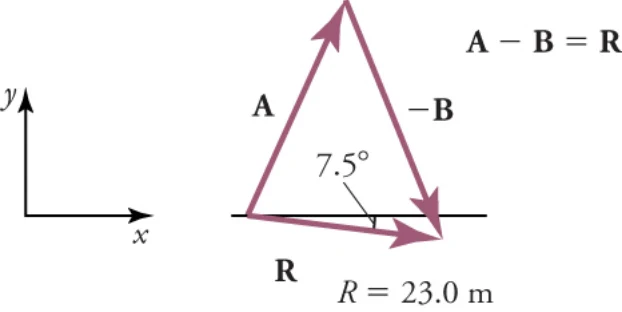
In this case
この場合、
and
また、
Discussion考察
Because subtraction of a vector is the same as addition of the same vector with the opposite direction, the graphical method for subtracting vectors works the same as for adding vectors.
ベクトルを引くことは、向きを逆にした同じベクトルを足すことと同じなので、ベクトルを図で引く方法は、足す方法とまったく同じように使える。
Adding Velocities: A Boat on a River A boat attempts to travel straight across a river at a speed of 3.8 m/s. The river current flows at a speed vriver of 6.1 m/s to the right. What is the total velocity and direction of the boat? You can represent each meter per second of velocity as one centimeter of vector length in your drawing.Strategy
速度を足す:川のボート あるボートが、速さ3.8 m/sで川をまっすぐ渡ろうとする。川の流れは右向きに速さvriver = 6.1 m/sである。ボートの全速度と向きはいくらか。図では、速度の毎秒1メートルをベクトルの長さ1センチメートルとして表してよい。方針
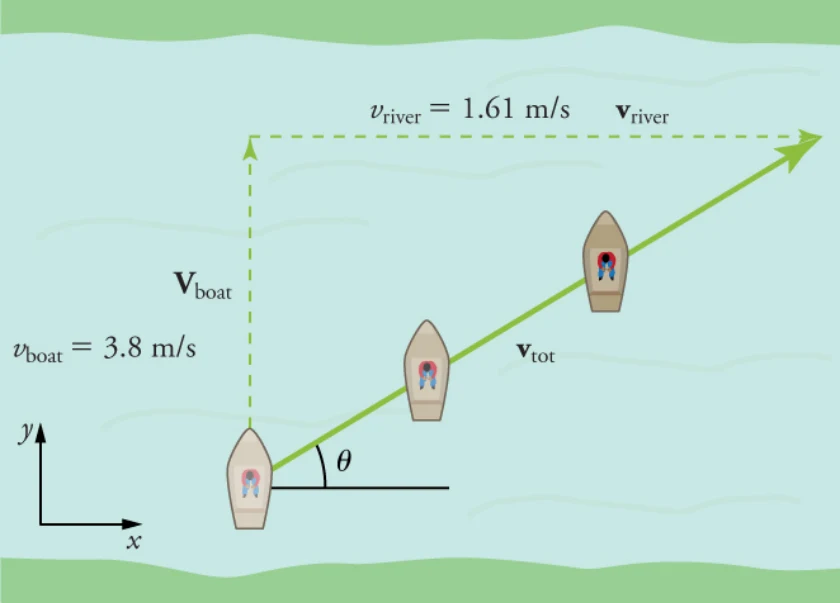
We start by choosing a coordinate system with its x-axis parallel to the velocity of the river. Because the boat is directed straight toward the other shore, its velocity is perpendicular to the velocity of the river. We draw the two vectors, vboat and vriver, as shown in Figure 5.16.
まず、x軸が川の速度に平行になるように座標系を選ぶ。ボートは対岸へまっすぐ向いているので、その速度は川の速度に垂直である。図5.16のように、二つのベクトルvboatとvriverを描く。
Using the head-to-tail method, we draw the resulting total velocity vector from the tail of vboat to the head of vriver.
頭尾法を使って、vboatの尾からvriverの頭へ、全速度のベクトルを描く。
Solution解答
By using a ruler, we find that the length of the resultant vector is 7.2 cm, which means that the magnitude of the total velocity is
定規で測ると合成ベクトルの長さは7.2 cmであり、これは全速度の大きさが次の値であることを意味する。
By using a protractor to measure the angle, we find
分度器で角を測ると、次が得られる。
Discussion考察
If the velocity of the boat and river were equal, then the direction of the total velocity would have been 45°. However, since the velocity of the river is greater than that of the boat, the direction is less than 45° with respect to the shore, or x axis.
ボートと川の速度が等しければ、全速度の向きは45°になっただろう。しかし川の速度のほうがボートより大きいので、岸すなわちx軸に対する向きは45°より小さい。
Practice Problems練習問題
1Vector , having magnitude , pointing south of east and vector having magnitude , pointing north of east are added. What is the magnitude of the resultant vector?a. b.
1大きさで東から南への向きを指すベクトルと、大きさで東から北への向きを指すベクトルを足す。合成ベクトルの大きさはいくらか。a. b.
2A person walks north of west for and east of south for . What is the magnitude of his displacement?
2ある人が西から北への向きに、次に南から東への向きに歩く。その変位の大きさはいくらか。
VIRTUAL PHYSICSシミュレーションVector Additionベクトルの加法
In this simulation (https://openstax.org/l/28vectoradd/), you will experiment with adding vectors graphically. Click and drag the red vectors from the Grab One basket onto the graph in the middle of the screen. These red vectors can be rotated, stretched, or repositioned by clicking and dragging with your mouse. Check the Show Sum box to display the resultant vector (in green), which is the sum of all of the red vectors placed on the graph. To remove a red vector, drag it to the trash or click the Clear All button if you wish to start over. Notice that, if you click on any of the vectors, the is its magnitude, is its direction with respect to the positive x-axis, Rx is its horizontal component, and Ry is its vertical component. You can check the resultant by lining up the vectors so that the head of the first vector touches the tail of the second. Continue until all of the vectors are aligned together head-to-tail. You will see that the resultant magnitude and angle is the same as the arrow drawn from the tail of the first vector to the head of the last vector. Rearrange the vectors in any order head-to-tail and compare. The resultant will always be the same.
このシミュレーション(https://openstax.org/l/28vectoradd/)では、ベクトルを図で足すことを試す。Grab Oneの籠から赤いベクトルをクリックしてつかみ、画面中央のグラフへドラッグする。この赤いベクトルは、マウスでクリックしてドラッグすれば回したり伸ばしたり置き直したりできる。Show Sumの箱にチェックを入れると、グラフ上に置いたすべての赤いベクトルの和である合成ベクトル(緑)が表示される。赤いベクトルを消すにはごみ箱へドラッグし、最初からやり直すならClear Allボタンを押す。どれかのベクトルをクリックすると、がその大きさ、がx軸の正の向きに対する向き、Rxが水平成分、Ryが鉛直成分であることが分かる。一つ目のベクトルの頭に二つ目の尾が触れるようにベクトルを並べていけば、合成を確かめられる。すべてのベクトルが頭と尾でつながるまで続ける。合成の大きさと角が、一つ目のベクトルの尾から最後のベクトルの頭へ引いた矢印と同じであることが分かるだろう。ベクトルの順序をどう並べ替えて頭尾でつないでも比べてみよう。合成はつねに同じになる。
Access multimedia content (http://openstax.org/books/physics/pages/5-1-vector-addition-and-subtraction-graphical-methods)
マルチメディア教材はこちら(http://openstax.org/books/physics/pages/5-1-vector-addition-and-subtraction-graphical-methods)
GRASP CHECK True or False—The more long, red vectors you put on the graph, rotated in any direction, the greater the magnitude of the resultant green vector.
理解の確認 正誤問題——長い赤いベクトルを、どんな向きに回してでもグラフにたくさん置くほど、合成である緑のベクトルの大きさは大きくなる。
a. Trueb. False
a. 正b. 誤
Check Your Understanding理解の確認
3While there is no single correct choice for the sign of axes, which of the following are conventionally considered positive?
3軸の符号の取り方に唯一の正解はないが、慣例として正とされるのはどれか。
a. backward and to the leftb. backward and to the rightc. forward and to the rightd. forward and to the left
a. 後ろ向きと左向きb. 後ろ向きと右向きc. 前向きと右向きd. 前向きと左向き
4True or False—A person walks 2 blocks east and 5 blocks north. Another person walks 5 blocks north and then two blocks east. The displacement of the first person will be more than the displacement of the second person.
4正誤問題——ある人が東へ2ブロック、北へ5ブロック歩く。別の人が北へ5ブロック歩いてから東へ2ブロック歩く。前者の変位は後者の変位より大きい。
a. Trueb. False
a. 正b. 誤