第8章運動量Momentum原書 p.259–286
CHAPTER OUTLINE章の構成
8.1 Linear Momentum, Force, and Impulse8.2 Conservation of Momentum8.3 Elastic and Inelastic Collisions
INTRODUCTION We know from everyday use of the word momentum that it is a tendency to continue on course in the same direction. Newscasters speak of sports teams or politicians gaining, losing, or maintaining the momentum to win. As we learned when studying about inertia, which is Newton's first law of motion, every object or system has inertia—that is, a tendency for an object in motion to remain in motion or an object at rest to remain at rest. Mass is a useful variable that lets us quantify inertia. Momentum is mass in motion.
はじめに 日常で使う「勢い(モメンタム)」という語から、それが同じ向きに進み続けようとする傾向を指すことは分かっている。キャスターは、スポーツチームや政治家が勝つための勢いを得た、失った、保っている、と言う。ニュートンの運動の第一法則である慣性を学んだときに見たとおり、あらゆる物体や系は慣性を持つ。すなわち、動いている物体は動き続けようとし、静止している物体は静止し続けようとする。質量は、その慣性を数量として表せる便利な変数である。運動量とは、動いている質量のことである。
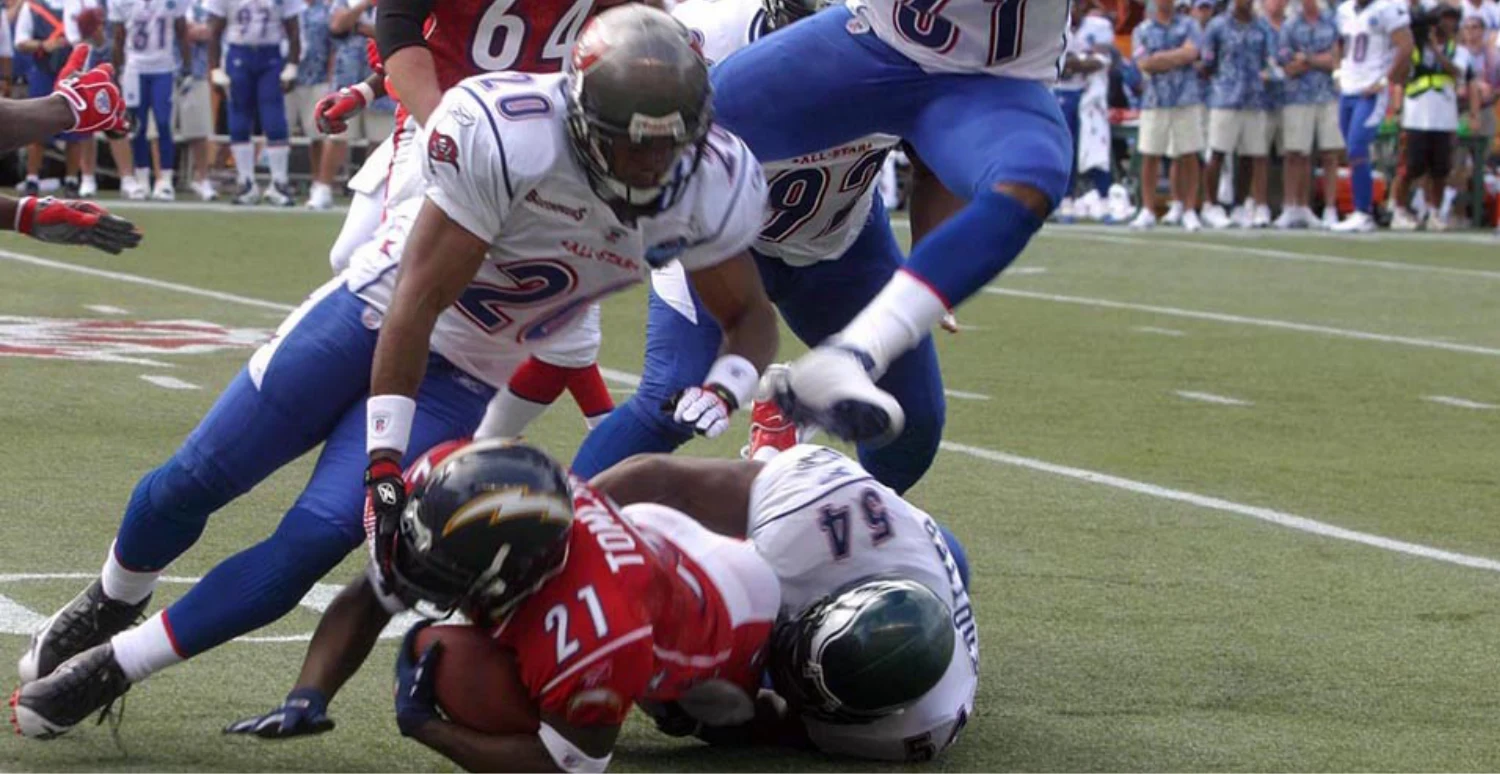
Momentum is important because it is conserved in isolated systems; this fact is convenient for solving problems where objects collide. The magnitude of momentum grows with greater mass and/or speed. For example, look at the football players in the photograph (Figure 8.1). They collide and fall to the ground. During their collisions, momentum will play a large part. In this chapter, we will learn about momentum, the different types of collisions, and how to use momentum equations to solve collision problems.
運動量は、孤立した系では保存される。この性質を使うと、物体どうしが衝突する問題を解きやすくなる。運動量の大きさは、物体の質量が大きいほど、また速さが大きいほど大きい。写真(図8.1)のアメリカンフットボールの選手がぶつかり、地面に倒れる場面にも、運動量の考え方が役立つ。この章では、運動量、衝突の種類、そして運動量の式を使った衝突問題の解き方を学ぶ。