第8章運動量Momentum原書 p.259–286
8.3 Elastic and Inelastic Collisions8.3 弾性衝突と非弾性衝突
SECTION LEARNING OBJECTIVES By the end of this section, you will be able to do the following:
この節の学習目標 この節を終えると、次のことができるようになる。
• Distinguish between elastic and inelastic collisions• Solve collision problems by applying the law of conservation of momentum
・弾性衝突と非弾性衝突を区別する・運動量保存の法則を当てはめて衝突の問題を解く
Section Key Termsこの節の重要語
elastic collisioninelastic collisionpoint massesrecoil
弾性衝突非弾性衝突質点反跳
Elastic and Inelastic Collisions弾性衝突と非弾性衝突
When objects collide, they can either stick together or bounce off one another, remaining separate. In this section, we’ll cover these two different types of collisions, first in one dimension and then in two dimensions.
物体どうしが衝突すると、くっついて一体になることもあれば、跳ね返って別々のままでいることもある。この節では、この二つの型の衝突を、まず一次元で、次に二次元で扱う。
In an elastic collision, the objects separate after impact and don’t lose any of their kinetic energy. Kinetic energy is the energy of motion and is covered in detail elsewhere. The law of conservation of momentum is very useful here, and it can be used whenever the net external force on a system is zero. Figure 8.6 shows an elastic collision where momentum is conserved.
弾性衝突では、物体は衝突後に離れ、運動エネルギーを失わない。運動エネルギーとは運動のエネルギーであり、詳しくは別のところで扱う。ここでは運動量保存の法則がたいへん役に立ち、系にはたらく外力の合力が0であればいつでも使える。図8.6に、運動量が保存される弾性衝突を示す。
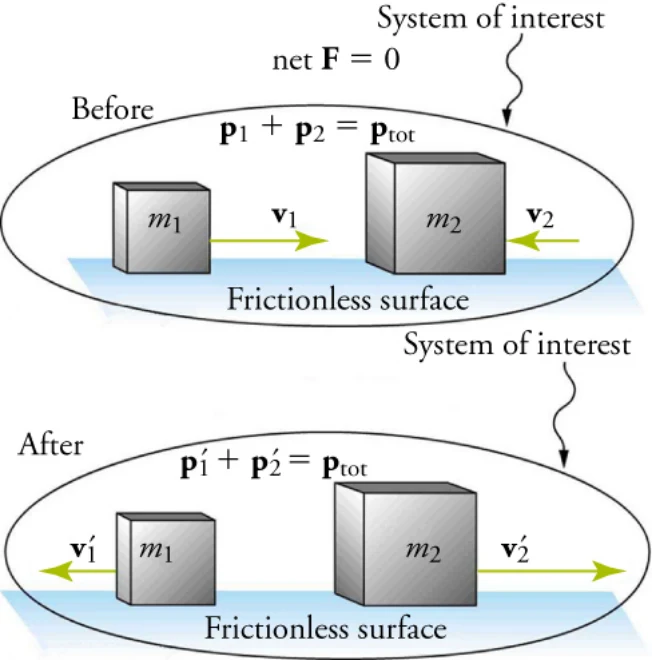
An animation of an elastic collision between balls can be seen by watching this video (https://openstax.org/l/ 28elasticball). It replicates the elastic collisions between balls of varying masses.
球どうしの弾性衝突のアニメーションは、この動画(https://openstax.org/l/28elasticball)で見られる。質量の違う球どうしの弾性衝突を再現している。
Perfectly elastic collisions can happen only with subatomic particles. Everyday observable examples of perfectly elastic collisions don’t exist—some kinetic energy is always lost, as it is converted into heat transfer due to friction. However, collisions between everyday objects are almost perfectly elastic when they occur with objects and surfaces that are nearly frictionless, such as with two steel blocks on ice.
完全な弾性衝突は、素粒子どうしでしか起こりえない。日常で見られる完全な弾性衝突の例は存在しない。摩擦による熱への移り変わりで、運動エネルギーが必ずいくらか失われるからである。とはいえ、氷の上の二つの鋼のかたまりのように、ほとんど摩擦のない物体や面どうしで起これば、日常の物体どうしの衝突もほぼ完全な弾性衝突になる。
Now, to solve problems involving one-dimensional elastic collisions between two objects, we can use the equation for conservation of momentum. First, the equation for conservation of momentum for two objects in a one-
さて、二つの物体の間の一次元の弾性衝突に関する問題を解くには、運動量保存の式が使える。まず、一次元における二つの物体についての運動量保存の式は、
dimensional collision is
次のとおりである。
Substituting the definition of momentum p = mv for each initial and final momentum, we get
初めと終わりの各運動量に運動量の定義 p = mv を代入すると、次が得られる。
where the primes (') indicate values after the collision; In some texts, you may see i for initial (before collision) and f for final (after collision). The equation assumes that the mass of each object does not change during the collision.
ここでダッシュ(′)は衝突後の値を示す。本によっては、初め(衝突前)にi、終わり(衝突後)にfを使うこともある。この式は、衝突の間に各物体の質量が変わらないことを前提にしている。
Momentum: Ice Skater Throws a Ball This video covers an elastic collision problem in which we find the recoil velocity of an ice skater who throws a ball straight forward. To clarify, Sal is using the equation
運動量:スケーターがボールを投げる この動画は、まっすぐ前へボールを投げたスケーターの反跳の速度を求める弾性衝突の問題を扱う。念のため、サルが使っている式は次のものである。
Momentum: Ice skater throws a ball | Impacts and linear momentum | Physics | Khan Academy (https://openstax.org/l/02momentball)
運動量:スケーターがボールを投げる|衝突と運動量|物理|カーンアカデミー(https://openstax.org/l/02momentball)
The resultant vector of the addition of vectors and is . The magnitudes of , , and are , , and , respectively. Which of the following is true?
ベクトルとを足した合成ベクトルはである。、、の大きさはそれぞれ、、である。次のうち正しいのはどれか。
Now, let us turn to the second type of collision. An inelastic collision is one in which kinetic energy is not conserved. A perfectly inelastic collision (also sometimes called completely or maximally inelastic) is one in which objects stick together after impact, and the maximum amount of kinetic energy is lost. This lack of conservation means that the forces between colliding objects may convert kinetic energy to other forms of energy, such as potential energy or thermal energy. The concepts of energy are discussed more thoroughly elsewhere. For inelastic collisions, kinetic energy may be lost in the form of heat. Figure 8.7 shows an example of an inelastic collision. Two objects that have equal masses head toward each other at equal speeds and then stick together. The two objects come to rest after sticking together, conserving momentum but not kinetic energy after they collide. Some of the energy of motion gets converted to thermal energy, or heat.
さて、二つ目の型の衝突に移ろう。非弾性衝突とは、運動エネルギーが保存されない衝突である。完全非弾性衝突(完全に、あるいは最大限に非弾性、とも呼ばれる)とは、衝突後に物体どうしがくっつき、運動エネルギーが最大限に失われる衝突である。保存されないということは、衝突する物体どうしの間の力が、運動エネルギーを位置エネルギーや熱エネルギーといった他の形のエネルギーに変えうるということである。エネルギーの考えは別のところで詳しく論じる。非弾性衝突では、運動エネルギーが熱の形で失われうる。図8.7に非弾性衝突の例を示す。等しい質量の二つの物体が等しい速さで向かい合って進み、そしてくっつく。二つはくっついたあと静止する。衝突後、運動量は保存されるが運動エネルギーは保存されない。運動のエネルギーの一部は熱エネルギー、すなわち熱に変わる。
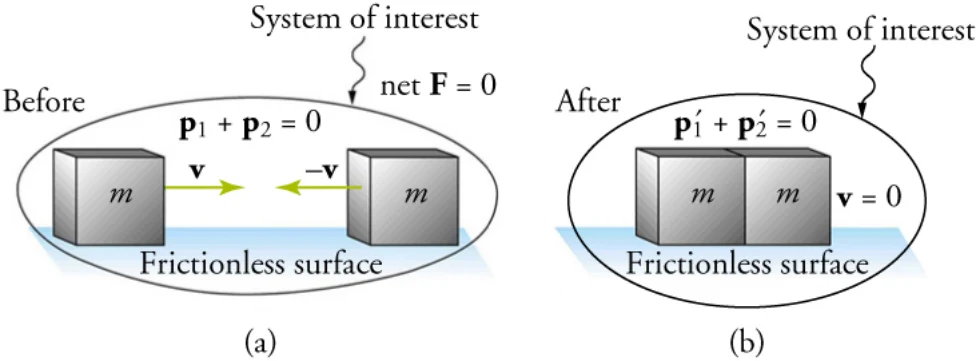
Since the two objects stick together after colliding, they move together at the same speed. This lets us simplify the conservation of momentum equation from
衝突後に二つの物体はくっつくので、同じ速さで一緒に動く。これによって、運動量保存の式を
to
次のように
for inelastic collisions, where v′ is the final velocity for both objects as they are stuck together, either in motion or at rest.
簡単にできる。ここでv′は、くっついた二つの物体が動いているか静止しているかにかかわらず、その終わりの速度である。
Introduction to Momentum This video reviews the definitions of momentum and impulse. It also covers an example of using conservation of momentum to solve a problem involving an inelastic collision between a car with constant velocity and a stationary truck. Note that Sal accidentally gives the unit for impulse as Joules; it is actually N s or kg m/s.
運動量の入門 この動画は、運動量と力積の定義を復習する。また、一定の速度で走る車と止まっているトラックの非弾性衝突の問題を、運動量保存を使って解く例も扱う。なお、サルは力積の単位をうっかりジュールと言っているが、正しくはN·s、すなわちkg·m/sである。
Introduction to momentum | Impacts and linear momentum | Physics | Khan Academy (https://openstax.org/l/ 02introtwomom)
運動量の入門|衝突と運動量|物理|カーンアカデミー(https://openstax.org/l/02introtwomom)
GRASP CHECK How would the final velocity of the car-plus-truck system change if the truck had some initial velocity moving in the same direction as the car? What if the truck were moving in the opposite direction of the car initially? Why?a. If the truck was initially moving in the same direction as the car, the final velocity would be greater. If the truck was initially moving in the opposite direction of the car, the final velocity would be smaller.b. If the truck was initially moving in the same direction as the car, the final velocity would be smaller. If the truck was initially moving in the opposite direction of the car, the final velocity would be greater.c. The direction in which the truck was initially moving would not matter. If the truck was initially moving in either direction, the final velocity would be smaller.d. The direction in which the truck was initially moving would not matter. If the truck was initially moving in either direction, the final velocity would be greater.
理解の確認 トラックが初めに車と同じ向きにいくらかの速度で動いていたら、車とトラックの系の終わりの速度はどう変わるか。トラックが初めに車と逆向きに動いていたらどうか。それはなぜか。a. トラックが初め車と同じ向きに動いていたなら、終わりの速度は大きくなる。逆向きに動いていたなら、終わりの速度は小さくなる。b. トラックが初め車と同じ向きに動いていたなら、終わりの速度は小さくなる。逆向きに動いていたなら、終わりの速度は大きくなる。c. トラックが初めどちらの向きに動いていたかは関係ない。どちらの向きに動いていても、終わりの速度は小さくなる。d. トラックが初めどちらの向きに動いていたかは関係ない。どちらの向きに動いていても、終わりの速度は大きくなる。
SNAP LAB身近な実験Ice Cubes and Elastic Collisions氷のかけらと弾性衝突
In this activity, you will observe an elastic collision by sliding an ice cube into another ice cube on a smooth surface, so that a negligible amount of energy is converted to heat.
この活動では、なめらかな面の上で氷のかけらを別の氷のかけらに滑らせてぶつけ、熱に変わるエネルギーが無視できるようにして、弾性衝突を観察する。
• Several ice cubes (The ice must be in the form of cubes.)• A smooth surface
・氷のかけらいくつか(立方体の形であること)・なめらかな面
Procedure手順
1. Find a few ice cubes that are about the same size and a smooth kitchen tabletop or a table with a glass top.2. Place the ice cubes on the surface several centimeters away from each other.3. Flick one ice cube toward a stationary ice cube and observe the path and velocities of the ice cubes after the collision. Try to avoid edge-on collisions and collisions with rotating ice cubes.4. Explain the speeds and directions of the ice cubes using momentum.
1. 大きさのだいたい同じ氷のかけらをいくつか用意し、なめらかな台所の天板か、ガラス天板の机を使う。2. 氷のかけらを数センチメートル離して面の上に置く。3. 一つのかけらを、静止しているかけらへ向けて指で弾き、衝突後のかけらの道筋と速度を観察する。かすめる衝突や、回転しているかけらとの衝突は避けるようにする。4. 運動量を使って、かけらの速さと向きを説明せよ。
Was the collision elastic or inelastic?a. perfectly elasticb. perfectly inelastic
この衝突は弾性衝突だったか、非弾性衝突だったか。a. 完全な弾性衝突b. 完全な非弾性衝突
c. Nearly perfect elasticd. Nearly perfect inelastic
c. ほぼ完全な弾性衝突d. ほぼ完全な非弾性衝突
TIPS FOR SUCCESS Here’s a trick for remembering which collisions are elastic and which are inelastic: Elastic is a bouncy material, so when objects bounce off one another in the collision and separate, it is an elastic collision. When they don’t, the collision is inelastic.
学習のポイント どちらが弾性でどちらが非弾性かを覚えるこつがある。elastic(弾性)とはよく跳ねる材料のことなので、衝突で物体が互いに跳ね返って離れるなら弾性衝突である。そうならないなら非弾性衝突である。
Solving Collision Problems衝突の問題を解く
The Khan Academy videos referenced in this section show examples of elastic and inelastic collisions in one dimension. In one-dimensional collisions, the incoming and outgoing velocities are all along the same line. But what about collisions, such as those between billiard balls, in which objects scatter to the side? These are two-dimensional collisions, and just as we did with two-dimensional forces, we will solve these problems by first choosing a coordinate system and separating the motion into its x and y components.
この節で参照したカーンアカデミーの動画は、一次元の弾性衝突と非弾性衝突の例を示している。一次元の衝突では、入ってくる速度も出ていく速度もすべて同じ直線上にある。では、ビリヤードの球どうしのように、物体が横へ散らばる衝突はどうか。それが二次元の衝突であり、二次元の力を扱ったときと同じように、まず座標系を選び、運動をx成分とy成分に分けることでこれらの問題を解く。
One complication with two-dimensional collisions is that the objects might rotate before or after their collision. For example, if two ice skaters hook arms as they pass each other, they will spin in circles. We will not consider such rotation until later, and so for now, we arrange things so that no rotation is possible. To avoid rotation, we consider only the scattering of point masses—that is, structureless particles that cannot rotate or spin.
二次元の衝突でやっかいなのは、物体が衝突の前後で回転しうることである。たとえば二人のスケーターがすれ違いざまに腕を組めば、二人は円を描いて回る。そうした回転はあとまで扱わないので、今は回転が起こらないように設定する。回転を避けるために、質点、すなわち回ったり自転したりしない、構造を持たない粒子の散乱だけを考える。
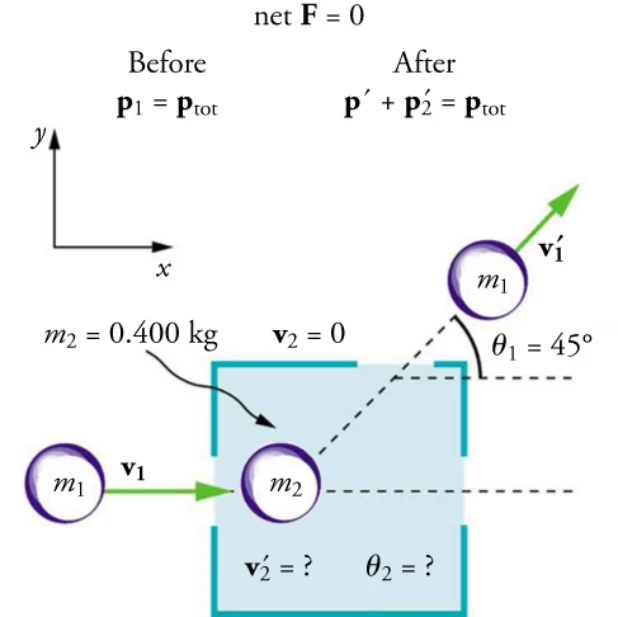
We start by assuming that Fnet = 0, so that momentum p is conserved. The simplest collision is one in which one of the particles is initially at rest. The best choice for a coordinate system is one with an axis parallel to the velocity of the incoming particle, as shown in Figure 8.8. Because momentum is conserved, the components of momentum along the x- and y-axes, displayed as px and py, will also be conserved. With the chosen coordinate system, py is initially zero and px is the momentum of the incoming particle.
まず Fnet = 0 とし、運動量pが保存されるとする。最も単純な衝突は、粒子の一方が初め静止している場合である。座標系としては、図8.8のように、入ってくる粒子の速度に平行な軸をとるのが最もよい。運動量が保存されるので、x軸方向とy軸方向の運動量の成分pxとpyも保存される。この座標系では、pyは初め0で、pxは入ってくる粒子の運動量である。
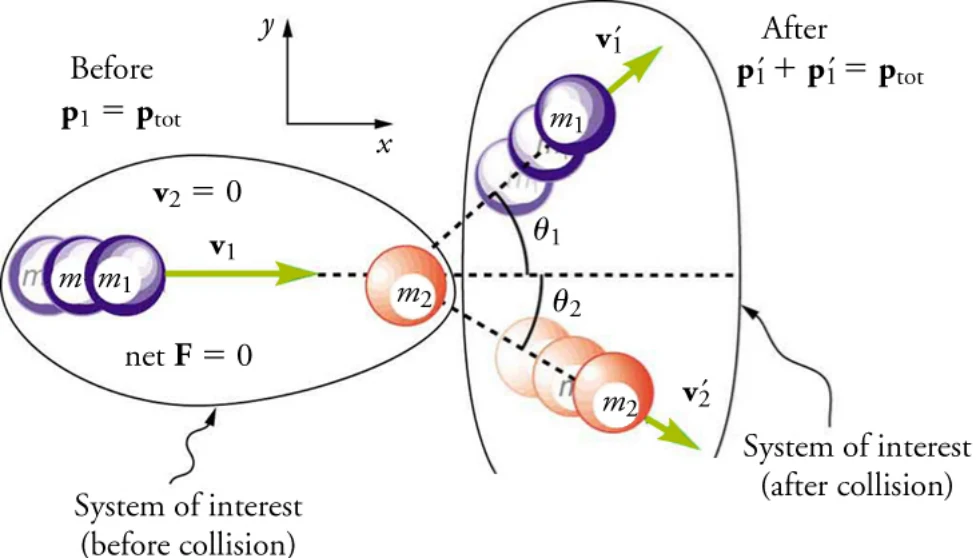
Now, we will take the conservation of momentum equation, p1 + p2 = p′1 + p′2 and break it into its x and y components.
では、運動量保存の式 p1 + p2 = p′1 + p′2 をとり、x成分とy成分に分けよう。
Along the x-axis, the equation for conservation of momentum is
x軸方向の運動量保存の式は次のとおりである。
In terms of masses and velocities, this equation is
質量と速度で書けば、この式は次のようになる。
But because particle 2 is initially at rest, this equation becomes
しかし粒子2は初め静止しているので、この式は次のようになる。
The components of the velocities along the x-axis have the form v cos θ . Because particle 1 initially moves along the x-axis, we find v1x = v1. Conservation of momentum along the x-axis gives the equation
x軸方向の速度の成分は v cos θ の形をとる。粒子1は初めx軸に沿って動いているので、v1x = v1 である。x軸方向の運動量保存から、次の式が得られる。
where and are as shown in Figure 8.8.
ここでとは図8.8に示したとおりである。
Along the y-axis, the equation for conservation of momentum is
y軸方向の運動量保存の式は次のとおりである。
or
すなわち、
But v1y is zero, because particle 1 initially moves along the x-axis. Because particle 2 is initially at rest, v2y is also zero. The equation for conservation of momentum along the y-axis becomes
しかし粒子1は初めx軸に沿って動いているので、v1yは0である。粒子2は初め静止しているので、v2yも0である。y軸方向の運動量保存の式は次のようになる。
The components of the velocities along the y-axis have the form v sin . Therefore, conservation of momentum along the y-axis gives the following equation:
y軸方向の速度の成分は v sin の形をとる。したがってy軸方向の運動量保存から、次の式が得られる。
VIRTUAL PHYSICSシミュレーションCollision Lab衝突実験室
In this simulation (https://openstax.org/l/28collisionlab), you will investigate collisions on an air hockey table. Place checkmarks next to the momentum vectors and momenta diagram options. Experiment with changing the masses of the balls and the initial speed of ball 1. How does this affect the momentum of each ball? What about the total momentum? Next, experiment with changing the elasticity of the collision. You will notice that collisions have varying degrees of elasticity, ranging from perfectly elastic to perfectly inelastic.
このシミュレーション(https://openstax.org/l/28collisionlab)では、エアホッケー台の上での衝突を調べる。運動量ベクトルと運動量の図の項目にチェックを入れる。球の質量と球1の初速を変えて試してみよう。それが各球の運動量にどう効くか。全運動量はどうか。次に、衝突の弾性の度合いを変えてみよう。衝突には、完全な弾性から完全な非弾性まで、さまざまな弾性の度合いがあることに気づくだろう。
GRASP CHECK If you wanted to maximize the velocity of ball 2 after impact, how would you change the settings for the masses of the balls, the initial speed of ball 1, and the elasticity setting? Why? Hint—Placing a checkmark next to the velocity vectors and removing the momentum vectors will help you visualize the velocity of ball 2, and pressing the More Data button will let you take readings.
理解の確認 衝突後の球2の速度を最大にしたければ、球の質量、球1の初速、そして弾性の設定をどうするか。それはなぜか。ヒント——速度ベクトルにチェックを入れて運動量ベクトルを外すと球2の速度を思い描きやすく、More Dataボタンを押せば数値を読み取れる。
a. Maximize the mass of ball 1 and initial speed of ball 1; minimize the mass of ball 2; and set elasticity to 50 percent.b. Maximize the mass of ball 2 and initial speed of ball 1; minimize the mass of ball 1; and set elasticity to 100 percent.c. Maximize the mass of ball 1 and initial speed of ball 1; minimize the mass of ball 2; and set elasticity to 100 percent.d. Maximize the mass of ball 2 and initial speed of ball 1; minimize the mass of ball 1; and set elasticity to 50 percent.
a. 球1の質量と球1の初速を最大にし、球2の質量を最小にし、弾性を50パーセントにする。b. 球2の質量と球1の初速を最大にし、球1の質量を最小にし、弾性を100パーセントにする。c. 球1の質量と球1の初速を最大にし、球2の質量を最小にし、弾性を100パーセントにする。d. 球2の質量と球1の初速を最大にし、球1の質量を最小にし、弾性を50パーセントにする。
Calculating Velocity: Inelastic Collision of a Puck and a Goalie Find the recoil velocity of a 70 kg ice hockey goalie who catches a 0.150-kg hockey puck slapped at him at a velocity of 35 m/s. Assume that the goalie is at rest before catching the puck, and friction between the ice and the puck-goalie system is negligible (see Figure 8.9).
速度を計算する:パックとゴールキーパーの非弾性衝突 質量70 kgのアイスホッケーのゴールキーパーが、速度35 m/sで打ち込まれた質量0.150 kgのパックを受け止めるとき、その反跳の速度を求めよ。ゴールキーパーはパックを受ける前は静止しており、氷とパック・ゴールキーパーの系の間の摩擦は無視できるものとする(図8.9を見よ)。
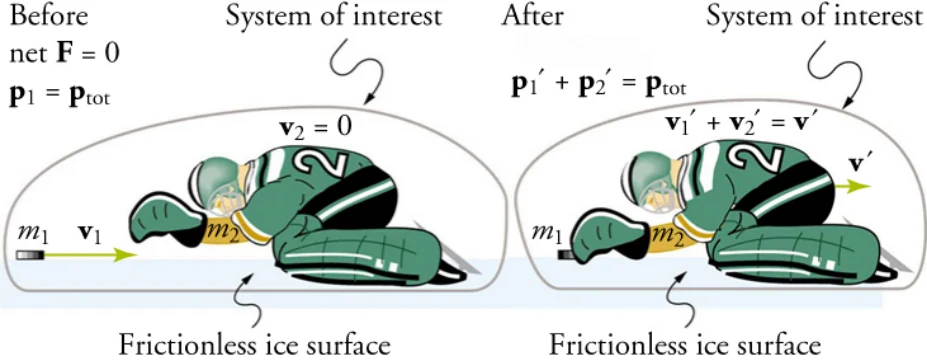
Strategy方針
Momentum is conserved because the net external force on the puck-goalie system is zero. Therefore, we can use conservation of momentum to find the final velocity of the puck and goalie system. Note that the initial velocity of the goalie is zero and that the final velocity of the puck and goalie are the same.
パックとゴールキーパーの系にはたらく外力の合力が0なので、運動量は保存される。したがって運動量保存を使って、パックとゴールキーパーの系の終わりの速度を求められる。ゴールキーパーの初速度は0であり、パックとゴールキーパーの終わりの速度は同じであることに注意しよう。
Solution解答
For an inelastic collision, conservation of momentum is
非弾性衝突では、運動量保存は次のとおりである。
where v′ is the velocity of both the goalie and the puck after impact. Because the goalie is initially at rest, we know v2 = 0. This simplifies the equation to
ここでv′は衝突後のゴールキーパーとパックの速度である。ゴールキーパーは初め静止しているので v2 = 0 である。これによって式は次のように簡単になる。
Solving for v′ yields
v′について解くと次が得られる。
Entering known values in this equation, we get
この式に既知の値を入れると、次が得られる。
Discussion考察
This recoil velocity is small and in the same direction as the puck’s original velocity.
この反跳の速度は小さく、向きはパックのもとの速度と同じである。
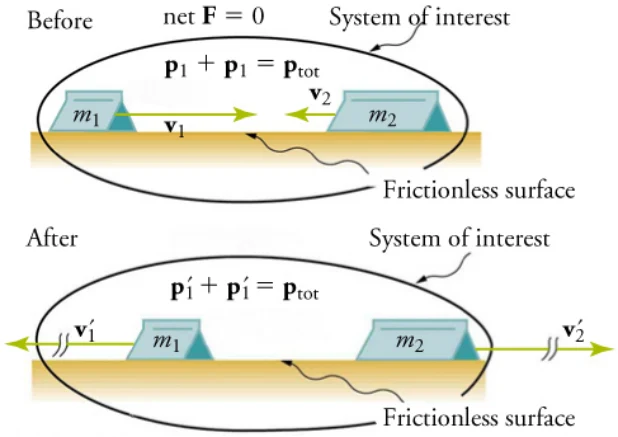
Calculating Final Velocity: Elastic Collision of Two Carts Two hard, steel carts collide head-on and then ricochet off each other in opposite directions on a frictionless surface (see Figure 8.10). Cart 1 has a mass of 0.350 kg and an initial velocity of 2 m/s. Cart 2 has a mass of 0.500 kg and an initial velocity of −0.500 m/s. After the collision, cart 1 recoils with a velocity of −0.94 m/s. What is the final velocity of cart 2?
終わりの速度を計算する:二台の台車の弾性衝突 硬い鋼の台車が二台、摩擦のない面の上で正面衝突し、互いに逆向きに跳ね返る(図8.10を見よ)。台車1は質量0.350 kg、初速度2 m/sである。台車2は質量0.500 kg、初速度−0.500 m/sである。衝突後、台車1は速度−0.94 m/sで跳ね返る。台車2の終わりの速度はいくらか。
Strategy方針
Since the track is frictionless, Fnet = 0 and we can use conservation of momentum to find the final velocity of cart 2.
軌道に摩擦がないので Fnet = 0 であり、運動量保存を使って台車2の終わりの速度を求められる。
Solution解答
As before, the equation for conservation of momentum for a one-dimensional elastic collision in a two-object system is
先と同じく、二物体系における一次元の弾性衝突についての運動量保存の式は次のとおりである。
The only unknown in this equation is v′2. Solving for v′2 and substituting known values into the previous equation yields
この式で分かっていないのは v′2 だけである。v′2 について解き、前の式に既知の値を代入すると次が得られる。
Discussion考察
The final velocity of cart 2 is large and positive, meaning that it is moving to the right after the collision.
台車2の終わりの速度は大きな正の値であり、衝突後に右へ動いていることを意味する。
Calculating Final Velocity in a Two-Dimensional Collision Suppose the following experiment is performed (Figure 8.11). An object of mass 0.250 kg (m1) is slid on a frictionless surface into a dark room, where it strikes an initially stationary object of mass 0.400 kg (m2). The 0.250 kg object emerges from the room at an angle of 45º with its incoming direction. The speed of the 0.250 kg object is originally 2 m/s and is 1.50 m/s after the collision. Calculate the magnitude and direction of the velocity (v′2 and ) of the 0.400 kg object after the collision.
二次元の衝突における終わりの速度を計算する 次の実験を行うとする(図8.11)。質量0.250 kgの物体(m1)を、摩擦のない面の上を滑らせて暗い部屋に入れると、そこで初め静止していた質量0.400 kgの物体(m2)に当たる。0.250 kgの物体は、入ってきた向きに対して45°の角で部屋から出てくる。0.250 kgの物体の速さは、もとは2 m/s、衝突後は1.50 m/sである。衝突後の0.400 kgの物体の速度の大きさと向き(v′2と)を計算せよ。
Strategy方針
Momentum is conserved because the surface is frictionless. We chose the coordinate system so that the initial velocity is parallel to the x-axis, and conservation of momentum along the x- and y-axes applies.
面に摩擦がないので運動量は保存される。初速度がx軸に平行になるように座標系を選んだので、x軸方向とy軸方向それぞれについて運動量保存が使える。
Everything is known in these equations except v′2 and θ2, which we need to find. We can find two unknowns because we have two independent equations—the equations describing the conservation of momentum in the x and y directions.
これらの式では、求めたい v′2 と θ2 以外はすべて分かっている。x方向とy方向の運動量保存を表す二つの独立な式があるので、二つの未知数を求められる。
Solution解答
First, we’ll solve both conservation of momentum equations ( and ) for v′2 sin .
まず、二つの運動量保存の式(と)を v′2 sin について解く。
For conservation of momentum along x-axis, let’s substitute sin /tan for cos so that terms may cancel out later on. This comes from rearranging the definition of the trigonometric identity tan = sin /cos . This gives us
x軸方向の運動量保存については、あとで項が約分できるよう、cos を sin/tan に置き換えよう。これは三角比の恒等式 tan = sin/cos を変形したものである。すると次が得られる。
Solving for v′2 sin yields
v′2 sin について解くと次が得られる。
For conservation of momentum along y-axis, solving for v′2 sin yields
y軸方向の運動量保存については、v′2 sin について解くと次が得られる。
Since both equations equal v′2 sin , we can set them equal to one another, yielding
どちらの式も v′2 sin に等しいので、両者を等しいと置ける。すると次が得られる。
Solving this equation for tan , we get
この式を tan について解くと、次が得られる。
Entering known values into the previous equation gives
前の式に既知の値を入れると、次が得られる。
Therefore,
したがって、
Since angles are defined as positive in the counterclockwise direction, m2 is scattered to the right.
角は反時計回りを正と定めているので、m2は右へ散乱される。
We’ll use the conservation of momentum along the y-axis equation to solve for v′2.
v′2 を求めるには、y軸方向の運動量保存の式を使う。
Entering known values into this equation gives
この式に既知の値を入れると、次が得られる。
Therefore,
したがって、
Discussion考察
Either equation for the x- or y-axis could have been used to solve for v′2, but the equation for the y-axis is easier because it has fewer terms.
v′2 を求めるにはx軸方向の式でもy軸方向の式でも使えたが、y軸方向の式のほうが項が少ないので楽である。
Practice Problems練習問題
10In an elastic collision, an object with momentum collides with another object moving to the right that has a momentum . After the collision, both objects are still moving to the right, but the first object’s momentum changes to . What is the final momentum of the second object? a. b.
10弾性衝突で、運動量の物体が、右へ動いている運動量の別の物体に衝突する。衝突後も両方の物体は右へ動いているが、一つ目の物体の運動量はに変わった。二つ目の物体の終わりの運動量はいくらか。 a. b.
11In an elastic collision, an object with momentum 25 kg ⋅ m/s collides with another that has a momentum 35 kg ⋅ m/s. The first object’s momentum changes to 10 kg ⋅ m/s. What is the final momentum of the second object?
11弾性衝突で、運動量25 kg·m/sの物体が、運動量35 kg·m/sの別の物体に衝突する。一つ目の物体の運動量は10 kg·m/sに変わった。二つ目の物体の終わりの運動量はいくらか。
a. 10 kg ⋅ m/sb. 20 kg ⋅ m/sc. 35 kg ⋅ m/sd. 50 kg ⋅ m/s
a. 10 kg·m/sb. 20 kg·m/sc. 35 kg·m/sd. 50 kg·m/s
Check Your Understanding理解の確認
12What is an elastic collision?a. An elastic collision is one in which the objects after impact are deformed permanently.b. An elastic collision is one in which the objects after impact lose some of their internal kinetic energy.c. An elastic collision is one in which the objects after impact do not lose any of their internal kinetic energy.d. An elastic collision is one in which the objects after impact become stuck together and move with a common velocity.
12弾性衝突とは何か。a. 弾性衝突とは、衝突後に物体が永久に変形する衝突である。b. 弾性衝突とは、衝突後に物体が内部の運動エネルギーの一部を失う衝突である。c. 弾性衝突とは、衝突後に物体が内部の運動エネルギーをまったく失わない衝突である。d. 弾性衝突とは、衝突後に物体がくっついて共通の速度で動く衝突である。
13Are perfectly elastic collisions possible?
13完全な弾性衝突はありうるか。
a. Perfectly elastic collisions are not possible.b. Perfectly elastic collisions are possible only with subatomic particles.
a. 完全な弾性衝突はありえない。b. 完全な弾性衝突は素粒子どうしでしかありえない。
c. Perfectly elastic collisions are possible only when the objects stick together after impact.d. Perfectly elastic collisions are possible if the objects and surfaces are nearly frictionless.
c. 完全な弾性衝突は、衝突後に物体がくっつく場合にしかありえない。d. 完全な弾性衝突は、物体と面がほとんど摩擦のないものならありうる。
14What is the equation for conservation of momentum for two objects in a one-dimensional collision?a. p1 + p1′ = p2 + p2′b. p1 + p2 = p1′ + p2′
14一次元の衝突における二つの物体についての運動量保存の式はどれか。a. p1 + p′1 = p2 + p′2b. p1 + p2 = p′1 + p′2
c. p1 − p2 = p1′ − p2′d. p1 + p2 + p1′ + p2′ = 0
c. p1 − p2 = p′1 − p′2d. p1 + p2 + p′1 + p′2 = 0