第2章一次元の運動Motion in One Dimension原書 p.55–96
2.2 Speed and Velocity2.2 速さと速度
SECTION LEARNING OBJECTIVES By the end of this section, you will be able to do the following:• Calculate the average speed of an object• Relate displacement and average velocity
この節の学習目標 この節を終えると、次のことができるようになる。・物体の平均の速さを計算する・変位と平均速度を結びつける
Section Key Termsこの節の重要語
average speedaverage velocityinstantaneous speedinstantaneous velocityspeedvelocity
平均の速さ平均速度瞬間の速さ瞬間速度速さ速度
Speed速さ
There is more to motion than distance and displacement. Questions such as, “How long does a foot race take?” and “What was the runner’s speed?” cannot be answered without an understanding of other concepts. In this section we will look at time, speed, and velocity to expand our understanding of motion.
道のりと変位だけでは、運動の様子を十分に記述できない。「競走を終えるまで何秒かかったか」「走者はどれほどの速さで走ったか」といった問いに答えるには、別の量も必要になる。この節では、時間・速さ・速度を学び、運動の捉え方を広げる。
A description of how fast or slow an object moves is its speed. Speed is the rate at which an object changes its location. Like distance, speed is a scalar because it has a magnitude but not a direction. Because speed is a rate, it depends on the time interval of motion. You can calculate the elapsed time or the change in time, , of motion as the difference between the ending time and the beginning time
物体の動きがどれほど速いかを表す量が、速さである。速さは、単位時間にどれだけの道のりを進むかを表す。道のりと同じく、速さは大きさを持つが向きを持たないのでスカラーである。速さを求めるには、進んだ道のりに加えて、かかった時間を知る必要がある。運動の経過時間、すなわち時間の変化は、終わりの時刻と始めの時刻の差として計算できる。
The SI unit of time is the second (s), and the SI unit of speed is meters per second (m/s), but sometimes kilometers per hour (km/h), miles per hour (mph) or other units of speed are used.
時間のSI単位は秒(s)、速さのSI単位はメートル毎秒(m/s)だが、キロメートル毎時(km/h)、マイル毎時(mph)など他の速さの単位が使われることもある。
When you describe an object's speed, you often describe the average over a time period. Average speed, vavg, is the distance traveled divided by the time during which the motion occurs.
物体の速さを述べるとき、ある時間にわたる平均を述べることが多い。平均の速さvavgとは、進んだ道のりを、その運動にかかった時間で割ったものである。
You can, of course, rearrange the equation to solve for either distance or time
もちろん、この式を変形して道のりや時間について解くこともできる。
Suppose, for example, a car travels 150 kilometers in 3.2 hours. Its average speed for the trip is
たとえば、ある車が150キロメートルを3.2時間で走ったとしよう。この旅の平均の速さは次のようになる。
A car's speed would likely increase and decrease many times over a 3.2 hour trip. Its speed at a specific instant in time, however, is its instantaneous speed. A car's speedometer describes its instantaneous speed.
3.2時間の旅の間、車の速さは何度も上がったり下がったりしただろう。しかしある瞬間における速さが、瞬間の速さである。車の速度計は瞬間の速さを示している。
Calculating Average Speed A marble rolls 5.2 m in 1.8 s. What was the marble's average speed? Strategy
平均の速さを計算する ビー玉が1.8秒で5.2 m転がった。このビー玉の平均の速さはいくらだったか。 方針
We know the distance the marble travels, 5.2 m, and the time interval, 1.8 s. We can use these values in the average speed equation.
ビー玉が進んだ道のり5.2 mと、時間間隔1.8 sが分かっている。これらの値を平均の速さの式に使えばよい。
Solution解答
Discussion考察
Average speed is a scalar, so we do not include direction in the answer. We can check the reasonableness of the answer by estimating: 5 meters divided by 2 seconds is 2.5 m/s. Since 2.5 m/s is close to 2.9 m/s, the answer is reasonable. This is about the speed of a brisk walk, so it also makes sense.
平均の速さはスカラーなので、答えに向きは含めない。答えが妥当かどうかは、見積もりで確かめられる。5メートルを2秒で割れば2.5 m/sである。2.5 m/sは2.9 m/sに近いので、答えは妥当である。これは早歩きくらいの速さなので、その点でも筋が通っている。
Practice Problems練習問題
9A pitcher throws a baseball from the pitcher’s mound to home plate in 0.46 s. The distance is 18.4 m. What was the average speed of the baseball?
9投手がマウンドから本塁までボールを0.46秒で投げた。距離は18.4 mである。このボールの平均の速さはいくらだったか。
a. 40 m/sb. - 40 m/sc. 0.03 m/sd. 8.5 m/s
a. 40 m/sb. −40 m/sc. 0.03 m/sd. 8.5 m/s
10Cassie walked to her friend’s house with an average speed of 1.40 m/s. The distance between the houses is
10キャシーは平均の速さ1.40 m/sで友人の家まで歩いた。二軒の間の距離は
205 m. How long did the trip take her?a. 146 sb. 0.01 s
205 mである。この移動には何秒かかったか。a. 146 sb. 0.01 s
c. 2.50 mind. 287 s
c. 2.50分d. 287 s
Velocity The vector version of speed is velocity. Velocity describes the speed and direction of an object. As with speed, it is useful to describe either the average velocity over a time period or the velocity at a specific moment. Average velocity is displacement divided by the time over which the displacement occurs.
速度速度は、物体の速さに運動の向きを加えたベクトル量である。速さと同じように、ある時間区間での平均値と、ある瞬間の値を区別して考える。平均速度は、その時間区間での変位を、経過した時間で割ったものである。
Velocity, like speed, has SI units of meters per second (m/s), but because it is a vector, you must also include a direction. Furthermore, the variable v for velocity is bold because it is a vector, which is in contrast to the variable v for speed which is italicized because it is a scalar quantity.
速度のSI単位は、速さと同じくメートル毎秒(m/s)である。ただし、速度はベクトルなので向きも示す必要がある。本書では、ベクトルである速度を太字の v、スカラーである速さを斜体の v で表し、両者を区別する。
TIPS FOR SUCCESS It is important to keep in mind that the average speed is not the same thing as the average velocity without its direction. Like we saw with displacement and distance in the last section, changes in direction over a time interval have a bigger effect on speed and velocity.
学習のポイント平均の速さは、平均速度の向きを取り去ったものとは限らない。平均の速さには道のりを使い、平均速度には変位を使う。前節で見たように、途中で向きを変える運動では、この違いが特に重要になる。
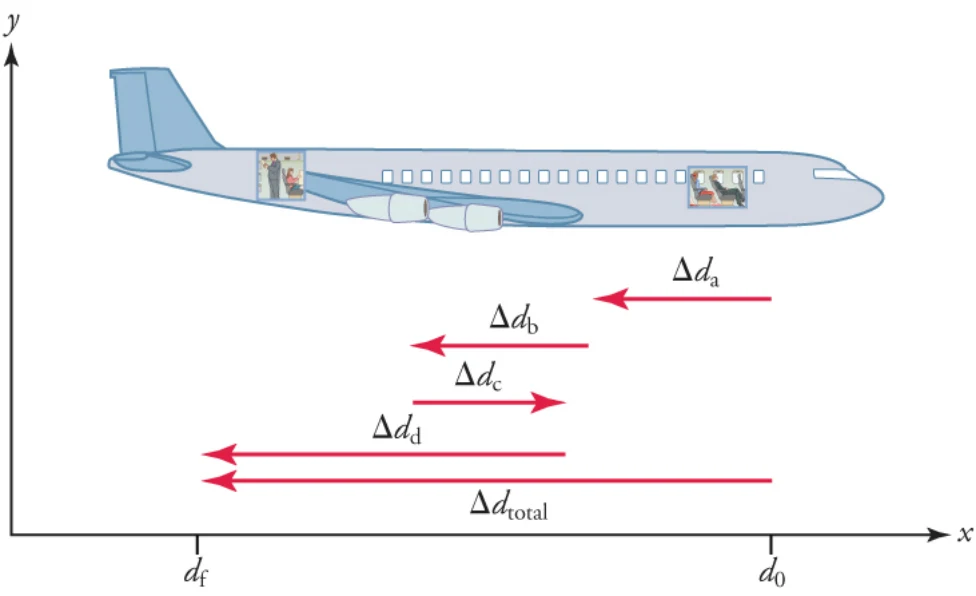
Suppose a passenger moved toward the back of a plane with an average velocity of –4 m/s. We cannot tell from the average velocity whether the passenger stopped momentarily or backed up before he got to the back of the plane. To get more details, we must consider smaller segments of the trip over smaller time intervals such as those shown in Figure 2.9. If you consider infinitesimally small intervals, you can define instantaneous velocity, which is the velocity at a specific instant in time. Instantaneous velocity and average velocity are the same if the velocity is constant.
飛行機の乗客が、機内を後方へ平均速度 −4 m/s で移動したとしよう。この平均速度だけでは、途中で立ち止まったのか、引き返したのかまでは分からない。運動を詳しく調べるには、図2.9のように時間をより短く区切り、それぞれの区間の変位を見る必要がある。時間区間を限りなく短くしたときの速度を、その時刻の瞬間速度という。速度が一定なら、瞬間速度と平均速度は等しい。
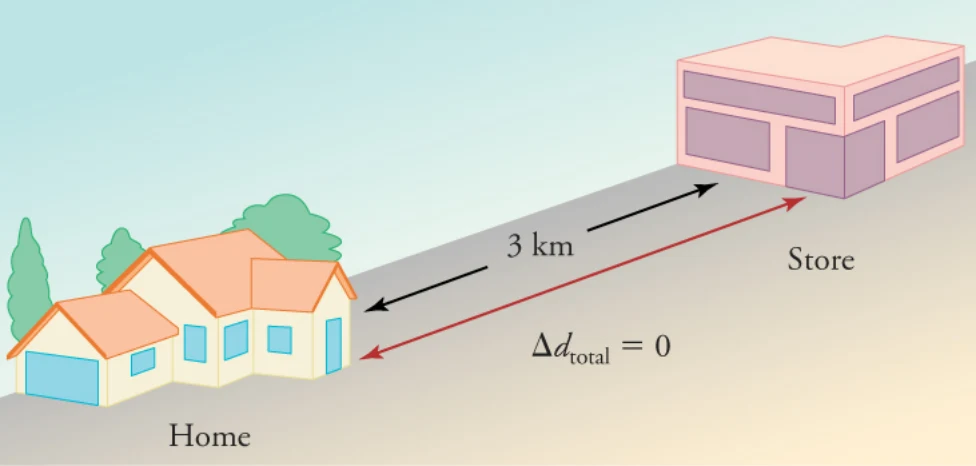
Earlier, you have read that distance traveled can be different than the magnitude of displacement. In the same way, speed can be different than the magnitude of velocity. For example, you drive to a store and return home in half an hour. If your car’s odometer shows the total distance traveled was 6 km, then your average speed was 12 km/h. Your average velocity, however, was zero because your displacement for the round trip is zero.
道のりは、変位の大きさとは限らない。同じように、平均の速さは平均速度の大きさと異なることがある。たとえば、車で店へ行って家へ戻るまでに30分かかり、走行距離計で6 km進んだと分かったなら、平均の速さは12 km/hである。しかし、出発点に戻ったため往復の変位は0であり、平均速度は0になる。
Calculating Average Velocity or Speed This video (https://openstax.org/l/28avgvelocity) reviews vectors and scalars and describes how to calculate average velocity and average speed when you know displacement and change in time. The video also reviews how to convert km/h to m/s.
平均速度や平均の速さを計算する この動画(https://openstax.org/l/28avgvelocity)は、ベクトルとスカラーを復習し、変位と時間の変化がわかっているときに平均速度と平均の速さをどう計算するかを説明する。km/hをm/sに換算するしかたも復習できる。
Average velocity for constant acceleration | One-dimensional motion | Physics | Khan Academy (https://openstax.org/l/28avgvelocity)
等加速度における平均速度|一次元の運動|物理|カーンアカデミー(https://openstax.org/l/28avgvelocity)
Which of the following fully describes a vector and a scalar quantity and correctly provides an example of each?a. A scalar quantity is fully described by its magnitude, while a vector needs both magnitude and direction to fully describe it. Displacement is an example of a scalar quantity and time is an example of a vector quantity.b. A scalar quantity is fully described by its magnitude, while a vector needs both magnitude and direction to fully describe it. Time is an example of a scalar quantity and displacement is an example of a vector quantity.c. A scalar quantity is fully described by its magnitude and direction, while a vector needs only magnitude to fully describe it. Displacement is an example of a scalar quantity and time is an example of a vector quantity.d. A scalar quantity is fully described by its magnitude and direction, while a vector needs only magnitude to fully describe it. Time is an example of a scalar quantity and displacement is an example of a vector quantity.
ベクトル量とスカラー量を過不足なく説明し、それぞれの例を正しく挙げているのはどれか。a. スカラー量は大きさだけで完全に決まり、ベクトルは大きさと向きの両方がないと決まらない。変位がスカラー量の例、時間がベクトル量の例である。b. スカラー量は大きさだけで完全に決まり、ベクトルは大きさと向きの両方がないと決まらない。時間がスカラー量の例、変位がベクトル量の例である。c. スカラー量は大きさと向きで完全に決まり、ベクトルは大きさだけで決まる。変位がスカラー量の例、時間がベクトル量の例である。d. スカラー量は大きさと向きで完全に決まり、ベクトルは大きさだけで決まる。時間がスカラー量の例、変位がベクトル量の例である。
Calculating Average Velocity A student has a displacement of 304 m north in 180 s. What was the student's average velocity? Strategy
平均速度を計算する ある生徒の変位は、180秒間で北へ304 mだった。この生徒の平均速度はいくらだったか。 方針
We know that the displacement is 304 m north and the time is 180 s. We can use the formula for average velocity to solve the problem.
変位が北へ304 m、時間が180秒だと分かっている。平均速度の式を使えば解ける。
Solution解答
Discussion考察
Since average velocity is a vector quantity, you must include direction as well as magnitude in the answer. Notice, however, that the direction can be omitted until the end to avoid cluttering the problem. Pay attention to the significant figures in the problem. The distance 304 m has three significant figures, but the time interval 180 s has only two, so the quotient should have only two significant figures.
平均速度はベクトル量なので、答えには大きさだけでなく向きも含めねばならない。ただし、式が煩雑にならないよう、向きは最後まで省いておいてよいことに注意しよう。問題の有効数字にも気をつけること。距離304 mは有効数字3桁だが、時間間隔180 sは2桁しかないので、商は2桁でなければならない。
TIPS FOR SUCCESS Note the way scalars and vectors are represented. In this book d represents distance and displacement.Similarly, v represents speed, and v represents velocity. A variable that is not bold indicates a scalar quantity, and a bold variable indicates a vector quantity. Vectors are sometimes represented by small arrows above the variable.
学習のポイント文字の書体による区別に注意しよう。本書では、道のりを d、変位を d、速さを v、速度を v で表す。太字でない記号はスカラー量、太字の記号はベクトル量を表す。ベクトルを示すために、文字の上に矢印を付ける表記もある。
Solving for Displacement when Average Velocity and Time are Known Layla jogs with an average velocity of 2.4 m/s east. What is her displacement after 46 seconds?
平均速度と時間から変位を求める レイラは平均速度2.4 m/sで東へジョギングしている。46秒後の変位はいくらか。
Strategy方針
We know that Layla's average velocity is 2.4 m/s east, and the time interval is 46 seconds. We can rearrange the average velocity formula to solve for the displacement.
レイラの平均速度が東へ2.4 m/s、時間間隔が46秒だと分かっている。平均速度の式を変形して変位について解けばよい。
Solution解答
Discussion考察
The answer is about 110 m east, which is a reasonable displacement for slightly less than a minute of jogging. A calculator shows the answer as 110.4 m. We chose to write the answer using scientific notation because we wanted to make it clear that we only used two significant figures.
答えは東へ約110 mで、1分弱のジョギングの変位として妥当である。電卓では110.4 mと出る。有効数字を2桁しか使っていないことをはっきりさせたかったので、答えは科学的記数法で書いた。
TIPS FOR SUCCESS Dimensional analysis is a good way to determine whether you solved a problem correctly. Write the calculation using only units to be sure they match on opposite sides of the equal mark. In the worked example, you have m = (m/s)(s). Since seconds is in the denominator for the average velocity and in the numerator for the time, the unit cancels out leaving only m and, of course, m = m.
学習のポイント 次元解析は、問題を正しく解けたかどうかを確かめるよい方法である。単位だけを使って計算を書き、等号の両側で単位が合うかを確かめる。この計算例では m = (m/s)(s) となる。秒は平均速度では分母に、時間では分子にあるので打ち消し合い、mだけが残る。もちろん m = m である。
Solving for Time when Displacement and Average Velocity are Known Phillip walks along a straight path from his house to his school. How long will it take him to get to school if he walks 428 m west with an average velocity of 1.7 m/s west?Strategy
変位と平均速度から時間を求める フィリップは家から学校まで一直線の道を歩く。平均速度が西へ1.7 m/sで、西へ428 m歩くとすると、学校まで何秒かかるか。方針
We know that Phillip's displacement is 428 m west, and his average velocity is 1.7 m/s west. We can calculate the time required for the trip by rearranging the average velocity equation.
フィリップの変位が西へ428 m、平均速度が西へ1.7 m/sだと分かっている。平均速度の式を変形すれば、移動に要する時間を計算できる。
Solution解答
Discussion考察
Here again we had to use scientific notation because the answer could only have two significant figures. Since time is a scalar, the answer includes only a magnitude and not a direction.
ここでも、答えの有効数字が2桁しかとれないので科学的記数法を使った。時間はスカラーなので、答えには大きさだけが含まれ、向きは含まれない。
Practice Problems練習問題
11A trucker drives along a straight highway for 0.25 h with a displacement of 16 km south. What is the trucker’s average velocity?
11あるトラック運転手が、まっすぐな高速道路を0.25時間走り、変位は南へ16 kmだった。この運転手の平均速度はいくらか。
a. 4 km/h northb. 4 km/h south
a. 北へ4 km/hb. 南へ4 km/h
c. 64 km/h northd. 64 km/h south
c. 北へ64 km/hd. 南へ64 km/h
12A bird flies with an average velocity of 7.5 m/s east from one branch to another in 2.4 s. It then pauses before flying with an average velocity of 6.8 m/s east for 3.5 s to another branch. What is the bird’s total displacement from its starting point?
12ある鳥が、平均速度7.5 m/sで東へ2.4秒かけて枝から枝へ飛ぶ。そのあと一休みしてから、平均速度6.8 m/sで東へ3.5秒かけて別の枝へ飛ぶ。出発点からの合計の変位はいくらか。
a. 42 m westb. 6 m west
a. 西へ42 mb. 西へ6 m
c. 6 m eastd. 42 m east
c. 東へ6 md. 東へ42 m
VIRTUAL PHYSICSシミュレーションThe Walking Man歩く人
In this simulation (https://openstax.org/l/02moving_man) you will put your cursor on the man and move him first in one direction and then in the opposite direction. Keep the Introduction tab active. You can use the Charts tab after you learn about graphing motion later in this chapter. Carefully watch the sign of the numbers in the position and velocity boxes. Ignore the acceleration box for now. See if you can make the man’s position positive while the velocity is negative. Then see if you can do the opposite.
このシミュレーション(https://openstax.org/l/02moving_man)では、カーソルを人の上に置いて、まず一方の向きへ、次に反対の向きへ動かす。Introductionのタブを開いたままにしておくこと。Chartsのタブは、この章で運動のグラフを学んだあとで使うとよい。位置と速度の欄の数の符号をよく見ること。加速度の欄は今は無視してよい。人の位置が正のまま速度を負にできるか試してみよう。次に、その逆ができるか試してみよう。
GRASP CHECK Which situation correctly describes when the moving man’s position was negative but his velocity was positive?
理解の確認 歩く人の位置が負で、速度が正だった状況を正しく述べているのはどれか。
a. Man moving toward 0 from left of 0b. Man moving toward 0 from right of 0
a. 0より左にいて、0へ向かって動いているb. 0より右にいて、0へ向かって動いている
c. Man moving away from 0 from left of 0d. Man moving away from 0 from right of 0
c. 0より左にいて、0から遠ざかっているd. 0より右にいて、0から遠ざかっている
Check Your Understanding理解の確認
13Two runners traveling along the same straight path start and end their run at the same time. At the halfway mark, they have different instantaneous velocities. Is it possible for their average velocities for the entire trip to be the same?
13同じ一直線の道を走る二人の走者が、同時に走り始め、同時に走り終えた。中間地点では二人の瞬間速度は違っていた。全行程の平均速度が同じになることはありうるか。
a. Yes, because average velocity depends on the net or total displacement.b. Yes, because average velocity depends on the total distance traveled.
a. ありうる。平均速度は正味の変位で決まるから。b. ありうる。平均速度は進んだ道のりの合計で決まるから。
c. No, because the velocities of both runners must remain exactly the same throughout the journey.d. No, because the instantaneous velocities of the runners must remain the same at the midpoint but can vary at other points.
c. ありえない。二人の速度は全行程を通じてまったく同じでなければならないから。d. ありえない。二人の瞬間速度は中間点では同じでなければならないが、他の点では違ってよいから。
14If you divide the total distance traveled on a car trip (as determined by the odometer) by the time for the trip, are you calculating the average speed or the magnitude of the average velocity, and under what circumstances are these two quantities the same?
14車で出かけたときの走行距離計が示す道のりの合計を、その所要時間で割ったとき、あなたが計算しているのは平均の速さか、それとも平均速度の大きさか。またこの二つが同じ値になるのはどんなときか。
a. Average speed. Both are the same when the car is traveling at a constant speed and changing direction.b. Average speed. Both are the same when the speed is constant and the car does not change its direction.c. Magnitude of average velocity. Both are same when the car is traveling at a constant speed.d. Magnitude of average velocity. Both are same when the car does not change its direction.
a. 平均の速さ。車が一定の速さで走り、向きを変えているとき両者は同じになる。b. 平均の速さ。速さが一定で、車が向きを変えないとき両者は同じになる。c. 平均速度の大きさ。車が一定の速さで走っているとき両者は同じになる。d. 平均速度の大きさ。車が向きを変えないとき両者は同じになる。
15Is it possible for average velocity to be negative?a. Yes, if net displacement is negative.b. Yes, if the object’s direction changes during motion.
15平均速度が負になることはありうるか。a. ありうる。正味の変位が負なら。b. ありうる。運動の途中で物体の向きが変わるなら。
c. No, because average velocity describes only the magnitude and not the direction of motion.d. No, because average velocity only describes the magnitude in the positive direction of motion.
c. ありえない。平均速度は運動の大きさだけを表し、向きは表さないから。d. ありえない。平均速度は運動の正の向きについての大きさしか表さないから。