20.4 Amines and Amides 20.4 アミンとアミド Learning Objectives 学習目標 By the end of this section, you will be able to:
この節を終えると、次のことができるようになる。
Describe the structure and properties of an amine
アミンの構造と性質を説明する。
Describe the structure and properties of an amide
アミドの構造と性質を説明する。
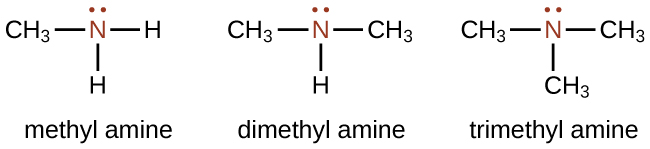
Amines are molecules that contain carbon-nitrogen bonds. The nitrogen atom in an amine has a lone pair of electrons and three bonds to other atoms, either carbon or hydrogen. Various nomenclatures are used to derive names for amines, but all involve the class-identifying suffix –ine as illustrated here for a few simple examples:
英語のヒント アミンは、炭素–窒素結合を含む分子である。アミンの窒素原子には孤立電子対が1組あり、炭素または水素の原子と3本の結合を作る。命名には複数の方式があるが、どれも、種類を表す接尾辞–ineを含む。簡単な例を示す。
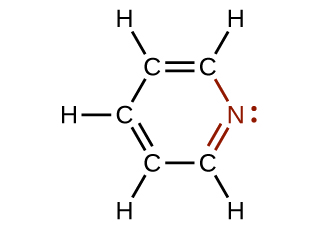
In some amines, the nitrogen atom replaces a carbon atom in an aromatic hydrocarbon. Pyridine (
Figure 20.17 ) is one such heterocyclic amine. A heterocyclic compound contains atoms of two or more different elements in its ring structure.
英語のヒント アミンの中には、芳香族炭化水素の炭素原子を窒素原子で置き換えたものがある。ピリジン(図20.17 )は、そのような複素環式アミンの1つである。複素環式化合物の環には、2種類以上の元素の原子が含まれる。
Figure 20.17 図 20.17
The illustration shows one of the resonance structures of pyridine.
ピリジンの共鳴構造の1つ。
DNA in Forensics and Paternity 法科学と父子鑑定におけるDNA The genetic material for all living things is a polymer of four different molecules, which are themselves a combination of three subunits. The genetic information, the code for developing an organism, is contained in the specific sequence of the four molecules, similar to the way the letters of the alphabet can be sequenced to form words that convey information. The information in a DNA sequence is used to form two other types of polymers, one of which are proteins. The proteins interact to form a specific type of organism with individual characteristics.
英語のヒント すべての生物の遺伝物質は、4種類の異なる分子からなる高分子で、それぞれの分子は3つの小単位の組合せでできている。生物を発生させるためのコードである遺伝情報は、4種類の分子の特定の並び順に含まれる。アルファベットの文字を並べて、情報を伝える単語を作るのと似ている。 DNA配列の情報は、さらに2種類の高分子を作るために使われ、その1つがタンパク質である。タンパク質が相互作用し、個々の特徴をもつ特定の種類の生物を形作る。
A genetic molecule is called DNA, which stands for deoxyribonucleic acid. The four molecules that make up DNA are called nucleotides. Each nucleotide consists of a single- or double-ringed molecule containing nitrogen, carbon, oxygen, and hydrogen called a nitrogenous base. Each base is bonded to a five-carbon sugar called deoxyribose. The sugar is in turn bonded to a phosphate group
( −PO 4 3− ) When new DNA is made, a polymerization reaction occurs that binds the phosphate group of one nucleotide to the sugar group of a second nucleotide. The nitrogenous bases of each nucleotide stick out from this sugar-phosphate backbone. DNA is actually formed from two such polymers coiled around each other and held together by hydrogen bonds between the nitrogenous bases. Thus, the two backbones are on the outside of the coiled pair of strands, and the bases are on the inside. The shape of the two strands wound around each other is called a double helix (see
Figure 20.18 ).
英語のヒント 遺伝を担う分子はDNAと呼ばれる。DNAはデオキシリボ核酸の略である。DNAを構成する4種類の分子は、ヌクレオチドという。各ヌクレオチドには、窒素、炭素、酸素、水素を含む、1つまたは2つの環からなる「窒素塩基」がある。各塩基は、炭素5個の糖デオキシリボースと結合し、その糖はリン酸基( −PO 4 3− ) 新しいDNAを作る際には、1つのヌクレオチドのリン酸基と、別のヌクレオチドの糖をつなぐ重合反応が起こる。各ヌクレオチドの窒素塩基は、この糖–リン酸骨格から突き出す。 実際のDNAは、そのような高分子2本が互いに巻き付き、窒素塩基間の水素結合で結び付いたものである。そのため、2本の骨格が巻き合った鎖の外側に、塩基が内側に位置する。2本の鎖が巻き付いた形を二重らせんという(図20.18 )。 It probably makes sense that the sequence of nucleotides in the DNA of a cat differs from those of a dog. But it is also true that the sequences of the DNA in the cells of two individual pugs differ. Likewise, the sequences of DNA in you and a sibling differ (unless your sibling is an identical twin), as do those between you and an unrelated individual. However, the DNA sequences of two related individuals are more similar than the sequences of two unrelated individuals, and these similarities in sequence can be observed in various ways. This is the principle behind DNA fingerprinting, which is a method used to determine whether two DNA samples came from related (or the same) individuals or unrelated individuals.
英語のヒント ネコのDNAのヌクレオチド配列がイヌのものと異なるのは、おそらく納得できるだろう。しかし、2匹のパグの細胞のDNA配列も異なる。同じように、あなたときょうだいのDNA配列も、きょうだいが一卵性双生児でなければ異なり、血縁のない人との間でも異なる。 ただし、血縁のある2人のDNA配列は、血縁のない2人のものより似ている。この配列の類似性は、さまざまな方法で観察できる。これがDNAフィンガープリント法の原理である。この方法では、2つのDNA試料が、血縁者(または同一人物)から来たのか、血縁のない人から来たのかを判定する。
Figure 20.18 図 20.18
DNA is an organic molecule and the genetic material for all living organisms. (a) DNA is a double helix consisting of two single DNA strands hydrogen bonded together at each nitrogenous base. (b) This detail shows the hydrogen bonding (dotted lines) between nitrogenous bases on each DNA strand and the way in which each nucleotide is joined to the next, forming a backbone of sugars and phosphate groups along each strand. (c) This detail shows the structure of one of the four nucleotides that makes up the DNA polymer. Each nucleotide consists of a nitrogenous base (a double-ring molecule, in this case), a five-carbon sugar (deoxyribose), and a phosphate group.
DNAは有機分子で、すべての生物の遺伝物質である。(a) DNAは、各窒素塩基で水素結合する2本のDNA鎖からなる二重らせんである。 (b) 拡大図は、各鎖の窒素塩基間の水素結合(点線)と、隣り合うヌクレオチドがつながり、各鎖に沿って糖とリン酸の骨格を作る様子を示す。(c) DNA高分子を構成する4種類のヌクレオチドの1つの構造。各ヌクレオチドは、窒素塩基(この例では2つの環をもつ分子)、炭素5個の糖(デオキシリボース)、リン酸基からなる。
Using similarities in sequences, technicians can determine whether a man is the father of a child (the identity of the mother is rarely in doubt, except in the case of an adopted child and a potential birth mother). Likewise, forensic geneticists can determine whether a crime scene sample of human tissue, such as blood or skin cells, contains DNA that matches exactly the DNA of a suspect.
英語のヒント 配列の類似性を使うと、ある男性が子どもの父親かどうかを判定できる。母親が誰かは、養子と実母の可能性がある女性の場合を除けば、ほとんど疑われない。同じように、法遺伝学者は、犯罪現場の血液や皮膚細胞などの人体組織試料に、容疑者のDNAと完全に一致するDNAが含まれるかを判定できる。
Watch this
video animation of how DNA is packaged for a visual lesson in its structure.
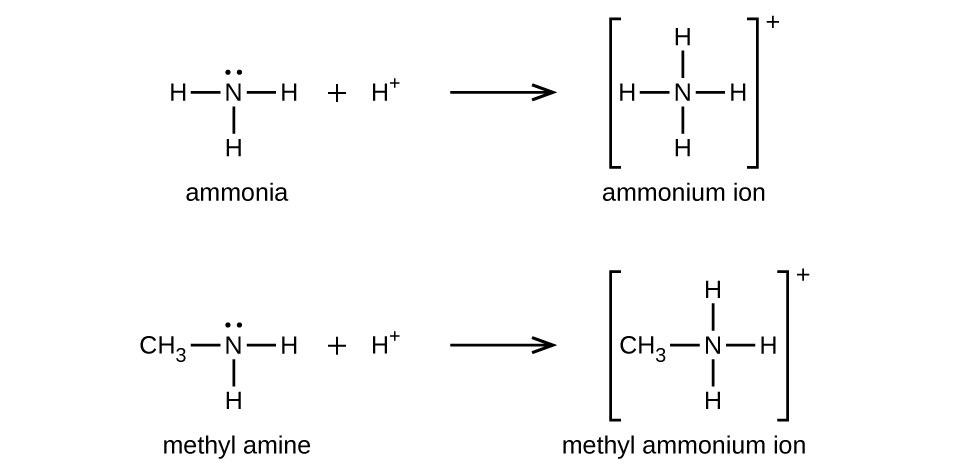
DNAがどのように折りたたまれて収まるかを、このアニメーション動画 で見て、構造を視覚的に学ぼう。 Like ammonia, amines are weak bases due to the lone pair of electrons on their nitrogen atoms:
アンモニアと同様に、アミンは窒素原子の孤立電子対により、弱い塩基となる。
The basicity of an amine’s nitrogen atom plays an important role in much of the compound’s chemistry. Amine functional groups are found in a wide variety of compounds, including natural and synthetic dyes, polymers, vitamins, and medications such as penicillin and codeine. They are also found in many molecules essential to life, such as amino acids, hormones, neurotransmitters, and DNA.
英語のヒント アミンの窒素原子の塩基性は、その化合物の化学的性質の多くで重要な役割を果たす。アミン官能基は、天然・合成染料、高分子、ビタミン、ペニシリンやコデインなどの医薬品を含む、広範な化合物に見られる。アミノ酸、ホルモン、神経伝達物質、DNAなど、生命に必須の多くの分子にも含まれる。
Addictive Alkaloids 依存性のあるアルカロイド Since ancient times, plants have been used for medicinal purposes. One class of substances, called alkaloids , found in many of these plants has been isolated and found to contain cyclic molecules with an amine functional group. These amines are bases. They can react with H3 O+ in a dilute acid to form an ammonium salt, and this property is used to extract them from the plant:
英語のヒント 植物は古代から薬用に使われてきた。その多くから、アルカロイドという種類の物質が単離され、アミン官能基をもつ環状分子を含むことが分かった。 これらのアミンは塩基であり、希酸中のH3 O+ と反応してアンモニウム塩を作る。この性質を、植物からの抽出に利用する。
R 3 N + H 3 O + + Cl − ⟶ [ R 3 NH + ] Cl − + H 2 O
The name alkaloid means “like an alkali.” Thus, an alkaloid reacts with acid. The free compound can be recovered after extraction by reaction with a base:
アルカロイドという名は「アルカリのような」という意味である。したがって、アルカロイドは酸と反応する。抽出後に塩基と反応させると、遊離の化合物を回収できる。
[ R 3 NH + ] Cl − + OH − ⟶ R 3 N + H 2 O + Cl −
The structures of many naturally occurring alkaloids have profound physiological and psychotropic effects in humans. Examples of these drugs include nicotine, morphine, codeine, and heroin. The plant produces these substances, collectively called secondary plant compounds, as chemical defenses against the numerous pests that attempt to feed on the plant:
英語のヒント 多くの天然アルカロイドの構造は、人体に強い生理作用と向精神作用をもたらす。その例に、ニコチン、モルヒネ、コデイン、ヘロインがある。 植物は、これら「植物二次化合物」と総称される物質を、植物を食べようとする多くの害虫などに対する化学的な防御として作る。
In these diagrams, as is common in representing structures of large organic compounds, carbon atoms in the rings and the hydrogen atoms bonded to them have been omitted for clarity. The solid wedges indicate bonds that extend out of the page. The dashed wedges indicate bonds that extend into the page. Notice that small changes to a part of the molecule change the properties of morphine, codeine, and heroin. Morphine, a strong narcotic used to relieve pain, contains two hydroxyl functional groups, located at the bottom of the molecule in this structural formula. Changing one of these hydroxyl groups to a methyl ether group forms codeine, a less potent drug used as a local anesthetic. If both hydroxyl groups are converted to esters of acetic acid, the powerfully addictive drug heroin results (
Figure 20.19 ).
英語のヒント これらの図では、大きな有機化合物の構造表示によくあるように、見やすくするため、環の炭素原子と、それに結合する水素原子を省略している。塗りつぶしたくさびは紙面の手前へ伸びる結合、破線のくさびは奥へ伸びる結合を表す。 分子の一部の小さな変化が、モルヒネ、コデイン、ヘロインの性質を変える点に注目しよう。鎮痛に使う強い麻薬であるモルヒネには、この構造式の下部に2つのヒドロキシ基がある。一方をメチルエーテル基に変えると、局所麻酔薬に使う、作用の弱いコデインになる。両方を酢酸のエステルに変えると、強い依存性をもつヘロインとなる(図20.19 )。
Figure 20.19 図 20.19
Poppies can be used in the production of opium, a plant latex that contains morphine from which other opiates, such as heroin, can be synthesized. (credit: Karen Roe)
ケシはアヘンの生産に使える。アヘンはモルヒネを含む植物の乳液で、そのモルヒネからヘロインなどのオピエートを合成できる。(出典:Karen Roe)
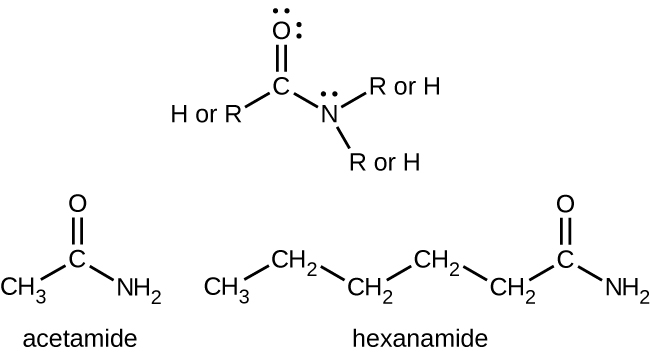
Amides are molecules that contain nitrogen atoms connected to the carbon atom of a carbonyl group. Like amines, various nomenclature rules may be used to name amides, but all include use of the class-specific suffix -amide :
英語のヒント アミドは、カルボニル基の炭素原子に窒素原子が結合した分子である。アミンと同様に、命名には複数の規則があるが、どれも種類を示す接尾辞–amideを含む。
Amides can be produced when carboxylic acids react with amines or ammonia in a process called amidation. A water molecule is eliminated from the reaction, and the amide is formed from the remaining pieces of the carboxylic acid and the amine (note the similarity to formation of an ester from a carboxylic acid and an alcohol discussed in the previous section):
英語のヒント カルボン酸がアミンやアンモニアと反応すると、アミド化と呼ばれる過程でアミドを作れる。反応で水分子が取り除かれ、カルボン酸とアミンの残った部分からアミドができる。前節で扱った、カルボン酸とアルコールからエステルを作る反応との類似性に注目しよう。
The reaction between amines and carboxylic acids to form amides is biologically important. It is through this reaction that amino acids (molecules containing both amine and carboxylic acid substituents) link together in a polymer to form proteins.
英語のヒント アミンとカルボン酸からアミドを作る反応は、生物学的に重要である。この反応によって、アミンとカルボン酸の両方の置換基をもつ分子であるアミノ酸がつながり、高分子のタンパク質を作る。
Proteins and Enzymes タンパク質と酵素 Proteins are large biological molecules made up of long chains of smaller molecules called amino acids. Organisms rely on proteins for a variety of functions—proteins transport molecules across cell membranes, replicate DNA, and catalyze metabolic reactions, to name only a few of their functions. The properties of proteins are functions of the combination of amino acids that compose them and can vary greatly. Interactions between amino acid sequences in the chains of proteins result in the folding of the chain into specific, three-dimensional structures that determine the protein’s activity.
英語のヒント タンパク質は、アミノ酸という小さい分子が長く鎖状につながった、大きな生体分子である。生物は、さまざまな機能をタンパク質に依存する。細胞膜を越えて分子を運ぶ、DNAを複製する、代謝反応を触媒するなどは、その一部である。 タンパク質の性質は、構成するアミノ酸の組合せによって決まり、大きく異なりうる。タンパク質鎖内のアミノ酸配列どうしが相互作用すると、鎖は特定の立体構造に折りたたまれる。この構造が、タンパク質の活性を決める。
Amino acids are organic molecules that contain an amine functional group (–NH
2 ), a carboxylic acid functional group (–COOH), and a side chain (that is specific to each individual amino acid). Most living things build proteins from the same 20 different amino acids. Amino acids connect by the formation of a peptide bond, which is a covalent bond formed between two amino acids when the carboxylic acid group of one amino acid reacts with the amine group of the other amino acid. The formation of the bond results in the production of a molecule of water (in general, reactions that result in the production of water when two other molecules combine are referred to as condensation reactions). The resulting bond—between the carbonyl group carbon atom and the amine nitrogen atom is called a peptide link or peptide bond. Since each of the original amino acids has an unreacted group (one has an unreacted amine and the other an unreacted carboxylic acid), more peptide bonds can form to other amino acids, extending the structure. (
Figure 20.20 ) A chain of connected amino acids is called a polypeptide. Proteins contain at least one long polypeptide chain.
英語のヒント アミノ酸は、アミン官能基(–NH2 )、カルボン酸官能基(–COOH)、各アミノ酸に固有の側鎖をもつ有機分子である。ほとんどの生物は、共通の20種類のアミノ酸からタンパク質を作る。 アミノ酸は、ペプチド結合を作ってつながる。これは、一方のアミノ酸のカルボン酸基と、もう一方のアミン基が反応して、2つのアミノ酸の間にできる共有結合である。結合の形成により水分子が1個生じる。一般に、2つの分子が結合して水を生じる反応を縮合反応と呼ぶ。カルボニル基の炭素とアミンの窒素の間に生じる結合を、ペプチド結合という。 元のアミノ酸には、それぞれ未反応の基が残る。一方にはアミン基、もう一方にはカルボン酸基が残るので、さらに別のアミノ酸とペプチド結合を作り、構造を延ばせる(図20.20 )。アミノ酸がつながった鎖をポリペプチドと呼ぶ。タンパク質は、少なくとも1本の長いポリペプチド鎖を含む。
Figure 20.20 図 20.20
This condensation reaction forms a dipeptide from two amino acids and leads to the formation of water.
この縮合反応では、2つのアミノ酸からジペプチドができ、水も生じる。
Enzymes are large biological molecules, mostly composed of proteins, which are responsible for the thousands of metabolic processes that occur in living organisms. Enzymes are highly specific catalysts; they speed up the rates of certain reactions. Enzymes function by lowering the activation energy of the reaction they are catalyzing, which can dramatically increase the rate of the reaction. Most reactions catalyzed by enzymes have rates that are millions of times faster than the noncatalyzed version. Like all catalysts, enzymes are not consumed during the reactions that they catalyze. Enzymes do differ from other catalysts in how specific they are for their substrates (the molecules that an enzyme will convert into a different product). Each enzyme is only capable of speeding up one or a few very specific reactions or types of reactions. Since the function of enzymes is so specific, the lack or malfunctioning of an enzyme can lead to serious health consequences. One disease that is the result of an enzyme malfunction is phenylketonuria. In this disease, the enzyme that catalyzes the first step in the degradation of the amino acid phenylalanine is not functional (
Figure 20.21 ). Untreated, this can lead to an accumulation of phenylalanine, which can lead to intellectual disabilities.
英語のヒント 酵素は、主にタンパク質からなる大きな生体分子で、生体内の何千もの代謝過程を担う。酵素は特異性の高い触媒で、特定の反応を速める。触媒する反応の活性化エネルギーを下げることで働き、反応速度を劇的に高めることがある。酵素が触媒する反応の多くは、触媒がない場合の数百万倍も速い。 ほかの触媒と同じく、酵素は触媒する反応で消費されない。ほかの触媒との違いは、基質、すなわち酵素が別の生成物へ変える分子に対する高い特異性にある。各酵素は、ごく特定の1つか数個の反応、または反応の種類しか速められない。 機能が非常に特異的なため、酵素の欠如や機能不全は、健康に深刻な影響を及ぼしうる。その1例がフェニルケトン尿症である。この病気では、アミノ酸フェニルアラニンの分解の最初の段階を触媒する酵素が働かない(図20.21 )。治療しないとフェニルアラニンが蓄積し、知的障害を引き起こすことがある。
Figure 20.21 図 20.21
A computer rendering shows the three-dimensional structure of the enzyme phenylalanine hydroxylase. In the disease phenylketonuria, a defect in the shape of phenylalanine hydroxylase causes it to lose its function in breaking down phenylalanine.
酵素フェニルアラニンヒドロキシラーゼの三次元構造を示すコンピューター画像。フェニルケトン尿症では、この酵素の形の異常によって、フェニルアラニンを分解する機能が失われる。
Kevlar ケブラー Kevlar (
Figure 20.22 ) is a synthetic polymer made from two monomers 1,4-phenylene-diamine and terephthaloyl chloride (Kevlar is a registered trademark of DuPont). The material was developed by Stephanie Kwolek while she worked to find a replacement for steel in tires. Kwolek's work involved synthesizing polyamides and dissolving them in solvents, then spinning the resulting solution into fibers. One of her solutions proved to be quite different in initial appearance and structure. And once spun, the resulting fibers were particularly strong. From this initial discovery, Kevlar was created. The material has a high tensile strength-to-weight ratio (it is about 5 times stronger than an equal weight of steel), making it useful for many applications from bicycle tires to sails to body armor.
英語のヒント ケブラー(図20.22 )は、1,4-フェニレンジアミンとテレフタロイルクロリドという2種類の単量体から作る合成高分子である。Kevlarはデュポンの登録商標である。 この材料は、タイヤ内の鋼の代替材料を探していたステファニー・クウォレクが開発した。研究では、ポリアミドを合成して溶媒に溶かし、その溶液を紡いで繊維にした。ある溶液は、最初の見た目や構造がほかと大きく異なっていた。そして、紡いだ繊維は特に強かった。この発見からケブラーが生まれた。 ケブラーは、重量に対する引張強度の比が大きく、同じ重量の鋼の約5倍の強度がある。そのため、自転車のタイヤ、帆、防弾装備など、多くの用途に役立つ。
Figure 20.22 図 20.22
This illustration shows the formula for polymeric Kevlar.
高分子ケブラーの構造式。
The material owes much of its strength to hydrogen bonds between polymer chains (refer back to the chapter on intermolecular interactions). These bonds form between the carbonyl group oxygen atom (which has a partial negative charge due to oxygen’s electronegativity) on one monomer and the partially positively charged hydrogen atom in the N–H bond of an adjacent monomer in the polymer structure (see dashed line in
Figure 20.23 ). There is additional strength derived from the interaction between the unhybridized
p orbitals in the six-membered rings, called aromatic stacking.
英語のヒント ケブラーの強さの大部分は、高分子鎖どうしの水素結合による(分子間相互作用の章参照)。この結合は、一方の単量体のカルボニル基のOと、隣接する単量体のN–H結合のHの間にできる。Oは電気陰性度のため部分的に負、Hは部分的に正に帯電している(図20.23 の破線)。 さらに、六員環内の混成していないp軌道どうしの相互作用も強度を高める。この相互作用を芳香族スタッキングという。
Figure 20.23 図 20.23
The diagram shows the polymer structure of Kevlar, with hydrogen bonds between polymer chains represented by dotted lines.
ケブラーの高分子構造。高分子鎖どうしの水素結合を点線で示す。
Kevlar may be best known as a component of body armor, combat helmets, and face masks. Since the 1980s, the US military has used Kevlar as a component of the PASGT (personal armor system for ground troops) helmet and vest. Kevlar is also used to protect armored fighting vehicles and aircraft carriers. Civilian applications include protective gear for emergency service personnel such as body armor for police officers and heat-resistant clothing for fire fighters. Kevlar based clothing is considerably lighter and thinner than equivalent gear made from other materials (
Figure 20.24 ). Beyond Kevlar, Stephanie Kwolek was instrumental in the development of Nomex, a fireproof material, and was also involved in the creation of Lycra. She became just the fourth woman inducted into the National Inventors Hall of Fame, and received a number of other awards for her significant contributions to science and society.
英語のヒント ケブラーは、防弾装備、戦闘用ヘルメット、フェイスマスクの材料として最もよく知られているかもしれない。米軍は1980年代から、PASGT(地上部隊用個人装甲システム)のヘルメットとベストにケブラーを使ってきた。装甲戦闘車両や空母の防護にも使う。 民間では、警察官の防弾装備や消防士の耐熱服など、緊急対応要員の保護装備に使われる。ケブラー製の衣類は、同じ性能をもつ他の材料の装備より、かなり軽く薄い(図20.24 )。 クウォレクはケブラー以外にも、耐火材料ノーメックスの開発で重要な役割を果たし、ライクラの開発にも関わった。全米発明家殿堂入りした4人目の女性となり、科学と社会への大きな貢献に対して、ほかにも多くの賞を受けた。
Figure 20.24 図 20.24
(a) These soldiers are sorting through pieces of a Kevlar helmet that helped absorb a grenade blast. Kevlar is also used to make (b) canoes and (c) marine mooring lines. (credit a: modification of work by “Cla68”/Wikimedia Commons; credit b: modification of work by “OakleyOriginals”/Flickr; credit c: modification of work by Casey H. Kyhl)
(a) 手榴弾の爆発を吸収するのに役立ったケブラー製ヘルメットの破片を、兵士が選り分けている。ケブラーは、(b)カヌー、(c)船舶用係留索にも使われる。(出典:aは「Cla68」/Wikimedia Commons、bは「OakleyOriginals」/Flickr、cはCasey H. Kyhlの作品を改変)
In addition to its better-known uses, Kevlar is also often used in cryogenics for its very low thermal conductivity (along with its high strength). Kevlar maintains its high strength when cooled to the temperature of liquid nitrogen (–196 °C).
英語のヒント よく知られる用途に加え、ケブラーは、高強度と非常に低い熱伝導率のため、低温技術にもよく使われる。液体窒素の温度(−196 °C)まで冷却しても、高い強度を保つ。
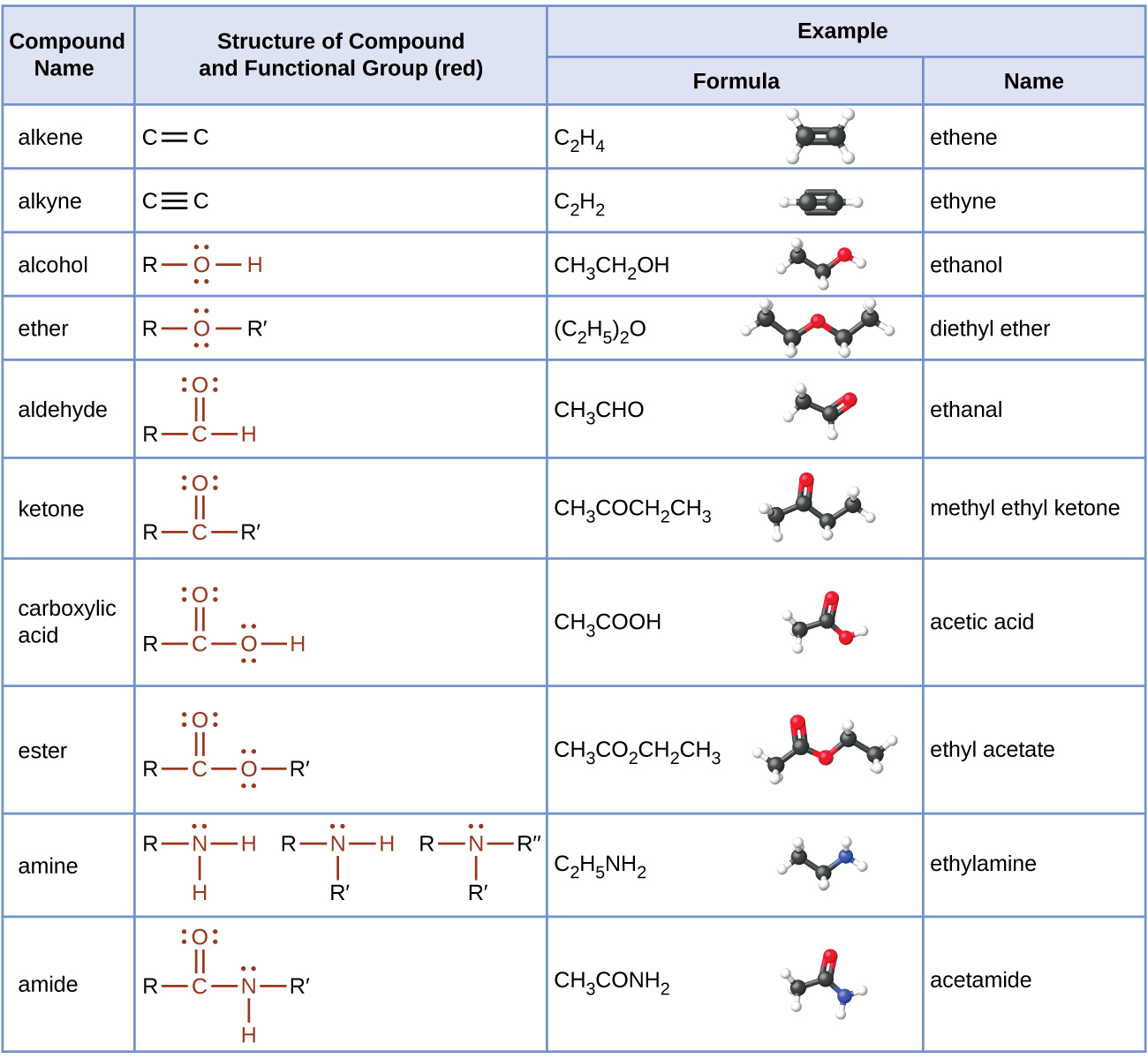
The table here summarizes the structures discussed in this chapter:
この章で扱った構造を、次の表にまとめる。