第20章有機化学
20.2 Alcohols and Ethers20.2 アルコールとエーテル
Learning Objectives学習目標
By the end of this section, you will be able to:
この節を終えると、次のことができるようになる。
- Describe the structure and properties of alcoholsアルコールの構造と性質を説明する。
- Describe the structure and properties of ethersエーテルの構造と性質を説明する。
- Name and draw structures for alcohols and ethersアルコールとエーテルを命名し、構造を描く。
In this section, we will learn about alcohols and ethers.
この節では、アルコールとエーテルを学ぶ。
Alcoholsアルコール
Incorporation of an oxygen atom into carbon- and hydrogen-containing molecules leads to new functional groups and new families of compounds. When the oxygen atom is attached by single bonds, the molecule is either an alcohol or ether.
炭素と水素を含む分子に酸素原子を組み込むと、新しい官能基と新しい種類の化合物が生まれる。酸素原子が単結合で結合している場合、その分子はアルコールまたはエーテルである。
Alcohols are derivatives of hydrocarbons in which an –OH group has replaced a hydrogen atom. Although all alcohols have one or more hydroxyl (–OH) functional groups, they do not behave like bases such as NaOH and KOH. NaOH and KOH are ionic compounds that contain OH– ions. Alcohols are covalent molecules; the –OH group in an alcohol molecule is attached to a carbon atom by a covalent bond.
英語のヒント
アルコールは、水素原子を–OH基で置き換えた炭化水素の誘導体である。すべてのアルコールは一つ以上のヒドロキシ基(–OH)という官能基を持つが、NaOHやKOHのような塩基と同じようには振る舞わない。NaOHとKOHは、OH–イオンを含むイオン性化合物である。アルコールは共有結合性の分子であり、アルコール分子の–OH基は、共有結合によって炭素原子に結合している。
Ethanol, CH3CH2OH, also called ethyl alcohol, is a particularly important alcohol for human use. Ethanol is the alcohol produced by some species of yeast that is found in wine, beer, and distilled drinks. It has long been prepared by humans harnessing the metabolic efforts of yeasts in fermenting various sugars:
英語のヒント
エチルアルコールとも呼ばれるエタノールCH3CH2OHは、人間が使うアルコールとして特に重要である。エタノールは、一部の種類の酵母が作るアルコールで、ワイン、ビール、蒸留酒に含まれる。人間は昔から、酵母が各種の糖を発酵させる代謝活動を利用して、エタノールを作ってきた。

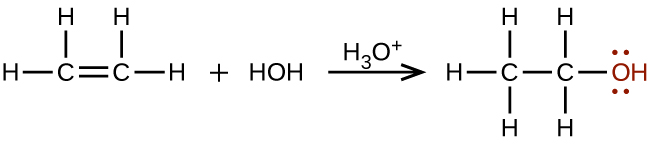
Large quantities of ethanol are synthesized from the addition reaction of water with ethylene using an acid as a catalyst:
酸を触媒として用いる、水とエチレンの付加反応によって、大量のエタノールが合成される。
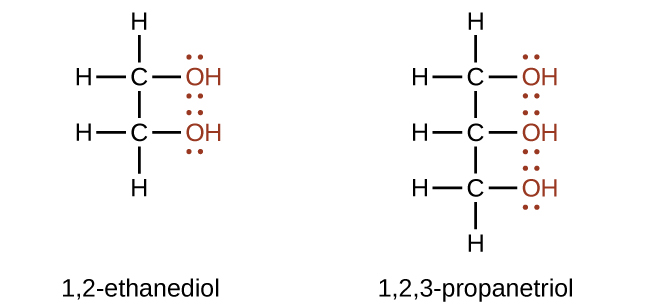
Alcohols containing two or more hydroxyl groups can be made. Examples include 1,2-ethanediol (ethylene glycol, used in antifreeze) and 1,2,3-propanetriol (glycerine, used as a solvent for cosmetics and medicines):
英語のヒント
ヒドロキシ基を二つ以上含むアルコールも作ることができる。例として、1,2-エタンジオール(不凍液に使うエチレングリコール)、1,2,3-プロパントリオール(化粧品や医薬品の溶媒に使うグリセリン)がある。
Naming Alcoholsアルコールの命名
The name of an alcohol comes from the hydrocarbon from which it was derived. The final -e in the name of the hydrocarbon is replaced by -ol, and the carbon atom to which the –OH group is bonded is indicated by a number placed before the name. The IUPAC adopted new nomenclature guidelines in 2013 that require this number to be placed as an “infix” rather than a prefix. For example, the new name for 2-propanol would be propan-2-ol. Widespread adoption of this new nomenclature will take some time, and students are encouraged to be familiar with both the old and new naming protocols.
英語のヒント
アルコールの名称は、その誘導元の炭化水素に由来する。炭化水素の英語名の最後の-eを-olに置き換え、–OH基が結合する炭素原子を、名称の前に置く番号で示す。IUPACは2013年に新たな命名指針を採用し、この番号を接頭辞ではなく「接中辞」として置くことを求めた。たとえば、2-プロパノールの新しい名称はプロパン-2-オールとなる。この新しい命名法が広く採用されるまでには時間がかかるため、学生は新旧両方の命名手順に慣れておくことが勧められる。
Example 20.8例題 20.8
Naming Alcoholsアルコールの命名
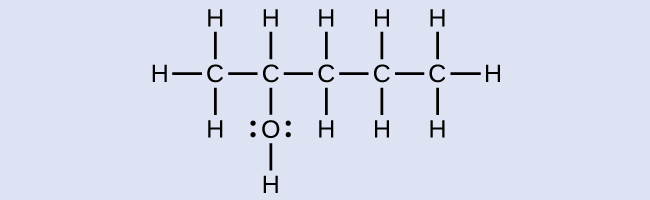
Consider the following example. How should it be named?
次の例を考えよう。どのように命名すべきか。
Solution解答
The carbon chain contains five carbon atoms. If the hydroxyl group was not present, we would have named this molecule pentane. To address the fact that the hydroxyl group is present, we change the ending of the name to -ol. In this case, since the –OH is attached to carbon 2 in the chain, we would name this molecule 2-pentanol.
英語のヒント
炭素鎖は五個の炭素原子を含む。ヒドロキシ基がなければ、この分子はペンタンと命名していただろう。ヒドロキシ基が存在することを反映するために、英語名の語尾を-olに変える。この場合、–OHは鎖内の炭素2に結合しているので、この分子を2-ペンタノールと命名する。
Check Your Learning理解を確認しよう
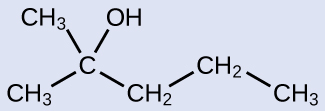
Name the following molecule:
次の分子を命名しなさい。
Ethersエーテル
Ethers are compounds that contain the functional group –O–. Ethers do not have a designated suffix like the other types of molecules we have named so far. In the IUPAC system, the oxygen atom and the smaller carbon branch are named as an alkoxy substituent and the remainder of the molecule as the base chain, as in alkanes. As shown in the following compound, the red symbols represent the smaller alkyl group and the oxygen atom, which would be named “methoxy.” The larger carbon branch would be ethane, making the molecule methoxyethane. Many ethers are referred to with common names instead of the IUPAC system names. For common names, the two branches connected to the oxygen atom are named separately and followed by “ether.” The common name for the compound shown in Example 20.9 is ethylmethyl ether:
英語のヒント
エーテルは、官能基–O–を含む化合物である。これまで命名した他の種類の分子とは異なり、エーテルには決まった接尾辞がない。IUPAC体系では、酸素原子と小さい方の炭素の枝をアルコキシ置換基として命名し、分子の残りを、アルカンの場合と同様に主鎖として命名する。次の化合物で示すように、赤い記号は小さい方のアルキル基と酸素原子を表し、「メトキシ」と命名する。大きい方の炭素の枝はエタンなので、分子はメトキシエタンとなる。多くのエーテルは、IUPAC体系の名称の代わりに慣用名で呼ばれる。慣用名では、酸素原子につながる二つの枝を別々に命名し、その後に「エーテル」を付ける。例題20.9に示す化合物の慣用名は、エチルメチルエーテルである。

Example 20.9例題 20.9
Naming Ethersエーテルの命名
Provide the IUPAC and common name for the ether shown here:
ここに示すエーテルのIUPAC名と慣用名を示しなさい。

Solution解答
IUPAC: The molecule is made up of an ethoxy group attached to an ethane chain, so the IUPAC name would be ethoxyethane.
IUPAC名:この分子は、エタン鎖にエトキシ基が結合したものなので、IUPAC名はエトキシエタンとなる。
Common: The groups attached to the oxygen atom are both ethyl groups, so the common name would be diethyl ether.
慣用名:酸素原子に結合した基は、どちらもエチル基なので、慣用名はジエチルエーテルとなる。
Check Your Learning理解を確認しよう
Provide the IUPAC and common name for the ether shown:
示したエーテルのIUPAC名と慣用名を示しなさい。
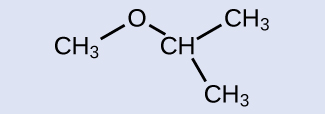
Ethers can be obtained from alcohols by the elimination of a molecule of water from two molecules of the alcohol. For example, when ethanol is treated with a limited amount of sulfuric acid and heated to 140 °C, diethyl ether and water are formed:
英語のヒント
エーテルは、二分子のアルコールから水一分子を脱離させることによって得られる。たとえば、エタノールを少量の硫酸で処理し、140 °Cに加熱すると、ジエチルエーテルと水が生じる。



In the general formula for ethers, R—O—R, the hydrocarbon groups (R) may be the same or different. Diethyl ether, the most widely used compound of this class, is a colorless, volatile liquid that is highly flammable. It was first used in 1846 as an anesthetic, but better anesthetics have now largely taken its place. Diethyl ether and other ethers are presently used primarily as solvents for gums, fats, waxes, and resins. Tertiary-butyl methyl ether, C4H9OCH3 (abbreviated MTBE—italicized portions of names are not counted when ranking the groups alphabetically—so butyl comes before methyl in the common name), is used as an additive for gasoline. MTBE belongs to a group of chemicals known as oxygenates due to their capacity to increase the oxygen content of gasoline.
英語のヒント
エーテルの一般式R—O—Rにおいて、炭化水素基(R)は同じでも異なっていてもよい。この種類の化合物で最も広く使われるジエチルエーテルは、無色で揮発性があり、非常に燃えやすい液体である。1846年に初めて麻酔薬として使われたが、現在では、より優れた麻酔薬がほぼ取って代わっている。ジエチルエーテルなどのエーテルは現在、主にガム質、脂肪、ろう、樹脂の溶媒として使われる。第三級ブチルメチルエーテルC4H9OCH3(略称MTBE。名称の斜体部分は、基をアルファベット順に並べる際には数えないので、慣用名ではbutylがmethylより前になる)は、ガソリン添加剤として使われる。MTBEは、ガソリンの酸素含有量を増す能力によって、含酸素添加剤と呼ばれる化学物質群に属する。