第20章有機化学
Aromatic Hydrocarbons芳香族炭化水素
Benzene, C6H6, is the simplest member of a large family of hydrocarbons, called aromatic hydrocarbons. These compounds contain ring structures and exhibit bonding that must be described using the resonance hybrid concept of valence bond theory or the delocalization concept of molecular orbital theory. (To review these concepts, refer to the earlier chapters on chemical bonding). The resonance structures for benzene, C6H6, are:
英語のヒント
ベンゼンC6H6は、芳香族炭化水素と呼ばれる大きな炭化水素群の、最も単純な一員である。これらの化合物は環構造を含み、その結合は、原子価結合理論の共鳴混成体の概念、または分子軌道理論の非局在化の概念を用いて記述する必要がある。(これらの概念を復習するには、前の化学結合の章を参照しよう。)ベンゼンC6H6の共鳴構造は、次のとおりである。
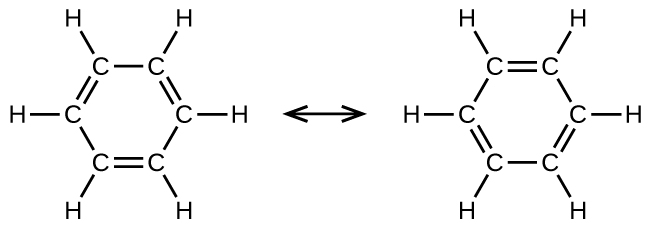
Valence bond theory describes the benzene molecule and other planar aromatic hydrocarbon molecules as hexagonal rings of sp2-hybridized carbon atoms with the unhybridized p orbital of each carbon atom perpendicular to the plane of the ring. Three valence electrons in the sp2 hybrid orbitals of each carbon atom and the valence electron of each hydrogen atom form the framework of σ bonds in the benzene molecule. The fourth valence electron of each carbon atom is shared with an adjacent carbon atom in their unhybridized p orbitals to yield the π bonds. Benzene does not, however, exhibit the characteristics typical of an alkene. Each of the six bonds between its carbon atoms is equivalent and exhibits properties that are intermediate between those of a C–C single bond and a double bond. To represent this unique bonding, structural formulas for benzene and its derivatives are typically drawn with single bonds between the carbon atoms and a circle within the ring as shown in Figure 20.11.
英語のヒント
原子価結合理論は、ベンゼン分子や他の平面状の芳香族炭化水素分子を、sp2混成炭素原子による六角形の環として記述する。各炭素原子の混成していないp軌道は、環の平面に垂直である。各炭素原子のsp2混成軌道内の三個の価電子と、各水素原子の価電子が、ベンゼン分子のσ結合の骨組みを作る。各炭素原子の第四の価電子は、混成していないp軌道内で隣接する炭素原子と共有され、π結合を作る。しかし、ベンゼンはアルケンに典型的な特徴を示さない。炭素原子間の六本の結合はすべて等価であり、C–C単結合と二重結合の中間の性質を示す。この特有の結合を表すため、ベンゼンとその誘導体の構造式は通常、図20.11のように、炭素原子間を単結合でつなぎ、環内に円を描いて示す。
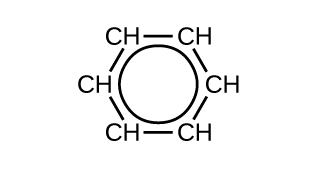
Figure 20.11図 20.11
This condensed formula shows the unique bonding structure of benzene.
この縮合式は、ベンゼンの特有の結合構造を示す。
There are many derivatives of benzene. The hydrogen atoms can be replaced by many different substituents. Aromatic compounds more readily undergo substitution reactions than addition reactions; replacement of one of the hydrogen atoms with another substituent will leave the delocalized double bonds intact. The following are typical examples of substituted benzene derivatives:
英語のヒント
ベンゼンには多くの誘導体がある。水素原子は、多くの異なる置換基で置き換えることができる。芳香族化合物は、付加反応より置換反応を起こしやすい。水素原子の一つを別の置換基で置き換えても、非局在化した二重結合はそのまま保たれる。以下は、置換ベンゼン誘導体の代表例である。
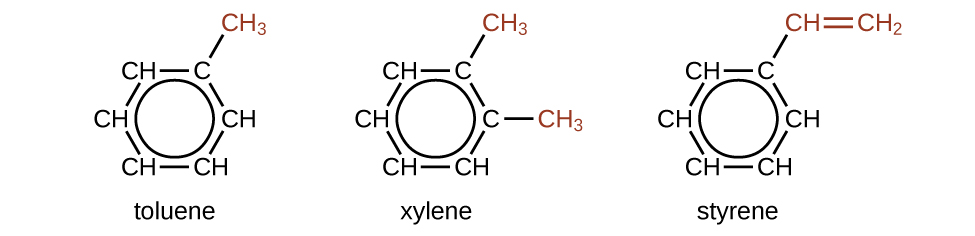
Toluene and xylene are important solvents and raw materials in the chemical industry. Styrene is used to produce the polymer polystyrene.
トルエンとキシレンは、化学工業で重要な溶媒および原料である。スチレンは、ポリマーであるポリスチレンの製造に使われる。
Example 20.7例題 20.7
Structure of Aromatic Hydrocarbons芳香族炭化水素の構造
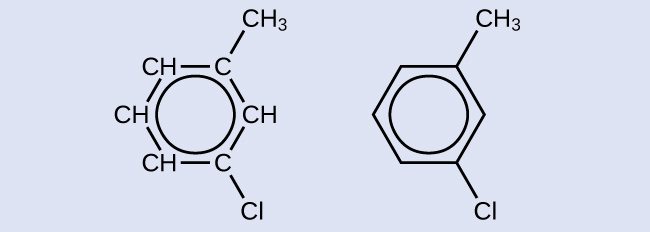
One possible isomer created by a substitution reaction that replaces a hydrogen atom attached to the aromatic ring of toluene with a chlorine atom is shown here. Draw two other possible isomers in which the chlorine atom replaces a different hydrogen atom attached to the aromatic ring:
トルエンの芳香環に結合する水素原子を塩素原子で置き換える置換反応で生じうる異性体の一つを、ここに示す。芳香環に結合する別の水素原子を塩素原子で置き換えた、他の二つの異性体を描きなさい。
Solution解答
Since the six-carbon ring with alternating double bonds is necessary for the molecule to be classified as aromatic, appropriate isomers can be produced only by changing the positions of the chloro-substituent relative to the methyl-substituent:
分子が芳香族に分類されるには、二重結合が交互にある六炭素環が必要なので、条件を満たす異性体は、メチル置換基に対するクロロ置換基の位置を変えることによってのみ作れる。

Check Your Learning理解を確認しよう
Draw three isomers of a six-membered aromatic ring compound substituted with two bromines.
臭素二個で置換された六員芳香環化合物の、三つの異性体を描きなさい。
Key Concepts and Summary主要概念とまとめ
Strong, stable bonds between carbon atoms produce complex molecules containing chains, branches, and rings. The chemistry of these compounds is called organic chemistry. Hydrocarbons are organic compounds composed of only carbon and hydrogen. The alkanes are saturated hydrocarbons—that is, hydrocarbons that contain only single bonds. Alkenes contain one or more carbon-carbon double bonds. Alkynes contain one or more carbon-carbon triple bonds. Aromatic hydrocarbons contain ring structures with delocalized π electron systems.
炭素原子間の強く安定な結合は、鎖、枝、環を含む複雑な分子を生み出す。これらの化合物を扱う化学を有機化学という。炭化水素は、炭素と水素だけからなる有機化合物である。アルカンは飽和炭化水素、すなわち単結合だけを含む炭化水素である。アルケンは一つ以上の炭素間二重結合を含む。アルキンは一つ以上の炭素間三重結合を含む。芳香族炭化水素は、非局在化したπ電子系を持つ環構造を含む。
Chemistry End of Chapter Exercises化学の章末演習
Exercises 1–29練習問題 1–29
Exercise 1問題 1
Write the chemical formula and Lewis structure of the following, each of which contains five carbon atoms:
それぞれ炭素原子を五個含む、次の化合物の化学式とルイス構造を書きなさい。
(a) an alkane
(a) アルカン
(b) an alkene
(b) アルケン
(c) an alkyne
(c) アルキン
Solution解き方
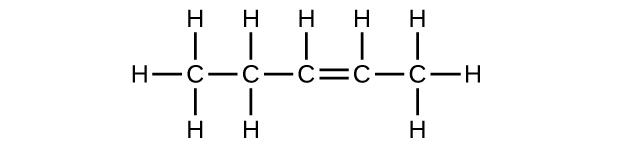
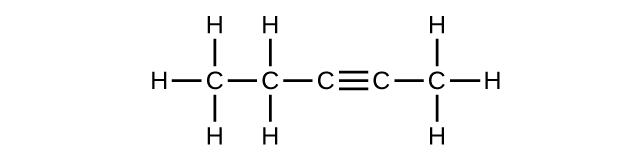
There are several sets of answers; one is:
(a) C5H12
(a) C5H12
答えの組合せはいくつかある。その一つは、(a) C5H12。

(b) C5H10
(b) C5H10
(c) C5H8
(c) C5H8
Exercise 2問題 2
What is the difference between the hybridization of carbon atoms’ valence orbitals in saturated and unsaturated hydrocarbons?
飽和炭化水素と不飽和炭化水素では、炭素原子の価電子軌道の混成がどのように異なるか。
Exercise 3問題 3
On a microscopic level, how does the reaction of bromine with a saturated hydrocarbon differ from its reaction with an unsaturated hydrocarbon? How are they similar?
微視的なレベルで、臭素と飽和炭化水素の反応は、臭素と不飽和炭化水素の反応とどのように異なるか。どの点が似ているか。
Solution解き方
Both reactions result in bromine being incorporated into the structure of the product. The difference is the way in which that incorporation takes place. In the saturated hydrocarbon, an existing C–H bond is broken, and a bond between the C and the Br can then be formed. In the unsaturated hydrocarbon, the only bond broken in the hydrocarbon is the π bond whose electrons can be used to form a bond to one of the bromine atoms in Br2 (the electrons from the Br–Br bond form the other C–Br bond on the other carbon that was part of the π bond in the starting unsaturated hydrocarbon).
どちらの反応でも、臭素が生成物の構造に組み込まれる。違いは、その組込みが起こる仕方である。飽和炭化水素では、既存のC–H結合が切れ、その後にCとBrの間の結合を作ることができる。不飽和炭化水素では、炭化水素内で切れる結合はπ結合だけであり、その電子を用いて、Br2の一方の臭素原子への結合を作ることができる(Br–Br結合の電子は、出発不飽和炭化水素のπ結合に含まれていたもう一方の炭素上で、他方のC–Br結合を作る)。
Exercise 4問題 4
On a microscopic level, how does the reaction of bromine with an alkene differ from its reaction with an alkyne? How are they similar?
微視的なレベルで、臭素とアルケンの反応は、臭素とアルキンの反応とどのように異なるか。どの点が似ているか。
Exercise 5問題 5
Explain why unbranched alkenes can form geometric isomers while unbranched alkanes cannot. Does this explanation involve the macroscopic domain or the microscopic domain?
枝分かれのないアルケンは幾何異性体を作れるのに、枝分かれのないアルカンは作れない理由を説明しなさい。この説明は、巨視的領域と微視的領域のどちらに関わるか。
Solution解き方
Unbranched alkanes have free rotation about the C–C bonds, yielding all orientations of the substituents about these bonds equivalent, interchangeable by rotation. In the unbranched alkenes, the inability to rotate about the bond results in fixed (unchanging) substituent orientations, thus permitting different isomers. Since these concepts pertain to phenomena at the molecular level, this explanation involves the microscopic domain.
英語のヒント
枝分かれのないアルカンでは、C–C結合の周りで自由に回転できるため、これらの結合の周囲の置換基の向きはすべて等価であり、回転によって互いに入れ替えられる。枝分かれのないアルケンでは、結合の周りで回転できないため、置換基の向きが固定され(変化せず)、異なる異性体が存在できる。これらの概念は分子レベルの現象に関わるので、この説明は微視的領域に関わる。
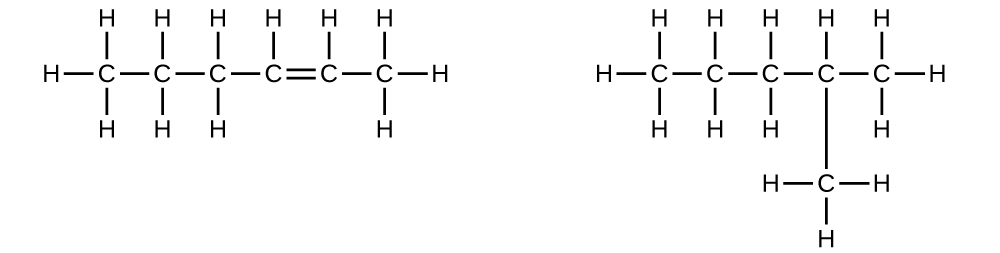
Exercise 6問題 6
Exercise 7問題 7
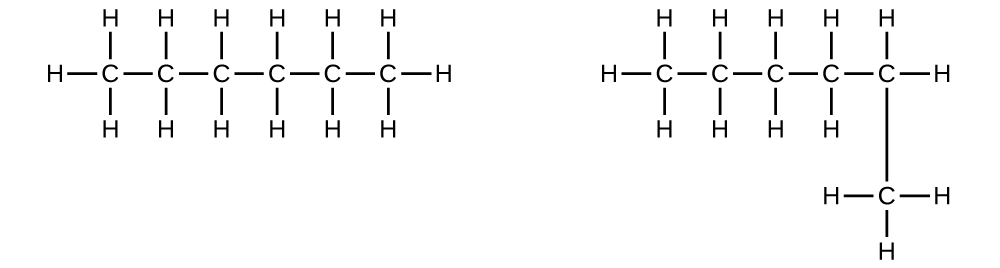
Solution解き方
They are the same compound because each is a saturated hydrocarbon containing an unbranched chain of six carbon atoms.
どちらも六個の炭素原子からなる枝分かれのない鎖を含む飽和炭化水素なので、同じ化合物である。
Exercise 8問題 8
How does the carbon-atom hybridization change when polyethylene is prepared from ethylene?
エチレンからポリエチレンを作るとき、炭素原子の混成はどのように変化するか。
Exercise 9問題 9
Write the Lewis structure and molecular formula for each of the following hydrocarbons:
次の各炭化水素のルイス構造と分子式を書きなさい。
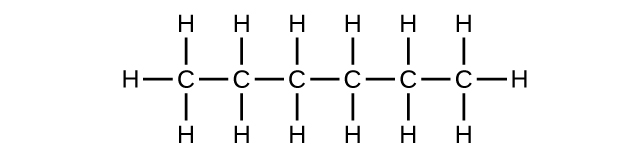
(a) hexane
(a) ヘキサン
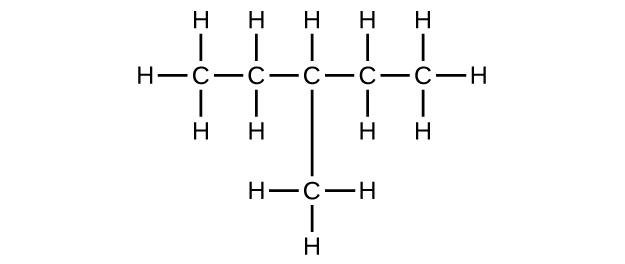
(b) 3-methylpentane
(b) 3-メチルペンタン
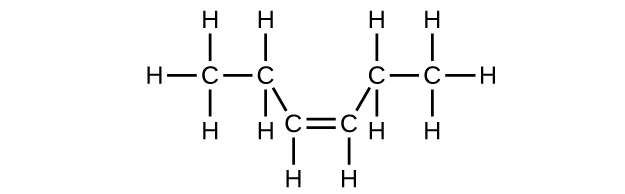
(c) cis-3-hexene
(c) シス-3-ヘキセン
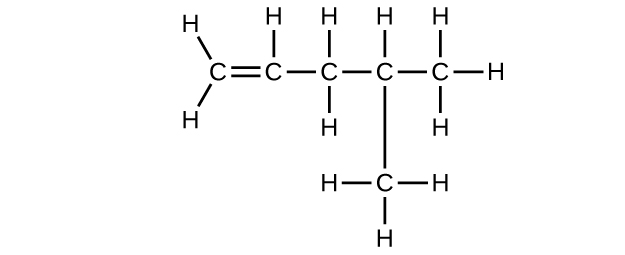
(d) 4-methyl-1-pentene
(d) 4-メチル-1-ペンテン
(e) 3-hexyne
(e) 3-ヘキシン
(f) 4-methyl-2-pentyne
(f) 4-メチル-2-ペンチン
Solution解き方
(a) C6H14
(a) C6H14
(b) C6H14
(b) C6H14
(c) C6H12
(c) C6H12
(d) C6H12
(d) C6H12
(e) C6H10
(e) C6H10
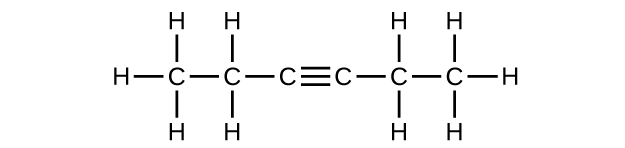
(f) C6H10
(f) C6H10
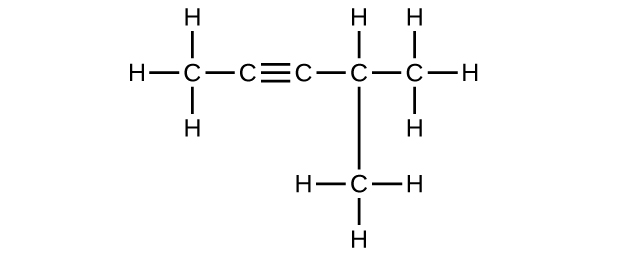
Exercise 10問題 10
Write the chemical formula, condensed formula, and Lewis structure for each of the following hydrocarbons:
次の各炭化水素の化学式、縮合式、ルイス構造を書きなさい。
(a) heptane
(a) ヘプタン
(b) 3-methylhexane
(b) 3-メチルヘキサン
(c) trans-3-heptene
(c) トランス-3-ヘプテン
(d) 4-methyl-1-hexene
(d) 4-メチル-1-ヘキセン
(e) 2-heptyne
(e) 2-ヘプチン
(f) 3,4-dimethyl-1-pentyne
(f) 3,4-ジメチル-1-ペンチン
Exercise 11問題 11
Give the complete IUPAC name for each of the following compounds:
次の各化合物の完全なIUPAC名を示しなさい。
(a) CH3CH2CBr2CH3
(a) CH3CH2CBr2CH3
(b) (CH3)3CCl
(b) (CH3)3CCl




(g)
(g)
Solution解き方
(a) 2,2-dibromobutane; (b) 2-chloro-2-methylpropane; (c) 2-methylbutane; (d) 1-butyne; (e) 4-fluoro-4-methyl-1-octyne; (f) trans-1-chloropropene; (g) 4-methyl-1-pentene
(a) 2,2-ジブロモブタン;(b) 2-クロロ-2-メチルプロパン;(c) 2-メチルブタン;(d) 1-ブチン;(e) 4-フルオロ-4-メチル-1-オクチン;(f) トランス-1-クロロプロペン;(g) 4-メチル-1-ペンテン。
Exercise 12問題 12
Give the complete IUPAC name for each of the following compounds:
次の各化合物の完全なIUPAC名を示しなさい。
(a) (CH3)2CHF
(a) (CH3)2CHF
(b) CH3CHClCHClCH3
(b) CH3CHClCHClCH3

(d)
(d)

(f)
(f)
Exercise 13問題 13
Butane is used as a fuel in disposable lighters. Write the Lewis structure for each isomer of butane.
英語のヒント
ブタンは使い捨てライターの燃料として使われる。ブタンの各異性体のルイス構造を書きなさい。
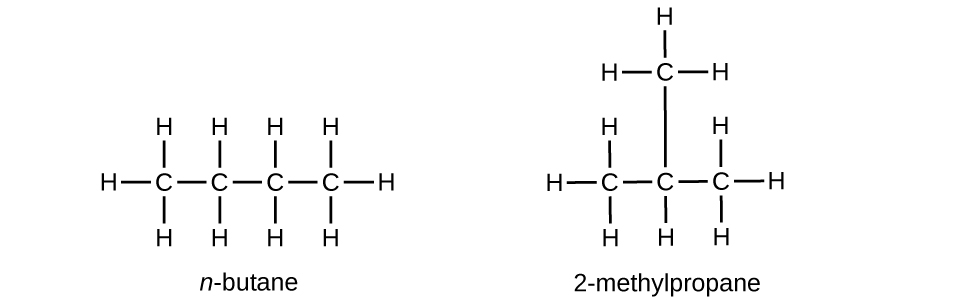
Exercise 14問題 14
Write Lewis structures and name the five structural isomers of hexane.
ヘキサンの五つの構造異性体について、ルイス構造を書き、命名しなさい。
Exercise 15問題 15
Write Lewis structures for the cis–trans isomers of
のシス・トランス異性体のルイス構造を書きなさい。
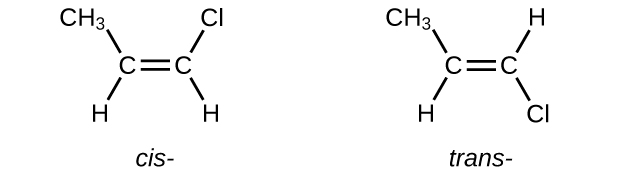
Exercise 16問題 16
Write structures for the three isomers of the aromatic hydrocarbon xylene, C6H4(CH3)2.
芳香族炭化水素キシレンC6H4(CH3)2の三つの異性体の構造を書きなさい。
Exercise 17問題 17
Isooctane is the common name of the isomer of C8H18 used as the standard of 100 for the gasoline octane rating:
英語のヒント
イソオクタンは、ガソリンのオクタン価100の基準として使われる、C8H18の異性体の慣用名である。

(a) What is the IUPAC name for the compound?
(a) この化合物のIUPAC名は何か。
(b) Name the other isomers that contain a five-carbon chain with three methyl substituents.
(b) 三つのメチル置換基を持つ五炭素鎖を含む、他の異性体を命名しなさい。

Exercise 18問題 18
Write Lewis structures and IUPAC names for the alkyne isomers of C4H6.
C4H6のアルキン異性体について、ルイス構造とIUPAC名を書きなさい。
Exercise 19問題 19
Write Lewis structures and IUPAC names for all isomers of C4H9Cl.
C4H9Clのすべての異性体について、ルイス構造とIUPAC名を書きなさい。
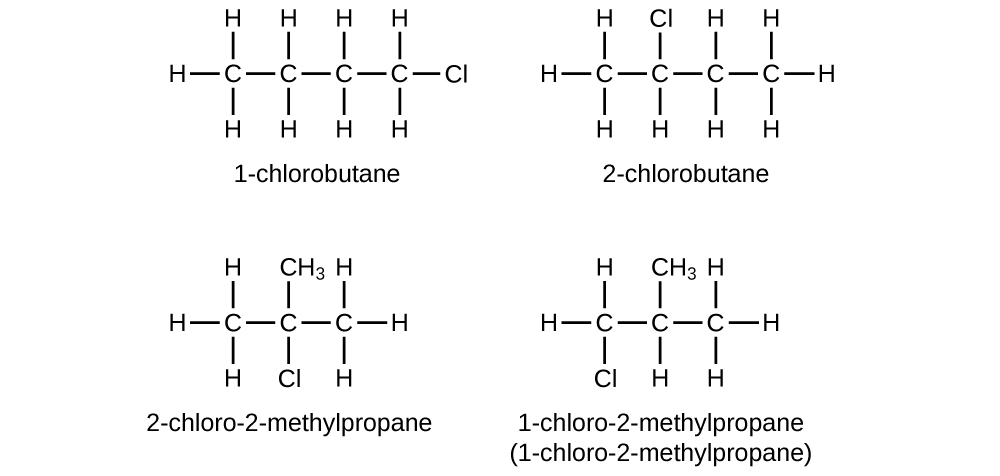
Exercise 20問題 20
Name and write the structures of all isomers of the propyl and butyl alkyl groups.
プロピル基とブチル基のすべての異性体について、名称と構造を書きなさい。
Exercise 21問題 21
Write the structures for all the isomers of the –C5H11 alkyl group.
–C5H11アルキル基のすべての異性体の構造を書きなさい。
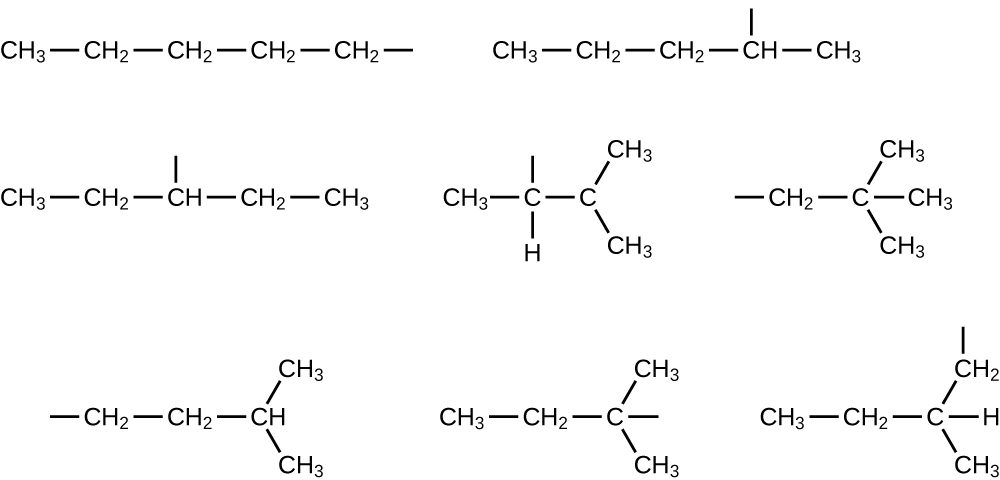
Exercise 22問題 22
Write Lewis structures and describe the molecular geometry at each carbon atom in the following compounds:
次の化合物のルイス構造を書き、各炭素原子における分子の形状を説明しなさい。
(a) cis-3-hexene
(a) シス-3-ヘキセン
(b) cis-1-chloro-2-bromoethene
(b) シス-1-クロロ-2-ブロモエテン
(c) 2-pentyne
(c) 2-ペンチン
(d) trans-6-ethyl-7-methyl-2-octene
(d) トランス-6-エチル-7-メチル-2-オクテン
Exercise 23問題 23
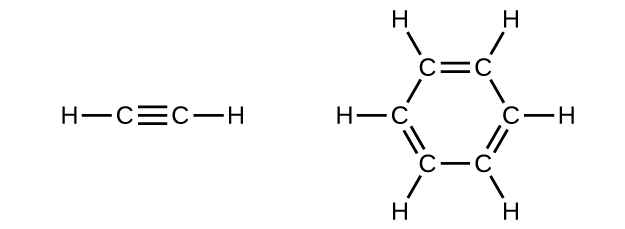
Benzene is one of the compounds used as an octane enhancer in unleaded gasoline. It is manufactured by the catalytic conversion of acetylene to benzene:
英語のヒント
ベンゼンは、無鉛ガソリンのオクタン価向上剤として使われる化合物の一つである。アセチレンを触媒によってベンゼンへ変換して製造する。
Draw Lewis structures for these compounds, with resonance structures as appropriate, and determine the hybridization of the carbon atoms in each.
これらの化合物のルイス構造を、必要に応じて共鳴構造も含めて描き、それぞれの炭素原子の混成を求めなさい。
Exercise 24問題 24
Teflon is prepared by the polymerization of tetrafluoroethylene. Write the equation that describes the polymerization using Lewis symbols.
テフロンは、テトラフルオロエチレンの重合によって作られる。ルイス記号を用いて、重合を表す反応式を書きなさい。
Exercise 25問題 25
Write two complete, balanced equations for each of the following reactions, one using condensed formulas and one using Lewis structures.
次の各反応について、一つは縮合式、もう一つはルイス構造を用いて、完全につり合わせた反応式を二つ書きなさい。
(a) 1 mol of 1-butyne reacts with 2 mol of iodine.
(a) 1 molの1-ブチンが、2 molのヨウ素と反応する。
(b) Pentane is burned in air.
(b) ペンタンを空気中で燃焼させる。




Exercise 26問題 26
Write two complete, balanced equations for each of the following reactions, one using condensed formulas and one using Lewis structures.
次の各反応について、一つは縮合式、もう一つはルイス構造を用いて、完全につり合わせた反応式を二つ書きなさい。
(a) 2-butene reacts with chlorine.
(a) 2-ブテンが塩素と反応する。
(b) benzene burns in air.
(b) ベンゼンが空気中で燃焼する。
Exercise 27問題 27
What mass of 2-bromopropane could be prepared from 25.5 g of propene? Assume a 100% yield of product.
25.5 gのプロペンから、どれだけの質量の2-ブロモプロパンを作れるか。生成物の収率を100%とする。
Solution解き方
74.5 g
74.5 g
Exercise 28問題 28
Acetylene is a very weak acid; however, it will react with moist silver(I) oxide and form water and a compound composed of silver and carbon. Addition of a solution of HCl to a 0.2352-g sample of the compound of silver and carbon produced acetylene and 0.2822 g of AgCl.
英語のヒント
アセチレンは非常に弱い酸であるが、湿った酸化銀(I)と反応して、水と、銀および炭素からなる化合物を作る。この銀と炭素の化合物0.2352 gの試料にHCl溶液を加えたところ、アセチレンと0.2822 gのAgClが生じた。
(a) What is the empirical formula of the compound of silver and carbon?
(a) 銀と炭素の化合物の組成式は何か。
(b) The production of acetylene on addition of HCl to the compound of silver and carbon suggests that the carbon is present as the acetylide ion, . Write the formula of the compound showing the acetylide ion.
英語のヒント
(b) 銀と炭素の化合物にHClを加えたときにアセチレンが生じることは、炭素がアセチリドイオンとして存在することを示唆する。アセチリドイオンを示す形で、この化合物の化学式を書きなさい。
Exercise 29問題 29
Ethylene can be produced by the pyrolysis of ethane:
英語のヒント
エチレンは、エタンの熱分解によって製造できる。
How many kilograms of ethylene is produced by the pyrolysis of 1.000 103 kg of ethane, assuming a 100.0% yield?
1.000 103 kgのエタンを熱分解すると、何kgのエチレンが生じるか。収率を100.0%とする。
Solution解き方
9.328 102 kg
9.328 102 kg
addition reaction
付加反応
reaction in which a double carbon-carbon bond forms a single carbon-carbon bond by the addition of a reactant. Typical reaction for an alkene.
反応物が付加することで、炭素間二重結合が炭素間単結合になる反応。アルケンに典型的な反応。
alkane
アルカン
molecule consisting of only carbon and hydrogen atoms connected by single (σ) bonds
単結合(σ結合)でつながった炭素原子と水素原子だけからなる分子。
alkene
アルケン
molecule consisting of carbon and hydrogen containing at least one carbon-carbon double bond
炭素と水素からなり、少なくとも一つの炭素間二重結合を含む分子。
alkyl group
アルキル基
substituent, consisting of an alkane missing one hydrogen atom, attached to a larger structure
アルカンから水素原子一個を取り除いたものからなり、より大きな構造に結合する置換基。
alkyne
アルキン
molecule consisting of carbon and hydrogen containing at least one carbon-carbon triple bond
炭素と水素からなり、少なくとも一つの炭素間三重結合を含む分子。
aromatic hydrocarbon
芳香族炭化水素
cyclic molecule consisting of carbon and hydrogen with delocalized alternating carbon-carbon single and double bonds, resulting in enhanced stability
炭素と水素からなる環状分子。交互の炭素間単結合と二重結合が非局在化し、その結果、安定性が高まっている。
functional group
官能基
part of an organic molecule that imparts a specific chemical reactivity to the molecule
分子に特定の化学反応性を与える、有機分子の部分。
organic compound
有機化合物
natural or synthetic compound that contains carbon
炭素を含む、天然または合成の化合物。
saturated hydrocarbon
飽和炭化水素
molecule containing carbon and hydrogen that has only single bonds between carbon atoms
炭素と水素を含み、炭素原子間には単結合だけを持つ分子。
skeletal structure
骨格式
shorthand method of drawing organic molecules in which carbon atoms are represented by the ends of lines and bends in between lines, and hydrogen atoms attached to the carbon atoms are not shown (but are understood to be present by the context of the structure)
有機分子を簡略化して描く方法。炭素原子は線の端と線の間の折れ曲がりで表し、炭素原子に結合する水素原子は示さない(ただし、構造の文脈から存在すると分かる)。
substituent
置換基
branch or functional group that replaces hydrogen atoms in a larger hydrocarbon chain
より大きな炭化水素鎖の水素原子を置き換える、枝または官能基。
substitution reaction
置換反応
reaction in which one atom replaces another in a molecule
分子内で、一つの原子が別の原子を置き換える反応。