第20章有機化学
Isomers of Alkenesアルケンの異性体
Molecules of 1-butene and 2-butene are structural isomers; the arrangement of the atoms in these two molecules differs. As an example of arrangement differences, the first carbon atom in 1-butene is bonded to two hydrogen atoms; the first carbon atom in 2-butene is bonded to three hydrogen atoms.
1-ブテンと2-ブテンの分子は、構造異性体である。この二つの分子では、原子の配置が異なる。配置の違いの一例として、1-ブテンの最初の炭素原子には二個の水素原子が結合するが、2-ブテンの最初の炭素原子には三個の水素原子が結合する。
The compound 2-butene and some other alkenes also form a second type of isomer called a geometric isomer. In a set of geometric isomers, the same types of atoms are attached to each other in the same order, but the geometries of the two molecules differ. Geometric isomers of alkenes differ in the orientation of the groups on either side of a bond.
英語のヒント
2-ブテンなどの一部のアルケンは、幾何異性体と呼ばれる第二の種類の異性体も作る。一組の幾何異性体では、同じ種類の原子が同じ順序で互いに結合しているが、二つの分子の形状が異なる。アルケンの幾何異性体は、結合の両側にある基の向きが異なる。
Carbon atoms are free to rotate around a single bond but not around a double bond; a double bond is rigid. This makes it possible to have two isomers of 2-butene, one with both methyl groups on the same side of the double bond and one with the methyl groups on opposite sides. When structures of butene are drawn with 120° bond angles around the sp2-hybridized carbon atoms participating in the double bond, the isomers are apparent. The 2-butene isomer in which the two methyl groups are on the same side is called a cis-isomer; the one in which the two methyl groups are on opposite sides is called a trans-isomer (Figure 20.10). The different geometries produce different physical properties, such as boiling point, that may make separation of the isomers possible:
英語のヒント
炭素原子は単結合の周りでは自由に回転できるが、二重結合の周りでは回転できない。二重結合は剛直である。そのため、2-ブテンには、二つのメチル基が二重結合の同じ側にあるものと、反対側にあるものという、二つの異性体が存在できる。二重結合に関与するsp2混成炭素原子の周囲の結合角を120°としてブテンの構造を描くと、異性体がはっきり分かる。二つのメチル基が同じ側にある2-ブテンの異性体をシス異性体と呼び、反対側にあるものをトランス異性体と呼ぶ(図20.10)。形状の違いは沸点などの物理的性質の違いを生み、異性体の分離が可能になる場合がある。
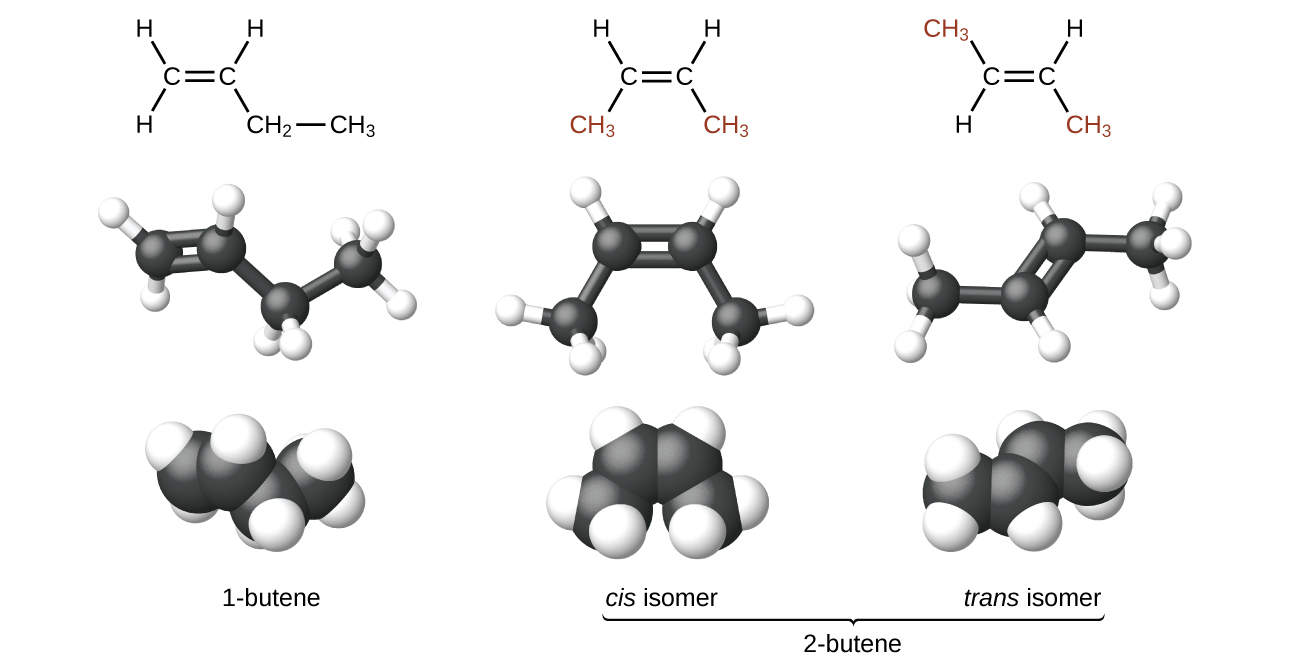
Figure 20.10図 20.10
These molecular models show the structural and geometric isomers of butene.
これらの分子模型は、ブテンの構造異性体と幾何異性体を示す。
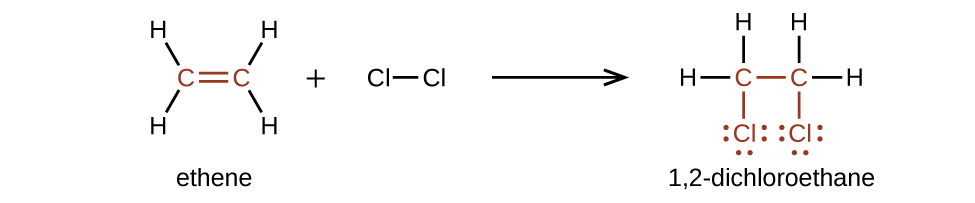
Alkenes are much more reactive than alkanes because the moiety is a reactive functional group. A π bond, being a weaker bond, is disrupted much more easily than a σ bond. Thus, alkenes undergo a characteristic reaction in which the π bond is broken and replaced by two σ bonds. This reaction is called an addition reaction. The hybridization of the carbon atoms in the double bond in an alkene changes from sp2 to sp3 during an addition reaction. For example, halogens add to the double bond in an alkene instead of replacing hydrogen, as occurs in an alkane:
英語のヒント
アルケンは、部分が反応性のある官能基であるため、アルカンよりはるかに反応性が高い。π結合は弱い結合なので、σ結合よりはるかに容易に切断される。したがって、アルケンは、π結合が切れ、二本のσ結合に置き換わる特有の反応をする。この反応を付加反応という。付加反応では、アルケンの二重結合内の炭素原子の混成が、sp2からsp3へ変わる。たとえば、ハロゲンは、アルカンの場合のように水素を置き換えるのではなく、アルケンの二重結合に付加する。
Example 20.5例題 20.5
Alkene Reactivity and Namingアルケンの反応性と命名
Provide the IUPAC names for the reactant and product of the halogenation reaction shown here:
英語のヒント
ここに示すハロゲン化反応の、反応物と生成物のIUPAC名を示しなさい。

Solution解答
The reactant is a five-carbon chain that contains a carbon-carbon double bond, so the base name will be pentene. We begin counting at the end of the chain closest to the double bond—in this case, from the left—the double bond spans carbons 2 and 3, so the name becomes 2-pentene. Since there are two carbon-containing groups attached to the two carbon atoms in the double bond—and they are on the same side of the double bond—this molecule is the cis-isomer, making the name of the starting alkene cis-2-pentene. The product of the halogenation reaction will have two chlorine atoms attached to the carbon atoms that were a part of the carbon-carbon double bond:
反応物は炭素五個の鎖で、炭素間に二重結合を含むので、基本名はペンテンとなる。二重結合に最も近い鎖の端、この場合は左から数え始める。二重結合は炭素2と3にまたがるため、名称は2-ペンテンとなる。二重結合の二個の炭素原子には、炭素を含む二つの基が結合し、それらは二重結合の同じ側にあるので、この分子はシス異性体であり、出発アルケンの名称はシス-2-ペンテンとなる。ハロゲン化反応の生成物では、炭素間二重結合の一部であった炭素原子に、二個の塩素原子が結合する。
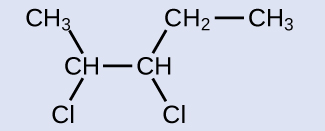
This molecule is now a substituted alkane and will be named as such. The base of the name will be pentane. We will count from the end that numbers the carbon atoms where the chlorine atoms are attached as 2 and 3, making the name of the product 2,3-dichloropentane.
この分子は今や置換アルカンなので、そのように命名する。基本名はペンタンである。塩素原子が結合する炭素原子の番号が2と3になる端から数えると、生成物の名称は2,3-ジクロロペンタンとなる。
Check Your Learning理解を確認しよう
Provide names for the reactant and product of the reaction shown:
示した反応の反応物と生成物の名称を示しなさい。

Alkynesアルキン
Hydrocarbon molecules with one or more triple bonds are called alkynes; they make up another series of unsaturated hydrocarbons. Two carbon atoms joined by a triple bond are bound together by one σ bond and two π bonds. The sp-hybridized carbons involved in the triple bond have bond angles of 180°, giving these types of bonds a linear, rod-like shape.
英語のヒント
一つ以上の三重結合を持つ炭化水素分子をアルキンといい、不飽和炭化水素のもう一つの系列をなす。三重結合でつながる二個の炭素原子は、一本のσ結合と二本のπ結合で結び付いている。三重結合に関与するsp混成炭素の結合角は180°であり、この種類の結合は、まっすぐな棒状の形になる。
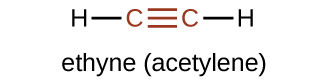
The simplest member of the alkyne series is ethyne, C2H2, commonly called acetylene. The Lewis structure for ethyne, a linear molecule, is:
アルキン系列の最も単純な化合物は、一般にアセチレンと呼ばれるエチンC2H2である。直線形の分子であるエチンのルイス構造は、次のとおりである。
The IUPAC nomenclature for alkynes is similar to that for alkenes except that the suffix -yne is used to indicate a triple bond in the chain. For example, is called 1-butyne.
アルキンのIUPAC命名法は、鎖内の三重結合を示すために語尾-yneを使う点を除けば、アルケンの場合と似ている。たとえば、は1-ブチンと呼ぶ。
Example 20.6例題 20.6
Structure of Alkynesアルキンの構造
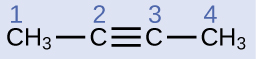
Describe the geometry and hybridization of the carbon atoms in the following molecule:
次の分子の炭素原子について、形状と混成を説明しなさい。
Solution解答
Carbon atoms 1 and 4 have four single bonds and are thus tetrahedral with sp3 hybridization. Carbon atoms 2 and 3 are involved in the triple bond, so they have linear geometries and would be classified as sp hybrids.
炭素原子1と4は四本の単結合を持つため、sp3混成による四面体である。炭素原子2と3は三重結合に関与するため、直線形の形状を持ち、sp混成に分類される。
Check Your Learning理解を確認しよう
Identify the hybridization and bond angles at the carbon atoms in the molecule shown:
示した分子の炭素原子における混成と結合角を求めなさい。

Chemically, the alkynes are similar to the alkenes. Since the functional group has two π bonds, alkynes typically react even more readily, and react with twice as much reagent in addition reactions. The reaction of acetylene with bromine is a typical example:
英語のヒント
化学的には、アルキンはアルケンに似ている。官能基には二本のπ結合があるため、アルキンは通常、さらに容易に反応し、付加反応では二倍の量の試薬と反応する。アセチレンと臭素の反応は、典型的な例である。



Acetylene and the other alkynes also burn readily. An acetylene torch takes advantage of the high heat of combustion for acetylene.
英語のヒント
アセチレンや他のアルキンも容易に燃焼する。アセチレントーチは、アセチレンの高い燃焼熱を利用する。