第20章有機化学
Carboxylic Acids and Estersカルボン酸とエステル
The odor of vinegar is caused by the presence of acetic acid, a carboxylic acid, in the vinegar. The odor of ripe bananas and many other fruits is due to the presence of esters, compounds that can be prepared by the reaction of a carboxylic acid with an alcohol. Because esters do not have hydrogen bonds between molecules, they have lower vapor pressures than the alcohols and carboxylic acids from which they are derived (see Figure 20.15).
英語のヒント
酢のにおいは、カルボン酸である酢酸が酢の中に存在するために生じる。熟したバナナや多くの他の果物のにおいは、エステルの存在による。エステルは、カルボン酸とアルコールの反応で作れる化合物である。エステルは分子間に水素結合を持たないため、誘導元のアルコールやカルボン酸より蒸気圧が低い(図20.15参照)。
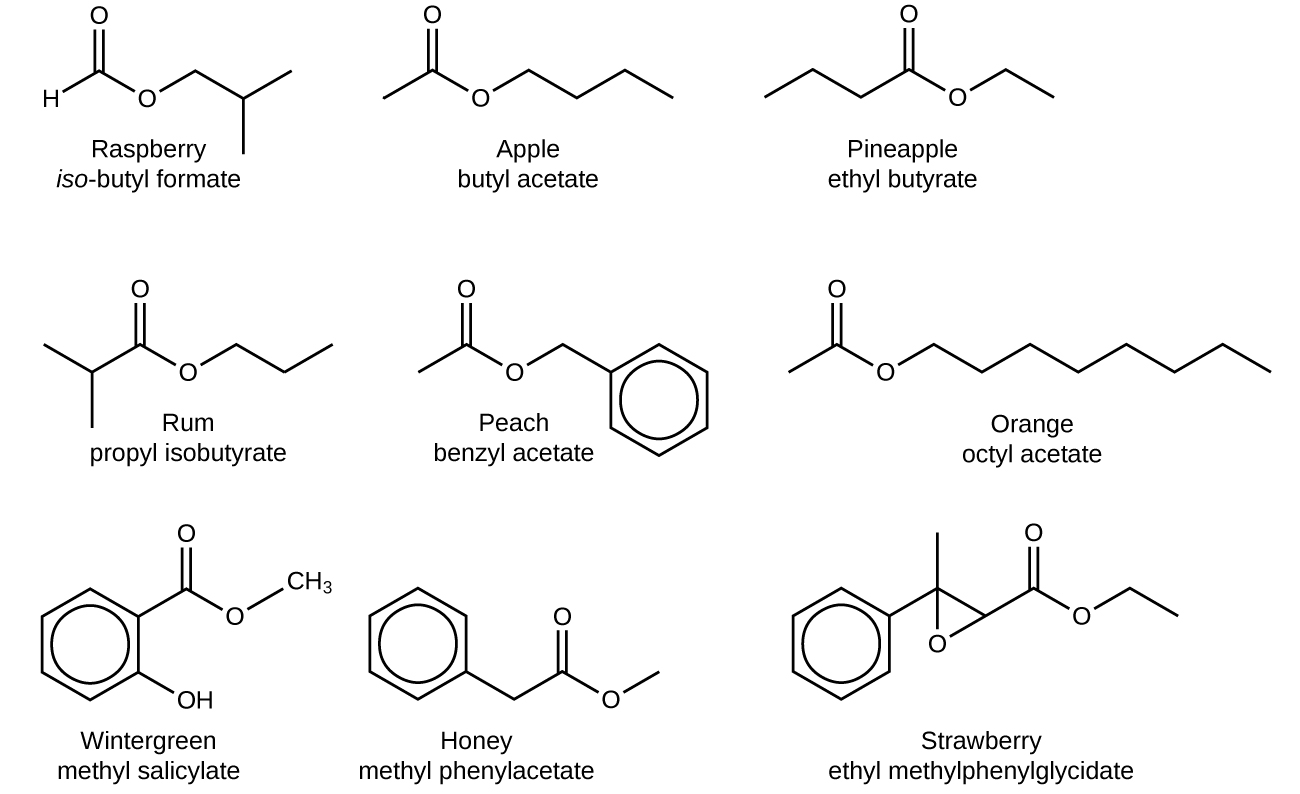
Figure 20.15図 20.15
Esters are responsible for the odors associated with various plants and their fruits.
エステルは、さまざまな植物やその果実に伴うにおいの原因である。
Both carboxylic acids and esters contain a carbonyl group with a second oxygen atom bonded to the carbon atom in the carbonyl group by a single bond. In a carboxylic acid, the second oxygen atom also bonds to a hydrogen atom. In an ester, the second oxygen atom bonds to another carbon atom. The names for carboxylic acids and esters include prefixes that denote the lengths of the carbon chains in the molecules and are derived following nomenclature rules similar to those for inorganic acids and salts (see these examples):
英語のヒント
カルボン酸とエステルはどちらも、カルボニル基の炭素原子に第二の酸素原子が単結合した構造を含む。カルボン酸では、第二の酸素原子は水素原子にも結合している。エステルでは、第二の酸素原子は別の炭素原子に結合している。カルボン酸とエステルの名称は、分子内の炭素鎖の長さを示す接頭辞を含み、無機の酸や塩と似た命名規則に従って作る(次の例を参照)。
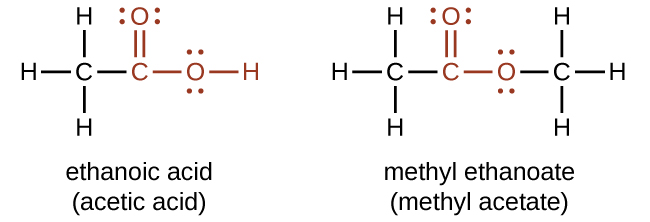
The functional groups for an acid and for an ester are shown in red in these formulas.
これらの化学式では、酸とエステルの官能基を赤で示している。
The hydrogen atom in the functional group of a carboxylic acid will react with a base to form an ionic salt:
カルボン酸の官能基内の水素原子は、塩基と反応してイオン性の塩を作る。

Carboxylic acids are weak acids (see the chapter on acids and bases), meaning they are not 100% ionized in water. Generally only about 1% of the molecules of a carboxylic acid dissolved in water are ionized at any given time. The remaining molecules are undissociated in solution.
英語のヒント
カルボン酸は弱酸であり(酸と塩基の章を参照)、水中で100%電離するわけではない。一般に、ある時点で電離しているのは、水に溶けたカルボン酸分子の約1%にすぎない。残る分子は、溶液中で解離していない。
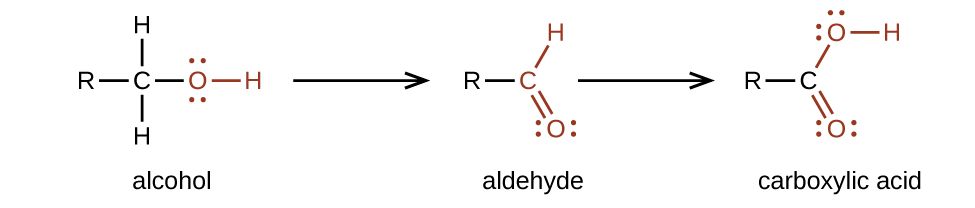
We prepare carboxylic acids by the oxidation of aldehydes or alcohols whose –OH functional group is located on the carbon atom at the end of the chain of carbon atoms in the alcohol:
カルボン酸は、アルデヒド、または–OH官能基が炭素鎖の末端の炭素原子にあるアルコールを酸化して作る。
Esters are produced by the reaction of acids with alcohols. For example, the ester ethyl acetate, CH3CO2CH2CH3, is formed when acetic acid reacts with ethanol:
エステルは、酸とアルコールの反応で作られる。たとえば、エステルである酢酸エチルCH3CO2CH2CH3は、酢酸がエタノールと反応すると生じる。



The simplest carboxylic acid is formic acid, HCO2H, known since 1670. Its name comes from the Latin word formicus, which means “ant”; it was first isolated by the distillation of red ants. It is partially responsible for the pain and irritation of ant and wasp stings, and is responsible for a characteristic odor of ants that can be sometimes detected in their nests.
英語のヒント
最も単純なカルボン酸は、1670年から知られているギ酸HCO2Hである。その名前は、「アリ」を意味するラテン語formicusに由来し、最初は赤アリを蒸留して単離された。ギ酸は、アリやハチに刺されたときの痛みと刺激の一因であり、ときに巣で感じられる、アリ特有のにおいの原因でもある。
Acetic acid, CH3CO2H, constitutes 3–6% vinegar. Cider vinegar is produced by allowing apple juice to ferment without oxygen present. Yeast cells present in the juice carry out the fermentation reactions. The fermentation reactions change the sugar present in the juice to ethanol, then to acetic acid. Pure acetic acid has a penetrating odor and produces painful burns. It is an excellent solvent for many organic and some inorganic compounds, and it is essential in the production of cellulose acetate, a component of many synthetic fibers such as rayon.
英語のヒント
酢酸CH3CO2Hは、酢の3~6%を占める。リンゴ酢は、酸素がない状態でリンゴ果汁を発酵させて作る。果汁中の酵母細胞が発酵反応を行う。発酵反応によって、果汁中の糖はエタノールに、次に酢酸に変わる。純粋な酢酸は強く鼻を突くにおいを持ち、痛みを伴うやけどを起こす。多くの有機化合物と一部の無機化合物にとって優れた溶媒であり、レーヨンなどの多くの合成繊維の成分である酢酸セルロースの製造に不可欠である。
The distinctive and attractive odors and flavors of many flowers, perfumes, and ripe fruits are due to the presence of one or more esters (Figure 20.16). Among the most important of the natural esters are fats (such as lard, tallow, and butter) and oils (such as linseed, cottonseed, and olive oils), which are esters of the trihydroxyl alcohol glycerine, C3H5(OH)3, with large carboxylic acids, such as palmitic acid, CH3(CH2)14CO2H, stearic acid, CH3(CH2)16CO2H, and oleic acid, Oleic acid is an unsaturated acid; it contains a double bond. Palmitic and stearic acids are saturated acids that contain no double or triple bonds.
英語のヒント
多くの花、香水、熟した果物の、独特で魅力的なにおいや風味は、一つ以上のエステルの存在による(図20.16)。天然エステルの中でも特に重要なものに、脂肪(ラード、獣脂、バターなど)と油(亜麻仁油、綿実油、オリーブ油など)がある。これらは、三つのヒドロキシ基を持つアルコールであるグリセリンC3H5(OH)3と、パルミチン酸CH3(CH2)14CO2H、ステアリン酸CH3(CH2)16CO2H、オレイン酸などの大きなカルボン酸とのエステルである。オレイン酸は不飽和酸で、二重結合を含む。パルミチン酸とステアリン酸は、二重結合も三重結合も含まない飽和酸である。
Image omitted because its reuse rights could not be verified.権利の確認ができないため画像を割愛。
Figure 20.16図 20.16
Over 350 different volatile molecules (many members of the ester family) have been identified in strawberries. (credit: Rebecca Siegel)
イチゴでは、350種類を超える異なる揮発性分子(多くはエステル類)が同定されている。(クレジット:Rebecca Siegel)
Key Concepts and Summary主要概念とまとめ
Functional groups related to the carbonyl group include the –CHO group of an aldehyde, the –CO– group of a ketone, the –CO2H group of a carboxylic acid, and the –CO2R group of an ester. The carbonyl group, a carbon-oxygen double bond, is the key structure in these classes of organic molecules: Aldehydes contain at least one hydrogen atom attached to the carbonyl carbon atom, ketones contain two carbon groups attached to the carbonyl carbon atom, carboxylic acids contain a hydroxyl group attached to the carbonyl carbon atom, and esters contain an oxygen atom attached to another carbon group connected to the carbonyl carbon atom. All of these compounds contain oxidized carbon atoms relative to the carbon atom of an alcohol group.
カルボニル基に関連する官能基には、アルデヒドの–CHO基、ケトンの–CO–基、カルボン酸の–CO2H基、エステルの–CO2R基がある。炭素と酸素の二重結合であるカルボニル基は、これらの有機分子群の中心となる構造である。アルデヒドでは、カルボニル炭素原子に少なくとも一個の水素原子が結合し、ケトンでは二つの炭素基が結合し、カルボン酸ではヒドロキシ基が結合する。エステルでは、別の炭素基に結合した酸素原子が、カルボニル炭素原子につながっている。これらの化合物はすべて、アルコール基の炭素原子に比べて酸化された炭素原子を含む。