第20章有機化学
The Basics of Organic Nomenclature: Naming Alkanes有機化合物の命名法の基礎:アルカンの命名
The International Union of Pure and Applied Chemistry (IUPAC) has devised a system of nomenclature that begins with the names of the alkanes and can be adjusted from there to account for more complicated structures. The nomenclature for alkanes is based on two rules:
英語のヒント
国際純正・応用化学連合(IUPAC)は、アルカンの名称を出発点とし、より複雑な構造にも対応できるように調整する命名体系を考案した。アルカンの命名法は、次の二つの規則に基づく。
- To name an alkane, first identify the longest chain of carbon atoms in its structure. A two-carbon chain is called ethane; a three-carbon chain, propane; and a four-carbon chain, butane. Longer chains are named as follows: pentane (five-carbon chain), hexane (6), heptane (7), octane (8), nonane (9), and decane (10). These prefixes can be seen in the names of the alkanes described in Table 20.1.アルカンを命名するには、まず構造内の最も長い炭素原子の鎖を見つける。炭素二個の鎖はエタン、三個の鎖はプロパン、四個の鎖はブタンと呼ぶ。より長い鎖は、ペンタン(炭素五個の鎖)、ヘキサン(6)、ヘプタン(7)、オクタン(8)、ノナン(9)、デカン(10)のように命名する。これらの接頭辞は、表20.1に記したアルカンの名称に見られる。
- Add prefixes to the name of the longest chain to indicate the positions and names of substituents. Substituents are branches or functional groups that replace hydrogen atoms on a chain. The position of a substituent or branch is identified by the number of the carbon atom it is bonded to in the chain. We number the carbon atoms in the chain by counting from the end of the chain nearest the substituents. Multiple substituents are named individually and placed in alphabetical order at the front of the name.
英語のヒント
最長鎖の名称に接頭辞を加え、置換基の位置と名称を示す。置換基とは、鎖上の水素原子を置き換える枝または官能基である。置換基や枝の位置は、それが結合する鎖内の炭素原子の番号で示す。鎖内の炭素原子には、置換基に最も近い鎖の端から数えて番号を付ける。複数の置換基は個別に命名し、アルファベット順で名称の前に並べる。

When more than one substituent is present, either on the same carbon atom or on different carbon atoms, the substituents are listed alphabetically. Because the carbon atom numbering begins at the end closest to a substituent, the longest chain of carbon atoms is numbered in such a way as to produce the lowest number for the substituents. The ending -o replaces -ide at the end of the name of an electronegative substituent (in ionic compounds, the negatively charged ion ends with -ide like chloride; in organic compounds, such atoms are treated as substituents and the -o ending is used). The number of substituents of the same type is indicated by the prefixes di- (two), tri- (three), tetra- (four), and so on (for example, difluoro- indicates two fluoride substituents).
英語のヒント
同じ炭素原子上であっても異なる炭素原子上であっても、置換基が複数ある場合は、アルファベット順に並べる。炭素原子の番号は置換基に最も近い端から付け始めるので、最長の炭素鎖には、置換基の番号が最小になるように番号を付ける。電気陰性な置換基の名称の語尾は、-ideを-oに置き換える(イオン性化合物では、負に帯電したイオンはchlorideのように-ideで終わる。有機化合物では、そのような原子を置換基として扱い、-oの語尾を用いる)。同じ種類の置換基の数は、di-(二つ)、tri-(三つ)、tetra-(四つ)などの接頭辞で示す(たとえば、difluoro-は二つのフッ化物置換基を表す)。
Example 20.3例題 20.3
Naming Halogen-substituted Alkanesハロゲン置換アルカンの命名
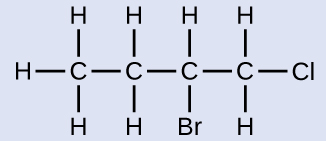
Name the molecule whose structure is shown here:
ここに構造を示す分子を命名しなさい。
Solution解答
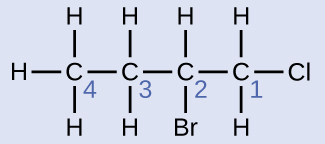
The four-carbon chain is numbered from the end with the chlorine atom. This puts the substituents on positions 1 and 2 (numbering from the other end would put the substituents on positions 3 and 4). Four carbon atoms means that the base name of this compound will be butane. The bromine at position 2 will be described by adding 2-bromo-; this will come at the beginning of the name, since bromo- comes before chloro- alphabetically. The chlorine at position 1 will be described by adding 1-chloro-, resulting in the name of the molecule being 2-bromo-1-chlorobutane.
四個の炭素からなる鎖には、塩素原子のある端から番号を付ける。これにより、置換基の位置は1と2になる(反対側の端から番号を付けると、置換基は3と4になる)。炭素原子が四個なので、この化合物の基本名はブタンである。位置2の臭素は、2-ブロモ-を加えて示す。bromo-はアルファベット順でchloro-より前なので、名称の先頭に置く。位置1の塩素は、1-クロロ-を加えて示す。その結果、分子名は2-ブロモ-1-クロロブタンとなる。
Check Your Learning理解を確認しよう
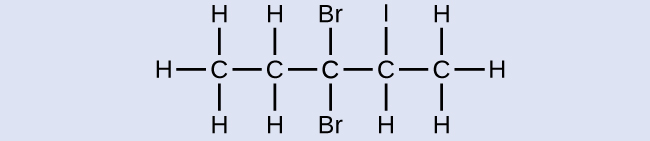
Name the following molecule:
次の分子を命名しなさい。
We call a substituent that contains one less hydrogen than the corresponding alkane an alkyl group. The name of an alkyl group is obtained by dropping the suffix -ane of the alkane name and adding -yl:
英語のヒント
対応するアルカンより水素が一個少ない置換基を、アルキル基と呼ぶ。アルキル基の名称は、アルカンの英語名から語尾-aneを取り除き、-ylを加えて作る。
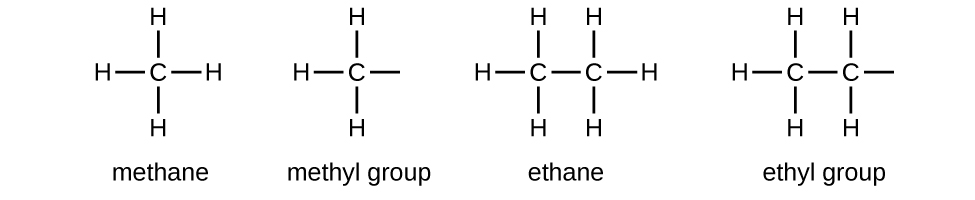
The open bonds in the methyl and ethyl groups indicate that these alkyl groups are bonded to another atom.
メチル基とエチル基の開いた結合は、これらのアルキル基が別の原子に結合していることを示す。
Example 20.4例題 20.4
Naming Substituted Alkanes置換アルカンの命名
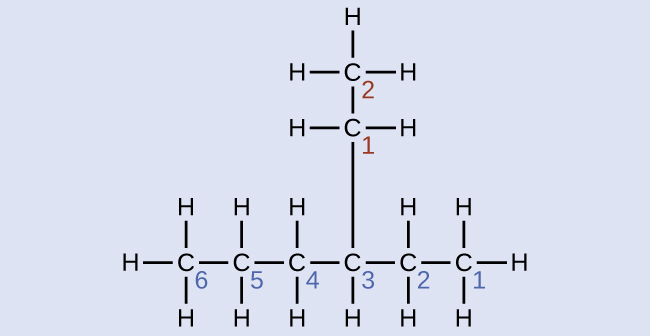
Name the molecule whose structure is shown here:
ここに構造を示す分子を命名しなさい。
Solution解答
The longest carbon chain runs horizontally across the page and contains six carbon atoms (this makes the base of the name hexane, but we will also need to incorporate the name of the branch). In this case, we want to number from right to left (as shown by the blue numbers) so the branch is connected to carbon 3 (imagine the numbers from left to right—this would put the branch on carbon 4, violating our rules). The branch attached to position 3 of our chain contains two carbon atoms (numbered in red)—so we take our name for two carbons eth- and attach -yl at the end to signify we are describing a branch. Putting all the pieces together, this molecule is 3-ethylhexane.
英語のヒント
最も長い炭素鎖はページを横に走り、六個の炭素原子を含む(したがって基本名はヘキサンとなるが、枝の名称も組み込む必要がある)。この場合は、枝が炭素3につながるように、(青い番号で示すように)右から左へ番号を付ける(左から右へ番号を付けると、枝が炭素4になり、規則に反することを考えてみよう)。鎖の位置3に結合した枝は、(赤で番号を付けた)二個の炭素原子を含む。そこで、炭素二個を表すeth-を取り、枝を表すために末尾に-ylを付ける。すべてを組み合わせると、この分子は3-エチルヘキサンである。
Check Your Learning理解を確認しよう
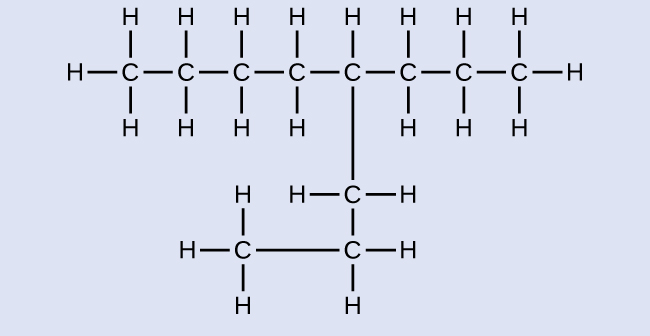
Name the following molecule:
次の分子を命名しなさい。
Some hydrocarbons can form more than one type of alkyl group when the hydrogen atoms that would be removed have different “environments” in the molecule. This diversity of possible alkyl groups can be identified in the following way: The four hydrogen atoms in a methane molecule are equivalent; they all have the same environment. They are equivalent because each is bonded to a carbon atom (the same carbon atom) that is bonded to three hydrogen atoms. (It may be easier to see the equivalency in the ball and stick models in Figure 20.2. Removal of any one of the four hydrogen atoms from methane forms a methyl group. Likewise, the six hydrogen atoms in ethane are equivalent (Figure 20.2) and removing any one of these hydrogen atoms produces an ethyl group. Each of the six hydrogen atoms is bonded to a carbon atom that is bonded to two other hydrogen atoms and a carbon atom. However, in both propane and 2–methylpropane, there are hydrogen atoms in two different environments, distinguished by the adjacent atoms or groups of atoms:
英語のヒント
ある炭化水素では、取り除く水素原子が分子内の異なる「環境」にある場合、複数種類のアルキル基を作ることができる。このように生成しうるアルキル基が多様であることは、次のように見分けられる。メタン分子の四個の水素原子は等価であり、すべて同じ環境にある。それぞれが、三個の水素原子に結合した炭素原子(同じ炭素原子)に結合しているため、等価である。(図20.2の球棒模型の方が、等価性を見やすいかもしれない。メタンの四個の水素原子のどれを一個取り除いても、メチル基ができる。同様に、エタンの六個の水素原子も等価であり(図20.2)、どれを一個取り除いてもエチル基ができる。六個の水素原子はそれぞれ、他の二個の水素原子と一個の炭素原子に結合した炭素原子に結合している。しかし、プロパンにも2-メチルプロパンにも、隣接する原子または原子団によって区別される、二つの異なる環境にある水素原子が存在する。
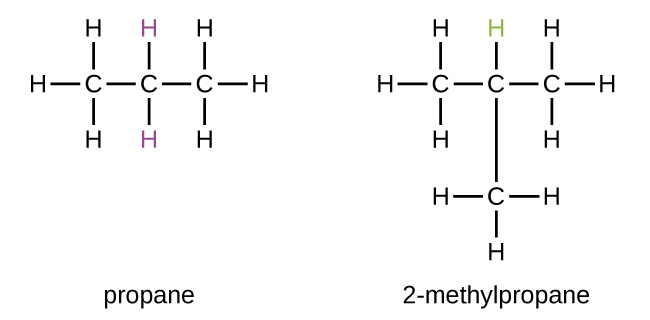
Each of the six equivalent hydrogen atoms of the first type in propane and each of the nine equivalent hydrogen atoms of that type in 2-methylpropane (all shown in black) are bonded to a carbon atom that is bonded to only one other carbon atom. The two purple hydrogen atoms in propane are of a second type. They differ from the six hydrogen atoms of the first type in that they are bonded to a carbon atom bonded to two other carbon atoms. The green hydrogen atom in 2-methylpropane differs from the other nine hydrogen atoms in that molecule and from the purple hydrogen atoms in propane. The green hydrogen atom in 2-methylpropane is bonded to a carbon atom bonded to three other carbon atoms. Two different alkyl groups can be formed from each of these molecules, depending on which hydrogen atom is removed. The names and structures of these and several other alkyl groups are listed in Figure 20.5.
英語のヒント
プロパンの第一の種類の等価な水素原子六個と、2-メチルプロパンの同じ種類の等価な水素原子九個(すべて黒で表示)は、それぞれ、他の炭素原子一個だけに結合した炭素原子に結合している。プロパンの二個の紫色の水素原子は、第二の種類である。他の炭素原子二個に結合した炭素原子に結合している点で、第一の種類の六個の水素原子とは異なる。2-メチルプロパンの緑色の水素原子は、その分子内の他の九個の水素原子とも、プロパンの紫色の水素原子とも異なる。2-メチルプロパンの緑色の水素原子は、他の炭素原子三個に結合した炭素原子に結合している。どの水素原子を取り除くかによって、これらの分子のそれぞれから、二種類のアルキル基を作ることができる。これらと他のいくつかのアルキル基の名称および構造を、図20.5に示す。
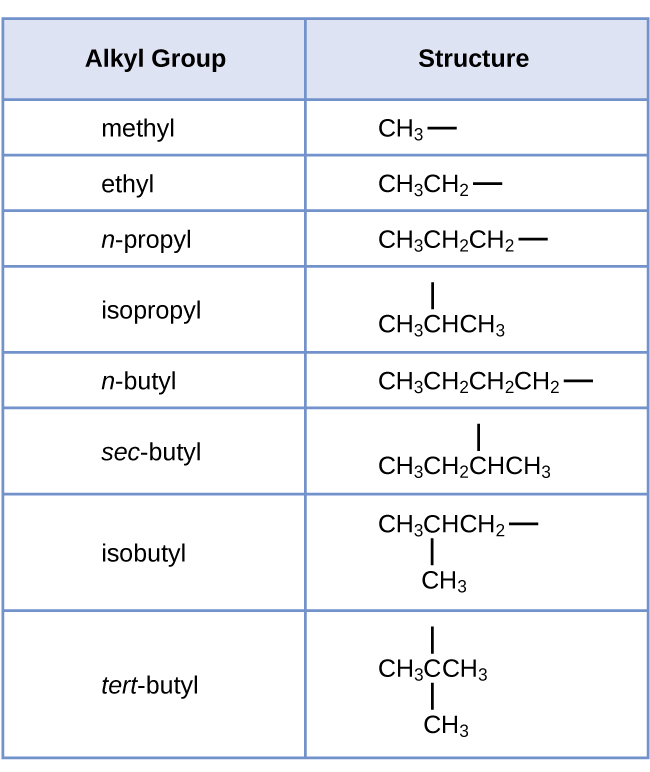
Figure 20.5図 20.5
This listing gives the names and formulas for various alkyl groups formed by the removal of hydrogen atoms from different locations.
この一覧は、異なる位置の水素原子を取り除くことでできる、さまざまなアルキル基の名称と化学式を示す。
Note that alkyl groups do not exist as stable independent entities. They are always a part of some larger molecule. The location of an alkyl group on a hydrocarbon chain is indicated in the same way as any other substituent:
英語のヒント
アルキル基は、安定した独立の実体としては存在しないことに注意しよう。常に、より大きな分子の一部である。炭化水素鎖上のアルキル基の位置は、他の置換基と同じ方法で示す。

Alkanes are relatively stable molecules, but heat or light will activate reactions that involve the breaking of C–H or C–C single bonds. Combustion is one such reaction:
英語のヒント
アルカンは比較的安定な分子だが、熱や光は、C–H単結合やC–C単結合の切断を伴う反応を引き起こす。燃焼はそのような反応の一つである。
Alkanes burn in the presence of oxygen, a highly exothermic oxidation-reduction reaction that produces carbon dioxide and water. As a consequence, alkanes are excellent fuels. For example, methane, CH4, is the principal component of natural gas. Butane, C4H10, used in camping stoves and lighters is an alkane. Gasoline is a liquid mixture of continuous- and branched-chain alkanes, each containing from five to nine carbon atoms, plus various additives to improve its performance as a fuel. Kerosene, diesel oil, and fuel oil are primarily mixtures of alkanes with higher molecular masses. The main source of these liquid alkane fuels is crude oil, a complex mixture that is separated by fractional distillation. Fractional distillation takes advantage of differences in the boiling points of the components of the mixture (see Figure 20.6). You may recall that boiling point is a function of intermolecular interactions, which was discussed in the chapter on solutions and colloids.
英語のヒント
アルカンは酸素の存在下で燃焼する。これは、二酸化炭素と水を生じる、非常に発熱性の高い酸化還元反応である。そのため、アルカンは優れた燃料である。たとえば、メタンCH4は天然ガスの主成分である。キャンプ用こんろやライターで使われるブタンC4H10もアルカンである。ガソリンは、それぞれ五~九個の炭素原子を含む直鎖アルカンと分岐鎖アルカンに、燃料としての性能を高める各種添加剤を加えた液体混合物である。灯油、軽油、燃料油は、主に、より分子質量の大きいアルカンの混合物である。これらの液体アルカン燃料の主な供給源は原油である。原油は複雑な混合物であり、分留によって分離する。分留は、混合物の成分の沸点の違いを利用する(図20.6参照)。溶液とコロイドの章で述べたように、沸点は分子間相互作用によって決まることを思い出そう。
Image omitted because its reuse rights could not be verified.権利の確認ができないため画像を割愛。
Figure 20.6図 20.6
In a column for the fractional distillation of crude oil, oil heated to about 425 °C in the furnace vaporizes when it enters the base of the tower. The vapors rise through bubble caps in a series of trays in the tower. As the vapors gradually cool, fractions of higher, then of lower, boiling points condense to liquids and are drawn off. (credit left: modification of work by Luigi Chiesa)
英語のヒント
原油の分留塔では、炉で約425 °Cに加熱した油が、塔の基部に入ると気化する。蒸気は、塔内の一連の棚段にあるバブルキャップを通って上昇する。蒸気が徐々に冷えるにつれて、まず沸点の高い留分、次に低い留分が液体へ凝縮し、取り出される。(クレジット左:Luigi Chiesaによる作品を改変)
In a substitution reaction, another typical reaction of alkanes, one or more of the alkane’s hydrogen atoms is replaced with a different atom or group of atoms. No carbon-carbon bonds are broken in these reactions, and the hybridization of the carbon atoms does not change. For example, the reaction between ethane and molecular chlorine depicted here is a substitution reaction:
英語のヒント
アルカンのもう一つの代表的な反応である置換反応では、アルカンの一個以上の水素原子が、別の原子または原子団に置き換わる。これらの反応では炭素間結合は切れず、炭素原子の混成も変わらない。たとえば、ここに示すエタンと分子状塩素の反応は、置換反応である。
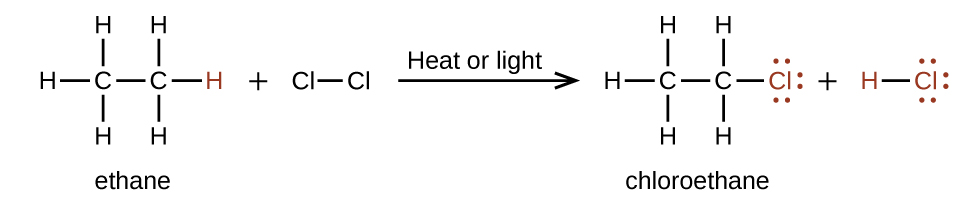


The C–Cl portion of the chloroethane molecule is an example of a functional group, the part or moiety of a molecule that imparts a specific chemical reactivity. The types of functional groups present in an organic molecule are major determinants of its chemical properties and are used as a means of classifying organic compounds as detailed in the remaining sections of this chapter.
英語のヒント
クロロエタン分子のC–Cl部分は、官能基の例である。官能基とは、特定の化学反応性を与える分子の部分または部分構造を指す。有機分子に存在する官能基の種類は、その化学的性質を決める主要因であり、この章の残りの節で詳しく述べるように、有機化合物を分類する手段として使われる。