第20章有機化学
20.1 Hydrocarbons20.1 炭化水素
Learning Objectives学習目標
By the end of this section, you will be able to:
この節を終えると、次のことができるようになる。
- Explain the importance of hydrocarbons and the reason for their diversity炭化水素の重要性と、その多様性の理由を説明する。
- Name saturated and unsaturated hydrocarbons, and molecules derived from them飽和炭化水素、不飽和炭化水素、およびそれらから誘導される分子を命名する。
- Describe the reactions characteristic of saturated and unsaturated hydrocarbons飽和炭化水素と不飽和炭化水素に特徴的な反応を説明する。
- Identify structural and geometric isomers of hydrocarbons炭化水素の構造異性体と幾何異性体を見分ける。
The largest database This is the Beilstein database, now available through the Reaxys site (www.elsevier.com/online-tools/reaxys). of organic compounds lists about 10 million substances, which include compounds originating from living organisms and those synthesized by chemists. The number of potential organic compounds has been estimated Peplow, Mark. “Organic Synthesis: The Robo-Chemist,” Nature 512 (2014): 20–2. at 1060—an astronomically high number. The existence of so many organic molecules is a consequence of the ability of carbon atoms to form up to four strong bonds to other carbon atoms, resulting in chains and rings of many different sizes, shapes, and complexities.
英語のヒント
有機化合物の最大のデータベースには、約1,000万の物質が登録されており、生物に由来する化合物も、化学者が合成した化合物も含まれる。これはバイルシュタイン・データベースで、現在はReaxysのサイト(www.elsevier.com/online-tools/reaxys)から利用できる。存在しうる有機化合物の数は、1060という天文学的に大きな数と推定されている。出典:Mark Peplow「有機合成:ロボット化学者」Nature 512(2014年):20–2。これほど多くの有機分子が存在するのは、炭素原子が他の炭素原子と最大四本の強い結合を作り、さまざまな大きさ、形、複雑さを持つ鎖や環を形成できるためである。
The simplest organic compounds contain only the elements carbon and hydrogen, and are called hydrocarbons. Even though they are composed of only two types of atoms, there is a wide variety of hydrocarbons because they may consist of varying lengths of chains, branched chains, and rings of carbon atoms, or combinations of these structures. In addition, hydrocarbons may differ in the types of carbon-carbon bonds present in their molecules. Many hydrocarbons are found in plants, animals, and their fossils; other hydrocarbons have been prepared in the laboratory. We use hydrocarbons every day, mainly as fuels, such as natural gas, acetylene, propane, butane, and the principal components of gasoline, diesel fuel, and heating oil. The familiar plastics polyethylene, polypropylene, and polystyrene are also hydrocarbons. We can distinguish several types of hydrocarbons by differences in the bonding between carbon atoms. This leads to differences in geometries and in the hybridization of the carbon orbitals.
英語のヒント
最も単純な有機化合物は、元素として炭素と水素だけを含み、炭化水素と呼ばれる。二種類の原子だけからできているにもかかわらず、炭素原子の長さの異なる鎖、枝分かれした鎖、環、またはこれらの構造の組合せからなりうるため、炭化水素には非常に多様なものがある。さらに、分子内の炭素間結合の種類が異なることもある。多くの炭化水素は植物、動物、それらの化石中に見られ、他の炭化水素は実験室で作られてきた。私たちは毎日、炭化水素を主に燃料として使っている。たとえば、天然ガス、アセチレン、プロパン、ブタン、ガソリン・軽油・暖房用燃料油の主成分などである。身近なプラスチックであるポリエチレン、ポリプロピレン、ポリスチレンも炭化水素である。炭素原子間の結合の違いによって、炭化水素をいくつかの種類に区別できる。この違いは、形状と炭素軌道の混成の違いにつながる。
Alkanesアルカン
Alkanes, or saturated hydrocarbons, contain only single covalent bonds between carbon atoms. Each of the carbon atoms in an alkane has sp3 hybrid orbitals and is bonded to four other atoms, each of which is either carbon or hydrogen. The Lewis structures and models of methane, ethane, and pentane are illustrated in Figure 20.2. Carbon chains are usually drawn as straight lines in Lewis structures, but one has to remember that Lewis structures are not intended to indicate the geometry of molecules. Notice that the carbon atoms in the structural models (the ball-and-stick and space-filling models) of the pentane molecule do not lie in a straight line. Because of the sp3 hybridization, the bond angles in carbon chains are close to 109.5°, giving such chains in an alkane a zigzag shape.
英語のヒント
アルカン、すなわち飽和炭化水素は、炭素原子間に単共有結合だけを含む。アルカンの各炭素原子はsp3混成軌道を持ち、炭素または水素である他の四個の原子に結合している。メタン、エタン、ペンタンのルイス構造と模型を図20.2に示す。ルイス構造では炭素鎖を通常直線として描くが、ルイス構造は分子の形状を示すためのものではないことを忘れてはならない。ペンタン分子の構造模型(球棒模型と空間充填模型)の炭素原子は、一直線上に並ばないことに注意しよう。sp3混成のため、炭素鎖の結合角は109.5°に近く、アルカンの鎖はジグザグ形になる。
The structures of alkanes and other organic molecules may also be represented in a less detailed manner by condensed structural formulas (or simply, condensed formulas). Instead of the usual format for chemical formulas in which each element symbol appears just once, a condensed formula is written to suggest the bonding in the molecule. These formulas have the appearance of a Lewis structure from which most or all of the bond symbols have been removed. Condensed structural formulas for ethane and pentane are shown at the bottom of Figure 20.2, and several additional examples are provided in the exercises at the end of this chapter.
英語のヒント
アルカンや他の有機分子の構造は、縮合構造式(単に縮合式ともいう)によって、細部を省いた形でも表せる。各元素記号が一度だけ現れる通常の化学式とは異なり、縮合式は分子内の結合を示唆するように書く。これらの式は、結合記号の大部分またはすべてを取り除いたルイス構造のように見える。エタンとペンタンの縮合構造式を図20.2の下部に示す。この章の終わりの演習には、さらにいくつかの例がある。
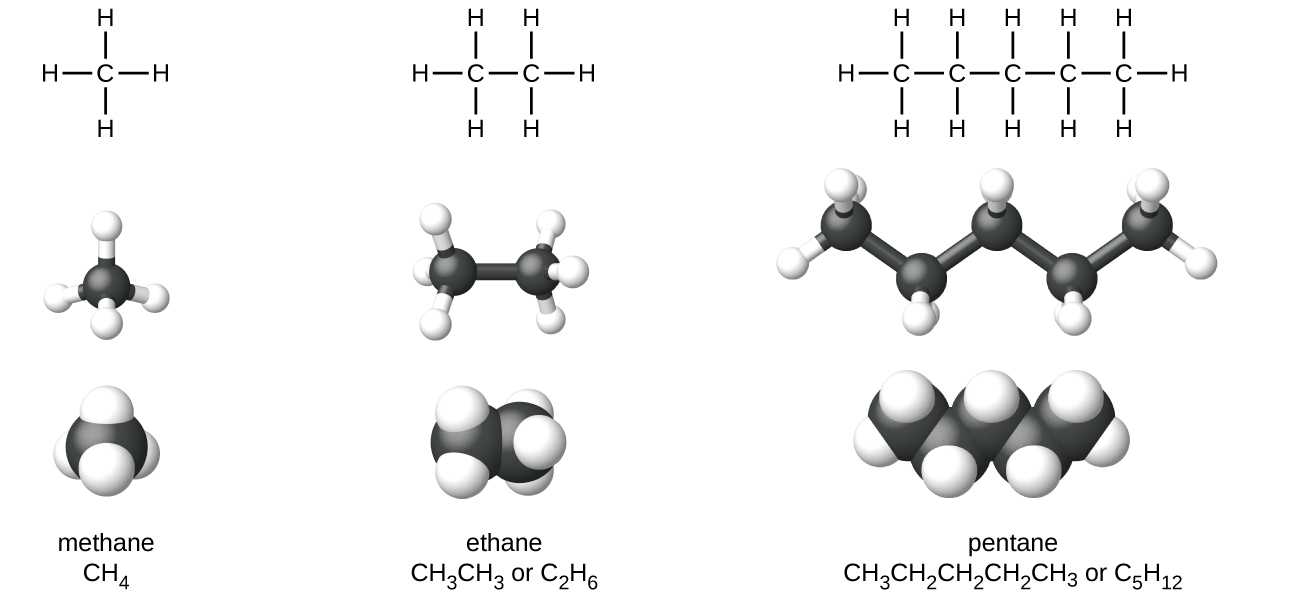
Figure 20.2図 20.2
Pictured are the Lewis structures, ball-and-stick models, and space-filling models for molecules of methane, ethane, and pentane.
メタン、エタン、ペンタンの分子について、ルイス構造、球棒模型、空間充填模型を示している。
A common method used by organic chemists to simplify the drawings of larger molecules is to use a skeletal structure (also called a line-angle structure). In this type of structure, carbon atoms are not symbolized with a C, but represented by each end of a line or bend in a line. Hydrogen atoms are not drawn if they are attached to a carbon. Other atoms besides carbon and hydrogen are represented by their elemental symbols. Figure 20.3 shows three different ways to draw the same structure.
英語のヒント
有機化学者が大きな分子の図を簡単にするためによく使う方法は、骨格式(線角構造式ともいう)を用いることである。この種類の構造式では、炭素原子をCの記号では表さず、線の各端や折れ曲がりによって表す。炭素に結合する水素原子は描かない。炭素と水素以外の原子は、それぞれの元素記号で表す。図20.3は、同じ構造を描く三つの異なる方法を示す。
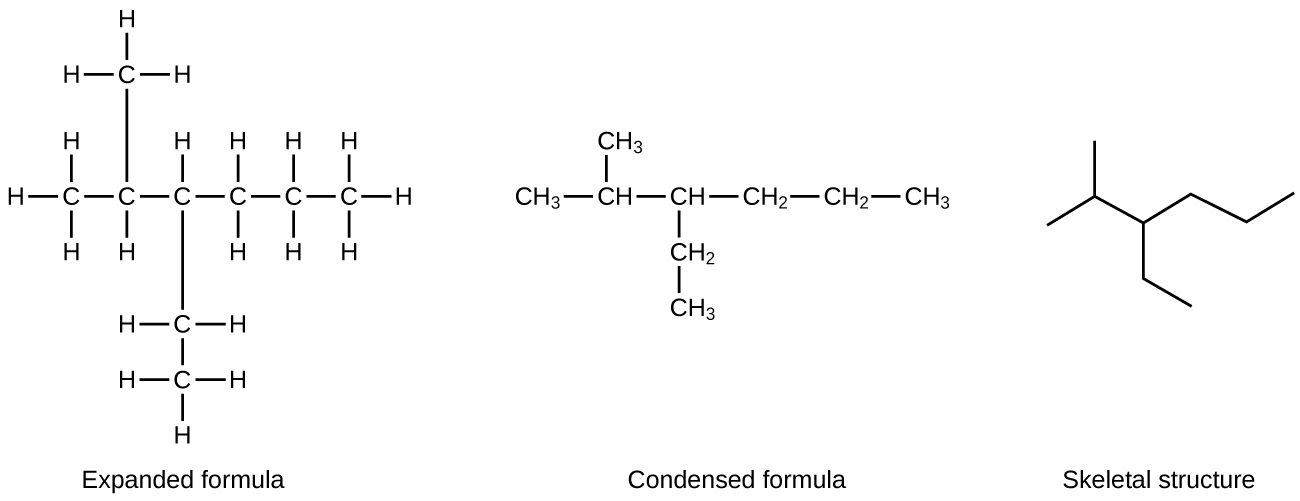
Figure 20.3図 20.3
The same structure can be represented three different ways: an expanded formula, a condensed formula, and a skeletal structure.
同じ構造を、展開式、縮合式、骨格式という三つの異なる方法で表すことができる。
Example 20.1例題 20.1
Drawing Skeletal Structures骨格式を描く
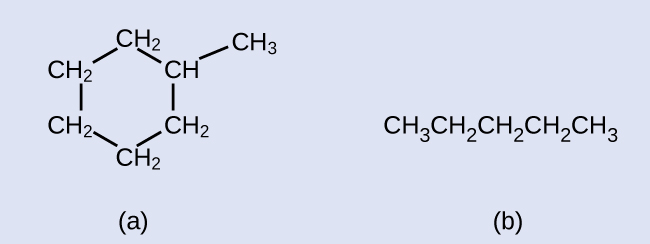
Draw the skeletal structures for these two molecules:
次の二つの分子の骨格式を描きなさい。
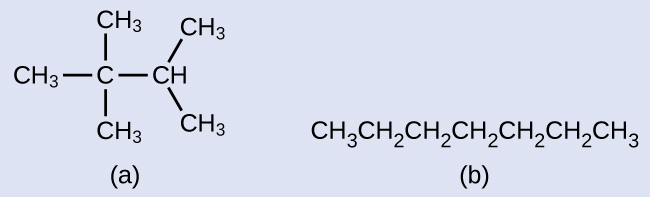
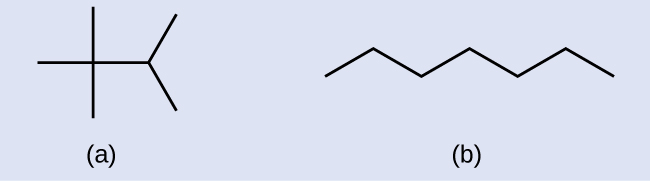
Solution解答
Each carbon atom is converted into the end of a line or the place where lines intersect. All hydrogen atoms attached to the carbon atoms are left out of the structure (although we still need to recognize they are there):
英語のヒント
各炭素原子を、線の端または線の交点に置き換える。炭素原子に結合するすべての水素原子を構造式から省く(ただし、そこに存在することは認識しておく必要がある)。
Check Your Learning理解を確認しよう
Draw the skeletal structures for these two molecules:
次の二つの分子の骨格式を描きなさい。
Example 20.2例題 20.2
Interpreting Skeletal Structures骨格式を読み取る
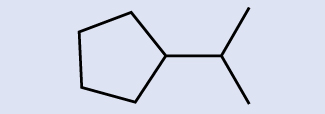
Identify the chemical formula of the molecule represented here:
ここに示す分子の化学式を求めなさい。
Solution解答
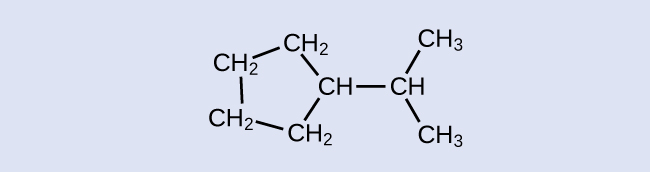
There are eight places where lines intersect or end, meaning that there are eight carbon atoms in the molecule. Since we know that carbon atoms tend to make four bonds, each carbon atom will have the number of hydrogen atoms that are required for four bonds. This compound contains 16 hydrogen atoms for a molecular formula of C8H16.
線が交わる点または終わる点は八つあり、分子に炭素原子が八個あることを意味する。炭素原子は四本の結合を作る傾向があることが分かっているので、各炭素原子には、四本の結合に必要な数の水素原子が結合する。この化合物は水素原子を16個含み、分子式はC8H16である。
Location of the hydrogen atoms:
水素原子の位置:
Check Your Learning理解を確認しよう
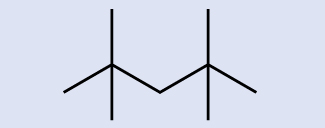
Identify the chemical formula of the molecule represented here:
ここに示す分子の化学式を求めなさい。
All alkanes are composed of carbon and hydrogen atoms, and have similar bonds, structures, and formulas; noncyclic alkanes all have a formula of CnH2n+2. The number of carbon atoms present in an alkane has no limit. Greater numbers of atoms in the molecules will lead to stronger intermolecular attractions (dispersion forces) and correspondingly different physical properties of the molecules. Properties such as melting point and boiling point (Table 20.1) usually change smoothly and predictably as the number of carbon and hydrogen atoms in the molecules change.
英語のヒント
すべてのアルカンは炭素原子と水素原子からなり、似た結合、構造、化学式を持つ。非環式アルカンは、すべてCnH2n+2という化学式を持つ。アルカンに含まれる炭素原子の数に上限はない。分子内の原子数が多いほど、分子間引力(分散力)が強くなり、それに応じて分子の物理的性質も異なる。融点や沸点(表20.1)などの性質は、通常、分子内の炭素原子と水素原子の数が変化するにつれて、なめらかに、予測可能な形で変化する。
Properties of Some Alkanes Physical properties for C4H10 and heavier molecules are those of the normal isomer, n-butane, n-pentane, etc. いくつかのアルカンの性質。C4H10およびそれより重い分子の物理的性質は、n-ブタン、n-ペンタンなど、ノルマル異性体のものである。 |
|||||
|---|---|---|---|---|---|
Alkane アルカン |
Molecular Formula 分子式 |
Melting Point (°C) 融点(°C) |
Boiling Point (°C) 沸点(°C) |
Phase at STP STP indicates a temperature of 0 °C and a pressure of 1 atm. STPでの相。STPは温度0 °C、圧力1 atmを表す。 |
Number of Structural Isomers 構造異性体の数 |
methane メタン |
CH4 |
–182.5 |
–161.5 |
gas 気体 |
1 |
ethane エタン |
C2H6 |
–183.3 |
–88.6 |
gas 気体 |
1 |
propane プロパン |
C3H8 |
–187.7 |
–42.1 |
gas 気体 |
1 |
butane ブタン |
C4H10 |
–138.3 |
–0.5 |
gas 気体 |
2 |
pentane ペンタン |
C5H12 |
–129.7 |
36.1 |
liquid 液体 |
3 |
hexane ヘキサン |
C6H14 |
–95.3 |
68.7 |
liquid 液体 |
5 |
heptane ヘプタン |
C7H16 |
–90.6 |
98.4 |
liquid 液体 |
9 |
octane オクタン |
C8H18 |
–56.8 |
125.7 |
liquid 液体 |
18 |
nonane ノナン |
C9H20 |
–53.6 |
150.8 |
liquid 液体 |
35 |
decane デカン |
C10H22 |
–29.7 |
174.0 |
liquid 液体 |
75 |
tetradecane テトラデカン |
C14H30 |
5.9 |
253.5 |
solid 固体 |
1858 |
octadecane オクタデカン |
C18H38 |
28.2 |
316.1 |
solid 固体 |
60,523 |
Hydrocarbons with the same formula, including alkanes, can have different structures. For example, two alkanes have the formula C4H10: They are called n-butane and 2-methylpropane (or isobutane), and have the following Lewis structures:
アルカンを含め、同じ化学式を持つ炭化水素でも、異なる構造を持つことがある。たとえば、C4H10という化学式を持つアルカンは二つあり、n-ブタンと2-メチルプロパン(またはイソブタン)と呼ばれる。それぞれ次のルイス構造を持つ。
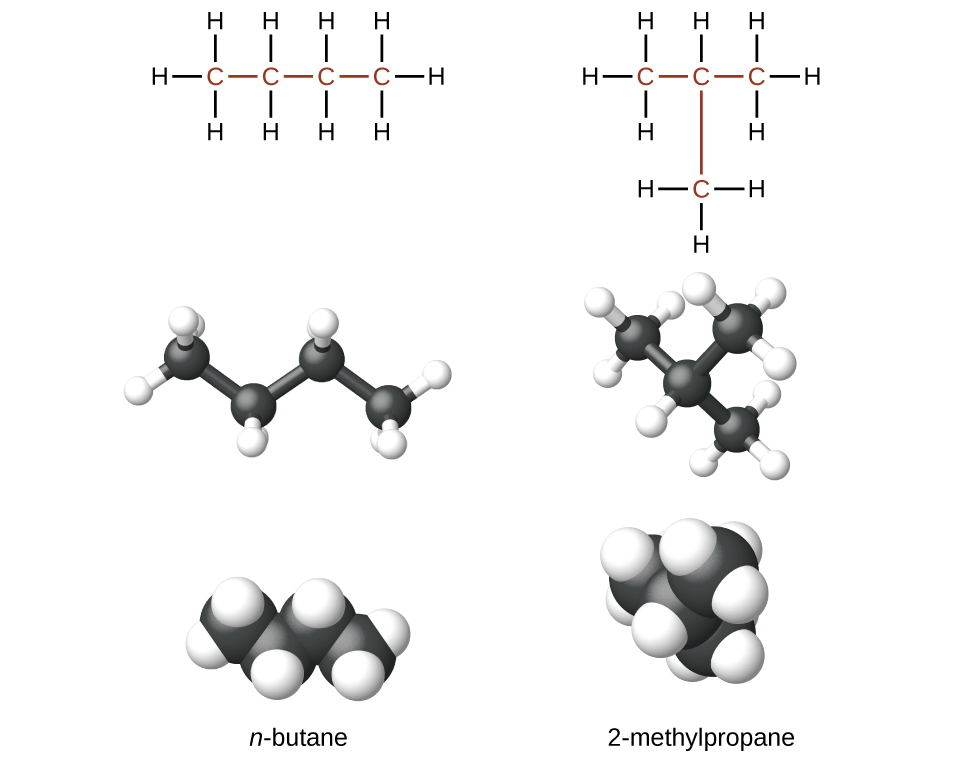
The compounds n-butane and 2-methylpropane are structural isomers (the term constitutional isomers is also commonly used). Constitutional isomers have the same molecular formula but different spatial arrangements of the atoms in their molecules. The n-butane molecule contains an unbranched chain, meaning that no carbon atom is bonded to more than two other carbon atoms. We use the term normal, or the prefix n, to refer to a chain of carbon atoms without branching. The compound 2–methylpropane has a branched chain (the carbon atom in the center of the Lewis structure is bonded to three other carbon atoms)
英語のヒント
n-ブタンと2-メチルプロパンは、構造異性体である(英語ではconstitutional isomersという用語も広く使われる)。構造異性体は同じ分子式を持つが、分子内の原子の空間配置が異なる。n-ブタン分子は枝分かれのない鎖を含む。つまり、他の炭素原子二個より多くに結合する炭素原子はない。枝分かれのない炭素原子の鎖を指すために、ノルマルという語、または接頭辞nを用いる。2-メチルプロパンは枝分かれした鎖を持つ(ルイス構造の中央の炭素原子が、他の三個の炭素原子に結合している)。
Identifying isomers from Lewis structures is not as easy as it looks. Lewis structures that look different may actually represent the same isomers. For example, the three structures in Figure 20.4 all represent the same molecule, n-butane, and hence are not different isomers. They are identical because each contains an unbranched chain of four carbon atoms.
英語のヒント
ルイス構造から異性体を見分けるのは、見た目ほど簡単ではない。異なって見えるルイス構造でも、実際には同じ異性体を表していることがある。たとえば、図20.4の三つの構造は、すべて同じ分子であるn-ブタンを表しており、異なる異性体ではない。どれも四個の炭素原子からなる枝分かれのない鎖を含むため、同一である。
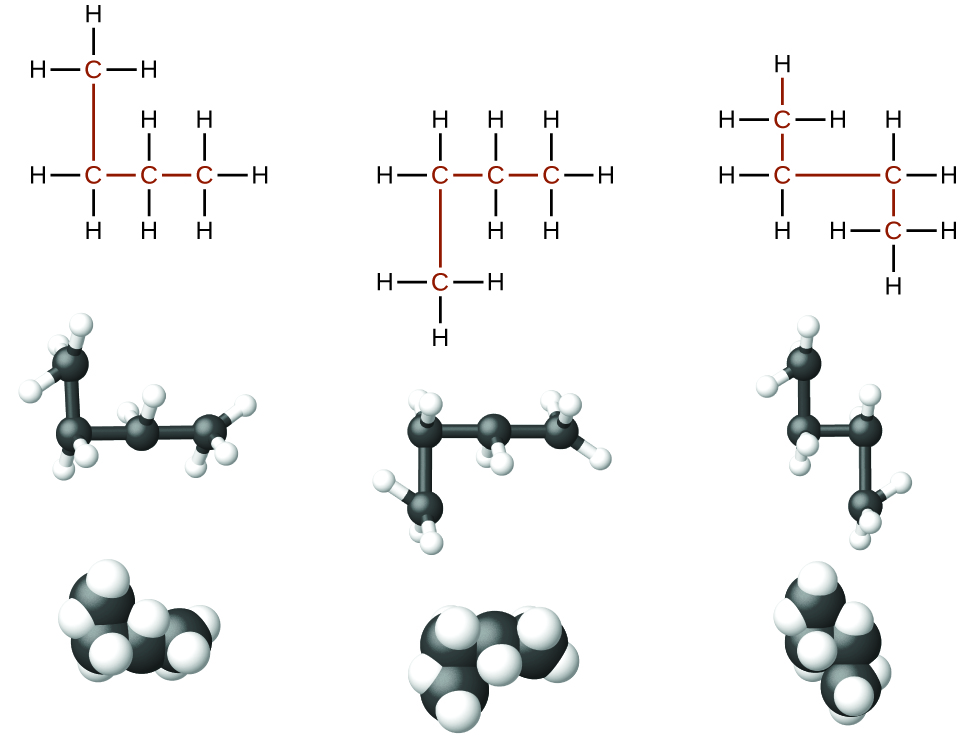


Figure 20.4図 20.4
These three representations of the structure of n-butane are not isomers because they all contain the same arrangement of atoms and bonds.
n-ブタンの構造を表すこの三つの表現は、原子と結合の配置がすべて同じなので、異性体ではない。