第20章有機化学
20.3 Aldehydes, Ketones, Carboxylic Acids, and Esters20.3 アルデヒド、ケトン、カルボン酸、エステル
Learning Objectives学習目標
By the end of this section, you will be able to:
この節を終えると、次のことができるようになる。
- Describe the structure and properties of aldehydes, ketones, carboxylic acids and estersアルデヒド、ケトン、カルボン酸、エステルの構造と性質を説明する。
Another class of organic molecules contains a carbon atom connected to an oxygen atom by a double bond, commonly called a carbonyl group. The trigonal planar carbon in the carbonyl group can attach to two other substituents leading to several subfamilies (aldehydes, ketones, carboxylic acids and esters) described in this section.
英語のヒント
別の種類の有機分子は、一般にカルボニル基と呼ばれる、炭素原子が酸素原子に二重結合した部分を含む。カルボニル基の平面三角形の炭素は、他の二つの置換基と結合でき、この節で述べるいくつかの下位の種類(アルデヒド、ケトン、カルボン酸、エステル)を生じる。
Aldehydes and Ketonesアルデヒドとケトン
Both aldehydes and ketones contain a carbonyl group, a functional group with a carbon-oxygen double bond. The names for aldehyde and ketone compounds are derived using similar nomenclature rules as for alkanes and alcohols, and include the class-identifying suffixes -al and -one, respectively:
英語のヒント
アルデヒドとケトンはどちらも、炭素と酸素の二重結合を持つ官能基、カルボニル基を含む。アルデヒド化合物とケトン化合物の名称は、アルカンやアルコールと似た命名規則で作り、種類を示す接尾辞として、それぞれ-alと-oneを含む。

In an aldehyde, the carbonyl group is bonded to at least one hydrogen atom. In a ketone, the carbonyl group is bonded to two carbon atoms:
アルデヒドでは、カルボニル基は少なくとも一個の水素原子に結合している。ケトンでは、カルボニル基は二個の炭素原子に結合している。
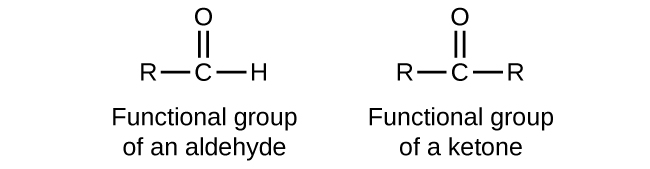
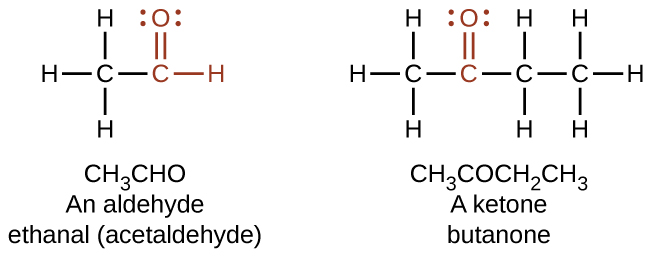
As text, an aldehyde group is represented as –CHO; a ketone is represented as –C(O)– or –CO–.
文字では、アルデヒド基を–CHO、ケトンを–C(O)–または–CO–と表す。
In both aldehydes and ketones, the geometry around the carbon atom in the carbonyl group is trigonal planar; the carbon atom exhibits sp2 hybridization. Two of the sp2 orbitals on the carbon atom in the carbonyl group are used to form σ bonds to the other carbon or hydrogen atoms in a molecule. The remaining sp2 hybrid orbital forms a σ bond to the oxygen atom. The unhybridized p orbital on the carbon atom in the carbonyl group overlaps a p orbital on the oxygen atom to form the π bond in the double bond.
アルデヒドでもケトンでも、カルボニル基の炭素原子の周囲の形状は平面三角形であり、炭素原子はsp2混成している。カルボニル基の炭素原子の二つのsp2軌道は、分子内の他の炭素原子や水素原子とのσ結合を作るために使われる。残るsp2混成軌道は、酸素原子とのσ結合を作る。カルボニル基の炭素原子上の混成していないp軌道が、酸素原子上のp軌道と重なり、二重結合のπ結合を作る。
Like the bond in carbon dioxide, the bond of a carbonyl group is polar (recall that oxygen is significantly more electronegative than carbon, and the shared electrons are pulled toward the oxygen atom and away from the carbon atom). Many of the reactions of aldehydes and ketones start with the reaction between a Lewis base and the carbon atom at the positive end of the polar bond to yield an unstable intermediate that subsequently undergoes one or more structural rearrangements to form the final product (Figure 20.14).
英語のヒント
二酸化炭素の結合と同様に、カルボニル基の結合は極性を持つ(酸素は炭素よりはるかに電気陰性度が高く、共有電子は炭素原子から離れ、酸素原子へ引き寄せられることを思い出そう)。アルデヒドとケトンの多くの反応は、ルイス塩基と、極性のある結合の正の端にある炭素原子との反応から始まる。その反応で不安定な中間体が生じ、続いて一つ以上の構造の再配列を経て、最終生成物を作る(図20.14)。
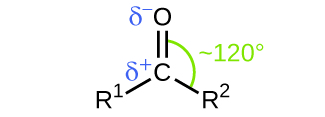
Figure 20.14図 20.14
The carbonyl group is polar, and the geometry of the bonds around the central carbon is trigonal planar.
カルボニル基は極性を持ち、中心の炭素の周囲の結合の形状は平面三角形である。
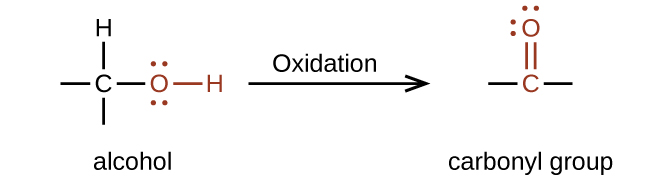
The importance of molecular structure in the reactivity of organic compounds is illustrated by the reactions that produce aldehydes and ketones. We can prepare a carbonyl group by oxidation of an alcohol—for organic molecules, oxidation of a carbon atom is said to occur when a carbon-hydrogen bond is replaced by a carbon-oxygen bond. The reverse reaction—replacing a carbon-oxygen bond by a carbon-hydrogen bond—is a reduction of that carbon atom. Recall that oxygen is generally assigned a –2 oxidation number unless it is elemental or attached to a fluorine. Hydrogen is generally assigned an oxidation number of +1 unless it is attached to a metal. Since carbon does not have a specific rule, its oxidation number is determined algebraically by factoring the atoms it is attached to and the overall charge of the molecule or ion. In general, a carbon atom attached to an oxygen atom will have a more positive oxidation number and a carbon atom attached to a hydrogen atom will have a more negative oxidation number. This should fit nicely with your understanding of the polarity of C–O and C–H bonds. The other reagents and possible products of these reactions are beyond the scope of this chapter, so we will focus only on the changes to the carbon atoms:
英語のヒント
有機化合物の反応性における分子構造の重要性は、アルデヒドとケトンを作る反応から分かる。アルコールを酸化すると、カルボニル基を作ることができる。有機分子では、炭素と水素の結合が炭素と酸素の結合に置き換わるとき、炭素原子の酸化が起こるという。逆に、炭素と酸素の結合を炭素と水素の結合で置き換える反応は、その炭素原子の還元である。酸素は、単体であるかフッ素に結合している場合を除き、一般に酸化数−2を割り当てられることを思い出そう。水素は、金属に結合している場合を除き、一般に酸化数+1を割り当てられる。炭素には固有の規則がないので、その酸化数は、結合する原子と分子またはイオン全体の電荷を考慮して、代数的に求める。一般に、酸素原子に結合する炭素原子は、より正の酸化数を持ち、水素原子に結合する炭素原子は、より負の酸化数を持つ。これは、C–O結合とC–H結合の極性についての理解と、よく一致するはずである。これらの反応の他の試薬や生成しうる物質は、この章の範囲を超えるため、炭素原子の変化だけに注目する。
Example 20.10例題 20.10
Oxidation and Reduction in Organic Chemistry有機化学における酸化と還元
Methane represents the completely reduced form of an organic molecule that contains one carbon atom. Sequentially replacing each of the carbon-hydrogen bonds with a carbon-oxygen bond would lead to an alcohol, then an aldehyde, then a carboxylic acid (discussed later), and, finally, carbon dioxide:
英語のヒント
メタンは、炭素原子一個を含む有機分子の、完全に還元された形を表す。それぞれの炭素と水素の結合を、炭素と酸素の結合に順次置き換えると、アルコール、次にアルデヒド、次にカルボン酸(後述)、最後に二酸化炭素となる。
What are the oxidation numbers for the carbon atoms in the molecules shown here?
ここに示す分子内の炭素原子の酸化数はいくつか。
Solution解答
In this example, we can calculate the oxidation number (review the chapter on oxidation-reduction reactions if necessary) for the carbon atom in each case (note how this would become difficult for larger molecules with additional carbon atoms and hydrogen atoms, which is why organic chemists use the definition dealing with replacing C–H bonds with C–O bonds described). For CH4, the carbon atom carries a –4 oxidation number (the hydrogen atoms are assigned oxidation numbers of +1 and the carbon atom balances that by having an oxidation number of –4). For the alcohol (in this case, methanol), the carbon atom has an oxidation number of –2 (the oxygen atom is assigned –2, the four hydrogen atoms each are assigned +1, and the carbon atom balances the sum by having an oxidation number of –2; note that compared to the carbon atom in CH4, this carbon atom has lost two electrons so it was oxidized); for the aldehyde, the carbon atom’s oxidation number is 0 (–2 for the oxygen atom and +1 for each hydrogen atom already balances to 0, so the oxidation number for the carbon atom is 0); for the carboxylic acid, the carbon atom’s oxidation number is +2 (two oxygen atoms each at –2 and two hydrogen atoms at +1); and for carbon dioxide, the carbon atom’s oxidation number is +4 (here, the carbon atom needs to balance the –4 sum from the two oxygen atoms).
この例では、各場合について炭素原子の酸化数を計算できる(必要なら酸化還元反応の章を復習しよう)。炭素原子や水素原子がさらに多い大きな分子では、この計算が難しくなることに注意しよう。そのため、有機化学者は、先ほど述べたC–H結合をC–O結合で置き換えることに基づく定義を使う。CH4では、炭素原子の酸化数は−4である(水素原子には酸化数+1を割り当て、炭素原子が酸化数−4を持つことでつり合う)。アルコール(この場合はメタノール)では、炭素原子の酸化数は−2である(酸素原子に−2、四個の水素原子にそれぞれ+1を割り当て、炭素原子が酸化数−2を持つことで合計をつり合わせる。CH4の炭素原子と比べると、この炭素原子は電子を二個失っており、酸化されたことに注意しよう)。アルデヒドでは、炭素原子の酸化数は0である(酸素原子の−2と各水素原子の+1がすでに0につり合うので、炭素原子の酸化数は0となる)。カルボン酸では、炭素原子の酸化数は+2である(酸素原子二個がそれぞれ−2、水素原子二個がそれぞれ+1)。二酸化炭素では、炭素原子の酸化数は+4である(ここでは、炭素原子は二個の酸素原子からの合計−4をつり合わせる必要がある)。
Check Your Learning理解を確認しよう
Indicate whether the marked carbon atoms in the three molecules here are oxidized or reduced relative to the marked carbon atom in ethanol:
ここにある三つの分子の印を付けた炭素原子が、エタノールの印を付けた炭素原子に対して、酸化されているか還元されているかを示しなさい。

There is no need to calculate oxidation states in this case; instead, just compare the types of atoms bonded to the marked carbon atoms:
この場合、酸化状態を計算する必要はない。代わりに、印を付けた炭素原子に結合する原子の種類を比較するだけでよい。
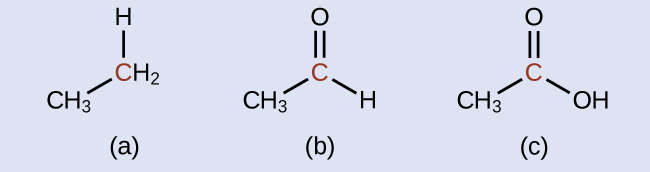
Aldehydes are commonly prepared by the oxidation of alcohols whose –OH functional group is located on the carbon atom at the end of the chain of carbon atoms in the alcohol:
英語のヒント
アルデヒドは通常、–OH官能基が炭素鎖の末端の炭素原子にあるアルコールを、酸化して作る。

Alcohols that have their –OH groups in the middle of the chain are necessary to synthesize a ketone, which requires the carbonyl group to be bonded to two other carbon atoms:
英語のヒント
カルボニル基が他の二個の炭素原子に結合する必要があるケトンを合成するには、–OH基が鎖の途中にあるアルコールが必要である。



An alcohol with its –OH group bonded to a carbon atom that is bonded to no or one other carbon atom will form an aldehyde. An alcohol with its –OH group attached to two other carbon atoms will form a ketone. If three carbons are attached to the carbon bonded to the –OH, the molecule will not have a C–H bond to be replaced, so it will not be susceptible to oxidation.
英語のヒント
–OH基が結合する炭素原子に、他の炭素原子が結合していないか、一個だけ結合しているアルコールは、アルデヒドを作る。–OH基が他の二個の炭素原子に結合したアルコールは、ケトンを作る。–OHに結合した炭素に三個の炭素が結合している場合、その分子には置き換えられるC–H結合がないため、酸化を受けにくい。
Formaldehyde, an aldehyde with the formula HCHO, is a colorless gas with a pungent and irritating odor. It is sold in an aqueous solution called formalin, which contains about 37% formaldehyde by weight. Formaldehyde causes coagulation of proteins, so it kills bacteria (and any other living organism) and stops many of the biological processes that cause tissue to decay. Thus, formaldehyde is used for preserving tissue specimens and embalming bodies. It is also used to sterilize soil or other materials. Formaldehyde is used in the manufacture of Bakelite, a hard plastic having high chemical and electrical resistance.
英語のヒント
化学式HCHOのアルデヒドであるホルムアルデヒドは、鼻を突く刺激臭を持つ無色の気体である。質量で約37%のホルムアルデヒドを含む、ホルマリンと呼ばれる水溶液として販売されている。ホルムアルデヒドはタンパク質を凝固させるため、細菌(および他のあらゆる生物)を殺し、組織を腐敗させる多くの生物学的過程を止める。そのため、組織標本の保存や遺体の防腐処理に使われる。土壌や他の材料の殺菌にも使われる。ホルムアルデヒドは、化学的抵抗性と電気抵抗の高い硬いプラスチック、ベークライトの製造にも使われる。
Dimethyl ketone, CH3COCH3, commonly called acetone, is the simplest ketone. It is made commercially by fermenting corn or molasses, or by oxidation of 2-propanol. Acetone is a colorless liquid. Among its many uses are as a solvent for lacquer (including fingernail polish), cellulose acetate, cellulose nitrate, acetylene, plastics, and varnishes; as a paint and varnish remover; and as a solvent in the manufacture of pharmaceuticals and chemicals.
英語のヒント
一般にアセトンと呼ばれるジメチルケトンCH3COCH3は、最も単純なケトンである。工業的には、トウモロコシや糖蜜を発酵させるか、2-プロパノールを酸化して作る。アセトンは無色の液体である。その多くの用途には、ラッカー(マニキュアを含む)、酢酸セルロース、硝酸セルロース、アセチレン、プラスチック、ワニスの溶媒、塗料やワニスの剥離剤、医薬品や化学薬品の製造での溶媒などがある。