第14章酸塩基平衡
14.7 Acid-Base Titrations14.7 酸塩基滴定
Learning Objectives学習目標
By the end of this section, you will be able to:
この節を学ぶと、次のことができるようになる。
- Interpret titration curves for strong and weak acid-base systems強酸・強塩基系と弱酸・弱塩基系の滴定曲線を読み取る
- Compute sample pH at important stages of a titration滴定の重要な各段階で試料のpHを計算する
- Explain the function of acid-base indicators酸塩基指示薬の働きを説明する
As seen in the chapter on the stoichiometry of chemical reactions, titrations can be used to quantitatively analyze solutions for their acid or base concentrations. In this section, we will explore the underlying chemical equilibria that make acid-base titrimetry a useful analytical technique.
英語のヒント
化学反応の化学量論の章で見たように、滴定を使うと、溶液中の酸や塩基の濃度を定量分析できる。この節では、酸塩基滴定を有用な分析手法にしている、その基礎となる化学平衡を調べる。
Titration Curves滴定曲線
A titration curve is a plot of some solution property versus the amount of added titrant. For acid-base titrations, solution pH is a useful property to monitor because it varies predictably with the solution composition and, therefore, may be used to monitor the titration’s progress and detect its end point. The following example exercise demonstrates the computation of pH for a titration solution after additions of several specified titrant volumes. The first example involves a strong acid titration that requires only stoichiometric calculations to derive the solution pH. The second example addresses a weak acid titration requiring equilibrium calculations.
英語のヒント
滴定曲線は、加えた滴定液の量に対して、溶液の何らかの性質をプロットしたものである。酸塩基滴定では、溶液のpHが観測に有用な性質となる。pHは溶液の組成に応じて予測できる形で変化するため、滴定の進行を追い、終点を検出するために使える。以下の例題では、指定したいくつかの体積の滴定液を加えた後に、滴定される溶液のpHをどう計算するかを示す。第1の例は強酸の滴定であり、化学量論計算だけでpHを求められる。第2の例は弱酸の滴定で、平衡計算が必要になる。
Example 14.21例題 14.21
Calculating pH for Titration Solutions: Strong Acid/Strong Base滴定中の溶液のpH計算:強酸と強塩基
A titration is carried out for 25.00 mL of 0.100 M HCl (strong acid) with 0.100 M of a strong base NaOH (the titration curve is shown in Figure 14.18). Calculate the pH at these volumes of added base solution:
0.100 M HCl(強酸)25.00 mLを、0.100 Mの強塩基NaOHで滴定する(滴定曲線は図14.18)。加えた塩基溶液の体積が次の各値のときのpHを計算しなさい。
(a) 0.00 mL
(a) 0.00 mL
(b) 12.50 mL
(b) 12.50 mL
(c) 25.00 mL
(c) 25.00 mL
(d) 37.50 mL
(d) 37.50 mL
Solution解法
(a) Titrant volume = 0 mL. The solution pH is due to the acid ionization of HCl. Because this is a strong acid, the ionization is complete and the hydronium ion molarity is 0.100 M. The pH of the solution is then
(a) 滴定液の体積 = 0 mL。溶液のpHは、HClの酸としての電離によって決まる。HClは強酸なので完全に電離し、オキソニウムイオンのモル濃度は0.100 Mとなる。したがって、溶液のpHは、
(b) Titrant volume = 12.50 mL. Since the acid sample and the base titrant are both monoprotic and equally concentrated, this titrant addition involves less than a stoichiometric amount of base, and so it is completely consumed by reaction with the excess acid in the sample. The concentration of acid remaining is computed by subtracting the consumed amount from the intial amount and then dividing by the solution volume:
英語のヒント
(b) 滴定液の体積 = 12.50 mL。酸の試料と塩基の滴定液は、どちらも一価で濃度が等しい。この量の滴定液では、塩基は化学量論的に必要な量より少ないため、試料中の過剰な酸との反応で完全に消費される。残った酸の濃度は、初めの量から消費された量を引き、溶液体積で割って計算する。
(c) Titrant volume = 25.00 mL. This titrant addition involves a stoichiometric amount of base (the equivalence point), and so only products of the neutralization reaction are in solution (water and NaCl). Neither the cation nor the anion of this salt undergo acid-base ionization; the only process generating hydronium ions is the autoprotolysis of water. The solution is neutral, having a pH = 7.00.
英語のヒント
(c) 滴定液の体積 = 25.00 mL。加えた塩基が化学量論的に必要な量に達する(当量点)ため、溶液には中和反応の生成物(水とNaCl)だけが存在する。この塩の陽イオンも陰イオンも酸塩基の電離を起こさず、オキソニウムイオンを生じる過程は、水の自己プロトン移動だけである。溶液は中性で、pH = 7.00となる。
(d) Titrant volume = 37.50 mL. This involves the addition of titrant in excess of the equivalence point. The solution pH is then calculated using the concentration of hydroxide ion:
(d) 滴定液の体積 = 37.50 mL。当量点を超えて滴定液を加えている。したがって、溶液のpHは水酸化物イオン濃度から計算する。
pH = 14 − pOH = 14 + log([OH−]) = 14 + log(0.0200) = 12.30
pH = 14 − pOH = 14 + log([OH−]) = 14 + log(0.0200) = 12.30
Check Your Learning理解度の確認
Calculate the pH for the strong acid/strong base titration between 50.0 mL of 0.100 M HNO3(aq) and 0.200 M NaOH (titrant) at the listed volumes of added base: 0.00 mL, 15.0 mL, 25.0 mL, and 40.0 mL.
0.100 M HNO3(aq) 50.0 mLを0.200 M NaOH(滴定液)で滴定する強酸–強塩基滴定について、加えた塩基の体積が0.00 mL、15.0 mL、25.0 mL、40.0 mLの各場合のpHを計算しなさい。
Example 14.22例題 14.22
Titration of a Weak Acid with a Strong Base強塩基による弱酸の滴定
Consider the titration of 25.00 mL of 0.100 M CH3CO2H with 0.100 M NaOH. The reaction can be represented as:
0.100 M CH3CO2H水溶液25.00 mLを、0.100 M NaOHで滴定する場合を考える。反応は次のように表される。
Calculate the pH of the titration solution after the addition of the following volumes of NaOH titrant:
NaOH滴定液を次の各体積だけ加えた後の、滴定中の溶液のpHを計算しなさい。
(a) 0.00 mL
(a) 0.00 mL
(b) 25.00 mL
(b) 25.00 mL
(c) 12.50 mL
(c) 12.50 mL
(d) 37.50 mL
(d) 37.50 mL
Solution解法
(a) The initial pH is computed for the acetic acid solution in the usual ICE approach:
(a) 初期pHは、酢酸水溶液について通常のICE法で計算する。
and
、および
(b) The acid and titrant are both monoprotic and the sample and titrant solutions are equally concentrated; thus, this volume of titrant represents the equivalence point. Unlike the strong-acid example above, however, the reaction mixture in this case contains a weak conjugate base (acetate ion). The solution pH is computed considering the base ionization of acetate, which is present at a concentration of
(b) 酸と滴定液はともに一価で、試料溶液と滴定液の濃度も等しいため、この滴定液の体積は当量点に当たる。しかし、上の強酸の例とは異なり、この場合の反応混合物には、弱い共役塩基である酢酸イオンが含まれる。溶液のpHは、次の濃度で存在する酢酸イオンの塩基としての電離を考えて計算する。
Base ionization of acetate is represented by the equation
酢酸イオンの塩基としての電離は、次の式で表される。
Assuming x << 0.0500, the pH may be calculated via the usual ICE approach:
x << 0.0500と仮定すると、通常のICE法でpHを計算できる。
Note that the pH at the equivalence point of this titration is significantly greater than 7, as expected when titrating a weak acid with a strong base.
弱酸を強塩基で滴定するときに予想されるとおり、この滴定の当量点でのpHは7よりかなり大きいことに注意しよう。
(c) Titrant volume = 12.50 mL. This volume represents one-half of the stoichiometric amount of titrant, and so one-half of the acetic acid has been neutralized to yield an equivalent amount of acetate ion. The concentrations of these conjugate acid-base partners, therefore, are equal. A convenient approach to computing the pH is use of the Henderson-Hasselbalch equation:
(c) 滴定液の体積 = 12.50 mL。この体積は化学量論的に必要な滴定液量の半分なので、酢酸の半分が中和され、同じ物質量の酢酸イオンが生じている。したがって、この共役酸塩基対の濃度は等しい。pHを計算するには、ヘンダーソン–ハッセルバルヒの式を使うと便利である。
(pH = pKa at the half-equivalence point in a titration of a weak acid)
(弱酸の滴定では、半当量点でpH = pKaとなる。)
(d) Titrant volume = 37.50 mL. This volume represents a stoichiometric excess of titrant, and a reaction solution containing both the titration product, acetate ion, and the excess strong titrant. In such solutions, the solution pH is determined primarily by the amount of excess strong base:
(d) 滴定液の体積 = 37.50 mL。この体積では滴定液が化学量論的に過剰となり、反応溶液は滴定の生成物である酢酸イオンと、過剰な強塩基の滴定液の両方を含む。このような溶液のpHは、主に過剰な強塩基の量で決まる。
Check Your Learning理解度の確認
Calculate the pH for the weak acid/strong base titration between 50.0 mL of 0.100 M HCOOH(aq) (formic acid) and 0.200 M NaOH (titrant) at the listed volumes of added base: 0.00 mL, 15.0 mL, 25.0 mL, and 30.0 mL.
0.100 M HCOOH(aq)(ギ酸)50.0 mLを0.200 M NaOH(滴定液)で滴定する弱酸–強塩基滴定について、加えた塩基の体積が0.00 mL、15.0 mL、25.0 mL、30.0 mLの各場合のpHを計算しなさい。
Performing additional calculations similar to those in the preceding example permits a more full assessment of titration curves. A summary of pH/volume data pairs for the strong and weak acid titrations is provided in Table 14.2 and plotted as titration curves in Figure 14.18. A comparison of these two curves illustrates several important concepts that are best addressed by identifying the four stages of a titration:
initial state (added titrant volume = 0 mL): pH is determined by the acid being titrated; because the two acid samples are equally concentrated, the weak acid will exhibit a greater initial pH
初期状態(加えた滴定液の体積 = 0 mL):pHは滴定される酸によって決まる。二つの酸試料は同じ濃度なので、弱酸のほうが初期pHは高い。
pre-equivalence point (0 mL < V < 25 mL): solution pH increases gradually and the acid is consumed by reaction with added titrant; composition includes unreacted acid and the reaction product, its conjugate base
当量点より前(0 mL < V < 25 mL):溶液のpHは徐々に上がり、加えた滴定液との反応によって酸が消費される。溶液は、未反応の酸と、反応生成物であるその共役塩基を含む。
equivalence point (V = 25 mL): a drastic rise in pH is observed as the solution composition transitions from acidic to either neutral (for the strong acid sample) or basic (for the weak acid sample), with pH determined by ionization of the conjugate base of the acid
当量点(V = 25 mL):溶液の組成が酸性から、中性(強酸の試料)または塩基性(弱酸の試料)へ移る際に、pHの急上昇が見られる。pHは、酸の共役塩基の電離によって決まる。
postequivalence point (V > 25 mL): pH is determined by the amount of excess strong base titrant added; since both samples are titrated with the same titrant, both titration curves appear similar at this stage.
当量点より後(V > 25 mL):pHは、過剰に加えた強塩基の滴定液の量によって決まる。両方の試料を同じ滴定液で滴定するので、この段階では二つの滴定曲線は似た形になる。
pH Values in the Titrations of a Strong Acid and of a Weak Acid 強酸と弱酸の滴定におけるpHの値 |
|||
|---|---|---|---|
Volume of 0.100 M NaOH Added (mL) 加えた0.100 M NaOHの体積(mL) |
Moles of NaOH Added 加えたNaOHの物質量(mol) |
pH Values 0.100 M HCl Titration of 25.00 mL of 0.100 M HCl (0.00250 mol of HCI) with 0.100 M NaOH. 0.100 M HClのpH。0.100 M HCl 25.00 mL(HCl 0.00250 mol)を0.100 M NaOHで滴定する。 |
pH Values 0.100 M CH3CO2H Titration of 25.00 mL of 0.100 M CH3CO2H (0.00250 mol of CH3CO2H) with 0.100 M NaOH. 0.100 M CH3CO2HのpH。0.100 M CH3CO2H 25.00 mL(CH3CO2H 0.00250 mol)を0.100 M NaOHで滴定する。 |
0.0 |
0.0 |
1.00 |
2.87 |
5.0 |
0.00050 |
1.18 |
4.14 |
10.0 |
0.00100 |
1.37 |
4.57 |
15.0 |
0.00150 |
1.60 |
4.92 |
20.0 |
0.00200 |
1.95 |
5.35 |
22.0 |
0.00220 |
2.20 |
5.61 |
24.0 |
0.00240 |
2.69 |
6.13 |
24.5 |
0.00245 |
3.00 |
6.44 |
24.9 |
0.00249 |
3.70 |
7.14 |
25.0 |
0.00250 |
7.00 |
8.72 |
25.1 |
0.00251 |
10.30 |
10.30 |
25.5 |
0.00255 |
11.00 |
11.00 |
26.0 |
0.00260 |
11.29 |
11.29 |
28.0 |
0.00280 |
11.75 |
11.75 |
30.0 |
0.00300 |
11.96 |
11.96 |
35.0 |
0.00350 |
12.22 |
12.22 |
40.0 |
0.00400 |
12.36 |
12.36 |
45.0 |
0.00450 |
12.46 |
12.46 |
50.0 |
0.00500 |
12.52 |
12.52 |
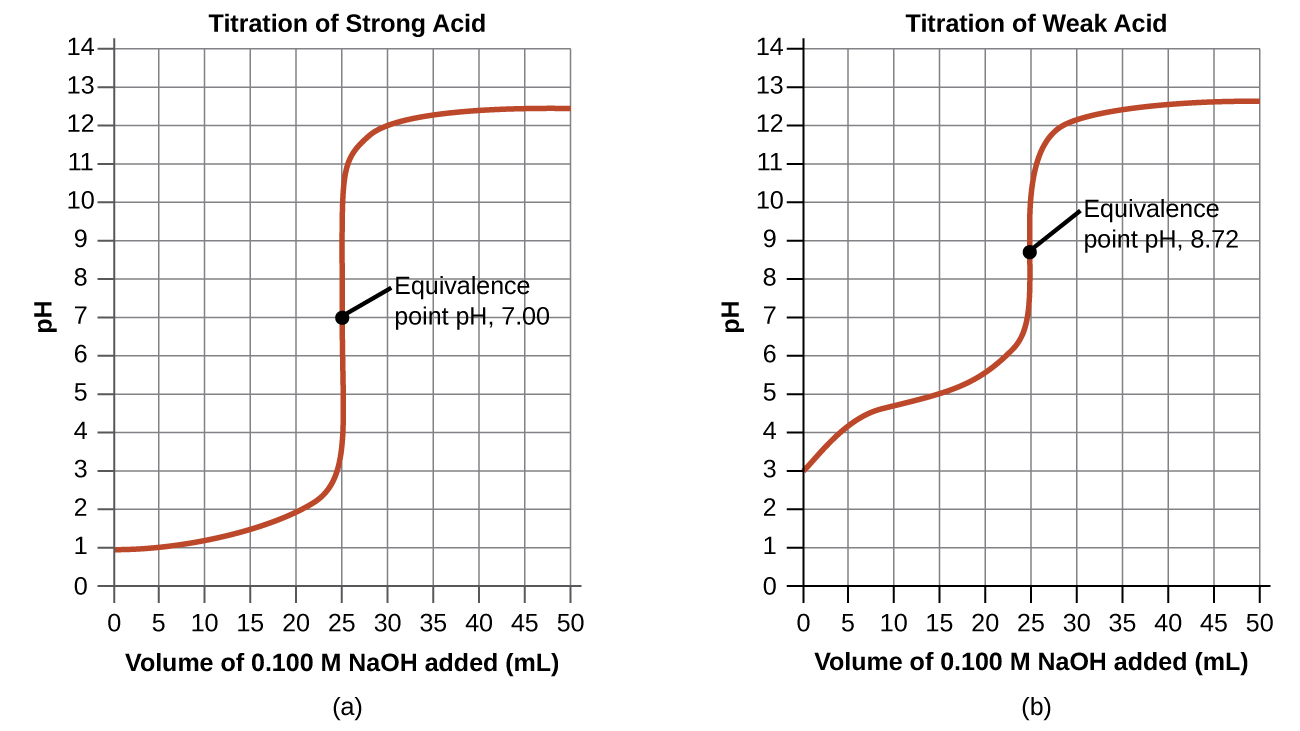

Figure 14.18図 14.18
(a) The titration curve for the titration of 25.00 mL of 0.100 M HCl (strong acid) with 0.100 M NaOH (strong base) has an equivalence point of 7.00 pH. (b) The titration curve for the titration of 25.00 mL of 0.100 M acetic acid (weak acid) with 0.100 M NaOH (strong base) has an equivalence point of 8.72 pH.
(a) 0.100 M HCl(強酸)25.00 mLを0.100 M NaOH(強塩基)で滴定した曲線では、当量点のpHは7.00である。(b) 0.100 M酢酸(弱酸)25.00 mLを0.100 M NaOH(強塩基)で滴定した曲線では、当量点のpHは8.72である。