第14章酸塩基平衡
14.3 Relative Strengths of Acids and Bases14.3 酸と塩基の相対的な強さ
Learning Objectives学習目標
By the end of this section, you will be able to:
この節を学ぶと、次のことができるようになる。
- Assess the relative strengths of acids and bases according to their ionization constants電離定数から酸と塩基の相対的な強さを評価する
- Rationalize trends in acid–base strength in relation to molecular structure酸と塩基の強さの傾向を、分子構造と関連づけて説明する
- Carry out equilibrium calculations for weak acid–base systems弱酸・弱塩基の系の平衡計算を行う
Acid and Base Ionization Constants酸と塩基の電離定数
The relative strength of an acid or base is the extent to which it ionizes when dissolved in water. If the ionization reaction is essentially complete, the acid or base is termed strong; if relatively little ionization occurs, the acid or base is weak. As will be evident throughout the remainder of this chapter, there are many more weak acids and bases than strong ones. The most common strong acids and bases are listed in Figure 14.6.
英語のヒント
酸や塩基の相対的な強さとは、水に溶けたときに電離する程度をいう。電離反応がほぼ完全に進む場合、その酸や塩基を強酸・強塩基といい、電離が比較的わずかしか起こらない場合は弱酸・弱塩基という。本章の残りの部分で明らかになるように、弱酸や弱塩基は、強酸や強塩基よりもはるかに数が多い。代表的な強酸と強塩基を図14.6に挙げる。
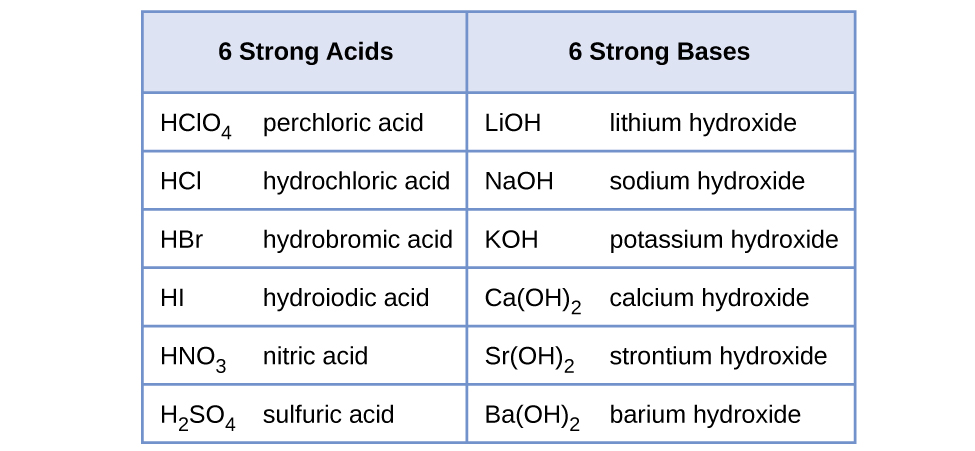

Figure 14.6図 14.6
Some of the common strong acids and bases are listed here.
代表的な強酸と強塩基のいくつかを示す。
The relative strengths of acids may be quantified by measuring their equilibrium constants in aqueous solutions. In solutions of the same concentration, stronger acids ionize to a greater extent, and so yield higher concentrations of hydronium ions than do weaker acids. The equilibrium constant for an acid is called the acid-ionization constant, Ka. For the reaction of an acid HA:
英語のヒント
酸の相対的な強さは、水溶液中の平衡定数を測定することで数値化できる。濃度が同じ溶液では、強い酸ほど電離の程度が大きいため、弱い酸より高いオキソニウムイオン濃度を生じる。酸の平衡定数を酸の電離定数Kaという。酸HAの反応
the acid ionization constant is written
に対して、酸の電離定数は次のように表される。
where the concentrations are those at equilibrium. Although water is a reactant in the reaction, it is the solvent as well, so we do not include [H2O] in the equation. The larger the Ka of an acid, the larger the concentration of and A− relative to the concentration of the nonionized acid, HA, in an equilibrium mixture, and the stronger the acid. An acid is classified as “strong” when it undergoes complete ionization, in which case the concentration of HA is zero and the acid ionization constant is immeasurably large (Ka ≈ ∞). Acids that are partially ionized are called “weak,” and their acid ionization constants may be experimentally measured. A table of ionization constants for weak acids is provided in Appendix H.
英語のヒント
ここで濃度は平衡時の値である。水はこの反応の反応物だが、同時に溶媒でもあるため、式に[H2O]は含めない。酸のKaが大きいほど、平衡混合物中の電離していない酸HAに対するとA−の濃度が大きくなり、その酸は強い。完全に電離する酸は「強酸」に分類される。この場合、HAの濃度はゼロで、酸の電離定数は測定できないほど大きい(Ka ≈ ∞)。一部だけが電離する酸は「弱酸」と呼ばれ、その電離定数は実験で測定できる。弱酸の電離定数の表を付録Hに示す。
To illustrate this idea, three acid ionization equations and Ka values are shown below. The ionization constants increase from first to last of the listed equations, indicating the relative acid strength increases in the order CH3CO2H < HNO2 <
この考えを具体的に示すため、三つの酸の電離反応式とKaの値を以下に挙げる。電離定数は、挙げた反応式の最初から最後へ向かって大きくなり、酸の相対的な強さがCH3CO2H < HNO2 < の順に増すことを示している。
Another measure of the strength of an acid is its percent ionization. The percent ionization of a weak acid is defined in terms of the composition of an equilibrium mixture:
英語のヒント
酸の強さを表す別の尺度は、電離率である。弱酸の電離率は、平衡混合物の組成を使って次のように定義される。
where the numerator is equivalent to the concentration of the acid's conjugate base (per stoichiometry, [A−] = [H3O+]). Unlike the Ka value, the percent ionization of a weak acid varies with the initial concentration of acid, typically decreasing as concentration increases. Equilibrium calculations of the sort described later in this chapter can be used to confirm this behavior.
英語のヒント
ここで分子は、その酸の共役塩基の濃度に等しい(化学量論により、[A−] = [H3O+])。Kaの値とは異なり、弱酸の電離率は酸の初濃度に応じて変化し、通常、濃度が増すほど低下する。このふるまいは、本章の後で説明するような平衡計算によって確かめられる。
Example 14.7例題 14.7
Calculation of Percent Ionization from pHpHから電離率を計算する
Calculate the percent ionization of a 0.125-M solution of nitrous acid (a weak acid), with a pH of 2.09.
pHが2.09である0.125 Mの亜硝酸(弱酸)水溶液の電離率を計算しなさい。
Solution解法
The percent ionization for an acid is:
酸の電離率は、次のとおりである。
Converting the provided pH to hydronium ion molarity yields
与えられたpHをオキソニウムイオンのモル濃度に換算すると、
Substituting this value and the provided initial acid concentration into the percent ionization equation gives
この値と、与えられた酸の初濃度を電離率の式に代入すると、
(Recall the provided pH value of 2.09 is logarithmic, and so it contains just two significant digits, limiting the certainty of the computed percent ionization.)
(与えられたpHの値2.09は対数で表した値なので、有効数字は2桁しかなく、計算した電離率の確かさもそれに制限されることを思い出そう。)
Check Your Learning理解度の確認
Calculate the percent ionization of a 0.10-M solution of acetic acid with a pH of 2.89.
pHが2.89である0.10 M酢酸水溶液の電離率を計算しなさい。
Just as for acids, the relative strength of a base is reflected in the magnitude of its base-ionization constant (Kb) in aqueous solutions. In solutions of the same concentration, stronger bases ionize to a greater extent, and so yield higher hydroxide ion concentrations than do weaker bases. A stronger base has a larger ionization constant than does a weaker base. For the reaction of a base, B:
英語のヒント
酸の場合と同様に、塩基の相対的な強さは、水溶液中での塩基の電離定数(Kb)の大きさに表れる。同じ濃度の溶液では、強い塩基ほど電離の程度が大きいため、弱い塩基より高い水酸化物イオン濃度を生じる。強い塩基の電離定数は、弱い塩基の電離定数より大きい。塩基Bの反応
the ionization constant is written as
に対して、電離定数は次のように表される。
Inspection of the data for three weak bases presented below shows the base strength increases in the order
英語のヒント
以下の三つの弱塩基のデータを見ると、塩基の強さがの順に増すことがわかる。
A table of ionization constants for weak bases appears in Appendix I. As for acids, the relative strength of a base is also reflected in its percent ionization, computed as
弱塩基の電離定数の表を付録Iに示す。酸と同様に、塩基の相対的な強さも電離率に表れる。電離率は次式で計算されるが、
but will vary depending on the base ionization constant and the initial concentration of the solution.
塩基の電離定数と溶液の初濃度によって変化する。