第14章酸塩基平衡
14.1 Brønsted-Lowry Acids and Bases14.1 ブレンステッド・ローリーの酸と塩基
Learning Objectives学習目標
By the end of this section, you will be able to:
この節を学ぶと、次のことができるようになる。
- Identify acids, bases, and conjugate acid-base pairs according to the Brønsted-Lowry definitionブレンステッド・ローリーの定義に従って、酸、塩基、共役酸塩基対を特定する
- Write equations for acid and base ionization reactions酸と塩基の電離反応の式を書く
- Use the ion-product constant for water to calculate hydronium and hydroxide ion concentrations水のイオン積定数を使って、オキソニウムイオン濃度と水酸化物イオン濃度を計算する
- Describe the acid-base behavior of amphiprotic substances両性物質の酸塩基としてのふるまいを説明する
The acid-base reaction class has been studied for quite some time. In 1680, Robert Boyle reported traits of acid solutions that included their ability to dissolve many substances, to change the colors of certain natural dyes, and to lose these traits after coming in contact with alkali (base) solutions. In the eighteenth century, it was recognized that acids have a sour taste, react with limestone to liberate a gaseous substance (now known to be CO2), and interact with alkalis to form neutral substances. In 1815, Humphry Davy contributed greatly to the development of the modern acid-base concept by demonstrating that hydrogen is the essential constituent of acids. Around that same time, Joseph Louis Gay-Lussac concluded that acids are substances that can neutralize bases and that these two classes of substances can be defined only in terms of each other. The significance of hydrogen was reemphasized in 1884 when Svante Arrhenius defined an acid as a compound that dissolves in water to yield hydrogen cations (now recognized to be hydronium ions) and a base as a compound that dissolves in water to yield hydroxide anions.
英語のヒント
酸塩基反応は、長い間研究されてきた。1680年、ロバート・ボイルは酸性溶液の性質として、多くの物質を溶かすこと、特定の天然色素の色を変えること、アルカリ(塩基)溶液に触れるとそれらの性質を失うことを報告した。18世紀には、酸は酸味を持ち、石灰岩と反応して気体(現在ではCO2とわかっている)を放出し、アルカリと反応して中性の物質を作ると認識されるようになった。1815年、ハンフリー・デービーは、水素が酸の不可欠な構成成分であることを示し、現代の酸塩基概念の発展に大きく貢献した。同じ頃、ジョゼフ・ルイ・ゲイ=リュサックは、酸は塩基を中和できる物質であり、この二種類の物質は互いの関係によってのみ定義できると結論づけた。1884年、スヴァンテ・アレニウスは、水に溶けて水素陽イオン(現在ではヒドロニウムイオンと認識される)を生じる化合物を酸、水に溶けて水酸化物陰イオンを生じる化合物を塩基と定義した。これにより、水素の重要性が改めて強調された。
Johannes Brønsted and Thomas Lowry proposed a more general description in 1923 in which acids and bases were defined in terms of the transfer of hydrogen ions, H+. (Note that these hydrogen ions are often referred to simply as protons, since that subatomic particle is the only component of cations derived from the most abundant hydrogen isotope, 1H.) A compound that donates a proton to another compound is called a Brønsted-Lowry acid, and a compound that accepts a proton is called a Brønsted-Lowry base. An acid-base reaction is, thus, the transfer of a proton from a donor (acid) to an acceptor (base).
英語のヒント
1923年、ヨハネス・ブレンステッドとトマス・ローリーは、水素イオンH+の移動によって酸と塩基を定義する、より一般的な説明を提案した。この水素イオンは、単にプロトン、すなわち陽子と呼ばれることが多い。最も豊富な水素同位体1Hからできる陽イオンは、この素粒子だけでできているためである。ほかの化合物へプロトンを与える化合物をブレンステッド・ローリーの酸、プロトンを受け取る化合物をブレンステッド・ローリーの塩基という。したがって酸塩基反応とは、供与体である酸から、受容体である塩基へのプロトンの移動である。
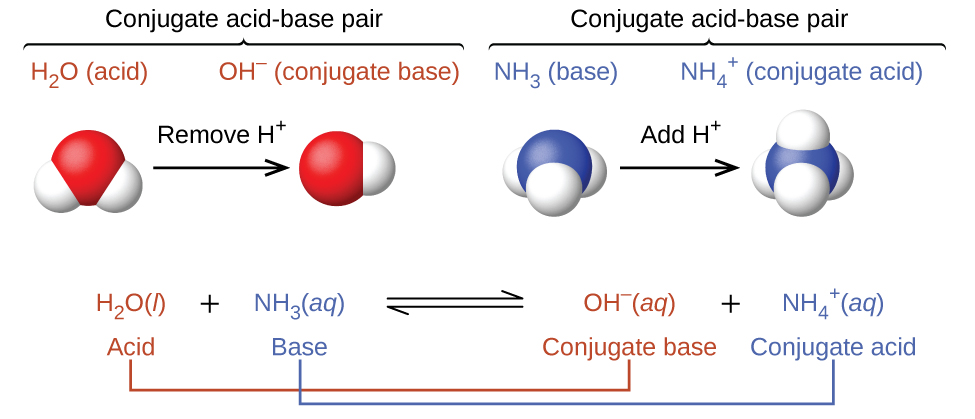
The concept of conjugate pairs is useful in describing Brønsted-Lowry acid-base reactions (and other reversible reactions, as well). When an acid donates H+, the species that remains is called the conjugate base of the acid because it reacts as a proton acceptor in the reverse reaction. Likewise, when a base accepts H+, it is converted to its conjugate acid. The reaction between water and ammonia illustrates this idea. In the forward direction, water acts as an acid by donating a proton to ammonia and subsequently becoming a hydroxide ion, OH−, the conjugate base of water. The ammonia acts as a base in accepting this proton, becoming an ammonium ion, the conjugate acid of ammonia. In the reverse direction, a hydroxide ion acts as a base in accepting a proton from ammonium ion, which acts as an acid.
英語のヒント
ブレンステッド・ローリーの酸塩基反応や、ほかの可逆反応を説明するには、共役対の概念が役立つ。酸がH+を与えた後に残る化学種を、その酸の共役塩基という。逆反応では、プロトンを受け取るものとして働くためである。同様に、塩基がH+を受け取ると、その共役酸になる。水とアンモニアの反応を使って、この考えを示そう。正方向では、水はアンモニアにプロトンを与える酸として働き、その後、水の共役塩基である水酸化物イオンOH−になる。アンモニアはこのプロトンを受け取る塩基として働き、自らの共役酸であるアンモニウムイオンになる。逆方向では、水酸化物イオンが塩基として働き、酸として働くアンモニウムイオンからプロトンを受け取る。
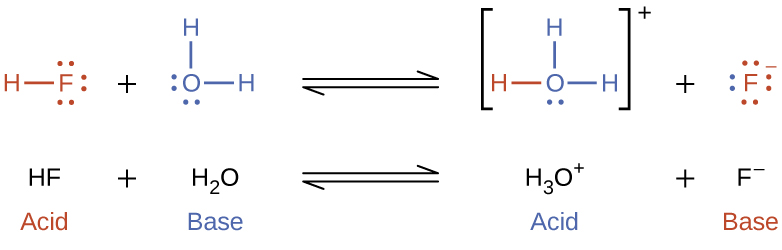
The reaction between a Brønsted-Lowry acid and water is called acid ionization. For example, when hydrogen fluoride dissolves in water and ionizes, protons are transferred from hydrogen fluoride molecules to water molecules, yielding hydronium ions and fluoride ions:
英語のヒント
ブレンステッド・ローリーの酸と水の反応を、酸の電離という。例えば、フッ化水素が水に溶けて電離すると、フッ化水素分子から水分子へプロトンが移り、ヒドロニウムイオンとフッ化物イオンが生じる。
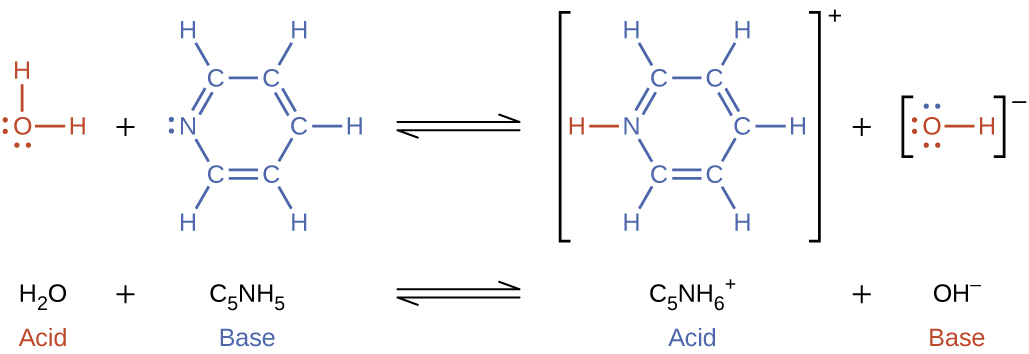
Base ionization of a species occurs when it accepts protons from water molecules. In the example below, pyridine molecules, C5NH5, undergo base ionization when dissolved in water, yielding hydroxide and pyridinium ions:
英語のヒント
ある化学種が水分子からプロトンを受け取るとき、塩基の電離が起こる。次の例では、ピリジン分子C5NH5が水に溶けると塩基として電離し、水酸化物イオンとピリジニウムイオンを生じる。
The preceding ionization reactions suggest that water may function as both a base (as in its reaction with hydrogen fluoride) and an acid (as in its reaction with ammonia). Species capable of either donating or accepting protons are called amphiprotic, or more generally, amphoteric, a term that may be used for acids and bases per definitions other than the Brønsted-Lowry one. The equations below show the two possible acid-base reactions for two amphiprotic species, bicarbonate ion and water:
英語のヒント
以上の電離反応から、水は塩基としても(フッ化水素との反応)、酸としても(アンモニアとの反応)働けることがわかる。プロトンを与えることも受け取ることもできる化学種を、両性プロトン性という。より一般的には両性ともいう。両性という語は、ブレンステッド・ローリー以外の定義に基づく酸と塩基にも使える。次の式は、二つの両性プロトン性の化学種、炭酸水素イオンと水について、可能な二つの酸塩基反応を示す。
The first equation represents the reaction of bicarbonate as an acid with water as a base, whereas the second represents reaction of bicarbonate as a base with water as an acid. When bicarbonate is added to water, both these equilibria are established simultaneously and the composition of the resulting solution may be determined through appropriate equilibrium calculations, as described later in this chapter.
英語のヒント
最初の式では、炭酸水素イオンが酸、水が塩基として反応する。二つ目では、炭酸水素イオンが塩基、水が酸として反応する。炭酸水素イオンを水に加えると、二つの平衡が同時に成立する。できた溶液の組成は、この章の後半で説明する適切な平衡計算によって求められる。
In the liquid state, molecules of an amphiprotic substance can react with one another as illustrated for water in the equations below:
液体状態では、両性プロトン性物質の分子どうしが反応できる。次の式に、水を例として示す。
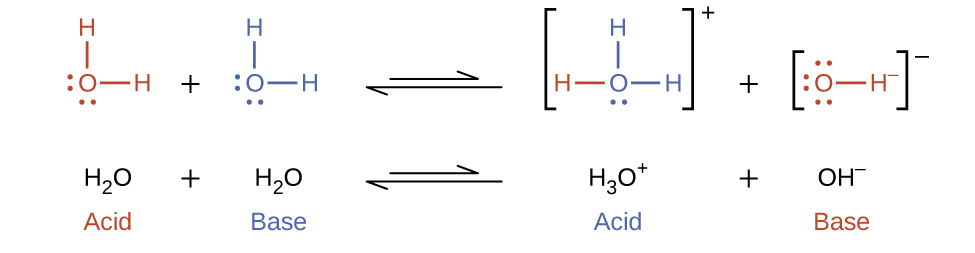


The process in which like molecules react to yield ions is called autoionization. Liquid water undergoes autoionization to a very slight extent; at 25 °C, approximately two out of every billion water molecules are ionized. The extent of the water autoionization process is reflected in the value of its equilibrium constant, the ion-product constant for water, Kw:
英語のヒント
同種の分子どうしが反応してイオンを生じる過程を、自己電離という。液体の水はごくわずかに自己電離しており、25 °Cでは水分子10億個につき約2個が電離している。その進み具合は、平衡定数である水のイオン積Kwに表れる。
The slight ionization of pure water is reflected in the small value of the equilibrium constant; at 25 °C, Kw has a value of 1.0 10−14. The process is endothermic, and so the extent of ionization and the resulting concentrations of hydronium ion and hydroxide ion increase with temperature. For example, at 100 °C, the value for Kw is about 5.6 10−13, roughly 50 times larger than the value at 25 °C.
純水の電離がわずかであることは、小さい平衡定数に表れている。25 °CでKwは1.0 10−14である。この過程は吸熱的なので、温度が上がると電離の程度が大きくなり、ヒドロニウムイオンと水酸化物イオンの濃度も増加する。例えば100 °CではKwは約5.6 10−13で、25 °Cの値のおよそ50倍である。
Example 14.1例題 14.1
Ion Concentrations in Pure Water純水中のイオン濃度
What are the hydronium ion concentration and the hydroxide ion concentration in pure water at 25 °C?
25 °Cの純水のヒドロニウムイオン濃度と水酸化物イオン濃度はいくらか。
Solution解法
The autoionization of water yields the same number of hydronium and hydroxide ions. Therefore, in pure water, [H3O+] = [OH−] = x. At 25 °C:
水の自己解離では、オキソニウムイオンと水酸化物イオンが同じ数だけ生じる。したがって、純水では[H3O+] = [OH−] = xである。25 °Cでは、
So:
したがって、
The hydronium ion concentration and the hydroxide ion concentration are the same, 1.0 10−7 M.
オキソニウムイオン濃度と水酸化物イオン濃度は等しく、1.0 10−7 Mである。
Check Your Learning理解度の確認
The ion product of water at 80 °C is 2.4 10−13. What are the concentrations of hydronium and hydroxide ions in pure water at 80 °C?
80 °Cにおける水のイオン積は2.4 10−13である。80 °Cの純水中のオキソニウムイオンと水酸化物イオンの濃度はいくらか。
Example 14.2例題 14.2
The Inverse Relation between [H3O+] and [OH−][H3O+]と[OH−]の反比例関係
A solution of an acid in water has a hydronium ion concentration of 2.0 10−6 M. What is the concentration of hydroxide ion at 25 °C?
ある酸の水溶液のオキソニウムイオン濃度は2.0 10−6 Mである。25 °Cにおける水酸化物イオン濃度はいくらか。
Solution解法
Use the value of the ion-product constant for water at 25 °C
25 °Cにおける水のイオン積定数の値
to calculate the missing equilibrium concentration.
を用いて、未知の平衡濃度を求める。
Rearrangement of the Kw expression shows that [OH−] is inversely proportional to [H3O+]:
英語のヒント
Kwの式を変形すると、[OH−]は[H3O+]に反比例することがわかる。
Compared with pure water, a solution of acid exhibits a higher concentration of hydronium ions (due to ionization of the acid) and a proportionally lower concentration of hydroxide ions. This may be explained via Le Châtelier’s principle as a left shift in the water autoionization equilibrium resulting from the stress of increased hydronium ion concentration.
英語のヒント
純水と比べると、酸の水溶液では、酸の電離によってオキソニウムイオン濃度が高くなり、それに反比例して水酸化物イオン濃度が低くなる。これはルシャトリエの原理を用いて、オキソニウムイオン濃度の増加という外部からの変化によって、水の自己解離平衡が左へ移動するためと説明できる。
Substituting the ion concentrations into the Kw expression confirms this calculation, resulting in the expected value:
イオン濃度をKwの式に代入すると予想どおりの値が得られ、この計算を確認できる。
Check Your Learning理解度の確認
What is the hydronium ion concentration in an aqueous solution with a hydroxide ion concentration of 0.001 M at 25 °C?
25 °Cで水酸化物イオン濃度が0.001 Mである水溶液の、オキソニウムイオン濃度はいくらか。
Example 14.3例題 14.3
Representing the Acid-Base Behavior of an Amphoteric Substance両性物質の酸塩基としてのふるまいを表す
Write separate equations representing the reaction of
が次のように反応することを表す式を、それぞれ書きなさい。
(a) as an acid with OH−
(a) 酸としてOH−と反応する
(b) as a base with HI
(b) 塩基としてHIと反応する
Solution解法
(a)
(a)
(b)
(b)
Check Your Learning理解度の確認
Write separate equations representing the reaction of
が次のように反応することを表す式を、それぞれ書きなさい。
(a) as a base with HBr
(a) 塩基としてHBrと反応する
(b) as an acid with OH−
(b) 酸としてOH−と反応する