第14章酸塩基平衡
14.5 Polyprotic Acids14.5 多価酸
Learning Objectives学習目標
By the end of this section, you will be able to:
この節を学ぶと、次のことができるようになる。
- Extend previously introduced equilibrium concepts to acids and bases that may donate or accept more than one protonこれまでに導入した平衡の概念を、二つ以上のプロトンを与えたり受け取ったりする酸と塩基へ拡張する
Acids are classified by the number of protons per molecule that they can give up in a reaction. Acids such as HCl, HNO3, and HCN that contain one ionizable hydrogen atom in each molecule are called monoprotic acids. Their reactions with water are:
英語のヒント
酸は、反応で1分子あたりに与えることのできるプロトンの数によって分類される。HCl、HNO3、HCNのように、1分子中に電離できる水素原子を1個含む酸を、一価酸という。水との反応は次のとおりである。
Even though it contains four hydrogen atoms, acetic acid, CH3CO2H, is also monoprotic because only the hydrogen atom from the carboxyl group (COOH) reacts with bases:
英語のヒント
酢酸CH3CO2Hは水素原子を4個含むが、塩基と反応するのはカルボキシ基(COOH)の水素原子だけなので、やはり一価酸である。

Similarly, monoprotic bases are bases that will accept a single proton.
同様に、一価塩基は一つのプロトンを受け取る塩基である。
Diprotic acids contain two ionizable hydrogen atoms per molecule; ionization of such acids occurs in two steps. The first ionization always takes place to a greater extent than the second ionization. For example, sulfuric acid, a strong acid, ionizes as follows:
英語のヒント
二価酸は1分子に電離できる水素原子を2個含み、その電離は2段階で起こる。第1段階の電離は、常に第2段階より大きな程度まで進む。例えば、強酸である硫酸は、次のように電離する。
This stepwise ionization process occurs for all polyprotic acids. Carbonic acid, H2CO3, is an example of a weak diprotic acid. The first ionization of carbonic acid yields hydronium ions and bicarbonate ions in small amounts.
英語のヒント
この段階的な電離は、すべての多価酸で起こる。炭酸H2CO3は、弱い二価酸の例である。炭酸の第1段階の電離では、少量のオキソニウムイオンと炭酸水素イオンが生じる。
The bicarbonate ion can also act as an acid. It ionizes and forms hydronium ions and carbonate ions in even smaller quantities.
炭酸水素イオンも酸として働くことができる。電離して、さらに少量のオキソニウムイオンと炭酸イオンを生じる。
is larger than by a factor of 104, so H2CO3 is the dominant producer of hydronium ion in the solution. This means that little of the formed by the ionization of H2CO3 ionizes to give hydronium ions (and carbonate ions), and the concentrations of H3O+ and are practically equal in a pure aqueous solution of H2CO3.
英語のヒント
はの104倍大きいので、溶液中のオキソニウムイオンは主にH2CO3から生じる。これは、H2CO3の電離で生じたのうち、さらに電離してオキソニウムイオン(と炭酸イオン)を生じる割合はごくわずかであることを意味する。そのため、H2CO3だけを溶かした水溶液では、H3O+との濃度は実質的に等しい。
If the first ionization constant of a weak diprotic acid is larger than the second by a factor of at least 20, it is appropriate to treat the first ionization separately and calculate concentrations resulting from it before calculating concentrations of species resulting from subsequent ionization. This approach is demonstrated in the following example exercise.
英語のヒント
弱い二価酸の第1段階の電離定数が、第2段階の電離定数の少なくとも20倍であれば、第1段階を別に扱い、その電離で生じる濃度を求めてから、続く電離によって生じる化学種の濃度を求めてよい。この方法を次の例題で示す。
Example 14.19例題 14.19
Ionization of a Diprotic Acid二価酸の電離
“Carbonated water” contains a palatable amount of dissolved carbon dioxide. The solution is acidic because CO2 reacts with water to form carbonic acid, H2CO3. What are and in a saturated solution of CO2 with an initial [H2CO3] = 0.033 M?
英語のヒント
「炭酸水」には、飲んで心地よく感じる量の二酸化炭素が溶けている。CO2が水と反応して炭酸H2CO3を生じるため、この溶液は酸性である。CO2の飽和水溶液で、初期の[H2CO3] = 0.033 Mのとき、、、はいくらか。
Solution解法
As indicated by the ionization constants, H2CO3 is a much stronger acid than so the stepwise ionization reactions may be treated separately.
電離定数が示すように、H2CO3はよりはるかに強い酸なので、各段階の電離反応を別々に扱える。
The first ionization reaction is
第1段階の電離反応は、
Using provided information, an ICE table for this first step is prepared:
与えられた情報から、この第1段階のICE表を作る。
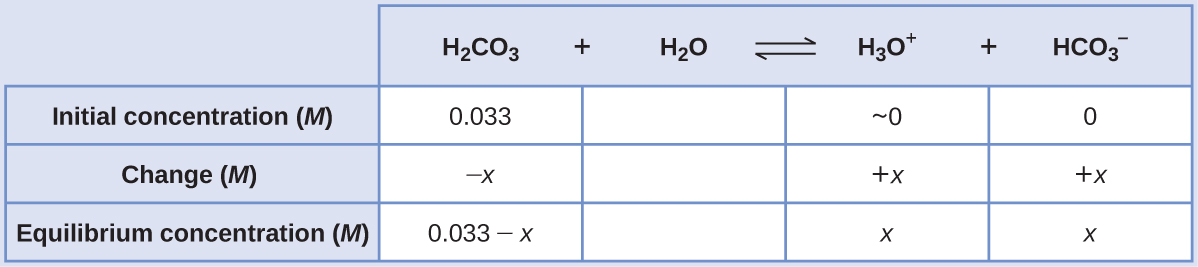


Substituting the equilibrium concentrations into the equilibrium equation gives
平衡濃度を平衡の式に代入すると、
Assuming x << 0.033 and solving the simplified equation yields
x << 0.033と仮定して、簡単にした式を解くと、
The ICE table defined x as equal to the bicarbonate ion molarity and the hydronium ion molarity:
ICE表ではxを、炭酸水素イオンのモル濃度とオキソニウムイオンのモル濃度に等しいものとして定義した。
Using the bicarbonate ion concentration computed above, the second ionization is subjected to a similar equilibrium calculation:
上で求めた炭酸水素イオン濃度を使い、第2段階の電離についても同様の平衡計算を行う。
To summarize: at equilibrium [H2CO3] = 0.033 M; = 1.2 10−4;
まとめると、平衡時には[H2CO3] = 0.033 M、 = 1.2 10−4、、となる。
Check Your Learning理解度の確認
The concentration of H2S in a saturated aqueous solution at room temperature is approximately 0.1 M. Calculate [HS−], and [S2−] in the solution:
室温の飽和水溶液中のH2S濃度は、約0.1 Mである。この溶液中の、[HS−]、[S2−]を計算しなさい。
A triprotic acid is an acid that has three ionizable H atoms. Phosphoric acid is one example:
三価酸は、電離できるH原子を3個持つ酸である。リン酸はその一例である。
As for the diprotic acid examples, each successive ionization reaction is less extensive than the former, reflected in decreasing values for the stepwise acid ionization constants. This is a general characteristic of polyprotic acids and successive ionization constants often differ by a factor of about 105 to 106.
英語のヒント
二価酸の例と同様に、電離反応は次の段階ほど前の段階より進む程度が小さくなり、それが各段階の酸の電離定数の減少に表れる。これは多価酸に共通する特徴であり、隣り合う段階の電離定数は、しばしば約105~106倍異なる。
This set of three dissociation reactions may appear to make calculations of equilibrium concentrations in a solution of H3PO4 complicated. However, because the successive ionization constants differ by a factor of 105 to 106, large differences exist in the small changes in concentration accompanying the ionization reactions. This allows the use of math-simplifying assumptions and processes, as demonstrated in the examples above.
この三つの解離反応があるために、H3PO4水溶液の平衡濃度の計算は複雑になるように思えるかもしれない。しかし、隣り合う段階の電離定数は105~106倍も異なるため、各電離反応に伴う小さな濃度変化にも大きな差がある。そのため、上の例のように、数学的な計算を簡単にする仮定や手順を使える。
Polyprotic bases are capable of accepting more than one hydrogen ion. The carbonate ion is an example of a diprotic base, because it can accept two protons, as shown below. Similar to the case for polyprotic acids, note the ionization constants decrease with ionization step. Likewise, equilibrium calculations involving polyprotic bases follow the same approaches as those for polyprotic acids.
多価塩基は、二つ以上の水素イオンを受け取ることができる。炭酸イオンは、以下に示すように二つのプロトンを受け取れるので、二価塩基の例である。多価酸の場合と同様に、電離定数は段階が進むにつれて小さくなることに注意しよう。また、多価塩基の平衡計算にも、多価酸と同じ方法を使う。