第14章酸塩基平衡
14.6 Buffers14.6 緩衝液
Learning Objectives学習目標
By the end of this section, you will be able to:
この節を学ぶと、次のことができるようになる。
- Describe the composition and function of acid–base buffers酸塩基緩衝液の組成と働きを説明する
- Calculate the pH of a buffer before and after the addition of added acid or base酸または塩基を加える前と後の緩衝液のpHを計算する
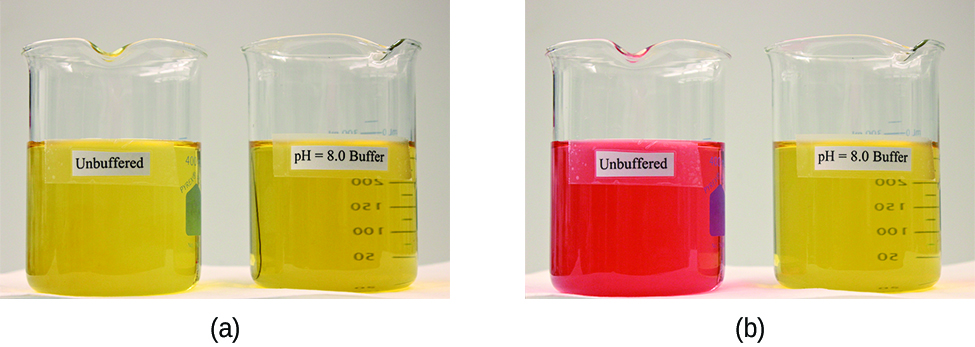
A solution containing appreciable amounts of a weak conjugate acid-base pair is called a buffer solution, or a buffer. Buffer solutions resist a change in pH when small amounts of a strong acid or a strong base are added (Figure 14.14). A solution of acetic acid and sodium acetate (CH3COOH + CH3COONa) is an example of a buffer that consists of a weak acid and its salt. An example of a buffer that consists of a weak base and its salt is a solution of ammonia and ammonium chloride (NH3(aq) + NH4Cl(aq)).
英語のヒント
弱い共役酸塩基対を十分な量だけ含む溶液を、緩衝溶液または緩衝液という。緩衝液は少量の強酸や強塩基を加えても、pHが変わりにくい(図14.14)。酢酸と酢酸ナトリウムの溶液(CH3COOH + CH3COONa)は、弱酸とその塩からなる緩衝液の例である。弱塩基とその塩からなる例としては、アンモニアと塩化アンモニウムの溶液(NH3(aq) + NH4Cl(aq))がある。
OpenStax, Rice University, Chemistry 2e. Original caption credit: (credit: modification of work by Mark Ott) · CC BY 4.0 · Source出典
Figure 14.14図 14.14
(a) The unbuffered solution on the left and the buffered solution on the right have the same pH (pH 8); they are basic, showing the yellow color of the indicator methyl orange at this pH. (b) After the addition of 1 mL of a 0.01-M HCl solution, the buffered solution has not detectably changed its pH but the unbuffered solution has become acidic, as indicated by the change in color of the methyl orange, which turns red at a pH of about 4. (credit: modification of work by Mark Ott)
英語のヒント
(a) 左の緩衝作用のない溶液と、右の緩衝液は、同じpH(pH 8)である。どちらも塩基性で、このpHで指示薬メチルオレンジが示す黄色になっている。(b) 0.01 M HCl水溶液を1 mL加えた後、緩衝液のpHには検出できる変化がないが、緩衝作用のない溶液は酸性になった。これは、pHが約4になると赤くなるメチルオレンジの色の変化からわかる。(クレジット:Mark Ottの作品を改変)
How Buffers Work緩衝液の働き
To illustrate the function of a buffer solution, consider a mixture of roughly equal amounts of acetic acid and sodium acetate. The presence of a weak conjugate acid-base pair in the solution imparts the ability to neutralize modest amounts of added strong acid or base. For example, strong base added to this solution will neutralize hydronium ion, causing the acetic acid ionization equilibrium to shift to the right and generate additional amounts of the weak conjugate base (acetate ion):
英語のヒント
緩衝液の働きを示すため、ほぼ等量の酢酸と酢酸ナトリウムの混合物を考えよう。溶液中に弱い共役酸塩基対があることで、加えられた強酸や強塩基が少量なら中和できる。例えば、この溶液に強塩基を加えるとオキソニウムイオンが中和され、酢酸の電離平衡が右へ移動して、弱い共役塩基(酢酸イオン)がさらに生じる。
Likewise, strong acid added to this buffer solution will shift the above ionization equilibrium left, producing additional amounts of the weak conjugate acid (acetic acid). Figure 14.15 provides a graphical illustration of the changes in conjugate-partner concentration that occur in this buffer solution when strong acid and base are added. The buffering action of the solution is essentially a result of the added strong acid and base being converted to the weak acid and base that make up the buffer's conjugate pair. The weaker acid and base undergo only slight ionization, as compared with the complete ionization of the strong acid and base, and the solution pH, therefore, changes much less drastically than it would in an unbuffered solution.
英語のヒント
同様に、この緩衝液に強酸を加えると、上の電離平衡は左へ移動し、弱い共役酸(酢酸)がさらに生じる。図14.15は、この緩衝液に強酸や強塩基を加えたとき、共役の相手どうしの濃度がどう変化するかを図示している。溶液の緩衝作用は、基本的には、加えた強酸や強塩基が、緩衝液の共役対を構成する弱酸や弱塩基に変わることで生じる。強酸や強塩基は完全に電離するのに対し、弱い酸や塩基の電離はわずかなので、緩衝作用のない溶液に比べ、pHの変化ははるかに小さくなる。
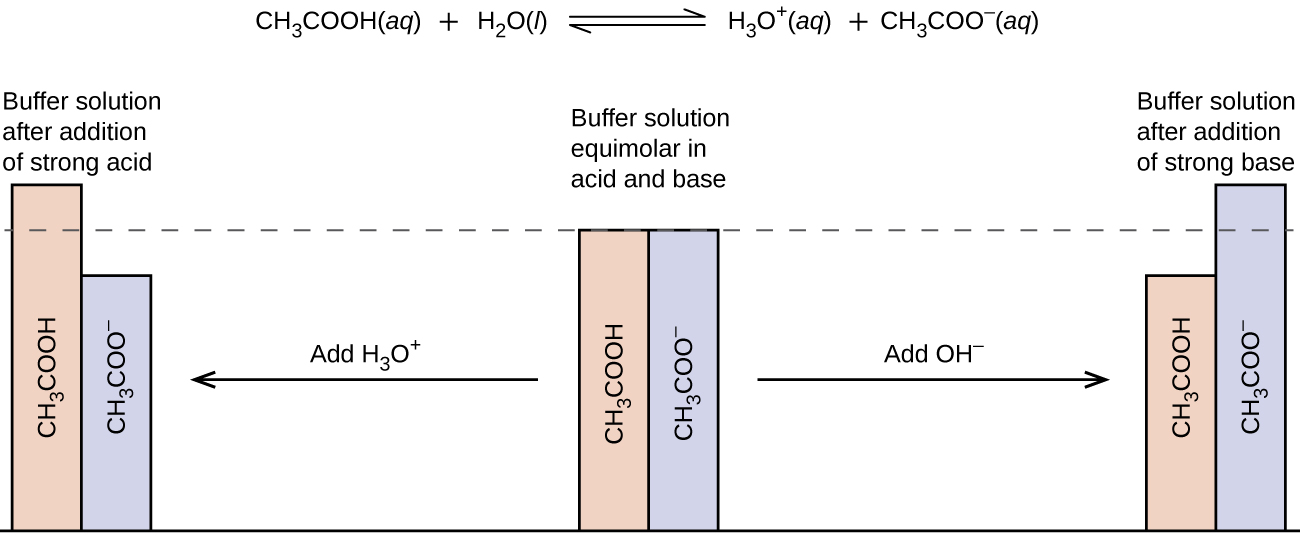
Figure 14.15図 14.15
Buffering action in a mixture of acetic acid and acetate salt.
酢酸と酢酸塩の混合物における緩衝作用。
Example 14.20例題 14.20
pH Changes in Buffered and Unbuffered Solutions緩衝液と緩衝作用のない溶液のpH変化
Acetate buffers are used in biochemical studies of enzymes and other chemical components of cells to prevent pH changes that might affect the biochemical activity of these compounds.
英語のヒント
酢酸緩衝液は、酵素や細胞のほかの化学成分を扱う生化学研究で、それらの化合物の生化学的な活性に影響しかねないpH変化を防ぐために使われる。
(a) Calculate the pH of an acetate buffer that is a mixture with 0.10 M acetic acid and 0.10 M sodium acetate.
(a) 酢酸0.10 Mと酢酸ナトリウム0.10 Mを含む混合物である、酢酸緩衝液のpHを計算しなさい。
(b) Calculate the pH after 1.0 mL of 0.10 NaOH is added to 100 mL of this buffer.
(b) この緩衝液100 mLに0.10 NaOHを1.0 mL加えた後のpHを計算しなさい。
(c) For comparison, calculate the pH after 1.0 mL of 0.10 M NaOH is added to 100 mL of a solution of an unbuffered solution with a pH of 4.74.
(c) 比較のため、pH 4.74の緩衝作用のない溶液100 mLに、0.10 M NaOH水溶液を1.0 mL加えた後のpHを計算しなさい。
Solution解法
(a) Following the ICE approach to this equilibrium calculation yields the following:
(a) この平衡計算にICE法を用いると、次のようになる。
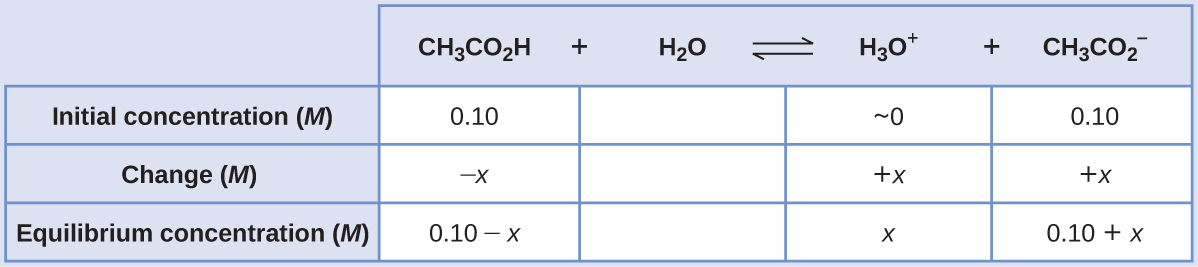


Substituting the equilibrium concentration terms into the Ka expression, assuming x << 0.10, and solving the simplified equation for x yields
平衡濃度を表す項をKaの式に代入し、x << 0.10と仮定して、簡単にした式をxについて解くと、
(b) Calculate the pH after 1.0 mL of 0.10 M NaOH is added to 100 mL of this buffer.
(b) この緩衝液100 mLに0.10 M NaOH水溶液を1.0 mL加えた後のpHを計算する。
Adding strong base will neutralize some of the acetic acid, yielding the conjugate base acetate ion. Compute the new concentrations of these two buffer components, then repeat the equilibrium calculation of part (a) using these new concentrations.
強塩基を加えると酢酸の一部が中和され、共役塩基である酢酸イオンが生じる。この二つの緩衝成分の新たな濃度を求め、その濃度を使って(a)の平衡計算を繰り返す。
The initial molar amount of acetic acid is
酢酸の最初の物質量は、
The amount of acetic acid remaining after some is neutralized by the added base is
加えた塩基によって一部が中和された後に残る酢酸の量は、
The newly formed acetate ion, along with the initially present acetate, gives a final acetate concentration of
英語のヒント
新たに生じた酢酸イオンと、初めから存在した酢酸イオンを合わせると、最終的な酢酸イオン濃度は、
Compute molar concentrations for the two buffer components:
二つの緩衝成分のモル濃度を計算する。
Using these concentrations, the pH of the solution may be computed as in part (a) above, yielding pH = 4.75 (only slightly different from that prior to adding the strong base).
英語のヒント
これらの濃度を使い、上の(a)と同様に溶液のpHを計算すると、pH = 4.75となる(強塩基を加える前の値との違いはごくわずかである)。
(c) For comparison, calculate the pH after 1.0 mL of 0.10 M NaOH is added to 100 mL of a solution of an unbuffered solution with a pH of 4.74.
(c) 比較のため、pH 4.74の緩衝作用のない溶液100 mLに、0.10 M NaOH水溶液を1.0 mL加えた後のpHを計算しなさい。
The amount of hydronium ion initially present in the solution is
溶液中に初めから存在したオキソニウムイオンの量は、
The amount of hydroxide ion added to the solution is
溶液に加えた水酸化物イオンの量は、
The added hydroxide will neutralize hydronium ion via the reaction
加えた水酸化物イオンは、次の反応によってオキソニウムイオンを中和する。
The 1:1 stoichiometry of this reaction shows that an excess of hydroxide has been added (greater molar amount than the initially present hydronium ion).
この反応の化学量論比は1:1なので、水酸化物イオンを過剰に加えたことがわかる(初めから存在したオキソニウムイオンより物質量が多い)。
The amount of hydroxide ion remaining is
残った水酸化物イオンの量は、
corresponding to a hydroxide molarity of
これに対応する水酸化物イオンのモル濃度は、
The pH of the solution is then calculated to be
したがって、溶液のpHは次のように計算される。
In this unbuffered solution, addition of the base results in a significant rise in pH (from 4.74 to 10.99) compared with the very slight increase observed for the buffer solution in part (b) (from 4.74 to 4.75).
この緩衝作用のない溶液では、塩基を加えるとpHが大きく上昇する(4.74から10.99へ)。これに対し、(b)の緩衝液で見られた上昇は、ごくわずかだった(4.74から4.75へ)。
Check Your Learning理解度の確認
Show that adding 1.0 mL of 0.10 M HCl changes the pH of 100 mL of a 1.8 10−5 M HCl solution from 4.74 to 3.00.
1.8 10−5 MのHCl水溶液100 mLに、0.10 M HCl水溶液を1.0 mL加えると、pHが4.74から3.00に変化することを示しなさい。