第14章酸塩基平衡
Buffer Capacity緩衝容量
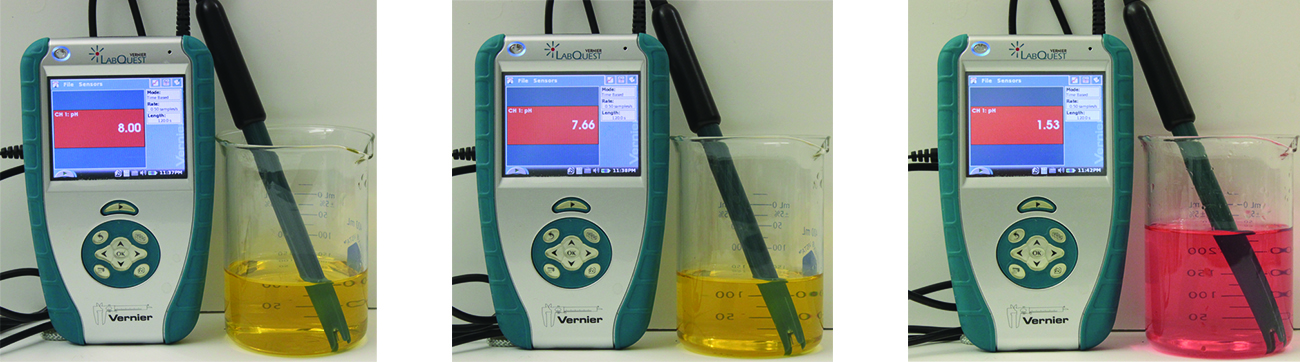
Buffer solutions do not have an unlimited capacity to keep the pH relatively constant (Figure 14.16). Instead, the ability of a buffer solution to resist changes in pH relies on the presence of appreciable amounts of its conjugate weak acid-base pair. When enough strong acid or base is added to substantially lower the concentration of either member of the buffer pair, the buffering action within the solution is compromised.
英語のヒント
緩衝液がpHを比較的一定に保てる能力には、限界がある(図14.16)。pHの変化を抑える能力は、共役の弱酸塩基対が十分な量だけ存在することによる。強酸や強塩基を、緩衝対のどちらかの濃度が大幅に下がるほど加えると、溶液の緩衝作用は損なわれる。
OpenStax, Rice University, Chemistry 2e. Original caption credit: (credit: modification of work by Mark Ott) · CC BY 4.0 · Source出典
Figure 14.16図 14.16
The indicator color (methyl orange) shows that a small amount of acid added to a buffered solution of pH 8 (beaker on the left) has little affect on the buffered system (middle beaker). However, a large amount of acid exhausts the buffering capacity of the solution and the pH changes dramatically (beaker on the right). (credit: modification of work by Mark Ott)
英語のヒント
指示薬メチルオレンジの色から、pH 8の緩衝液(左のビーカー)に少量の酸を加えても、緩衝系にはほとんど影響しないことがわかる(中央のビーカー)。しかし、多量の酸を加えると溶液の緩衝容量を使い切り、pHは大きく変化する(右のビーカー)。(クレジット:Mark Ottの作品を改変)
The buffer capacity is the amount of acid or base that can be added to a given volume of a buffer solution before the pH changes significantly, usually by one unit. Buffer capacity depends on the amounts of the weak acid and its conjugate base that are in a buffer mixture. For example, 1 L of a solution that is 1.0 M in acetic acid and 1.0 M in sodium acetate has a greater buffer capacity than 1 L of a solution that is 0.10 M in acetic acid and 0.10 M in sodium acetate even though both solutions have the same pH. The first solution has more buffer capacity because it contains more acetic acid and acetate ion.
緩衝容量とは、一定体積の緩衝液のpHが大きく、通常は1だけ変わるまでに加えられる、酸または塩基の量である。緩衝容量は、混合物中の弱酸とその共役塩基の量に依存する。例えば、酢酸1.0 M、酢酸ナトリウム1.0 Mの溶液1 Lは、酢酸0.10 M、酢酸ナトリウム0.10 Mの溶液1 Lよりも緩衝容量が大きい。二つの溶液のpHは同じだが、最初の溶液にはより多くの酢酸と酢酸イオンが含まれているため、緩衝容量が大きい。
Selection of Suitable Buffer Mixtures適切な緩衝混合物を選ぶ
There are two useful rules of thumb for selecting buffer mixtures:
英語のヒント
緩衝混合物を選ぶ際には、二つの便利な目安がある。
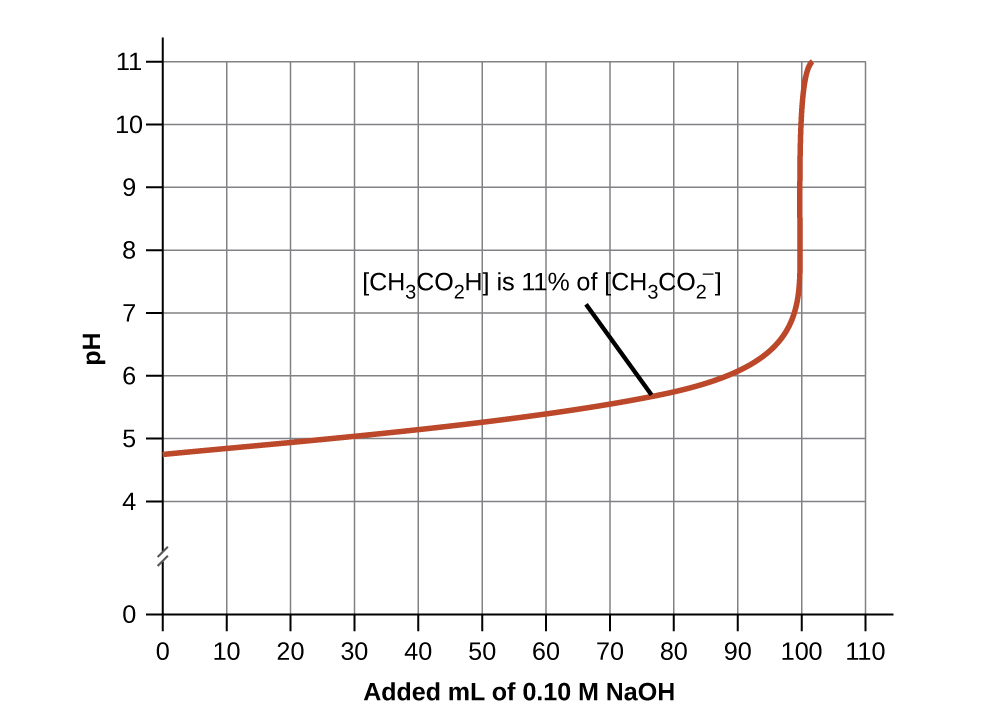
- A good buffer mixture should have about equal concentrations of both of its components. A buffer solution has generally lost its usefulness when one component of the buffer pair is less than about 10% of the other. Figure 14.17 shows how pH changes for an acetic acid-acetate ion buffer as base is added. The initial pH is 4.74. A change of 1 pH unit occurs when the acetic acid concentration is reduced to 11% of the acetate ion concentration.よい緩衝混合物では、二つの成分の濃度がほぼ等しい。一般に、緩衝対の一方の濃度がもう一方の約10%未満になると、緩衝液としての有用性は失われる。図14.17は、酢酸–酢酸イオン緩衝液に塩基を加えたときのpH変化を示す。初期pHは4.74である。酢酸濃度が酢酸イオン濃度の11%まで下がると、pHが1変化する。Figure 14.17図 14.17Change in pH as an increasing amount of a 0.10-M NaOH solution is added to 100 mL of a buffer solution in which, initially, [CH3CO2H] = 0.10 M and Note the greatly diminished buffering action occurring after the buffer capacity has been reached, resulting in drastic rises in pH on adding more strong base.初期の[CH3CO2H] = 0.10 M、である緩衝液100 mLに、0.10 M NaOH水溶液を徐々に加えたときのpH変化。緩衝容量に達した後は緩衝作用が大幅に弱まり、さらに強塩基を加えるとpHが急上昇することに注目しよう。
- Weak acids and their salts are better as buffers for pHs less than 7; weak bases and their salts are better as buffers for pHs greater than 7.pHが7未満の緩衝液には、弱酸とその塩が適している。pHが7より大きい緩衝液には、弱塩基とその塩が適している。


Blood is an important example of a buffered solution, with the principal acid and ion responsible for the buffering action being carbonic acid, H2CO3, and the bicarbonate ion, When a hydronium ion is introduced to the blood stream, it is removed primarily by the reaction:
血液は緩衝溶液の重要な例であり、緩衝作用を担う主な酸とイオンは、炭酸H2CO3と炭酸水素イオンである。血流にオキソニウムイオンが入ると、主に次の反応によって取り除かれる。
An added hydroxide ion is removed by the reaction:
加わった水酸化物イオンは、次の反応によって取り除かれる。
The added strong acid or base is thus effectively converted to the much weaker acid or base of the buffer pair (H3O+ is converted to H2CO3 and OH- is converted to HCO3-). The pH of human blood thus remains very near the value determined by the buffer pairs pKa, in this case, 7.35. Normal variations in blood pH are usually less than 0.1, and pH changes of 0.4 or greater are likely to be fatal.
英語のヒント
このように、加えられた強酸や強塩基は、緩衝対のはるかに弱い酸や塩基へ効果的に変えられる(H3O+はH2CO3に、OH-はHCO3-に変わる)。そのため、人の血液のpHは緩衝対のpKaで決まる値、この場合は7.35のごく近くに保たれる。血液のpHの通常の変動は0.1未満であり、0.4以上のpH変化は致命的になりうる。
The Henderson-Hasselbalch Equationヘンダーソン–ハッセルバルヒの式
The ionization-constant expression for a solution of a weak acid can be written as:
弱酸の水溶液について、電離定数の式は次のように書ける。
Rearranging to solve for [H3O+] yields:
[H3O+]について解くように変形すると、
Taking the negative logarithm of both sides of this equation gives
この式の両辺の負の対数を取ると、
which can be written as
これは次のように書ける。
where pKa is the negative of the logarithm of the ionization constant of the weak acid (pKa = −log Ka). This equation relates the pH, the ionization constant of a weak acid, and the concentrations of the weak conjugate acid-base pair in a buffered solution. Scientists often use this expression, called the Henderson-Hasselbalch equation, to calculate the pH of buffer solutions. It is important to note that the “x is small” assumption must be valid to use this equation.
ここでpKaは、弱酸の電離定数の対数に負号を付けた値である(pKa = −log Ka)。この式は、pH、弱酸の電離定数、そして緩衝液中の弱い共役酸塩基対の濃度を関連づける。科学者は、ヘンダーソン–ハッセルバルヒの式と呼ばれるこの式を、緩衝液のpHの計算によく用いる。この式を使うには「xが小さい」という仮定が成り立つ必要があることに注意しよう。