第14章酸塩基平衡
14.4 Hydrolysis of Salts14.4 塩の加水分解
Learning Objectives学習目標
By the end of this section, you will be able to:
この節を学ぶと、次のことができるようになる。
- Predict whether a salt solution will be acidic, basic, or neutral塩の水溶液が酸性・塩基性・中性のどれになるかを予測する
- Calculate the concentrations of the various species in a salt solution塩の水溶液中のさまざまな化学種の濃度を計算する
- Describe the acid ionization of hydrated metal ions水和金属イオンの酸としての電離を説明する
Salts with Acidic Ions酸性のイオンを持つ塩
Salts are ionic compounds composed of cations and anions, either of which may be capable of undergoing an acid or base ionization reaction with water. Aqueous salt solutions, therefore, may be acidic, basic, or neutral, depending on the relative acid-base strengths of the salt's constituent ions. For example, dissolving ammonium chloride in water results in its dissociation, as described by the equation
英語のヒント
塩は陽イオンと陰イオンからなるイオン化合物であり、そのいずれも、水と酸または塩基の電離反応を起こせる場合がある。したがって塩の水溶液は、塩を構成するイオンの酸・塩基としての相対的な強さに応じて、酸性、塩基性、中性のいずれかになる。例えば、塩化アンモニウムを水に溶かすと、次の式のように解離する。
The ammonium ion is the conjugate acid of the base ammonia, NH3; its acid ionization (or acid hydrolysis) reaction is represented by
アンモニウムイオンは、塩基であるアンモニアNH3の共役酸であり、その酸としての電離(または酸性加水分解)反応は、次のように表される。
Since ammonia is a weak base, Kb is measurable and Ka > 0 (ammonium ion is a weak acid).
アンモニアは弱塩基なので、Kbは測定できる値であり、Ka > 0となる(アンモニウムイオンは弱酸である)。
The chloride ion is the conjugate base of hydrochloric acid, and so its base ionization (or base hydrolysis) reaction is represented by
塩化物イオンは塩酸の共役塩基なので、その塩基としての電離(または塩基性加水分解)反応は、次のように表される。
Since HCl is a strong acid, Ka is immeasurably large and Kb ≈ 0 (chloride ions don’t undergo appreciable hydrolysis).
HClは強酸なので、Kaは測定できないほど大きく、Kb ≈ 0となる(塩化物イオンは無視できないほどの加水分解を起こさない)。
Thus, dissolving ammonium chloride in water yields a solution of weak acid cations () and inert anions (Cl−), resulting in an acidic solution.
英語のヒント
したがって、塩化アンモニウムを水に溶かすと、弱酸である陽イオン()と反応に関与しない陰イオン(Cl−)の溶液ができ、酸性になる。
Example 14.15例題 14.15
Calculating the pH of an Acidic Salt Solution酸性を示す塩の水溶液のpHを計算する
Aniline is an amine that is used to manufacture dyes. It is isolated as anilinium chloride, a salt prepared by the reaction of the weak base aniline and hydrochloric acid. What is the pH of a 0.233 M solution of anilinium chloride
英語のヒント
アニリンは染料の製造に使われるアミンである。弱塩基であるアニリンと塩酸との反応で作られる塩、塩化アニリニウムとして単離される。0.233 M塩化アニリニウム水溶液のpHはいくらか。
Solution解法
The Ka for anilinium ion is derived from the Kb for its conjugate base, aniline (see Appendix I):
アニリニウムイオンのKaは、その共役塩基アニリンのKbから求める(付録I参照)。
Using the provided information, an ICE table for this system is prepared:
与えられた情報を使って、この系のICE表を作る。
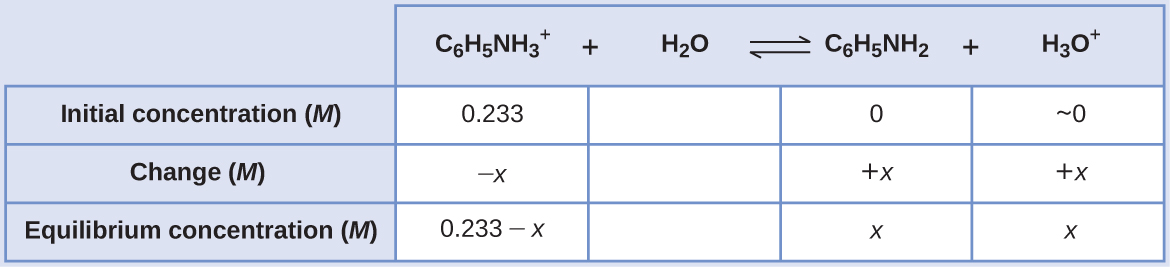

Substituting these equilibrium concentration terms into the Ka expression gives
これらの平衡濃度を表す項をKaの式に代入すると、
Assuming x << 0.233, the equation is simplified and solved for x:
x << 0.233と仮定して式を簡単にし、xについて解くと、
The ICE table defines x as the hydronium ion molarity, and so the pH is computed as
ICE表ではxをオキソニウムイオンのモル濃度としているので、pHは次のように計算される。
Check Your Learning理解度の確認
What is the hydronium ion concentration in a 0.100-M solution of ammonium nitrate, NH4NO3, a salt composed of the ions and Which is the stronger acid or
硝酸アンモニウムNH4NO3は、とからなる塩である。その0.100 M水溶液のオキソニウムイオン濃度はいくらか。とではどちらが強い酸か。
Salts with Basic Ions塩基性のイオンを持つ塩
As another example, consider dissolving sodium acetate in water:
別の例として、酢酸ナトリウムを水に溶かす場合を考えよう。
The sodium ion does not undergo appreciable acid or base ionization and has no effect on the solution pH. This may seem obvious from the ion's formula, which indicates no hydrogen or oxygen atoms, but some dissolved metal ions function as weak acids, as addressed later in this section.
英語のヒント
ナトリウムイオンは、酸としても塩基としても無視できないほどの電離を起こさず、溶液のpHに影響しない。イオンの式に水素原子も酸素原子も含まれないことから、これは当然に思えるかもしれない。しかし、本節の後で扱うように、溶けた金属イオンの中には弱酸として働くものがある。
The acetate ion, is the conjugate base of acetic acid, CH3CO2H, and so its base ionization (or base hydrolysis) reaction is represented by
酢酸イオンは酢酸CH3CO2Hの共役塩基なので、その塩基としての電離(または塩基性加水分解)反応は、次のように表される。
Because acetic acid is a weak acid, its Ka is measurable and Kb > 0 (acetate ion is a weak base).
酢酸は弱酸なので、そのKaは測定できる値であり、Kb > 0となる(酢酸イオンは弱塩基である)。
Dissolving sodium acetate in water yields a solution of inert cations (Na+) and weak base anions resulting in a basic solution.
酢酸ナトリウムを水に溶かすと、反応に関与しない陽イオン(Na+)と弱塩基である陰イオンの溶液ができ、塩基性になる。
Example 14.16例題 14.16
Equilibrium in a Solution of a Salt of a Weak Acid and a Strong Base弱酸と強塩基からなる塩の水溶液中の平衡
Determine the acetic acid concentration in a solution with and [OH−] = 2.5 10−6 M at equilibrium. The reaction is:
平衡時に、[OH−] = 2.5 10−6 Mである溶液の酢酸濃度を求めなさい。反応は次のとおりである。
Solution解法
The provided equilibrium concentrations and a value for the equilibrium constant will permit calculation of the missing equilibrium concentration. The process in question is the base ionization of acetate ion, for which
与えられた平衡濃度と平衡定数の値から、未知の平衡濃度を計算できる。対象とする過程は酢酸イオンの塩基としての電離であり、その定数は、
Substituting the available values into the Kb expression gives
わかっている値をKbの式に代入すると、
Solving the above equation for the acetic acid molarity yields [CH3CO2H] = 1.1 10−5 M.
上の式を酢酸のモル濃度について解くと、[CH3CO2H] = 1.1 10−5 Mとなる。
Check Your Learning理解度の確認
What is the pH of a 0.083-M solution of NaCN?
0.083 M NaCN水溶液のpHはいくらか。
Salts with Acidic and Basic Ions酸性と塩基性の両方のイオンを持つ塩
Some salts are composed of both acidic and basic ions, and so the pH of their solutions will depend on the relative strengths of these two species. Likewise, some salts contain a single ion that is amphiprotic, and so the relative strengths of this ion’s acid and base character will determine its effect on solution pH. For both types of salts, a comparison of the Ka and Kb values allows prediction of the solution’s acid-base status, as illustrated in the following example exercise.
酸性のイオンと塩基性のイオンの両方からなる塩もある。その水溶液のpHは、この二つの化学種の相対的な強さによって決まる。同様に、両性のイオンを一つ含む塩もあり、そのイオンの酸性と塩基性の相対的な強さが、溶液のpHへの影響を決める。どちらの種類の塩も、次の例題で示すように、KaとKbを比較することで、溶液が酸性か塩基性かを予測できる。
Example 14.17例題 14.17
Determining the Acidic or Basic Nature of Salts塩が酸性か塩基性かを判定する
Determine whether aqueous solutions of the following salts are acidic, basic, or neutral:
次の塩の水溶液が、酸性、塩基性、中性のいずれになるかを判定しなさい。
(a) KBr
(a) KBr
(b) NaHCO3
(b) NaHCO3
(c) Na2HPO4
(c) Na2HPO4
(d) NH4F
(d) NH4F
Solution解法
Consider each of the ions separately in terms of its effect on the pH of the solution, as shown here:
次のように、各イオンが溶液のpHへ及ぼす影響を個別に考える。
(a) The K+ cation is inert and will not affect pH. The bromide ion is the conjugate base of a strong acid, and so it is of negligible base strength (no appreciable base ionization). The solution is neutral.
(a) 陽イオンK+は反応に関与せず、pHに影響しない。臭化物イオンは強酸の共役塩基なので、塩基としての強さは無視できるほど小さい(無視できないほどの塩基の電離は起こらない)。溶液は中性である。
(b) The Na+ cation is inert and will not affect the pH of the solution; while the anion is amphiprotic. The Ka of is 4.7 10−11,and its Kb is
(b) 陽イオンNa+は反応に関与せず溶液のpHに影響しないが、陰イオンは両性である。のKaは4.7 10−11、そのKbはである。
Since Kb >> Ka, the solution is basic.
Kb >> Kaなので、溶液は塩基性である。
(c) The Na+ cation is inert and will not affect the pH of the solution, while the anion is amphiprotic. The Ka of is 4.2 10−13,
(c) 陽イオンNa+は反応に関与せず溶液のpHに影響しないが、陰イオンは両性である。のKaは4.2 10−13であり、
and its Kb is Because Kb >> Ka, the solution is basic.
そのKbはである。Kb >> Kaなので、溶液は塩基性である。
(d) The ion is acidic (see above discussion) and the F− ion is basic (conjugate base of the weak acid HF). Comparing the two ionization constants: Ka of is 5.6 10−10 and the Kb of F− is 1.6 10−11, so the solution is acidic, since Ka > Kb.
(d) イオンは酸性(上の説明を参照)、F−イオンは塩基性(弱酸HFの共役塩基)である。二つの電離定数を比べると、のKaは5.6 10−10、F−のKbは1.6 10−11である。Ka > Kbなので、溶液は酸性になる。
Check Your Learning理解度の確認
Determine whether aqueous solutions of the following salts are acidic, basic, or neutral:
次の塩の水溶液が、酸性、塩基性、中性のいずれになるかを判定しなさい。
(a) K2CO3
(a) K2CO3
(b) CaCl2
(b) CaCl2
(c) KH2PO4
(c) KH2PO4
(d) (NH4)2CO3
(d) (NH4)2CO3