第14章酸塩基平衡
Effect of Molecular Structure on Acid-Base Strength分子構造が酸と塩基の強さに及ぼす影響
Binary Acids and Bases二元化合物の酸と塩基
In the absence of any leveling effect, the acid strength of binary compounds of hydrogen with nonmetals (A) increases as the H-A bond strength decreases down a group in the periodic table. For group 17, the order of increasing acidity is HF < HCl < HBr < HI. Likewise, for group 16, the order of increasing acid strength is H2O < H2S < H2Se < H2Te.
英語のヒント
水平化効果がない場合、水素と非金属(A)からなる二元化合物の酸の強さは、周期表の同じ族を下がるにつれてH–A結合が弱くなるほど増す。17族では、酸性が強くなる順はHF < HCl < HBr < HIである。同様に16族では、H2O < H2S < H2Se < H2Teの順に酸が強くなる。
Across a row in the periodic table, the acid strength of binary hydrogen compounds increases with increasing electronegativity of the nonmetal atom because the polarity of the H-A bond increases. Thus, the order of increasing acidity (for removal of one proton) across the second row is CH4 < NH3 < H2O < HF; across the third row, it is SiH4 < PH3 < H2S < HCl (see Figure 14.11).
英語のヒント
周期表の同じ周期を横に進むと、水素の二元化合物の酸の強さは、非金属原子の電気陰性度が大きくなるにつれて増す。これはH–A結合の極性が大きくなるためである。したがって、一つのプロトンを取り除く場合の酸性の強さは、第2周期ではCH4 < NH3 < H2O < HF、第3周期ではSiH4 < PH3 < H2S < HClの順に増す(図14.11参照)。
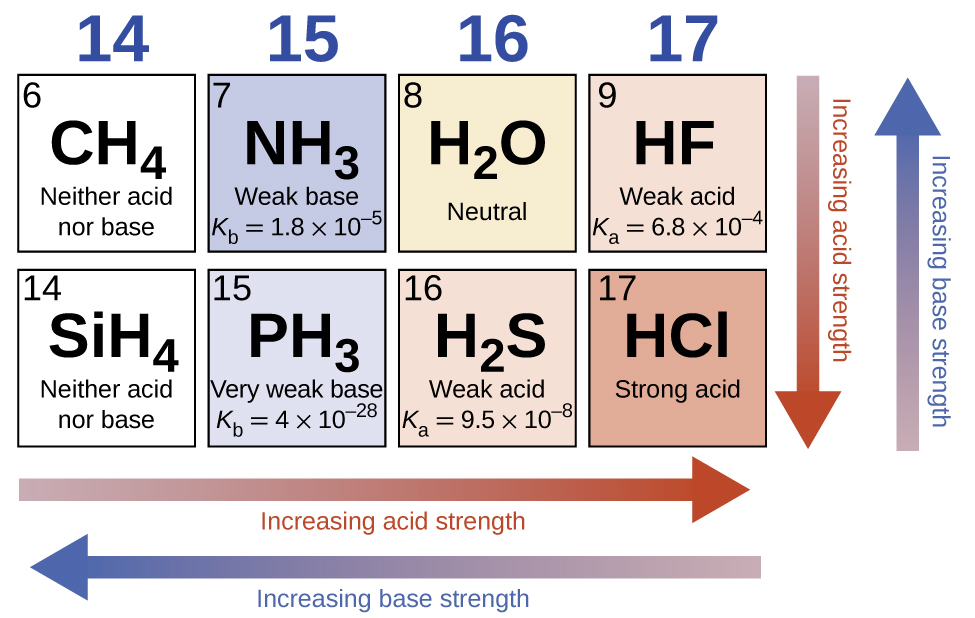
Figure 14.11図 14.11
The figure shows trends in the strengths of binary acids and bases.
二元化合物の酸と塩基の強さの傾向を示す。
Ternary Acids and Bases三元化合物の酸と塩基
Ternary compounds composed of hydrogen, oxygen, and some third element (“E”) may be structured as depicted in the image below. In these compounds, the central E atom is bonded to one or more O atoms, and at least one of the O atoms is also bonded to an H atom, corresponding to the general molecular formula OmE(OH)n. These compounds may be acidic, basic, or amphoteric depending on the properties of the central E atom. Examples of such compounds include sulfuric acid, O2S(OH)2, sulfurous acid, OS(OH)2, nitric acid, O2NOH, perchloric acid, O3ClOH, aluminum hydroxide, Al(OH)3, calcium hydroxide, Ca(OH)2, and potassium hydroxide, KOH:
英語のヒント
水素、酸素、そして第3の元素「E」からなる三元化合物には、下図のような構造をとるものがある。このような化合物では、中心のE原子が一つ以上のO原子と結合し、少なくとも一つのO原子はH原子とも結合している。一般的な分子式はOmE(OH)nとなる。中心のE原子の性質に応じて、これらの化合物は酸性、塩基性、両性のいずれかを示す。例として、硫酸O2S(OH)2、亜硫酸OS(OH)2、硝酸O2NOH、過塩素酸O3ClOH、水酸化アルミニウムAl(OH)3、水酸化カルシウムCa(OH)2、水酸化カリウムKOHがある。
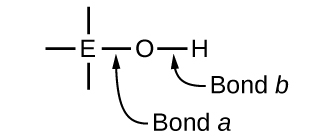
If the central atom, E, has a low electronegativity, its attraction for electrons is low. Little tendency exists for the central atom to form a strong covalent bond with the oxygen atom, and bond a between the element and oxygen is more readily broken than bond b between oxygen and hydrogen. Hence bond a is ionic, hydroxide ions are released to the solution, and the material behaves as a base—this is the case with Ca(OH)2 and KOH. Lower electronegativity is characteristic of the more metallic elements; hence, the metallic elements form ionic hydroxides that are by definition basic compounds.
英語のヒント
中心原子Eの電気陰性度が低いと、電子を引きつける力は弱い。中心原子が酸素原子と強い共有結合を作る傾向は小さく、元素と酸素との結合aは、酸素と水素との結合bより切れやすい。したがって、結合aはイオン結合となり、水酸化物イオンが溶液へ放出され、物質は塩基としてふるまう。Ca(OH)2やKOHがこの場合に当たる。低い電気陰性度は金属性の強い元素の特徴なので、金属元素はイオン性の水酸化物を作り、これらは定義上、塩基性化合物となる。
If, on the other hand, the atom E has a relatively high electronegativity, it strongly attracts the electrons it shares with the oxygen atom, making bond a relatively strongly covalent. The oxygen-hydrogen bond, bond b, is thereby weakened because electrons are displaced toward E. Bond b is polar and readily releases hydrogen ions to the solution, so the material behaves as an acid. High electronegativities are characteristic of the more nonmetallic elements. Thus, nonmetallic elements form covalent compounds containing acidic −OH groups that are called oxyacids.
英語のヒント
一方、E原子の電気陰性度が比較的高い場合、酸素原子と共有する電子を強く引きつけるため、結合aの共有結合性は比較的強くなる。電子がEのほうへ移るので、酸素–水素結合である結合bは弱まる。結合bは極性を持ち、水素イオンを溶液へ容易に放出するため、この物質は酸としてふるまう。高い電気陰性度は非金属性の強い元素の特徴である。したがって、非金属元素は、酸性の−OH基を含む、オキソ酸と呼ばれる共有結合性化合物を作る。
Increasing the oxidation number of the central atom E also increases the acidity of an oxyacid because this increases the attraction of E for the electrons it shares with oxygen and thereby weakens the O-H bond. Sulfuric acid, H2SO4, or O2S(OH)2 (with a sulfur oxidation number of +6), is more acidic than sulfurous acid, H2SO3, or OS(OH)2 (with a sulfur oxidation number of +4). Likewise nitric acid, HNO3, or O2NOH (N oxidation number = +5), is more acidic than nitrous acid, HNO2, or ONOH (N oxidation number = +3). In each of these pairs, the oxidation number of the central atom is larger for the stronger acid (Figure 14.12).
中心原子Eの酸化数を増やしても、オキソ酸の酸性は強くなる。Eが酸素と共有する電子を引きつける力が強まり、O–H結合が弱まるためである。硫酸H2SO4、すなわちO2S(OH)2(硫黄の酸化数は+6)は、亜硫酸H2SO3、すなわちOS(OH)2(硫黄の酸化数は+4)より酸性が強い。同様に、硝酸HNO3、すなわちO2NOH(Nの酸化数は+5)は、亜硝酸HNO2、すなわちONOH(Nの酸化数は+3)より酸性が強い。どちらの対でも、強い酸のほうが中心原子の酸化数が大きい(図14.12)。
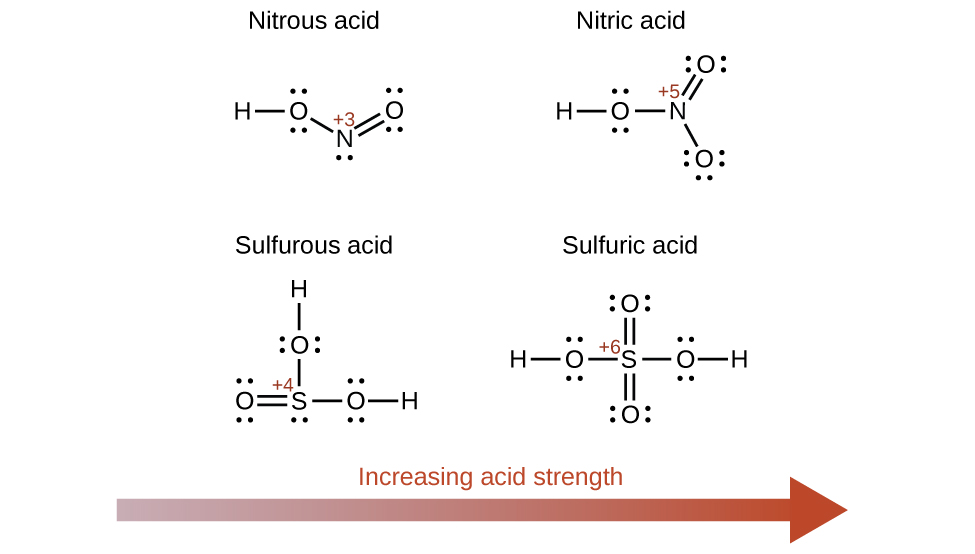


Figure 14.12図 14.12
As the oxidation number of the central atom E increases, the acidity also increases.
中心原子Eの酸化数が増すと、酸性も強くなる。
Hydroxy compounds of elements with intermediate electronegativities and relatively high oxidation numbers (for example, elements near the diagonal line separating the metals from the nonmetals in the periodic table) are usually amphoteric. This means that the hydroxy compounds act as acids when they react with strong bases and as bases when they react with strong acids. The amphoterism of aluminum hydroxide, which commonly exists as the hydrate Al(H2O)3(OH)3, is reflected in its solubility in both strong acids and strong bases. In strong bases, the relatively insoluble hydrated aluminum hydroxide, Al(H2O)3(OH)3, is converted into the soluble ion, by reaction with hydroxide ion:
英語のヒント
電気陰性度が中程度で酸化数が比較的高い元素(例えば、周期表で金属と非金属を隔てる斜めの境界線付近の元素)のヒドロキシ化合物は、通常、両性である。つまり、強塩基と反応するときは酸として、強酸と反応するときは塩基として働く。水酸化アルミニウムは通常、水和物Al(H2O)3(OH)3として存在し、強酸にも強塩基にも溶けることに両性が表れている。強塩基中では、比較的溶けにくい水和水酸化アルミニウムAl(H2O)3(OH)3が水酸化物イオンと反応し、可溶性のイオンに変わる。
In this reaction, a proton is transferred from one of the aluminum-bound H2O molecules to a hydroxide ion in solution. The Al(H2O)3(OH)3 compound thus acts as an acid under these conditions. On the other hand, when dissolved in strong acids, it is converted to the soluble ion by reaction with hydronium ion:
この反応では、アルミニウムに結合しているH2O分子の一つから、溶液中の水酸化物イオンへプロトンが移る。したがって、Al(H2O)3(OH)3はこの条件下で酸として働く。一方、強酸に溶かすと、オキソニウムイオンとの反応で可溶性のイオンに変わる。
In this case, protons are transferred from hydronium ions in solution to Al(H2O)3(OH)3, and the compound functions as a base.
この場合、溶液中のオキソニウムイオンからAl(H2O)3(OH)3へプロトンが移り、この化合物は塩基として働く。