第14章酸塩基平衡
14.2 pH and pOH14.2 pHとpOH
Learning Objectives学習目標
By the end of this section, you will be able to:
この節を学ぶと、次のことができるようになる。
- Explain the characterization of aqueous solutions as acidic, basic, or neutral水溶液を酸性・塩基性・中性に分類する基準を説明する
- Express hydronium and hydroxide ion concentrations on the pH and pOH scalesオキソニウムイオン濃度と水酸化物イオン濃度を、pHとpOHの尺度で表す
- Perform calculations relating pH and pOHpHとpOHを関連づける計算を行う
As discussed earlier, hydronium and hydroxide ions are present both in pure water and in all aqueous solutions, and their concentrations are inversely proportional as determined by the ion product of water (Kw). The concentrations of these ions in a solution are often critical determinants of the solution’s properties and the chemical behaviors of its other solutes, and specific vocabulary has been developed to describe these concentrations in relative terms. A solution is neutral if it contains equal concentrations of hydronium and hydroxide ions; acidic if it contains a greater concentration of hydronium ions than hydroxide ions; and basic if it contains a lesser concentration of hydronium ions than hydroxide ions.
英語のヒント
すでに述べたように、オキソニウムイオンと水酸化物イオンは、純水にもあらゆる水溶液にも存在し、それらの濃度は水のイオン積(Kw)によって定まる反比例関係にある。溶液中のこれらのイオンの濃度は、溶液の性質や、ほかの溶質の化学的なふるまいを決める重要な要因になることが多い。そこで、これらの濃度を相対的に表すための専用の用語が作られてきた。溶液中のオキソニウムイオンと水酸化物イオンの濃度が等しければ中性、オキソニウムイオン濃度が水酸化物イオン濃度より大きければ酸性、小さければ塩基性である。
A common means of expressing quantities that may span many orders of magnitude is to use a logarithmic scale. One such scale that is very popular for chemical concentrations and equilibrium constants is based on the p-function, defined as shown where “X” is the quantity of interest and “log” is the base-10 logarithm:
英語のヒント
値の範囲が何桁にも及ぶ量を表すには、対数目盛を用いるのが一般的である。化学における濃度や平衡定数に広く用いられる、そのような目盛の一つがp関数に基づくものである。p関数は次のように定義される。ここで「X」は対象とする量、「log」は底が10の対数である。
The pH of a solution is therefore defined as shown here, where [H3O+] is the molar concentration of hydronium ion in the solution:
したがって、溶液のpHは次のように定義される。ここで[H3O+]は、溶液中のオキソニウムイオンのモル濃度である。
Rearranging this equation to isolate the hydronium ion molarity yields the equivalent expression:
英語のヒント
この式を変形してオキソニウムイオンのモル濃度について解くと、次の同値な式が得られる。
Likewise, the hydroxide ion molarity may be expressed as a p-function, or pOH:
英語のヒント
同様に、水酸化物イオンのモル濃度もp関数、すなわちpOHで表せる。
or
または、
Finally, the relation between these two ion concentration expressed as p-functions is easily derived from the Kw expression:
最後に、p関数で表したこれら二つのイオン濃度の関係は、Kwの式から容易に導ける。
At 25 °C, the value of Kw is 1.0 10−14, and so:
25 °CではKwの値は1.0 10−14なので、
As was shown in Example 14.1, the hydronium ion molarity in pure water (or any neutral solution) is 1.0 10−7 M at 25 °C. The pH and pOH of a neutral solution at this temperature are therefore:
例題14.1で示したように、25 °Cにおける純水(または任意の中性溶液)のオキソニウムイオンのモル濃度は1.0 10−7 Mである。したがって、この温度における中性溶液のpHとpOHは次のとおりである。
And so, at this temperature, acidic solutions are those with hydronium ion molarities greater than 1.0 10−7 M and hydroxide ion molarities less than 1.0 10−7 M (corresponding to pH values less than 7.00 and pOH values greater than 7.00). Basic solutions are those with hydronium ion molarities less than 1.0 10−7 M and hydroxide ion molarities greater than 1.0 10−7 M (corresponding to pH values greater than 7.00 and pOH values less than 7.00).
したがって、この温度では、オキソニウムイオンのモル濃度が1.0 10−7 Mより大きく、水酸化物イオンのモル濃度が1.0 10−7 Mより小さい溶液が酸性である(pHは7.00より小さく、pOHは7.00より大きい)。オキソニウムイオンのモル濃度が1.0 10−7 Mより小さく、水酸化物イオンのモル濃度が1.0 10−7 Mより大きい溶液が塩基性である(pHは7.00より大きく、pOHは7.00より小さい)。
Since the autoionization constant Kw is temperature dependent, these correlations between pH values and the acidic/neutral/basic adjectives will be different at temperatures other than 25 °C. For example, the “Check Your Learning” exercise accompanying Example 14.1 showed the hydronium molarity of pure water at 80 °C is 4.9 10−7 M, which corresponds to pH and pOH values of:
英語のヒント
自己解離定数Kwは温度に依存するため、pHの値と酸性・中性・塩基性という表現との対応は、25 °C以外の温度では異なる。例えば、例題14.1に付属する「理解度の確認」では、80 °Cの純水のオキソニウムイオンのモル濃度が4.9 10−7 Mであることを示した。これに対応するpHとpOHの値は、次のとおりである。
At this temperature, then, neutral solutions exhibit pH = pOH = 6.31, acidic solutions exhibit pH less than 6.31 and pOH greater than 6.31, whereas basic solutions exhibit pH greater than 6.31 and pOH less than 6.31. This distinction can be important when studying certain processes that occur at other temperatures, such as enzyme reactions in warm-blooded organisms at a temperature around 36–40 °C. Unless otherwise noted, references to pH values are presumed to be those at 25 °C (Table 14.1).
英語のヒント
したがって、この温度では、中性溶液はpH = pOH = 6.31、酸性溶液はpHが6.31未満でpOHが6.31より大きく、塩基性溶液はpHが6.31より大きくpOHが6.31未満となる。この区別は、約36~40 °Cの恒温動物の体内で起こる酵素反応など、別の温度で生じる過程を調べるときに重要になる場合がある。特に断りがない限り、pHの値は25 °Cでのものとする(表14.1)。
Summary of Relations for Acidic, Basic and Neutral Solutions 酸性・塩基性・中性の溶液の関係のまとめ |
||
|---|---|---|
Classification 分類 |
Relative Ion Concentrations イオン濃度の大小関係 |
pH at 25 °C 25 °CでのpH |
acidic 酸性 |
[H3O+] > [OH−] |
pH < 7 |
neutral 中性 |
[H3O+] = [OH−] |
pH = 7 |
basic 塩基性 |
[H3O+] < [OH−] |
pH > 7 |
Figure 14.2 shows the relationships between [H3O+], [OH−], pH, and pOH for solutions classified as acidic, basic, and neutral.
図14.2は、酸性・塩基性・中性に分類される溶液について、[H3O+]、[OH−]、pH、pOHの関係を示している。
」。10¹から、10⁰すなわち1、10⁻¹を含め、10の指数が一つずつ下がり10⁻¹⁵まで並ぶ。第2列の見出しは「[OH⁻](M)」。10⁻¹⁵から指数が一つずつ増え、10⁰すなわち1と10¹まで並ぶ。第3列の見出しは「pH」で、−1から14まで1ずつ増える整数が並ぶ。第4列は「pOH」で、15から−1まで1ずつ減る整数が並ぶ。 第5列の見出しは「溶液の例」。列の左の縦線に、表の各pHに対応する目盛が付いている。その横に物質名が並び、線で目盛と結んでおおよそのpHとpOHを示している。1 M HClはpH 0、胃液は約1.5、ライム果汁は約2、その次に1 M CH₃CO₂H、さらにpH 3近くに胃酸がある。ワインは約3.5、コーヒーは5を少し超えた位置、純水は7、純粋な血液は7を少し超えた位置にある。マグネシア乳は10.5を少し超えた位置、家庭用アンモニア水は12の少し手前、1 M NaOHはpH 0にある。 この表示の付いた矢印の右に、列全体の高さにわたって上下を指す両矢印がある。pH 7のところをベージュ色の帯が表からこの両矢印まで横切り、帯の中の矢印の左に「中性」とある。矢印の中も細いベージュ色の帯が通る。そのすぐ上下は紫色で、上に行くほど鮮やかな赤色になり、上端の矢じり近くに「酸性」とある。同様に下側では紫色から青色に変わり、下端の矢じりに「塩基性」とある。](media/CNX_Chem_14_02_phscale.jpg)

Figure 14.2図 14.2
The pH and pOH scales represent concentrations of H3O+ and OH−, respectively. The pH and pOH values of some common substances at 25 °C are shown in this chart.
pHとpOHの尺度は、それぞれH3O+とOH−の濃度を表す。この図は、身近な物質の25 °CにおけるpHとpOHを示している。
Example 14.4例題 14.4
Calculation of pH from [H3O+][H3O+]からpHを計算する
What is the pH of stomach acid, a solution of HCl with a hydronium ion concentration of 1.2 10−3 M?
オキソニウムイオン濃度が1.2 10−3 MであるHCl水溶液、すなわち胃酸のpHはいくらか。
Solution解法
(The use of logarithms is explained in Appendix B. When taking the log of a value, keep as many decimal places in the result as there are significant figures in the value.)
英語のヒント
(対数の使い方は付録Bで説明している。ある値の対数を求めるときは、結果の小数点以下の桁数を、元の値の有効数字の桁数と同じにする。)
Check Your Learning理解度の確認
Water exposed to air contains carbonic acid, H2CO3, due to the reaction between carbon dioxide and water:
空気に触れた水には、二酸化炭素と水との反応によって炭酸H2CO3が含まれる。
Air-saturated water has a hydronium ion concentration caused by the dissolved CO2 of 2.0 10−6 M, about 20-times larger than that of pure water. Calculate the pH of the solution at 25 °C.
英語のヒント
空気で飽和した水では、溶け込んだCO2によってオキソニウムイオン濃度が2.0 10−6 Mとなり、純水の約20倍になる。25 °Cにおけるこの溶液のpHを計算しなさい。
Example 14.5例題 14.5
Calculation of Hydronium Ion Concentration from pHpHからオキソニウムイオン濃度を計算する
Calculate the hydronium ion concentration of blood, the pH of which is 7.3.
pHが7.3である血液のオキソニウムイオン濃度を計算しなさい。
Solution解法
(On a calculator take the antilog, or the “inverse” log, of −7.3, or calculate 10−7.3.)
英語のヒント
(電卓で−7.3の逆対数、すなわち対数の逆を求めるか、10−7.3を計算する。)
Check Your Learning理解度の確認
Calculate the hydronium ion concentration of a solution with a pH of −1.07.
pHが−1.07である溶液のオキソニウムイオン濃度を計算しなさい。
Example 14.6例題 14.6
Calculation of pOHpOHの計算
What are the pOH and the pH of a 0.0125-M solution of potassium hydroxide, KOH?
0.0125 Mの水酸化カリウムKOH水溶液のpOHとpHはいくらか。
Solution解法
Potassium hydroxide is a highly soluble ionic compound and completely dissociates when dissolved in dilute solution, yielding [OH−] = 0.0125 M:
英語のヒント
水酸化カリウムは非常によく溶けるイオン化合物であり、希薄な溶液では完全に解離するので、[OH−] = 0.0125 Mとなる。
The pH can be found from the pOH:
pHはpOHから求められる。
Check Your Learning理解度の確認
The hydronium ion concentration of vinegar is approximately 4 10−3 M. What are the corresponding values of pOH and pH?
食酢のオキソニウムイオン濃度は約4 10−3 Mである。これに対応するpOHとpHの値はいくらか。
The acidity of a solution is typically assessed experimentally by measurement of its pH. The pOH of a solution is not usually measured, as it is easily calculated from an experimentally determined pH value. The pH of a solution can be directly measured using a pH meter (Figure 14.4).
英語のヒント
溶液の酸性の程度は、通常、pHを測定して実験的に評価する。pOHは実験で求めたpHから容易に計算できるため、通常は測定しない。溶液のpHは、pH計を使って直接測定できる(図14.4)。
Image omitted because its reuse rights could not be verified.権利の確認ができないため画像を割愛。
Figure 14.4図 14.4
(a) A research-grade pH meter used in a laboratory can have a resolution of 0.001 pH units, an accuracy of ± 0.002 pH units, and may cost in excess of $1000. (b) A portable pH meter has lower resolution (0.01 pH units), lower accuracy (± 0.2 pH units), and a far lower price tag. (credit b: modification of work by Jacopo Werther)
英語のヒント
(a) 実験室で使う研究用pH計には、分解能がpH 0.001、精度がpH ±0.002のものがあり、価格が1000ドルを超える場合もある。(b) 携帯用pH計は、分解能(pH 0.01)も精度(pH ±0.2)も低いが、価格ははるかに安い。(クレジットb:Jacopo Wertherの作品を改変)
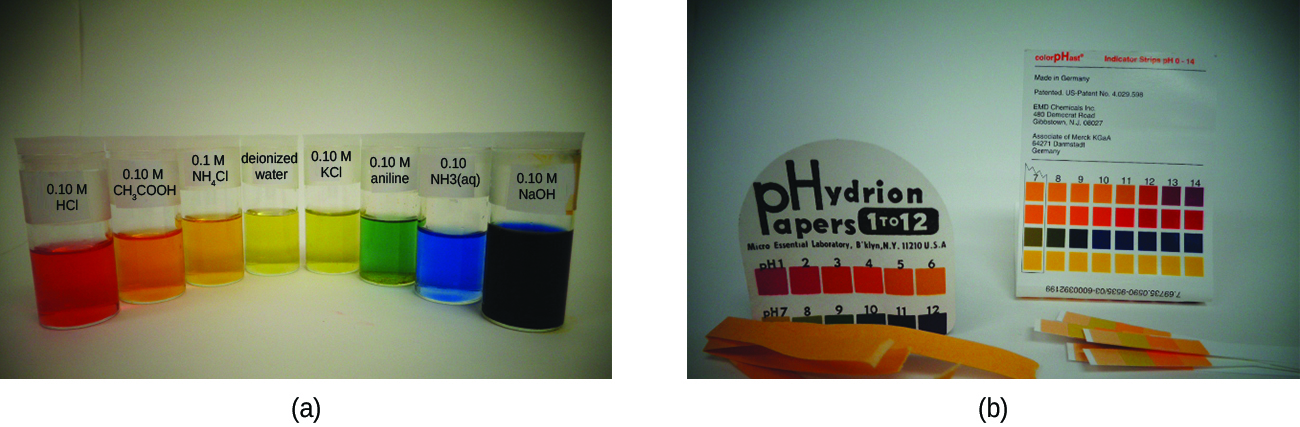
The pH of a solution may also be visually estimated using colored indicators (Figure 14.5). The acid-base equilibria that enable use of these indicator dyes for pH measurements are described in a later section of this chapter.
英語のヒント
溶液のpHは、有色の指示薬を使って目視で推定することもできる(図14.5)。これらの指示薬色素をpH測定に使えるようにする酸塩基平衡については、本章の後の節で説明する。
OpenStax, Rice University, Chemistry 2e. Original caption credit: (credit: modification of work by Sahar Atwa) · CC BY 4.0 · Source出典

Figure 14.5図 14.5
(a) A solution containing a dye mixture, called universal indicator, takes on different colors depending upon its pH. (b) Convenient test strips, called pH paper, contain embedded indicator dyes that yield pH-dependent color changes on contact with aqueous solutions.(credit: modification of work by Sahar Atwa)
英語のヒント
(a) 万能指示薬と呼ばれる色素の混合物を含む溶液は、pHに応じて異なる色を示す。(b) pH試験紙という便利な試験用の紙片には、指示薬の色素が染み込ませてあり、水溶液に触れるとpHに応じた色の変化が生じる。(クレジット:Sahar Atwaの作品を改変)